

Get the Right Fit Before You Buy
A well-sized engagement or wedding ring should slide over the knuckle with gentle resistance, rest comfortably at the base of the finger, and stay secure without pinching or spinning too much. For the most reliable result, measure the exact finger where the ring will be worn, at room temperature, and repeat the measurement on more than one day.
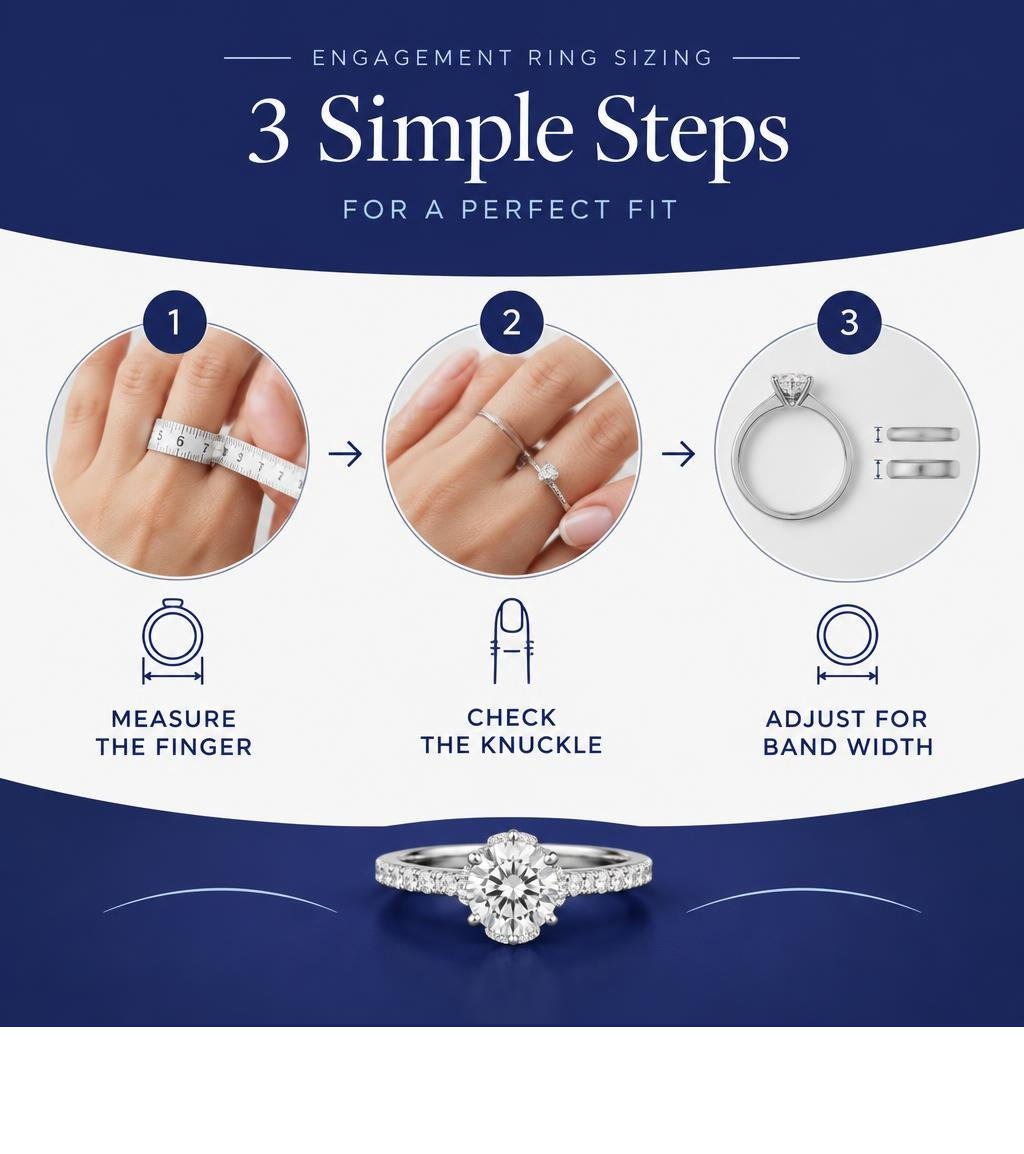
This engagement ring sizing guide starts with three practical steps:
- Measure the finger's circumference or a well-fitting ring's inside diameter in millimeters.
- Check both the knuckle and the base of the finger, especially if the knuckle is larger.
- Factor in the design. Wider bands often need more room, while pavé and full-eternity styles may have limited resizing options.
For US shoppers, women's sizes commonly fall between 6 and 7, while size 6 is the most frequently purchased women's size. These are useful benchmarks, not a substitute for measuring. Finger size changes with heat, exercise, time of day, and normal swelling, so do not size immediately after a workout, hot shower, or time outdoors in extreme temperatures.
I am Ken Rutz of Jeweler's Touch, where we specialize in fine jewelry, custom engagement rings, and jewelry repair. In this engagement ring sizing guide, I will help you understand the measurements and fit details that make choosing a ring feel much less like a guess.
Comprehensive Engagement Ring Sizing Guide: US Standard Sizes and Benchmarks
Finding the correct ring size comes down to millimeter accuracy. In the United States, ring sizes operate on a standardized numerical scale where each full size jump corresponds to an increase of roughly 0.8 millimeters in inner diameter and about 2.5 millimeters in inner circumference.
To help navigate these numbers, resources like the Engagement Ring Size Chart 2026 (Free Printable PDF) offer visual conversion scales. Understanding these dimensions guarantees that your ring sits comfortably without cutting off circulation or sliding off when you wash your hands.
Average Women's Sizes: Using an Engagement Ring Sizing Guide
For women in the United States, the average ring size typically falls between a size 6 and a size 7. A standard size 7 features an inner diameter of 17.3 millimeters, while a size 6 measures approximately 16.5 millimeters.
Industry data shows that size 6 is the most common ring size for women, accounting for roughly 20 percent of all women's ring purchases. If you are buying a ring for someone with very slender, petite hands, typical sizes often range from 4 to 5.5. For wider finger profiles, sizes often range between 7.5 and 9.
Average Men's Sizes: Engagement Ring Sizing Guide for Grooms
Men's hands require their own sizing considerations. The average male ring size in the US is a size 9 to size 10. A size 9 measures 19.0 millimeters across the inner diameter, while a size 10 measures 19.8 millimeters.
When shopping for men, you can consult our dedicated average male ring finger guide or review our Ring Sizing Chart Men to see how circumferences align with different ring profiles. In many cases, wedding bands built with comfort-fit shanks (which have a slightly domed interior) slide on much easier than flat-interior bands. For a broader perspective on men's rings, see our mens ring sizes guide 2026, and check our specific advice for mens wedding band size guide and average mens ring size considerations.
How to Measure Ring Size Accurately at Home
If you are determining your size outside of a jewelry showroom, consistency is critical. Our bodies change throughout the day based on hydration, activity, and climate. Your fingers are generally smallest when you first wake up and after exposure to cold air. Conversely, fingers expand after physical exercise, during warm afternoons, or following a salty meal.
For the most reliable reading, learn how to size a ring by measuring indoors at a stable room temperature during the late afternoon.
If you already own a ring that fits the intended finger, you can easily determine its proportions by measuring ring inner diameter with a digital caliper or a millimeter ruler. Measure strictly across the widest central opening, excluding the metal walls. If you are starting from scratch without a ring, wrap a 6mm strip of non-stretching paper around the base of your finger, mark where the ends overlap, and measure that length against a flat ruler to find the inner circumference.
| US Ring Size | Inner Diameter (mm) | Finger Circumference (mm) |
|---|---|---|
| 3.0 | 14.1 mm | 44.2 mm |
| 4.0 | 14.9 mm | 46.8 mm |
| 5.0 | 15.7 mm | 49.3 mm |
| 6.0 | 16.5 mm | 51.9 mm |
| 6.5 | 16.9 mm | 53.1 mm |
| 7.0 | 17.3 mm | 54.4 mm |
| 8.0 | 18.1 mm | 57.0 mm |
| 9.0 | 19.0 mm | 59.5 mm |
| 10.0 | 19.8 mm | 62.1 mm |
| 11.0 | 20.6 mm | 64.6 mm |
| 12.0 | 21.4 mm | 67.2 mm |
| 13.0 | 22.2 mm | 69.7 mm |
For those exploring specific measurement benchmarks or unique finger dimensions, you can explore guides on how big is a size 10 ring in inches, review the perfect fit everything you need to know about a size 10 ring in inches, or learn about measuring broader dimensions in our 6cm diameter ring size reference.
Discreet Sizing Methods for Surprise Proposals
Pulling off a surprise proposal without revealing the plan requires a bit of detective work. Here are proven strategies:
- Borrow an Existing Ring: Borrow a ring that your partner regularly wears on their left ring finger. Trace the inside of the band onto a piece of paper or press it gently into a bar of soap to record an impression.
- Recruit an Accomplice: Enlist a close friend or family member to casually bring up jewelry styles or try on rings together during a shopping trip.
- Examine Hand Dominance: If you can only access a ring worn on the right hand, keep in mind that the dominant hand's fingers are usually larger. For a right-handed person, the left ring finger is often 0.25 to 0.5 sizes smaller than the right.
- The "Safe Estimate" Rule: When torn between two sizes for a solitaire or simple band, choose the slightly larger size so the ring can still slide onto their finger during the proposal moment, and have it adjusted afterward.
Critical Design Factors That Change How Rings Fit
A ring's structural design directly affects how snug it feels against the skin. Two rings with the exact same internal diameter can feel completely different depending on their profile, band width, and center stone weight.
Band Width and Stacking Adjustments
Band width is one of the most overlooked variables in ring sizing. Narrow shanks (around 1.5mm to 2.5mm) displace very little skin and slide easily over the knuckle. However, wide bands cover more surface area, creating more friction.
- Bands 5mm to 7mm Wide: Typically require sizing up by half a size (0.5 US).
- Bands 8mm or Wider: Typically require sizing up by a full size (1.0 US).
- Bridal Stacks: When an engagement ring is paired with one or two wedding bands, the stacked set acts like a wide band. If you plan to wear multiple rings together, you may need a quarter to half size larger for the set to remain comfortable throughout the day.
Ring Setting Styles and Knuckle Shape
The setting style also dictates balance. Top-heavy designs, such as large solitaires or elaborate halos, tend to spin to the side if the band is even slightly loose. To learn about stone proportions and dimensions, check our one carat ring size guide. For technical fit specifications, consult Diamond Ring Size Guide - RingMeasure.com.
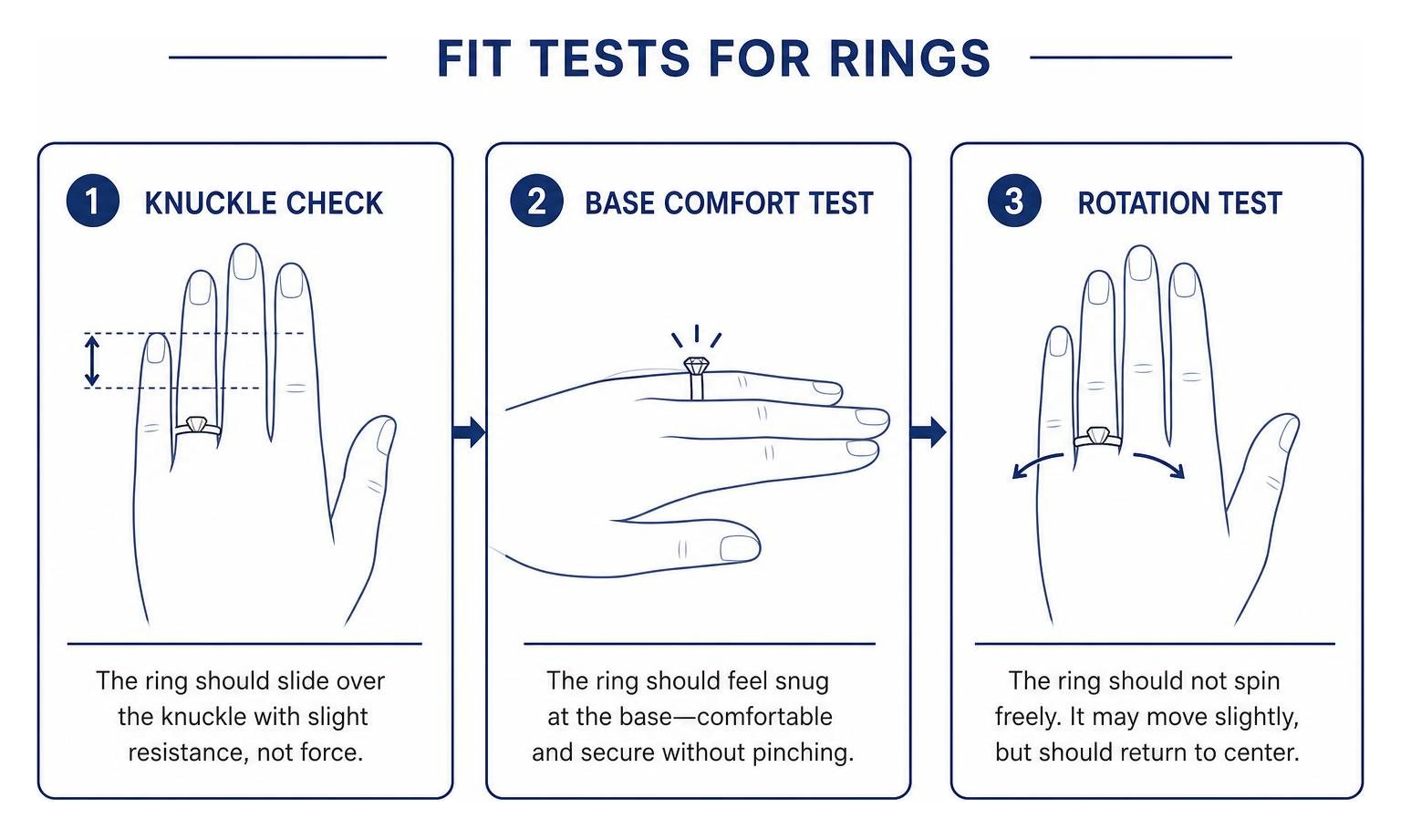
If you have prominent knuckles (where the knuckle joint is noticeably wider than the base of the finger), standard sizing can cause the ring to spin loosely once seated. Jewelers solve this challenge using specialized mechanisms:
- Sizing Beads: Small metal spheres soldered to the inner bottom of the shank. They allow the ring to clear the knuckle while gripping the narrower base of the finger to prevent rotation.
- Spring Shanks (Speed Bumps): A flexible inner band that expands as it passes over the knuckle and gently contracts at the base.
- Hinged Shanks: Custom shanks that open completely on a mechanical hinge and latch securely at the base of the finger, bypassing the knuckle entirely.
Understanding Resizing Limits and Alteration Options
Most precious metal rings can be adjusted by one to two sizes up or down without compromising structural integrity. Understanding how gold rings are resized gives peace of mind when planning adjustments. Professional resizing generally takes between 7 and 14 days depending on the metal type and design complexity.
Setting Constraints and Metal Limitations
While traditional metals and settings are straightforward to modify, certain styles and contemporary materials feature distinct limitations:
- Solitaires and Classic Bands: Platinum, yellow gold, rose gold, and white gold solitaires with plain metal shanks are the easiest rings to resize.
- Pavé and Channel Settings: Rings with diamonds set along the band can be adjusted within narrow limits (usually 0.5 to 1 full size). Significant adjustments warp the metal seats, causing accent diamonds to loosen or pop out.
- Full Eternity Bands: Because diamonds or gemstones wrap completely around the shank, full eternity bands cannot be traditionally cut and resized. They must be manufactured to the exact size from the start.
- Alternative Metals (Tungsten, Titanium, Ceramic): These ultra-hard contemporary metals cannot be cut, soldered, or stretched with conventional jewelry equipment. If an alternative metal band no longer fits, it must be completely replaced.
If you are exploring other finger adornments or men's jewelry traditions, our resources cover the engagement ring finger for male, the classic men ring finger customs, standard average mens ring finger size data, as well as specialized styling such as our average male pinky ring guide 2026 and mens pinky ring size guide.
Frequently Asked Questions About Sizing Wedding and Engagement Rings
How tight should an engagement ring feel on the finger?
A properly fitted engagement ring should slide over the knuckle with slight resistance when pushing it on, and require a deliberate, gentle pull to remove. Once past the knuckle, it should rest flat against the base of your finger without pinching the skin or causing throbbing. It should move slightly with normal hand gestures without rotating upside down.
Is the ring finger on the left hand smaller than the right?
Yes, for approximately 90 percent of people who are right-handed, the left hand's fingers are about 0.25 to 0.5 sizes smaller than the corresponding fingers on the right hand. Hand dominance builds slightly more muscular and connective tissue in the dominant hand. Always measure the specific finger on the hand where the ring will actually be worn.
Can full eternity bands or alternative metals be resized?
Full eternity bands cannot be resized through standard cutting and soldering methods because altering the circumference disrupts the metal prongs and stone settings. Similarly, metals like tungsten carbide, titanium, and cobalt chrome are too hard or brittle to be modified at a jeweler's bench. If a size change is needed for these materials, the ring must be exchanged or completely remade.
Conclusion
Getting the exact ring size creates a seamless proposal and guarantees daily comfort for years to come. While printable charts, paper strips, and borrowed rings provide great initial estimates, nothing replaces an accurate, hands-on sizing.
At Jeweler's Touch, we have been family-owned and serving clients since 1992 from our showroom in Brea, California. Our expert goldsmiths are always on hand to help you find your exact fit, customize adjustments, or build one-of-a-kind heirlooms. Explore our complete collection of Jeweler's Touch engagement rings, or stop by our showroom for a complimentary professional sizing fitting today.