

Why Knowing the Most Common Ring Size for Women Saves You Time, Money, and Stress
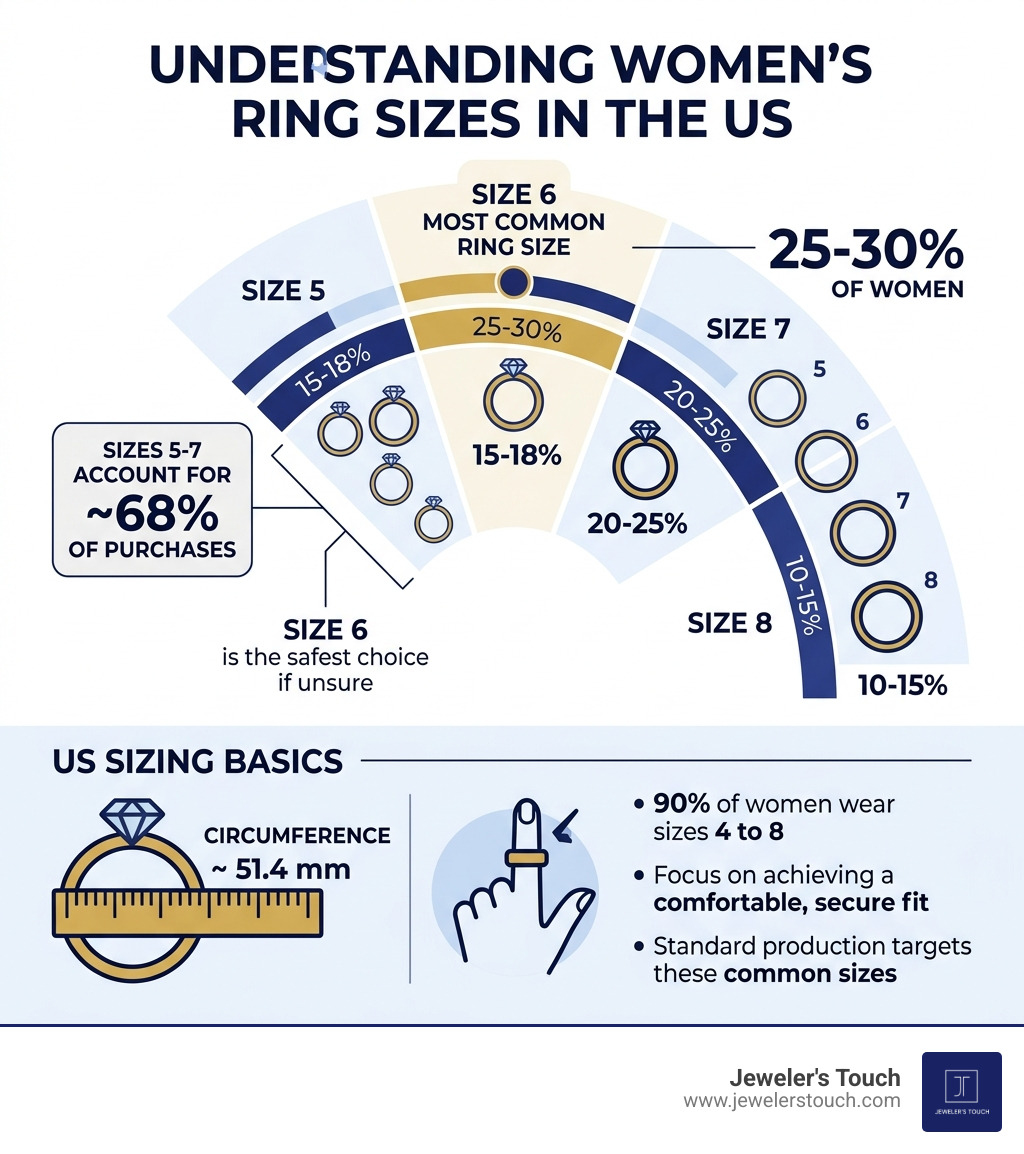
The most common ring size for women in the United States is size 6, the majority of women fall somewhere in the size 5 to 7 range.
Here's a quick snapshot of how women's ring sizes break down in the US:
| Ring Size | % of Women | Circumference |
|---|---|---|
| Size 5 | 15-18% | ~47.8 mm |
| Size 6 | 25-30% | ~51.4 mm |
| Size 7 | 20-25% | ~54.4 mm |
| Size 8 | 10-15% | ~57.4 mm |
Key takeaways at a glance:
- Size 6 is the single most purchased women's ring size in the US
- Sizes 5-7 together account for roughly 68% of all women's ring purchases
- About 90% of American women wear somewhere between a size 4 and a size 8
- If you're buying a surprise engagement ring and have no other information to go on, size 6 is your safest starting point
Getting the right ring size matters more than most people realize. A ring that's too tight can restrict blood flow. One that's too loose can slip off and disappear forever. And if you're planning a surprise proposal, an ill-fitting ring can turn a perfect moment awkward fast.
The good news? Once you understand the basics of how women's ring sizes work, finding the right fit becomes much simpler, whether you're shopping for yourself or secretly sizing up your partner's finger.
I'm Ken Rutz, and through my work at Jeweler's Touch helping countless customers find their perfect ring fit, I've seen how knowing the most common ring size for women can make the difference between a ring that gets worn every day and one that sits in a drawer. In this guide, I'll walk you through everything you need to know to get the sizing right the first time.
What is the Most Common Ring Size for Women?
When we talk about the most common ring size for women, we are looking at a statistical "sweet spot." While women’s fingers come in all shapes and sizes, the jewelry industry has standardized its production based on decades of sales data.
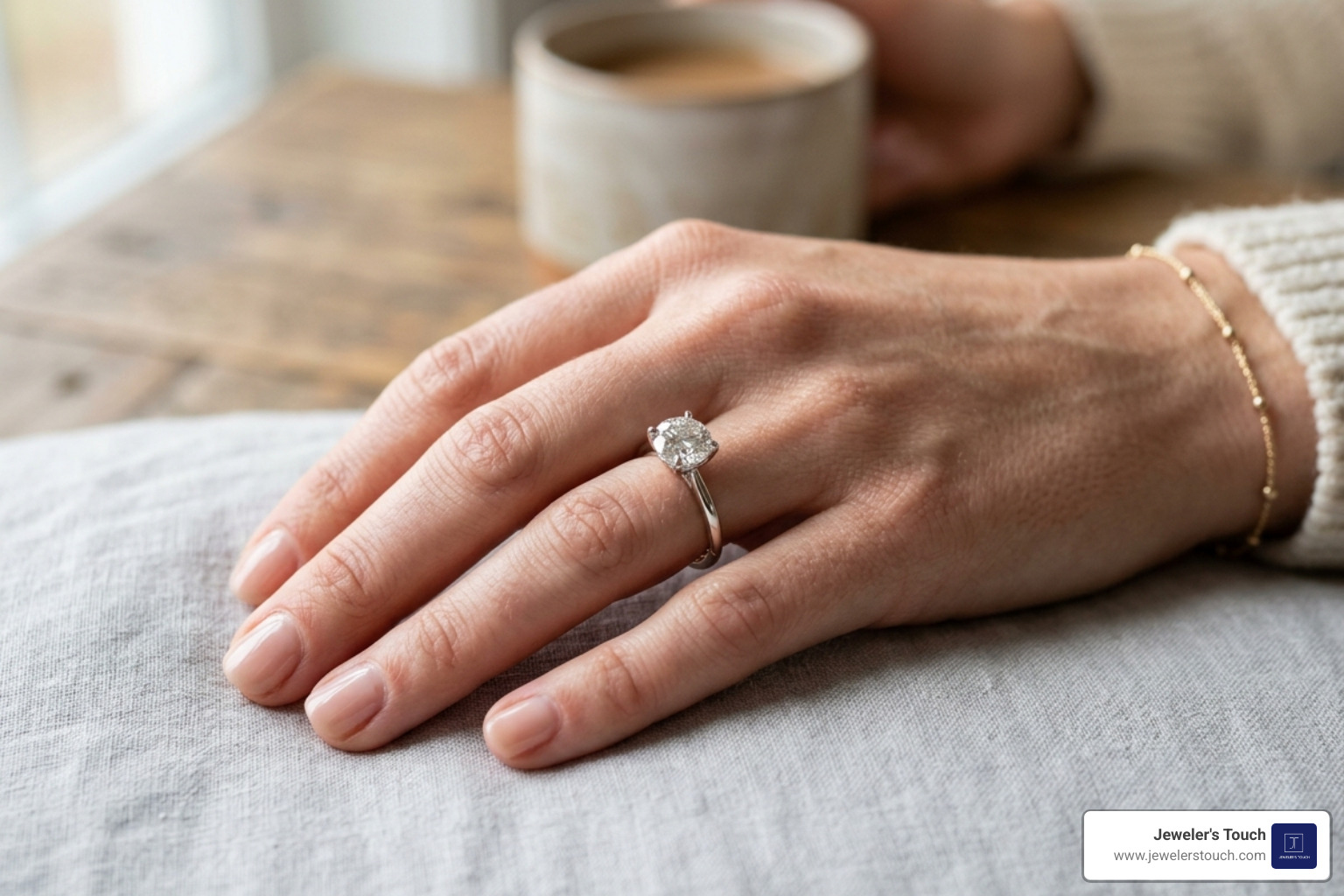
Statistically, the average woman in the US wears a size 6 or 6.5. This range is so prevalent that approximately 50% of all women’s rings sold fall between sizes 6 and 8. If you walk into a jewelry store and look at the rings in the display case, most of them will be a size 6 or 7. This isn't a coincidence; it's because these sizes fit the largest portion of the population.
The Most Common Ring Size for Women in the US
In the United States, size 6 reigns supreme. It is the single most frequently purchased size, appearing in 25% to 30% of all orders. A size 6 ring has an internal diameter of about 16.5mm and a circumference of 51.4mm.
Because this size is so popular, it has become the "standard display size" for most retail inventory. Manufacturers produce more size 6 rings than any other, which means if you are a size 6, you’ll rarely have to wait for a special order. However, if you are shopping for someone else and aren't sure of their size, knowing that sizes 5 through 7 make up nearly 68% of the market gives you a much better "educated guess" than picking a number out of a hat.
Most Common Ring Size for Women: Engagement vs. Wedding Bands
Interestingly, the "average" size can shift slightly depending on the type of ring being purchased. Because engagement rings are frequently surprise purchases, they are often bought in the standard size 6.
Wedding bands, however, are usually purchased together as a couple. This allows for more precise measurement, and we often see the "purchased average" for wedding bands tick up slightly to a size 6.5 or 7. This is partly because wedding bands are sometimes wider, and also because many women prefer a slightly looser fit for a band they wear all the time.
When choosing a band, it's also important to consider the style. For example, a delicate pavé band may fit differently than a thick, high-polish band. You can explore more about these variations in our Guide To Womens Wedding Band Styles.
Biological and Environmental Factors That Influence Fit
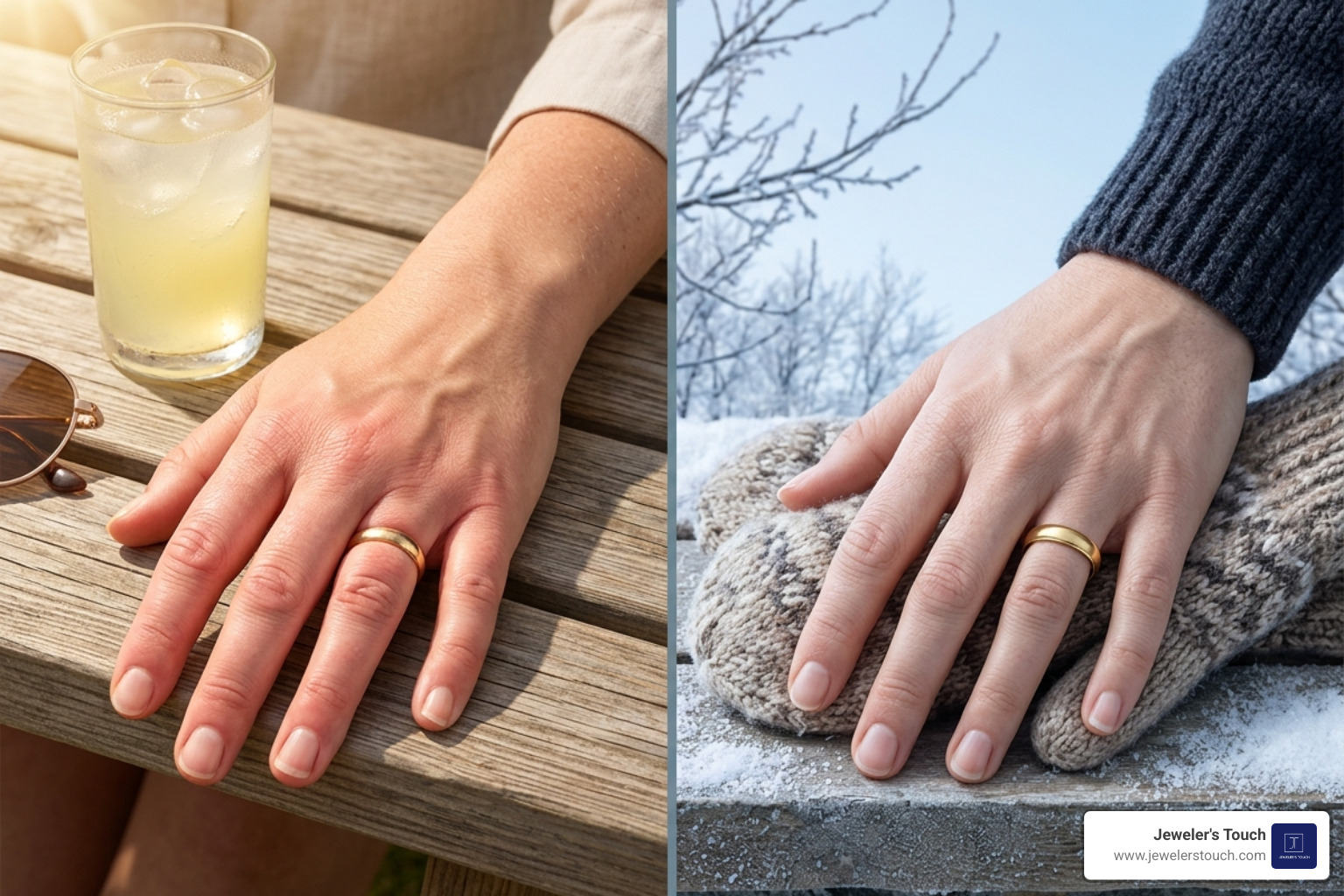
Your ring size isn't a static number like your height; it’s more like your weight—it fluctuates. At Jeweler's Touch, we always remind our Orange County clients that a ring that fits perfectly in the air-conditioned showroom might feel different after a walk in the Brea summer heat.
The Impact of Environment and Lifestyle
- Temperature: Heat causes blood vessels to dilate, causing fingers to swell. Conversely, cold weather causes fingers to shrink.
- The Dominant Hand: For most people, the dominant hand is slightly larger (often by half a size) because the muscles are more developed. Always measure the specific finger on the specific hand where the ring will be worn!
- Diet and Hydration: High sodium intake can lead to water retention, which can increase your finger circumference by nearly half a millimeter within 24 hours.
- Time of Day: Fingers are usually at their smallest in the morning and largest in the evening after a full day of activity.
Impact of Age and Body Type
As we move through different stages of life, our hands change. It is common for a woman's ring size to increase by half a size to a full size every 10 to 15 years.
- The Knuckle Factor: As we age, or due to conditions like arthritis, knuckles can become more prominent. The ring must be large enough to slide over the knuckle but snug enough not to spin at the base.
- Height and Frame: While not a perfect rule (we’ve seen 5'10" women with size 5 fingers!), there is a general correlation. Women under 5'4" often wear sizes 4.5 to 5.5, while those over 5'10" often average a size 7 or 8.
- Life Changes: Pregnancy often causes temporary swelling, but some women find their ring size changes permanently after childbirth.
The Width Effect and Band Style
The style of the ring itself dictates how it feels on your finger.
- Wide Bands: A wide band (anything over 4-5mm) traps more skin and creates more friction. We generally recommend sizing up by half a size for wide bands.
- Comfort Fit: These rings have a domed interior, making them easier to slide over the knuckle. You might actually need to size down by half a size for a comfort-fit band.
- Eternity Settings: Because diamonds go all the way around, these rings are very difficult (and sometimes impossible) to resize. Accuracy is paramount here.
For more technical details on how these measurements translate to inches, check out our guide on The Perfect Fit Everything You Need To Know About A Size 10 Ring In Inches.
How to Measure Your Ring Size at Home
While a professional measurement at our Brea location is the most accurate, you can get a very close estimate at home using several methods.
- The Paper Method: Wrap a thin strip of paper around the base of your finger. Mark where the ends meet. Measure that length in millimeters against a ruler to find the circumference.
- The Diameter Method: Take a ring you already own that fits the correct finger. Use a ruler to measure the internal diameter (the straight line across the center of the inside of the ring).
- The Plastic Multisizer: Many online retailers sell or give away plastic belt-like sizers. These work fairly well for home measurement because they mimic the feel of a real ring band.
Secret Methods for Surprise Proposals
If you're planning a surprise, you have to be a bit of a jewelry detective.
- Borrow a Ring: Take a ring she wears on her left ring finger to a jeweler. If you can't take it, press it into a bar of soap to create an impression, or slide it onto your own finger and mark exactly where it stops.
- The Candle Method: Slide her ring onto a tapered candle until it stops. Mark the spot and bring the candle to us.
- Enlist an Ally: Ask her best friend or mother. They often know the size, or can "casually" take her window shopping to find out.
- Trace It: Trace the inside of one of her rings on a piece of paper. Do this several times to ensure the circle is accurate.
For more covert tactics, read our full post on How To Get Your Partner S Ring Size Without Ruining The Surprise.
Common Measuring Mistakes to Avoid
- Using Elastic Material: Never use string that stretches (like yarn or some types of ribbon). It will always result in a size that is too small.
- Measuring Cold Hands: If your hands are cold, your ring will be too tight when you warm up.
- Ignoring the Knuckle: If you have large knuckles, the paper method at the base of the finger will fail. You must measure the knuckle too.
- Printer Scaling: If using a printable chart, ensure your printer is set to "100%" or "Actual Size." Even a 5% scaling error can throw off a ring size by two full sizes!
International Ring Size Conversions and Charts
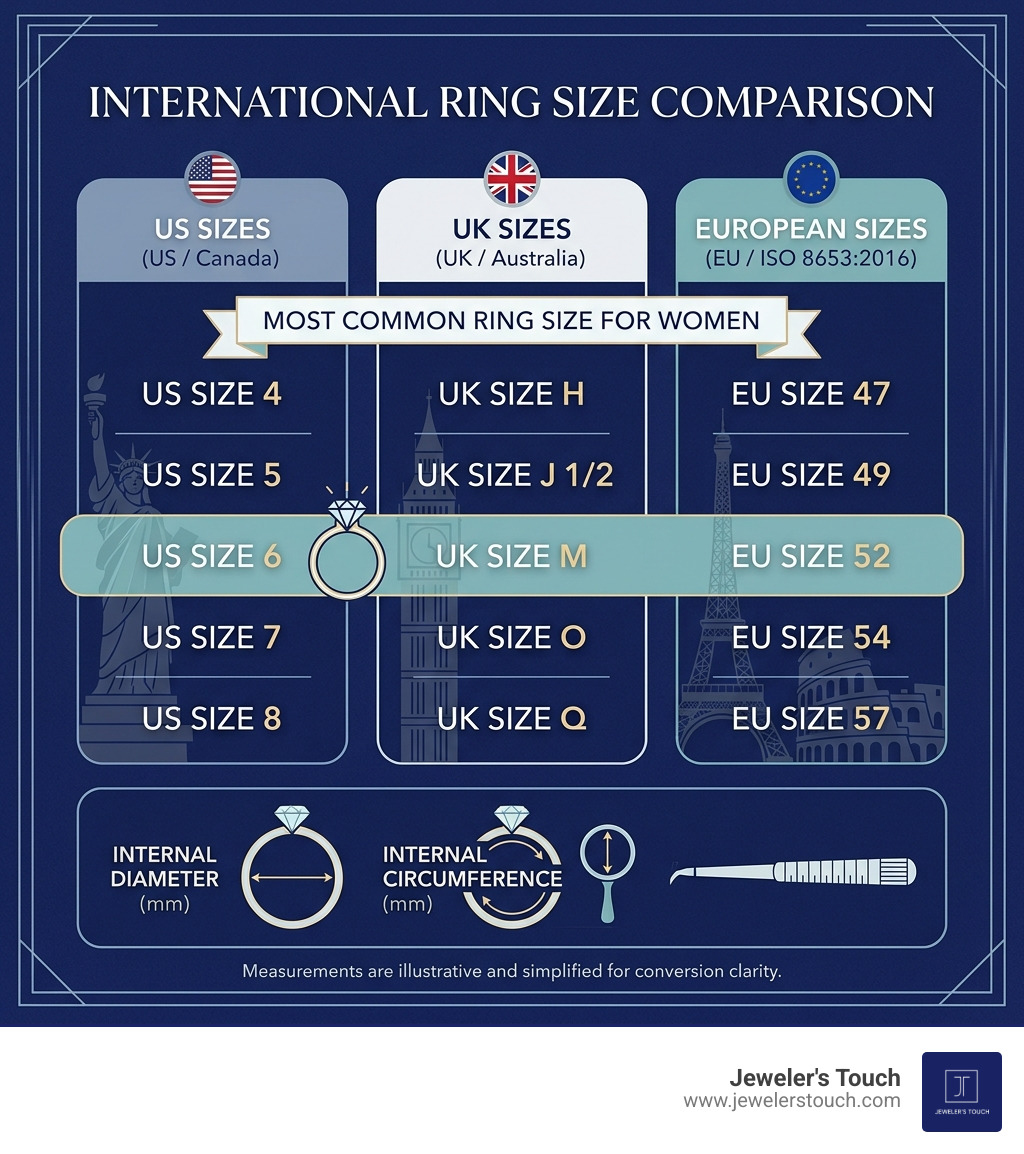
If you are shopping for a ring while traveling or ordering from an international designer, you'll notice that the US "Size 6" doesn't exist everywhere. Most of the world uses the ISO 8653:2016 standard, which is based on the inner circumference in millimeters.
Converting US Sizes to UK and European Scales
Here is how the most common ring size for women (Size 6) translates globally:
| US Size | UK / Australia | Europe (EU) | Japan / China |
|---|---|---|---|
| 5 | J ½ | 49 | 9 |
| 5.5 | L | 50.5 | 10 |
| 6 | L ½ | 52 | 11 |
| 6.5 | M ½ | 53 | 13 |
| 7 | N ½ | 54.5 | 14 |
UK and Australian sizes use a letter system. European sizes are generally the circumference in millimeters (so a size 52 is 52mm around). Asian sizes use a different numeric scale where a US 6 is roughly an 11 or 12.
What to Do if the Ring Doesn’t Fit
Don't panic! At Jeweler's Touch, our expert goldsmiths resize rings every day. Most rings made of precious metals like gold, silver, or platinum can be adjusted by up to two sizes.
- Sizing Down: This is the easiest and most affordable fix. The jeweler cuts out a small piece of the band and joins the ends back together.
- Sizing Up: This is more complex. The jeweler can either stretch the metal (if the change is very small) or cut the band and add a new piece of metal.
You can learn more about the technical process in our guide: How Does Ring Resizing Work Your Complete Guide.
Non-Resizable Metals and Settings
Some rings simply cannot be resized due to the nature of the material or the design:
- Industrial Metals: Tungsten, titanium, and stainless steel are too hard for traditional jeweler tools. They often shatter rather than bend.
- Full Eternity Bands: Because the diamonds go all the way around, there is no "blank" metal to cut into without ruining the stone settings.
- Tension Settings: These rely on the pressure of the band to hold the center stone. Altering the band destroys the tension.
Temporary Fixes for Loose Rings
If a ring is only slightly too large, or if you are waiting for a permanent resizing, there are several temporary options:
- Sizing Beads: Two small metal spheres added to the inside of the band. They help the ring grip the finger and are great for people with large knuckles.
- Ring Guards: A small metal bar that clips onto the inside of the band.
- Silicone Adjusters: Clear plastic coils that wrap around the band.
While we're on the subject of resizing, keep in mind that other jewelry needs a perfect fit too! If you have a bracelet that's sliding around, check out our Diamond Bracelet Resizing Guide Tips For Different Styles.
Frequently Asked Questions about Women's Ring Sizes
Is a size 7 ring big for a woman?
Not at all. A size 7 is very much within the average range. While size 6 is the most common, size 7 is the second most popular size, accounting for about 20-25% of all women's ring sales. It is a very standard size for women with medium frames.
How do I know my ring size without a sizer?
The most reliable DIY method is the "diameter method." Measure the inside of a ring you already own that fits perfectly. If the inside diameter is 16.5mm, you are a size 6. If it's 17.3mm, you are a size 7.
Does ring size correlate with shoe size?
This is a popular myth, but it’s completely false! There is no scientific correlation between your shoe size and your ring size. We have seen women with size 10 shoes wear a size 5 ring, and vice versa. Always measure the finger itself!
Conclusion
Finding the most common ring size for women is a great starting point, but every hand is unique. Whether you are looking for a size 4 or a size 12, the goal is a fit that feels secure, comfortable, and beautiful.
At Jeweler's Touch, we’ve been serving the Orange County and Brea community since 1992. Our on-site GIA gemologists and expert goldsmiths are here to ensure that your jewelry fits perfectly from the moment you put it on. From custom engagement ring designs to professional resizing and repairs, we provide the technical expertise and warm, family-owned service you deserve.
Ready to find your perfect fit? Find your perfect fit with our expert engagement ring services or visit us in Brea today!