

Aquamarine Birthstone Facts at a Glance
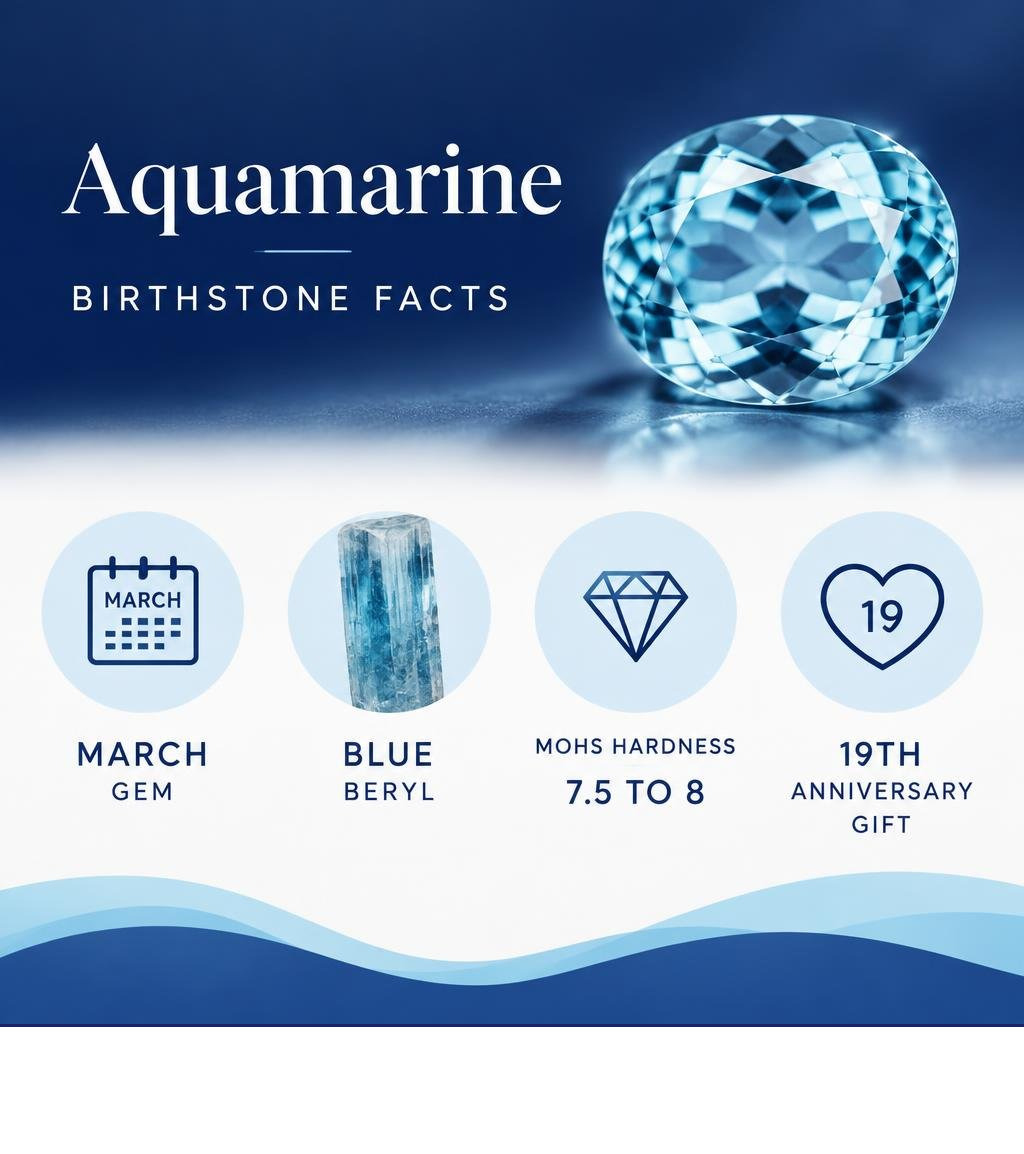
Aquamarine is March's blue to blue-green birthstone. It belongs to the beryl mineral family, ranks 7.5 to 8 on the Mohs hardness scale, and is also a traditional gift for a 19th wedding anniversary. Its name comes from Latin for "seawater."
That sea connection runs through the gem's history. Sailors once carried aquamarine for protection, while today its clear color makes it a popular choice for meaningful jewelry. The seven facts below cover its lore, color, value, and care.
I'm Ken Rutz of Jeweler's Touch, where our work centers on fine jewelry, custom engagement rings, and jewelry repair. I bring that jewelry experience to these aquamarine birthstone facts, starting with the story behind the name.
Essential Aquamarine Birthstone Facts: Lore, Origins, and Royal History

Aquamarine holds a storied place in gemological lore. For thousands of years, civilizations viewed this luminous crystal as crystallized seawater gifted to humanity by mythological sirens and oceanic deities. The mineral has adorned ancient amulets, medieval coronation regalia, and presidential collections. Exploring these historical roots reveals why the stone remains one of the most beloved blue gems in fine jewelry today.
1. The Seawater Gem: Ancient Nautical Lore and Name Origins
The name aquamarine is derived directly from the Latin words aqua (water) and marina (of the sea). When you glance into a finely cut specimen, its watery clarity explains why ancient Roman and Greek mariners held the gem in such high regard.
According to ancient Roman lore, aquamarine was sacred to Neptune (Poseidon in Greek mythology), the god of the sea. Sailors carried amulets carved from the blue beryl during treacherous voyages, believing the gemstone could calm turbulent waves, prevent seasickness, and protect vessels from sudden shipwrecks. In extreme storms, desperate sailors would toss their aquamarine stones overboard as an offering to appease the sea gods.
Beyond maritime safety, ancient civilizations viewed the gem as an emblem of purity, youthful vitality, and everlasting harmony. Pliny the Elder, a famous Roman naturalist, captured this romantic spirit when he wrote that the lovely stone seemed to have originated in some mermaid's treasure house. Medieval traditions later adopted the gem as a token of marital fidelity, with brides receiving the stone to ensure lasting happiness and open communication in their marriages. You can explore more about these historical roots in the GIA Guide to March Birthstones.
2. Royal Ties and Record-Breakers: Dom Pedro and Presidential Gems
Aquamarine crystals often grow in massive, well-formed pegmatite formations, allowing gem cutters to fashion record-breaking masterpieces that captivate historians and museum visitors alike.
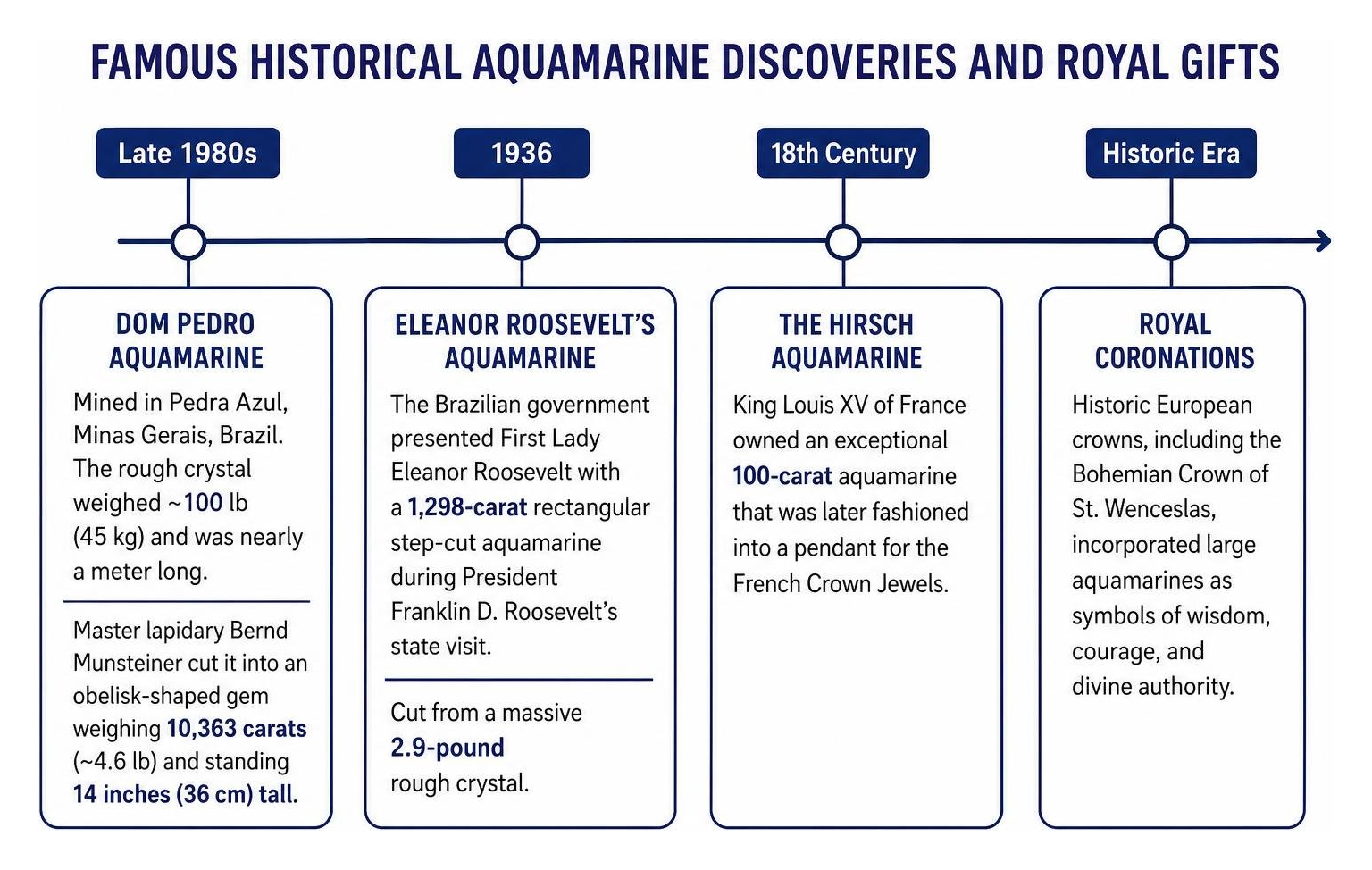
The most famous carved specimen in existence is the Dom Pedro Aquamarine, currently on permanent exhibition at the Smithsonian Institution in Washington, D.C. Mined in Pedra Azul, Minas Gerais, Brazil, in the late 1980s, the original rough crystal weighed approximately 100 pounds (45 kilograms) and measured nearly a meter long. After being broken by prospectors into three pieces, the largest section was entrusted to master German lapidary artist Bernd Munsteiner. He sculpted it into an obelisk-shaped fantasy-cut gem standing 14 inches (36 centimeters) tall and weighing a staggering 10,363 carats (roughly 4.6 pounds).
Other notable historical treasures include:
- Eleanor Roosevelt's Aquamarine: In 1936, the Brazilian government presented First Lady Eleanor Roosevelt with a magnificent 1,298-carat rectangular step-cut aquamarine during President Franklin D. Roosevelt's state visit. Cut from a massive 2.9-pound rough crystal, it is preserved today in the Franklin D. Roosevelt Presidential Library in Hyde Park, New York.
- The Hirsch Aquamarine: King Louis XV of France owned an exceptional 100-carat aquamarine that was later fashioned into a pendant for the French Crown Jewels.
- Royal Coronations: Historic European crowns, including the Bohemian Crown of St. Wenceslas, incorporated large aquamarines as symbols of wisdom, courage, and divine authority.
3. Fascinating Aquamarine Birthstone Facts: March Traditions, Zodiac Ties, and 19th Anniversaries
While ancient traditions associated bloodstone with March, the American National Retail Jewelers Association (now Jewelers of America) updated the modern birthstone calendar in 1952. Aquamarine was selected as the primary birthstone for March due to its breathtaking color and versatility in modern jewelry designs.
In astrology, aquamarine aligns closely with water and fire signs:
- Pisces (February 19 – March 20): Deeply connected to the element of water, Pisces wearers value the stone's tranquil aura and intuitive energy.
- Aries (March 21 – April 19): For fiery Aries, the cool blue beryl acts as a balancing gem, offering clarity and soothing fiery tempers.
- Scorpio (October 23 – November 21): Astrological traditions also associate aquamarine with Scorpio, viewing it as a talisman for emotional insight and faithful love.
The gem is also celebrated as the traditional gift for the 19th wedding anniversary. Marking nearly two decades of commitment, it symbolizes the tranquil waters and clear communication that sustain a loving, lifelong partnership. Whether worn as an anniversary token or a birthday present, there are countless ways to style stunning March birthstone jewelry for milestone occasions.
Geological and Physical Secrets: Chemistry, Hardness, and Mining
Behind aquamarine's delicate pastel appearance lies a durable crystalline structure forged deep inside the Earth's crust over millions of years.
4. Beryl Royalty: Chemical Makeup, Durability, and High-Altitude Mines
Aquamarine is the blue-to-green variety of the mineral species beryl, defined by the chemical formula $\text{Be}_3\text{Al}_2\text{Si}6\text{O}{18}$ (beryllium aluminum silicate). It shares this exact crystal framework with several celebrated gem cousins, including:
- Emerald: The vibrant green beryl colored by chromium and vanadium.
- Morganite: The soft pink to peach beryl colored by manganese.
- Heliodor: The radiant yellow to golden beryl colored by ferric iron.
- Goshenite: The colorless, pure beryl variety.
Boasting a rating of 7.5 to 8 on the Mohs hardness scale, aquamarine possesses excellent durability, resisting surface scratches from ambient dust and everyday handling.
The formation of aquamarine occurs within coarse-grained igneous rocks known as granite pegmatites. The largest producer of gem-quality aquamarine for the past two centuries has been the state of Minas Gerais in Brazil. However, significant deposits exist across the globe, including Mozambique, Nigeria, Zambia, Madagascar, and the United States (notably on Mount Antero in Colorado).
Some of the most breathtaking crystals emerge from the Karakoram Mountains in Pakistan. Miners work at elevations between 9,800 and over 13,000 feet, extracting water-clear, hexagonal beryl prisms from steep alpine pegmatite pockets. You can learn more about its geological formations via Geology.com on Aquamarine Properties.
5. The Iron Chemistry Behind the Signature Blue: Heat Treatments and Pleochroism
The color of an aquamarine depends on trace impurities of iron within the crystal lattice:
- Ferrous Iron ($\text{Fe}^{2+}$): Responsible for the desirable pure blue hues.
- Ferric Iron ($\text{Fe}^{3+}$): Imparts yellow undertones, which combine with blue to create a seafoam or greenish-blue tint.
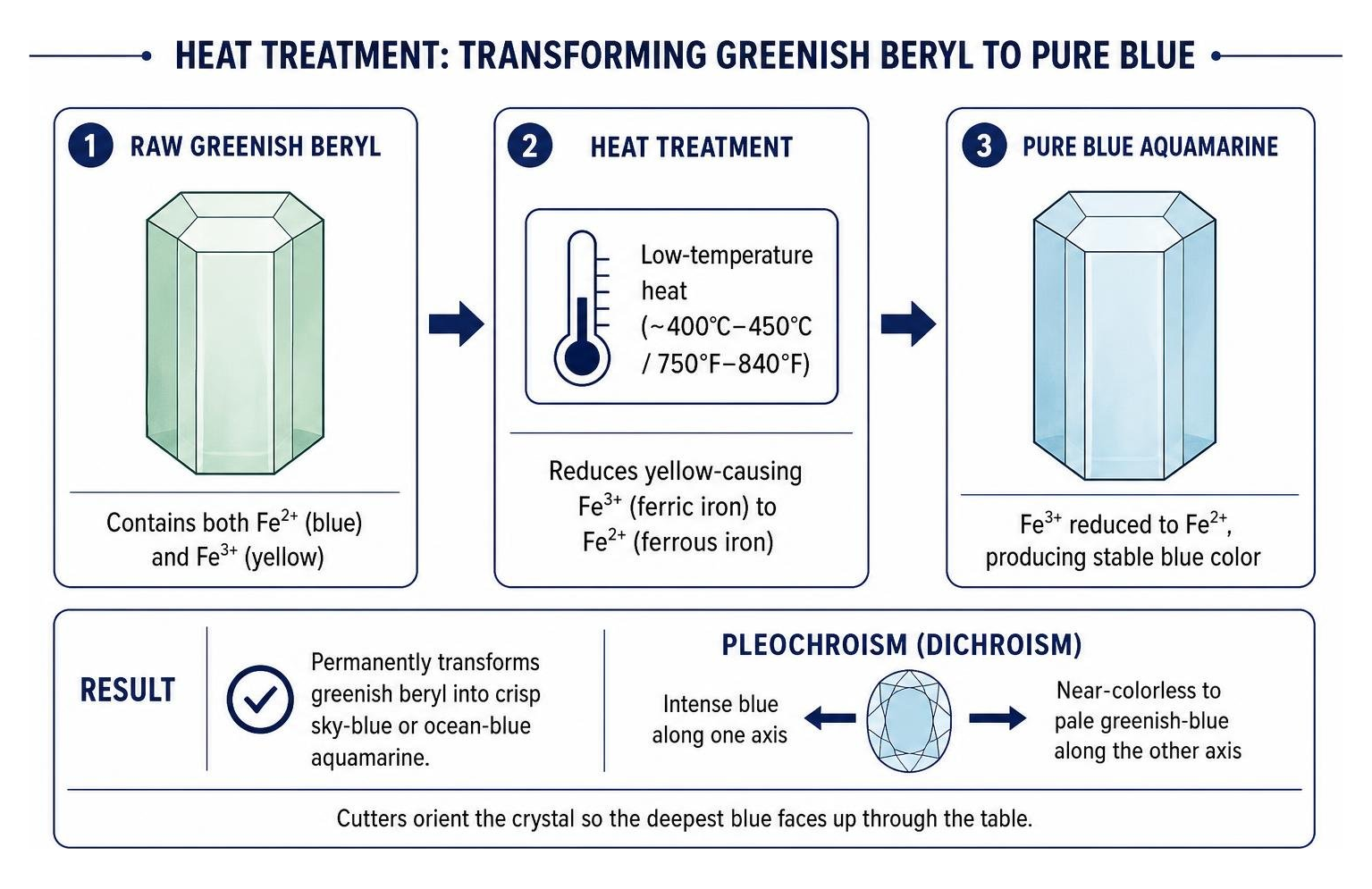
Most aquamarine offered in the modern fine jewelry market undergoes routine, low-temperature heat treatment (around 400°C to 450°C, or 750°F to 840°F). This controlled heating reduces the yellow-causing ferric iron ($\text{Fe}^{3+}$) to ferrous iron ($\text{Fe}^{2+}$), permanently transforming greenish stones into crisp sky-blue or ocean-blue hues. This treatment is stable, permanent, and accepted across the international gem trade without compromising stone integrity.
Aquamarine also exhibits strong pleochroism (specifically dichroism). When viewed from different crystallographic axes, a single crystal displays two distinct shades: an intense blue along one direction and a near-colorless or pale greenish-blue along another. Master gem cutters orient the rough crystal before faceting so that the deepest blue projects directly through the table of the finished gem.
Value, Identification, and Styling: How to Choose Genuine Gems
Whether you are looking for a statement cocktail ring or a delicate pendant, understanding how gemologists evaluate aquamarine helps you select an exceptional piece.
6. The 4 Cs and the Legendary 'Santa Maria' Quality Standard
Aquamarine value is assessed using the four Cs:
- Color: The primary driver of value. Highly saturated, pure medium-dark blues command the highest prices per carat, while pale ice-blue stones are more accessible.
- Clarity: Unlike its cousin the emerald, gem-quality aquamarine forms with exceptional transparency. Consumers should look for eye-clean stones free of visible inclusions or internal fractures.
- Cut: Emerald cuts and long oval brilliants complement the natural hexagonal crystal shape, maximizing brilliance while intensifying the face-up color.
- Carat Weight: Larger crystals are relatively plentiful. As a result, small stones (1 to 3 carats) range from $20 to $75 per carat for light shades, while large, richly saturated gems reach $500 to $2,000+ per carat.
The historic gold standard for color is Santa Maria, named after the Santa Maria de Itabira mine in Minas Gerais, Brazil. Although the original deposit is now virtually exhausted, the trade name describes deeply saturated, electric-blue aquamarines. Similar rare finds from Mozambique are sometimes traded as "Santa Maria Africana." In 2022, the Asian Institute of Gemological Sciences (AIGS) codified a formal lab grading standard for the Santa Maria color distinction.
When shopping for heirloom-quality pieces, classic settings like a 14k white gold cushion aquamarine halo ring or a 14k white gold oval aquamarine and diamond halo ring offer timeless elegance while shielding the gemstone's outer edges with diamond accents.
7. Vital Aquamarine Birthstone Facts: Comparing Real Beryl to Blue Topaz and Maxixe
Several blue gems share visual similarities with aquamarine, but their physical and optical characteristics differ significantly under gemological testing.
| Gemstone | Mineral Species | Mohs Hardness | Refractive Index | Color Stability in Sunlight | Primary Market Distinctions |
|---|---|---|---|---|---|
| Natural Aquamarine | Beryl | 7.5 – 8.0 | 1.577 – 1.583 | Stable | Soft watery pastel to deep blue; natural pleochroism |
| Blue Topaz | Topaz | 8.0 | 1.609 – 1.617 | Stable | Vibrant electric or steely blue; irradiated; budget alternative |
| Maxixe Beryl | Beryl | 7.5 – 8.0 | 1.584 – 1.592 | Unstable (Fades) | Deep cobalt/sapphire blue; color centers fade under light |
| Synthetic Aquamarine | Lab-Created Beryl | 7.5 – 8.0 | 1.570 – 1.580 | Stable | Hydrothermal growth; colored by transition metals like Co/Ni |
Blue topaz is frequently mistaken for aquamarine due to its crisp appearance and attractive price point. A sterling silver sky topaz halo pendant necklace provides a radiant, budget-friendly alternative for everyday March birthstone style, though gemologists distinguish topaz by its higher specific gravity (3.53 vs. aquamarine's 2.68–2.74) and higher refractive index.
Meanwhile, Maxixe (pronounced mah-SHE-she) beryl is a rare, dark-blue beryl that quickly loses its color when exposed to natural daylight, making routine gemological verification essential.
Daily Wear, Care, and Cleaning for Aquamarine Jewelry
With a hardness rating of 7.5 to 8, aquamarine is well-suited for daily wear in necklaces, brooches, and 14k white gold aquamarines huggie earrings. For rings subject to active hand movement, choosing protective prong, bezel, or halo mountings helps safeguard the stone against accidental impacts.
Follow these simple guidelines to keep your aquamarine jewelry sparkling:
- Warm Soapy Water: Mix lukewarm water with a few drops of mild dish soap. Soak your jewelry for 10 to 15 minutes to loosen trapped oils and lotions.
- Soft-Bristled Brush: Gently clean behind the setting and around the pavilion facets using a soft baby toothbrush.
- Rinse and Dry: Rinse thoroughly in clean water and pat dry with a lint-free microfiber cloth.
- Ultrasonic Cleaner Caution: Professional ultrasonic and steam cleaners are generally safe for untreated, eye-clean aquamarines. However, avoid ultrasonic cleaning if your gemstone contains liquid inclusions or surface-reaching fractures, as rapid vibrations can cause fractures to expand.
- Separate Storage: Store your aquamarine pieces in individual soft pouches or lined jewelry compartments. Harder gemstones like sapphires, rubies, and diamonds can scratch your beryl if stored loosely together.
For daily grace, designs such as a 14k white gold aquamarine halo pendant keep the gemstone safely rested against your neckline, minimizing contact with hard surfaces.
Frequently Asked Questions About Aquamarine
Is aquamarine durable enough for an everyday engagement ring?
Yes. Aquamarine rates 7.5 to 8 on the Mohs hardness scale, making it resistant to scratches from dust and daily contact. To ensure lifelong durability in an engagement ring, select a setting that protects the corners and girdle, such as a bezel setting or a diamond halo. It is best to remove your ring prior to heavy gardening, weightlifting, or household cleaning.
Does heat-treated aquamarine fade in sunlight?
No. Standard thermal heat treatment permanently alters the oxidation state of trace iron within the crystal lattice. Unlike unstable Maxixe beryl or irradiated brown topazes, standard natural aquamarines retain their blue color indefinitely under normal sunlight and room lighting.
What is the rarest and most valuable aquamarine color?
The most valuable aquamarines feature a rich, saturated medium-dark blue hue without overt gray or brownish modifiers. Trade terms like "Santa Maria" describe these saturated blue gems. Because aquamarines tend to show lighter color saturation in sizes under 5 carats, richly colored small gems command high price-per-carat premiums.
Conclusion
From ancient Roman maritime talismans to world-record museum sculptures, aquamarine continues to enchant jewelry lovers with its tranquil hues and rich history. Whether you are celebrating a March birthday, marking a 19th wedding anniversary, or curating a personal gemstone collection, aquamarine offers a refreshing touch of elegance to any jewelry wardrobe.
At Jeweler's Touch, we have served our Orange County community from our Brea, California showroom since 1992. As a family-owned jeweler, our team includes three GIA Graduate Gemologists on staff and master jewelers on-site to assist with routine cleanings, mounting inspections, fine jewelry selection, and custom repairs.
Discover the serene beauty of the March birthstone today. Explore our curated selection of fine pieces, including the timeless cushion cut created aquamarine halo ring, or visit our showroom to find a design that speaks to you.