

When Your Ring Doesn't Fit: What You Need to Know First
How gold rings are resized comes down to one of two approaches — making the band smaller by removing metal, or making it larger by stretching or adding metal — both done by a professional jeweler.
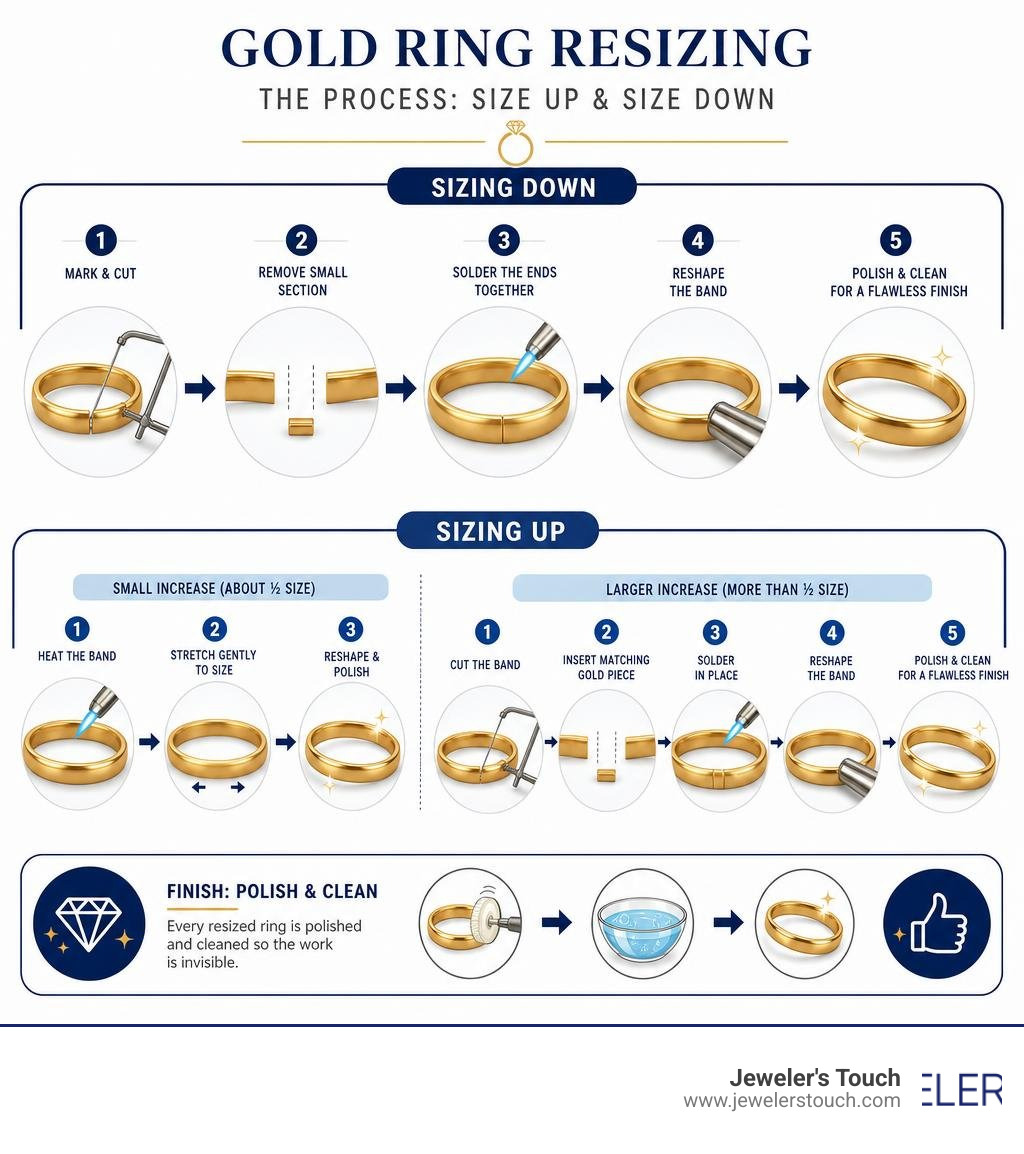
Quick Answer: The Gold Ring Resizing Process
- Sizing down — The jeweler cuts a small section out of the band, rejoins the ends, solders them together, then reshapes and polishes the ring.
- Sizing up (small change) — The jeweler heats and stretches the band, which works for increases of about half a size.
- Sizing up (larger change) — The jeweler cuts the band, inserts a matching piece of gold, solders it in place, then refinishes the ring.
- Polishing and cleaning — Either way, the ring is cleaned and polished so the work is invisible.
Most simple gold ring resizes cost between $30 and $100 and take 2 to 7 days. Rings can usually be safely resized up or down by one to two sizes.
Rings don't always come in the right size — and that's completely normal. Fingers change with weight, temperature, pregnancy, and age. An engagement ring bought in the wrong size, an inherited family heirloom, or a gift that's slightly off are all everyday situations that a skilled jeweler can fix quickly and cleanly.
I'm Ken Rutz from Jeweler's Touch, and how gold rings are resized is one of the most common questions I answer for couples and jewelry owners in our store every week. With years of hands-on experience in fine jewelry repair and custom work, I'll walk you through exactly what happens to your ring — from the first cut to the final polish.
How Are Gold Rings Resized? The Professional Methods

To understand how a master goldsmith alters the physical size of a ring, we have to look at the science of the metal itself. Gold jewelry is rarely made of 100% pure gold. Pure 24K gold is too soft for daily wear, so jewelers alloy it with other metals like copper, silver, zinc, or palladium to give it strength and durability.
Because of these alloy compositions, gold is highly workable, ductile, and receptive to heat. When we resize a gold ring, we must treat these alloys with precise thermal control to preserve their chemical and physical properties.
There are two primary professional methods used to join metal during the resizing process:
- Traditional Soldering: This time-tested method involves heating the gold band with a jeweler's torch. We apply a small piece of matching gold solder—which has a slightly lower melting point than the ring itself—to the joint. The solder melts and flows into the seam, fusing the two sides together as it cools.
- Laser Welding: This modern approach uses a highly concentrated, microscopic laser beam to weld the gold directly. Laser welding allows our goldsmiths to target an incredibly small area without heating the rest of the ring. This is particularly helpful when working near delicate gemstones or intricate engravings, as the heat does not spread to surrounding areas.
To see these professional techniques in action, you can How To Resize A Ring to watch a step-by-step video demonstration. Whether your ring requires a torch or a laser, choosing a qualified goldsmith ensures the seam is perfectly aligned and virtually invisible. If you have an older or heavily worn ring, you can also explore our specialized Gold Ring Repair services to restore its overall strength.
How Are Gold Rings Resized Larger?
Making a ring larger is a delicate balancing act. There are two main ways to accomplish this depending on how much larger the ring needs to be:
The Stretching Method
If a plain gold ring only needs to be enlarged by a fraction of a size (typically up to a half-size), we can use a highly polished, tapered metal rod called a mandrel along with a mechanical ring stretcher.
By applying gradual, even pressure, we can stretch the metal outward. However, stretching must be done with extreme caution. It physically thins the band (the shank), and stretching a ring too far or too quickly can cause the metal to crack, warp, or weaken structurally. We never recommend stretching rings that feature stone settings, as the stretching action will distort the stone seats and cause gems to fall out.
Adding a Metal Bridge (Splicing)
For size increases greater than a half-size, the only safe and professional method is to cut the band and insert a matching piece of gold.
First, we make a clean cut at the very bottom of the shank (the sizing bar). We then carefully spread the band open to the exact new size. Next, we cut a small "bridge" of gold that matches the ring's karat (such as 14K or 18K) and color (yellow, white, or rose gold) perfectly.
This bridge is precisely fitted into the gap, soldered or laser-welded on both sides, and then meticulously filed, sanded, and polished. When completed by an expert, the new metal blends seamlessly, leaving no visible lines or weak spots.
How Are Gold Rings Resized Smaller?
Making a ring smaller is generally a more straightforward process than making it larger, but it still requires high-precision craftsmanship to maintain perfect symmetry.
Cutting and Removing Metal
To downsize a ring, we begin by calculating exactly how many millimeters of metal must be removed to reach the target size. We make two clean cuts at the bottom of the shank to remove the unwanted segment of gold.
Once the piece is removed, we gently reform the remaining band back into a perfect circle, bringing the two open ends together so they meet flush with absolutely no gaps. We then solder or laser-weld the seam, file down the excess material, and polish the entire band.
The Compression Method
For plain, flat wedding bands with no gemstones or patterns, we can occasionally use a specialized ring compression machine. This tool applies uniform external pressure to compress the metal inward, reducing its diameter by up to a half-size without the need for cutting.
However, just like stretching, compression is limited to simple bands and cannot be used on any ring with stones, engravings, or complex designs.
Metal Compatibility: Why Gold, Platinum, and Silver Are Preferred
Not all metals behave the same way under a jeweler's torch. Precious metals like gold, platinum, and sterling silver are highly favored in the jewelry industry because they are ductile and malleable. This means they can be bent, cut, heated, and joined repeatedly without losing their structural integrity.
Alternative metals, which have grown in popularity for men's wedding bands over the last decade, present a completely different set of rules. Metals like tungsten carbide, titanium, and stainless steel are incredibly hard, brittle, and have extremely high melting points. They cannot be cut or soldered using traditional jewelry workshop tools.
If you buy a tungsten or titanium ring and your finger size changes later, the ring cannot be resized; it must be completely replaced.
| Metal Type | Can It Be Resized? | Resizing Difficulty & Notes |
|---|---|---|
| Yellow Gold (10K, 14K, 18K) | Yes | Highly malleable; very straightforward to resize. |
| White Gold | Yes | Easy to resize, but always requires rhodium plating afterward to restore its bright white finish. |
| Rose Gold | Yes | Resizable, but copper content makes it slightly brittle; requires specialized color-matched solder. |
| Platinum | Yes | Requires incredibly high heat and laser welders; more expensive and labor-intensive. |
| Sterling Silver | Yes | Highly conductive of heat; requires experienced handling to avoid melting surrounding details. |
| Titanium | No | Too hard to cut and solder; cannot be resized. |
| Tungsten Carbide | No | Extremely brittle and hard; will shatter under pressure and cannot be welded. |
| Stainless Steel | No | Industrial metal; standard jewelry torches cannot reach the necessary melting temperatures. |
When planning a lifetime purchase like a wedding band, metal choice is incredibly important. You can Discover how to choose the best metal for a men's wedding band to find a material that fits your lifestyle.
Additionally, if you are considering gold, it is helpful to Understand the differences between yellow and white gold wedding bands to see how color choice affects long-term maintenance and resizing needs.
Design Limitations: When Resizing Becomes Difficult or Impossible

While gold is an incredibly cooperative metal, the overall design and stone layout of a ring can make resizing incredibly difficult—and in some cases, completely impossible. Before attempting to alter a ring, we must evaluate its structural layout.
- Eternity Bands: Because diamonds or gemstones are set continuously around the entire perimeter of the band, there is no bare metal space to make a cut. Attempting to cut an eternity band disrupts the spacing, destroys the stone seats, and risks shattering the gems.
- Tension Settings: In a tension-set ring, the physical pressure of the metal band is what holds the center diamond in place. If you cut or alter the band's curve, you destroy the calibrated tension, causing the diamond to fall out. These rings typically must be completely remade to change sizes.
- Channel and Pave Settings: When a ring has accent stones set closely together along the shoulders of the band, bending or reshaping the metal to a new curve changes the shape of the stone seats. This can cause the small diamonds to pinch together and chip, or cause the prongs to open up, leading to lost stones.
- Intricate Engravings and Vintage Details: Patterned bands or vintage rings with delicate filigree work present aesthetic challenges. Cutting through a continuous pattern will leave a visible break in the design. While we can sometimes restore the pattern by hand, highly complex designs may lose their symmetry.
To understand how to measure your finger correctly from the start and avoid these design headaches, you can Find out how to size a ring properly. If you have inherited a delicate heirloom that needs adjustment, we recommend reading about Antique Ring Repair challenges to learn how we preserve historic details during restoration.
Cost, Timeline, and What to Expect at the Jeweler
When you bring a gold ring in for resizing, the final price and turnaround time depend on several key factors:
- Sizing Up vs. Sizing Down: Sizing down is generally less expensive because it only requires labor, solder, and finishing. Sizing up requires us to add new, matching gold alloy to the band, meaning you must pay for both the additional metal weight and the labor.
- Band Width and Thickness: A thick, heavy men's wedding band requires significantly more gold to size up than a delicate 1.5mm ladies' band, which naturally increases the material cost.
- Stone Settings: If your ring has side diamonds or a complex center setting, we must spend extra time checking, tightening, and protecting those stones before and after the metalwork is complete.
- Rhodium Plating (for White Gold): White gold is naturally a warm gray color. To give it that mirror-like white shine, it is plated with a rare metal called rhodium. The heat from soldering burns this plating off, so white gold rings must always be re-plated after resizing, which adds a small fee to the total cost.
Typically, a simple resize on a plain gold band costs between $30 and $100 and takes 2 to 7 days. For complex rings, platinum bands, or pieces requiring stone resetting, the cost can range from $100 to $300+, and the process may take up to two weeks.
To get a better idea of how ring dimensions translate to physical measurements, you can See our guide on the perfect fit for a size 10 ring in inches. You can also Check the average men's ring size and Check the average men's ring finger size to see how your measurements compare to national averages.
If you are researching options in Southern California, consulting with an experienced local jeweler can provide excellent context on regional standards and what to expect during your consultation.
Frequently Asked Questions About Ring Resizing
Does resizing weaken a gold ring over time?
When performed by a highly skilled jeweler, a single resizing will not noticeably weaken your ring. The new solder joint is incredibly strong, and after professional polishing, the seam is structurally sound and visually seamless.
However, metal does suffer from metal fatigue when subjected to repeated heating, cutting, and bending. Every time a ring is resized, the metal at the joint is subjected to stress.
As a general rule, we recommend resizing a ring no more than 2 to 3 times over its entire lifetime. Repeated resizing can cause the gold to become brittle, thin, and prone to cracking.
How do jewelers protect diamonds and gemstones during resizing?
Protecting your precious stones is our absolute highest priority. Gemstones are sensitive to thermal shock and direct heat; delicate stones like emeralds, opals, and pearls can easily crack, discolor, or burn under a jeweler's torch.
To prevent this, we use several professional techniques:
- Heat-Shielding Gels: We coat the stone-bearing portions of the ring in specialized, water-soluble protective gels that absorb and block heat from traveling up the band toward the gems.
- Laser Welding: Because a laser welder focuses light on a microscopic point for a fraction of a second, we can weld the bottom of the band without transferring any heat to the top of the ring where the stones reside.
- Stone Tightening and Inspection: The physical process of bending a band can slightly shift the prongs. We always inspect every stone under magnification before and after resizing, tightening any prongs that may have loosened.
To learn more about how we care for precious stones during structural work, check out our guide on Diamond Ring Repair.
What are the best alternatives if a ring cannot be resized?
If your ring has a design that makes traditional resizing impossible, or if your fingers tend to swell seasonally, there are several highly effective, non-invasive alternatives to improve the fit:
- Sizing Beads: These are two tiny, smooth gold spheres that a jeweler solders onto the inside bottom of your ring's band. They keep the ring from spinning on your finger, reduce the fit by about a quarter to a half-size, and can easily be removed later without damaging the band.
- Spring Inserts: A horseshoe-shaped metal band is inserted inside the shank. It flexes open to let the ring pass over your knuckle, then springs back to hug the base of your finger securely.
- Ring Guards: These are temporary metal or plastic clips that wrap around the bottom of the band to quickly reduce the size. While highly affordable, they are best used as temporary fixes.
- Remaking the Ring: If a highly complex ring is simply too large or too small, the best option is to have our custom design team melt down the original gold and reset the stones into a brand-new, perfectly sized band.
Conclusion
At Jeweler's Touch, we believe that a ring should fit so comfortably you forget you're wearing it—until you look down and see it sparkle. Since 1992, our family-owned jewelry store in Orange County has been helping clients across Brea, CA, and the surrounding areas find their perfect fit.
With our on-site GIA gemologist and expert goldsmiths, we perform our jewelry repairs and resizing right here in our state-of-the-art facility, giving your precious jewelry the direct care, safety, and precision it deserves.
Ready to get the perfect fit? Read our complete guide on how ring resizing works or visit us in Brea today to speak with our master craftspeople in person!