

Your Diamond Ring Is Tougher Than You Think — But Not Invincible
Diamond ring repair is something almost every ring owner will need at some point. The good news? Most common issues — loose stones, worn prongs, scratched bands — are fully fixable by a skilled jeweler.
Here is a quick overview of the most common repairs and what to expect:
| Repair Type | Average Cost | Typical Turnaround |
|---|---|---|
| Prong retipping (per prong) | $25 - $75 | 1-2 weeks |
| Multiple prong repair | $50 - $100 | 1-2 weeks |
| Ring resizing | From $49.99 | 2-4 business days |
| Loose stone tightening | $30 - $100 | 2-4 business days |
| Cracked shank repair | $75 - $200 | 1-2 weeks |
| Minor diamond recutting | $200 - $500+ | Varies |
Diamonds are the hardest natural substance on earth — but the metal settings holding them in place are relatively soft and wear down over time. Daily friction from typing, gripping a steering wheel, or even a quick knock against a countertop can silently weaken the tiny prongs keeping your stone secure. Ignore the warning signs long enough, and you risk losing the stone entirely.
The key is catching problems early, before a minor repair becomes a major one.
I'm Ken Rutz, owner of Jeweler's Touch, a premier fine jewelry and repair studio where our team has handled everything from routine prong maintenance to complex diamond ring repair on cherished heirlooms and modern engagement rings. In this guide, I'll walk you through exactly what to look for, what your repair options are, and how to keep your ring in top condition for years to come.
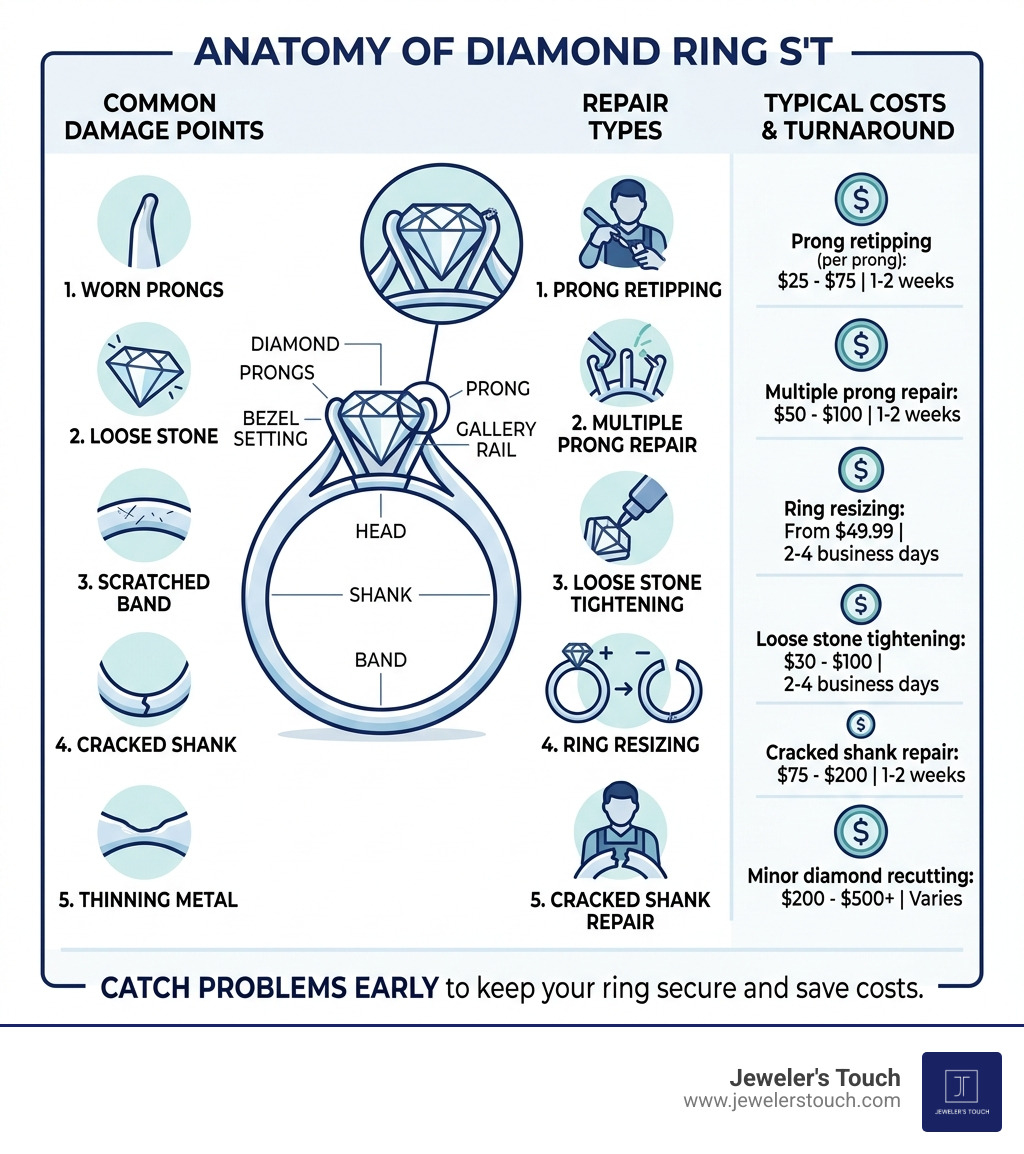
Common Issues and Warning Signs for Diamond Ring Repair
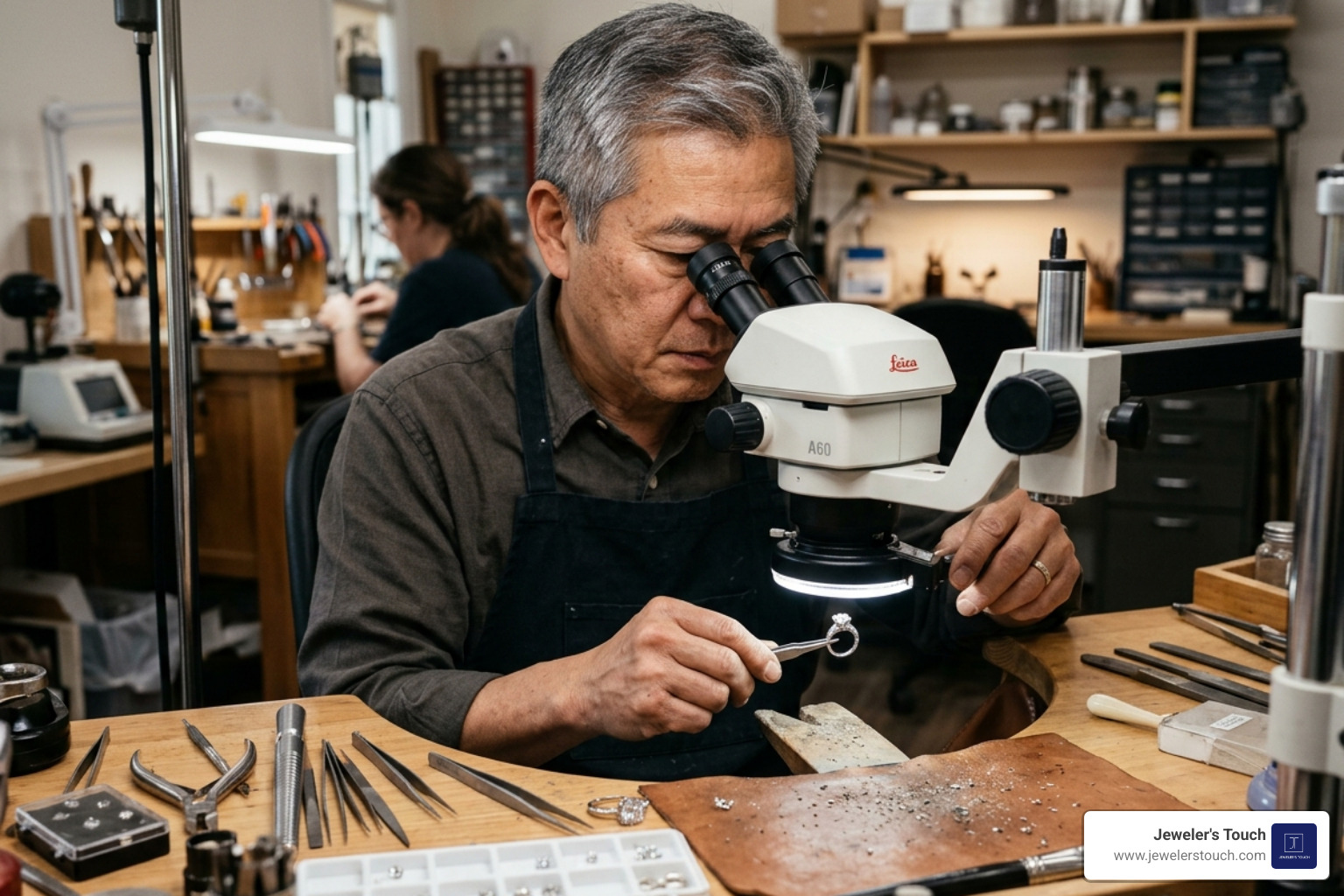
Even the most carefully worn ring eventually shows signs of "metal fatigue." This isn't just a fancy jeweler term; it’s a real physical process where the gold or platinum in your setting becomes brittle or wears away due to years of friction and pressure. Because we wear our rings on our hands—the most active part of our bodies—they take a beating that most other jewelry doesn't.
How do you know if your ring is crying out for help? Here are the primary warning signs:
The "Snag Test" and Rattling Sounds
One of the easiest ways to check your ring at home is the "snag test." Gently run your ring across a soft fabric, like a silk scarf or a knit sweater. If the ring catches or snags, it’s a major red flag that a prong has lifted or shifted.
Another diagnostic trick is the "tap test." Hold the ring close to your ear and gently tap the side of the band with your finger. If you hear a faint clicking or rattling sound, you likely have a loose stone. You can also use a toothpick to gently press on the edge of the diamond; if it moves even a fraction of a millimeter, it needs professional attention. For a deeper dive into these symptoms, check out Why Is My Diamond Loose in Its Setting and How Do I Fix It?
Visible Damage: Bent Prongs and Thinning Metal
Take a close look at your prongs—the tiny metal "claws" holding your diamond. Are they all the same height? Do they look rounded and full, or are they flattened and thin? Flat, thin prongs are much more likely to snap or bend. If you notice your ring looks lopsided or a prong is visibly out of alignment, stop wearing it immediately. We’ve detailed the 4 Signs of Damaged Prongs on a Ring to help you spot these issues before the diamond falls out.
Worn Shanks and Rhodium Wear
The "shank" is the bottom part of your ring band. Over time, constant contact with hard surfaces (like desks or steering wheels) causes the metal to wear thin. If the bottom of your ring looks like a thin wire compared to the rest of the band, it is at risk of cracking.
For those with white gold rings, you might notice your ring turning slightly yellow. This isn't damage, per se, but a sign that the protective rhodium plating has worn off. This is a standard maintenance issue that we can easily refresh in our Brea workshop.
Essential Types of Professional Ring Restoration

When you bring a ring to us for diamond ring repair, we don't just "fix the break." We look at the structural integrity of the entire piece. Modern technology, like laser welding, allows us to perform microscopic repairs right next to heat-sensitive stones without the risks associated with traditional torches.
Prong Retipping and Stone Tightening
This is the most common preventative repair. Retipping involves adding a small amount of new metal to the top of a worn prong to rebuild its strength and height. If a prong is completely broken or too thin to save, we may perform a full prong replacement. Tightening a stone is often a simpler process of carefully re-aligning the prongs to sit flush against the diamond's "crown" (the top part of the stone).
Shank Replacement and Resizing
If the band has worn too thin, we can perform a "half-shank" or "full-shank" replacement, where we cut away the thin section and solder on a fresh, thick piece of matching metal.
Resizing is another frequent request. Whether your ring is too tight or spinning on your finger, we can adjust the fit. To understand the mechanics of this process, read How Does Ring Resizing Work: Your Complete Guide.
Rhodium Plating and Polishing
To restore that "brand new" luster, we offer professional cleaning and polishing. For white gold owners, rhodium plating is the final step that provides that signature bright white finish. If you’ve wondered Why Is My White Gold Ring Turning Yellow and How Do I Fix It?, it’s simply time for a fresh coat of rhodium.
Repairing Damaged Diamonds
It’s a common myth that diamonds can’t be damaged. While they are incredibly hard, they can still chip or fracture if hit at the right angle (often called a "cleavage plane").
- Chipped Edges: Small chips can often be polished out, though this may slightly change the diamond's symmetry.
- Recutting: For larger fractures, a diamond can be recut into a slightly smaller stone or a different shape to remove the damage. While this results in carat weight loss, it restores the stone's brilliance and safety.
- Polishing: Over decades, diamonds can develop tiny surface scratches that dull their sparkle. A professional resurfacing can make an old stone look "better than new."
For more on restoring your stone's fire, see What to Do if Your Diamond Engagement Ring Loses Its Shine and our guide on Caring for Your Diamond Jewelry.
Repair vs. Replace: Making the Right Decision
At some point, every ring owner faces a difficult question: Is it worth repairing, or should I replace the setting entirely?
The 50% Rule
A good rule of thumb in the jewelry industry is the "50% Rule." If the cost of the diamond ring repair exceeds 50% of the replacement value of the setting, it might be time to consider a new mounting. Metal fatigue can reach a point where the metal is so brittle that repairing one spot just leads to a break in another.
Sentimental Value vs. Practicality
Heirlooms are different. If the ring belonged to your grandmother, the "Net Replacement Cost" doesn't matter as much as the history. In these cases, we often recommend a "redesign" as a middle ground—using your original diamonds in a new setting that mimics the vintage style but offers 2026-standard security.
Lab-Grown vs. Natural Diamonds
In May 2026, the market has shifted significantly. Lab-grown diamonds now account for a massive portion of the market (roughly 70% of engagement ring sales in some regions). If you’ve lost a center stone, you might find that you can replace it with a lab-grown diamond that is 30-50% less expensive than a natural one of the same quality, allowing for an "upgrade" during the repair process. If you find yourself in this situation, follow these 4 Steps to Take if a Diamond Falls Out of a Ring.
The Logistics of Professional Jewelry Services
Choosing where to take your ring is a big decision. You want to ensure the work is done by experts, not just sent off to a third-party "middleman." At Jeweler's Touch, we pride ourselves on our on-site workshop in Orange County.
Understanding the Cost of Diamond Ring Repair
Repair costs are influenced by several factors:
- Metal Type: Platinum is much harder to work with than gold, requiring higher temperatures and specialized tools, which increases labor costs.
- Complexity: Repairing an "invisible setting" (where stones are set side-by-side with no visible metal) is significantly more difficult than a standard solitaire.
- Stone Matching: If we need to replace a lost accent stone, we match it to the hundredth of a millimeter to ensure the light refraction and color match your original diamonds perfectly.
How Long Does a Diamond Ring Repair Take?
We know being without your engagement ring is stressful.
- Standard Repairs: Most resizing and stone tightening jobs take 2-4 business days.
- Complex Restorations: If we are rebuilding a shank or sourcing a specific replacement stone, expect 1-2 weeks.
- Estimates: We typically provide a detailed quote and digital inspection within 24-72 hours of receiving your piece.
When searching for a jeweler, look for GIA (Gemological Institute of America) certifications. This ensures the staff has the gemological knowledge to handle your diamonds with the respect they deserve. For help finding a reputable shop, see How to Find Jewelry Repair Near Me.
Frequently Asked Questions about Diamond Ring Repair
Does jewelry insurance cover diamond ring repairs?
Most standard jewelry insurance policies cover "accidental damage" (like a crushed ring) and "loss" (if the diamond falls out). However, they rarely cover "wear and tear" (like thinning prongs). This is why preventative maintenance is so important—it’s much cheaper to retip a prong than to replace a lost center diamond. Always keep your appraisals updated every 2-3 years so your coverage reflects current 2026 market values.
Can I repair a diamond ring at any jeweler?
Technically, yes, but we recommend choosing a specialist with an on-site workshop. Many mall jewelers don't actually do repairs; they ship your ring to a central facility, which adds risk and time. A specialist with a laser welder can perform more precise work, ensuring the repair is virtually invisible to the naked eye.
How do I prevent future damage to my ring?
The best way to avoid a major diamond ring repair is proactive care:
- Remove it: Take your ring off for gym sessions, gardening, heavy cleaning, or swimming.
- Clean it properly: Use a soft toothbrush and mild dish soap. Avoid harsh chemicals. Learn the full process here: How to Properly Clean a Diamond Engagement Ring.
- Annual Inspections: Bring your ring to us once a year (or every six months if you're very active) for a professional inspection under a microscope.
Conclusion
Your diamond ring is a symbol of a moment, a promise, or a family legacy. While metal wears down and accidents happen, professional diamond ring repair can ensure those memories stay secure on your hand.
Since 1992, Jeweler's Touch has been the trusted name in Orange County for expert craftsmanship and transparent service. With our on-site GIA gemologists and master goldsmiths, we handle your jewelry with the precision and care it deserves. Whether you’re in Brea or anywhere in the surrounding OC area, stop by for a complimentary inspection. We’ll help you keep your bling secure and sparkling for a lifetime.