

What Is the Opal Birthstone? A Quick Answer for October Birthdays
The opal birthstone is the official gemstone for the month of October, formalized in 1912 by the National Association of Jewelers in the United States.
Here are the key facts at a glance:
| Topic | Quick Answer |
|---|---|
| Birthstone month | October |
| Color | Varies — white, black, orange, blue, and multicolor |
| Key feature | Play-of-color (shifting rainbow hues) |
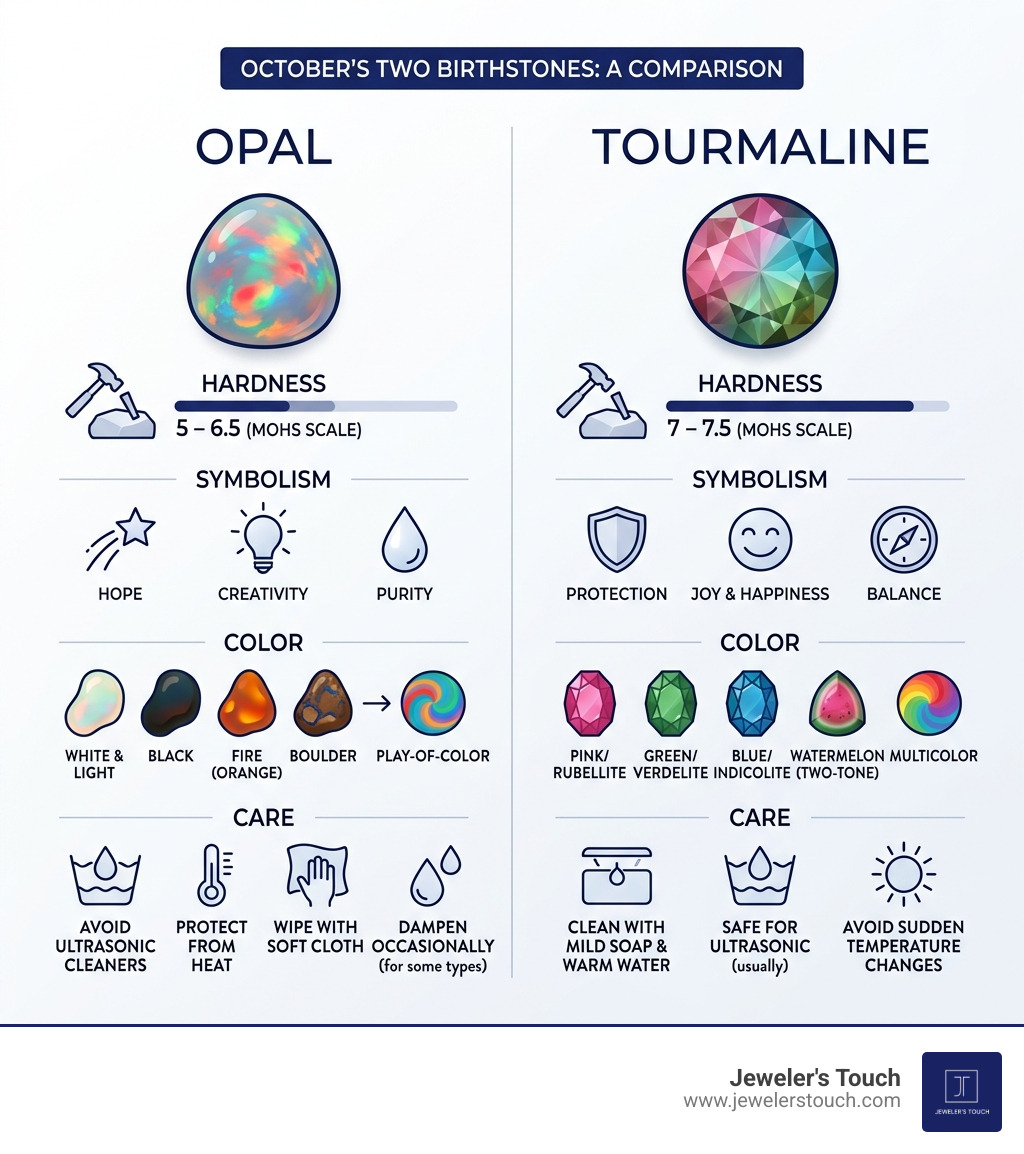
| Hardness | 5 to 6.5 on the Mohs scale |
| Primary source | Australia (about 95% of world supply) |
| Symbolism | Hope, purity, creativity, and individuality |
| Second October birthstone | Tourmaline |
| Anniversary | Traditional gift for the 14th wedding anniversary |
No two opals look alike. Each stone holds its own shifting spectrum of color — reds, blues, greens, and violets — all flickering with movement. The ancient Romans saw it as a single gem that captured the beauty of every other stone. It is easy to understand why.
Opal has fascinated people across cultures for thousands of years. Arabic folklore held that opals fell from the sky inside lightning bolts. Ancient Greeks believed the stone granted its wearer the gift of prophecy. Even today, opal carries a sense of mystery and wonder that few gemstones can match.
I'm Ken Rutz, and at Jeweler's Touch I have spent decades working with fine gemstones — including helping couples and gift-givers find the perfect opal birthstone jewelry for life's most meaningful moments. In this guide, I'll walk you through everything you need to know, from opal's rich history and varieties to how to care for it and what to look for when buying.
The History and Symbolism of the Opal Birthstone
The story of the opal birthstone begins with its name. Most historians believe the word originates from the Sanskrit term upala, which simply means "precious stone." This later evolved into the Greek opallios, meaning "to see a change in color," and the Roman opalus.
Throughout time, the opal has been more than just a pretty rock; it has been a vessel for human imagination. In ancient Rome, the scholar Pliny the Elder was famously enamored with the stone. He described it as a gem that combined the fire of the ruby, the brilliant purple of the amethyst, and the sea-green of the emerald—all shining together in an incredible union. You can explore more about how these traditions evolved in our look at The Secret History of Birthstones.
The Royal Influence and Darker Legends
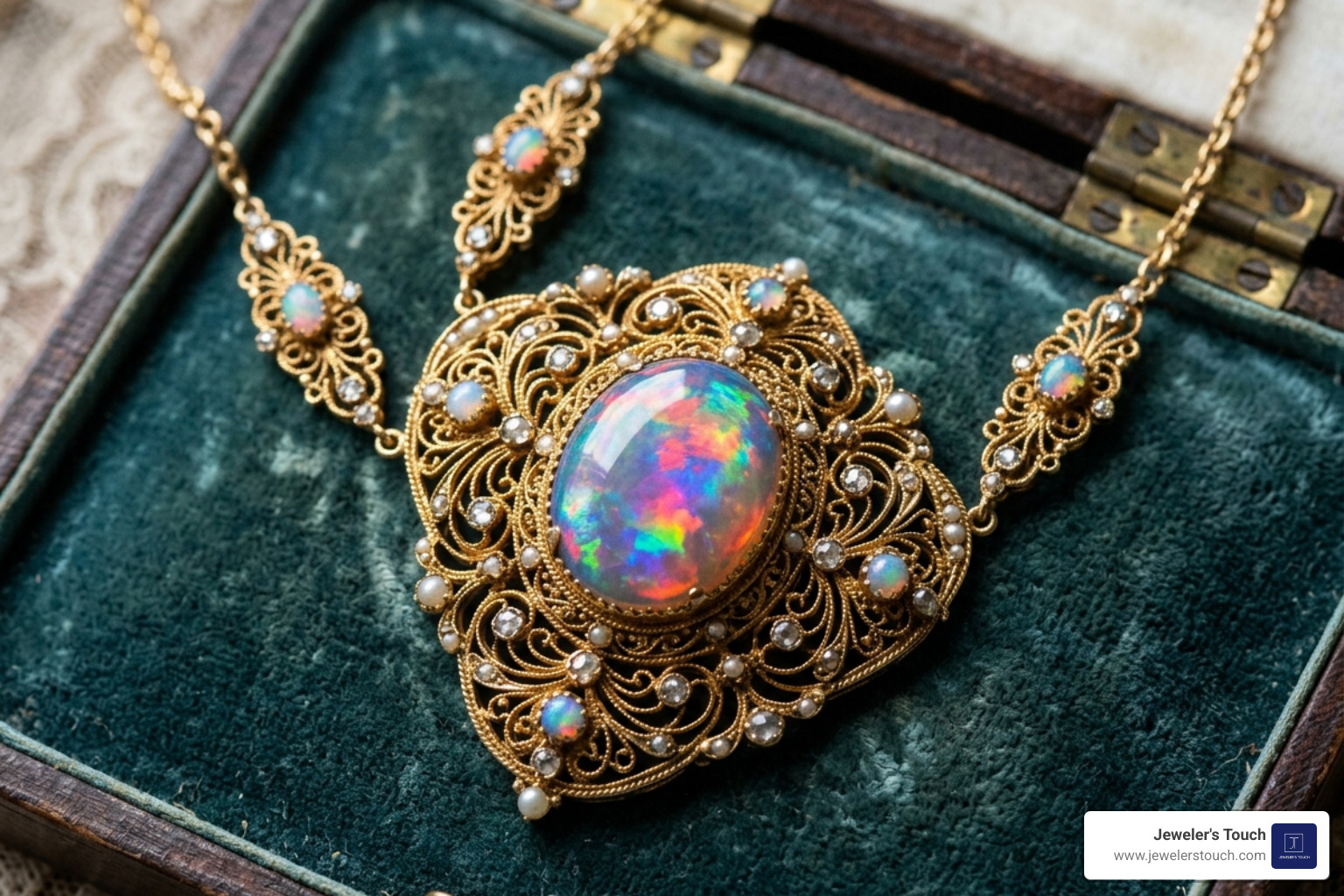
During the Victorian era, Queen Victoria became one of the greatest champions of the opal birthstone. She frequently wore opal jewelry and gifted it to her daughters on their wedding days, which helped cement the stone's status as a high-fashion staple. However, the opal hasn't always enjoyed a perfect reputation.
In 1829, Sir Walter Scott published the novel Anne of Geierstein, in which a character wore an opal that changed color with her moods and eventually lost its fire after being touched by holy water. This fictional story led to a real-world superstition that opals were unlucky. Fortunately, that myth has largely faded, replaced by the modern understanding of opal as a symbol of hope, purity, and emotional depth. Today, it is also celebrated as the traditional 14th-anniversary gemstone.
The Unique Play-of-Color in an Opal Birthstone
What makes an opal an opal? It’s all about the "play-of-color." While most gemstones get their color from chemical impurities, the opal’s rainbow comes from its physical structure.
Under a microscope, a precious opal birthstone is made of billions of tiny silica spheres arranged in a tight, grid-like pattern. When light hits these spheres, it diffracts—much like light passing through a prism—and breaks into a spectrum of colors.
- Small spheres produce violet and blue hues.
- Largers spheres create the much rarer and highly prized orange and red flashes.
This scientific phenomenon was only fully understood in the 1960s, but it has fascinated humans for millennia. You can learn more about the technical side of this in the Opal Gemstone Overview provided by the American Gem Society.
Cultural Significance Across Civilizations
- Ancient Greece: Greeks believed opals gave their owners the power of prophecy and protected them from disease.
- Ancient Rome: Romans viewed opal as a symbol of love and hope. One famous story tells of a Roman senator named Nonius who chose exile over surrendering his prized opal to Marc Antony.
- Arabic Lore: Bedouin tribes believed that opals fell from the heavens during thunderstorms, trapping the lightning within the stone.
- Australian Aboriginal Myths: In many indigenous legends, the "Creator" came down to earth on a rainbow to bring a message of peace. Where his feet touched the ground, the stones came alive with the colors of the rainbow, creating the first opals.
- Medieval Europe: Interestingly, some believed that an opal wrapped in a bay leaf could render the wearer invisible, earning it the nickname patronus furum or "patron of thieves."
Understanding Opal Varieties and Scientific Composition
Not all opals are created equal. In gemology, we differentiate between "Precious Opal," which shows play-of-color, and "Common Opal" (also known as potch), which is opaque and lacks that signature flash. For those seeking The World’s Finest Opals, understanding these varieties is essential.
| Variety | Description | Value Factor |
|---|---|---|
| Black Opal | Dark body tone (black or dark grey); makes colors "pop." | Highest |
| White Opal | Light or "milky" body tone; more common and affordable. | Moderate |
| Boulder Opal | Formed in ironstone boulders; often has a natural dark backing. | High |
| Fire Opal | Transparent to translucent; usually yellow, orange, or red. | Moderate to High |
| Crystal Opal | Transparent body that allows you to see through the stone. | High |
Scientifically, the opal birthstone is a hydrated amorphous form of silica. It can contain anywhere from 3% to 21% water within its structure, though gem-quality stones usually sit between 6% and 10%. This high water content is exactly why opals require special care—if they dry out too much, they can develop tiny cracks, a process known as "crazing."
In rare instances, silica-rich water seeps into the cavities left by decaying organic matter, creating "opalized fossils." We have seen incredible examples of opalized shells, wood, and even dinosaur bones that sparkle with a full rainbow of colors.
Global Sources and Mining Origins
While opals are found in several places around the world, Australia is the undisputed king of the opal birthstone. Since roughly 1850, Australia has produced about 95% of the world’s precious opal supply.

- Lightning Ridge (Australia): Famed for producing the world’s most sought-after black opals. The conditions here are so harsh that many miners actually live in underground "dugouts" to escape the blistering heat.
- Coober Pedy (Australia): Often called the "Opal Capital of the World," this area is the primary source of white or light opal.
- Ethiopia: A newer player in the market, specifically the Wollo Province. Ethiopian opals are often "hydrophane," meaning they can absorb water and change appearance temporarily.
- Mexico: Famous for "Fire Opals" found in volcanic rock, often displaying vibrant oranges and reds without the typical play-of-color.
- United States: Nevada and Idaho have small but notable deposits of precious opal.
For a deeper dive into how these geographic origins affect the look of your jewelry, check out our October Birthstone Guide: Opal & Tourmaline.
Caring for Your Opal Jewelry
Because the opal birthstone is relatively soft (5.5 to 6.5 on the Mohs scale) and contains water, it is more delicate than a diamond or sapphire. Think of it like a fine silk garment—it’s beautiful, but you can’t just throw it in the heavy wash!
The Do's and Don'ts of Opal Care
- Clean with Care: Use only warm, soapy water and a very soft cloth or brush.
- Avoid Chemicals: Keep your opal away from bleach, hairspray, perfumes, and even dish soap with harsh degreasers.
- Temperature Control: Rapid changes in temperature (thermal shock) can cause an opal to crack. Don't go from a freezing air-conditioned room to a hot tub while wearing your opal.
- No Ultrasonics: Never put an opal in an ultrasonic or steam cleaner. The vibrations and heat can shatter the stone or damage the adhesives in doublets and triplets.
- Storage: Store your opal jewelry in its own soft pouch. Because it is soft, harder stones like diamonds or even gold edges can scratch it if they rub together in a jewelry box.
For more maintenance tips, visit our comprehensive Birthstone Guide.
Is an Opal Birthstone Suitable for Engagement Rings?
We often get asked if an opal is a good choice for an engagement ring. The answer is: Yes, but with caveats.
If you have an active lifestyle or work with your hands, a solid opal might be prone to chipping. However, we can make it work by choosing a protective setting. A bezel setting, which wraps the metal around the entire edge of the stone, offers much better protection than standard prongs.
It is also important to know if your stone is a doublet or triplet. These are thin slices of opal glued to a darker backing (and sometimes topped with a clear cap). While they are more affordable and can look stunning, they are very sensitive to water. Prolonged soaking can weaken the glue, causing the layers to separate or turn foggy.
Frequently Asked Questions about Opals
Why does October have two birthstones?
October is lucky enough to have two: opal and tourmaline. This wasn't always the case. In 1912, when the National Association of Jewelers formalized the list, opal was the sole winner. However, because opals were perceived as fragile and some people still clung to old superstitions, tourmaline was later added as a more durable, colorful alternative. This gives October babies a choice between the shifting "captured starlight" of the opal and the vibrant, solid colors of the tourmaline.
What determines the price of an opal?
Several factors influence the value of an opal birthstone:
- Body Tone: Black opals are generally the most expensive because the dark background makes the colors appear more vivid.
- Play-of-Color: The more colors you see, and the brighter they are, the higher the price. Red is the rarest and most expensive "flash" color.
- Pattern: Rare patterns like "Harlequin" (large, distinct blocks of color) are worth significantly more than "Pinfire" (tiny dots of color).
- Brilliance: A dull opal is worth much less than one that "glows" from across the room.
How can you tell if an opal is real?
Telling a natural opal from a lab-grown or synthetic one can be tricky for the untrained eye. Synthetic opals often have a very "orderly" pattern—the colors look too perfect or appear in a "columnar" structure when viewed from the side.
Another thing to watch for are doublets and triplets. If you look at the stone from the side and see a perfectly straight line where the opal meets a black base, it’s likely a composite stone rather than a solid gem. At Jeweler's Touch, our on-site GIA gemologists use specialized equipment to verify every stone, ensuring you get exactly what you pay for.
Conclusion
The opal birthstone is truly nature’s kaleidoscope. Whether you are drawn to the deep mysteries of a black opal or the ethereal glow of a white opal, these stones offer a level of individuality that no other gem can provide. Because no two are exactly alike, an opal gift says, "You are unique."
At Jeweler's Touch, we’ve been part of the Orange County community since 1992. Our family-owned shop in Brea is staffed with expert goldsmiths and GIA-certified gemologists who love these stones as much as you do. Whether you’re looking for a custom-designed engagement ring or a simple pendant for an October birthday, we’re here to help you find a piece that will last a lifetime.
Ready to find your own piece of "captured starlight"? Find your perfect October gift in our comprehensive Birthstone Guide or stop by our showroom to see these incredible gems in person.