

What a 6cm Diameter Ring Size Actually Means (And What You Really Need to Know)
A 6cm diameter ring size is one of the most misunderstood measurements in jewelry shopping — and clearing up the confusion can save you from a costly mistake.
Here's the quick answer:
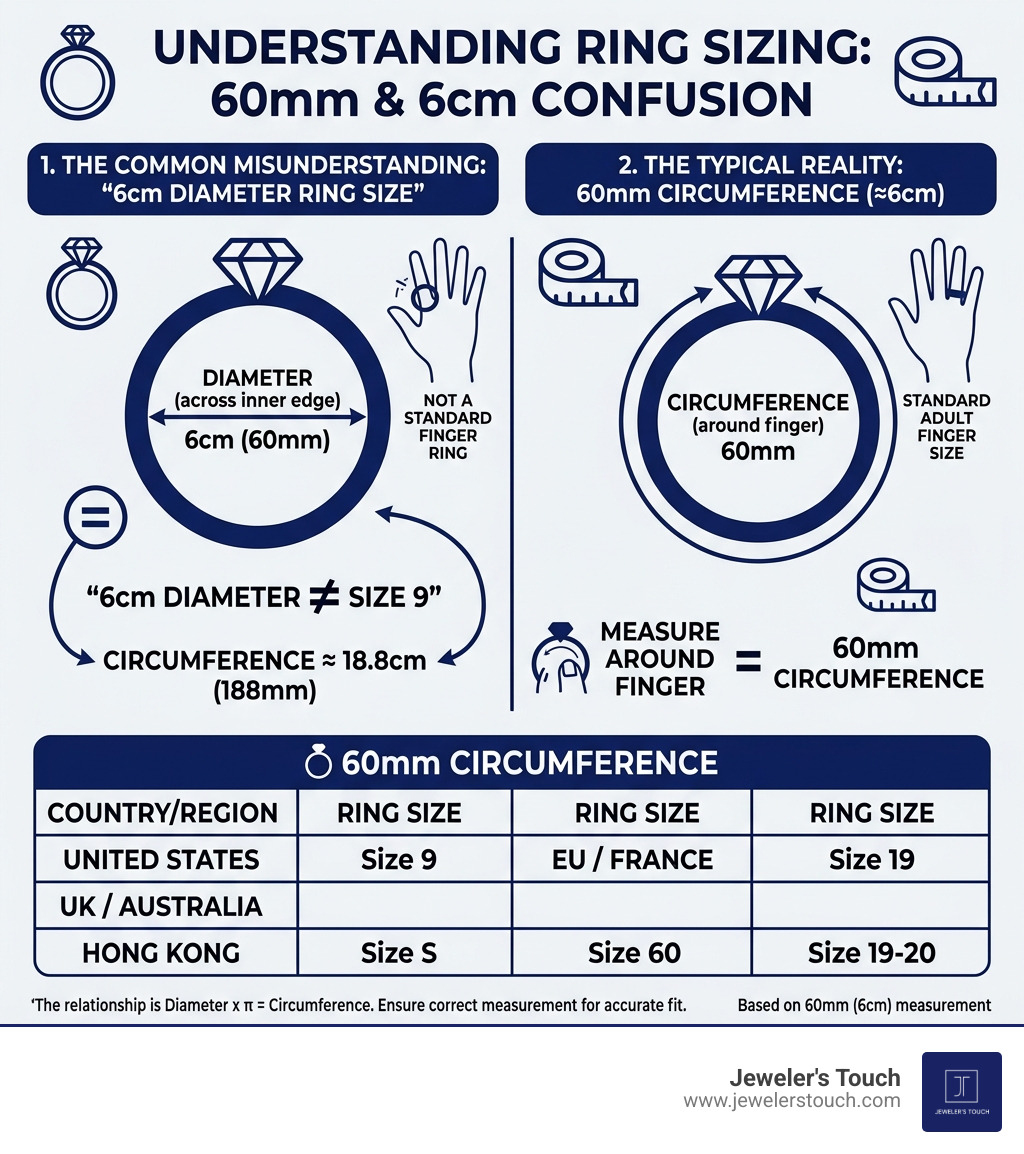
| What You Measured | What It Means | Ring Size Equivalent |
|---|---|---|
| 6cm circumference (60mm) | Standard adult finger size | US 9, UK S, EU 60 |
| 6cm diameter (60mm) | Size of a bracelet, not a finger ring | Not a standard finger ring size |
Key takeaway: If you measured 6cm with a strip of paper wrapped around your finger, that's your circumference — and it puts you at roughly US size 9. If you somehow got 6cm as a straight-line measurement across the inside of a ring, that ring would be closer to a bangle.
Most people searching for a 6cm ring size are working with a circumference measurement and don't realize it. That 60mm circumference corresponds to:
- US/Canada: Size 9 (or 9 1/8)
- UK/Australia: Size S
- EU/France: Size 60
- Hong Kong: Size 19-20
This guide will walk you through exactly how to use your centimeter measurement to find the right fit — no guesswork needed.
I'm Ken Rutz, a jeweler with years of hands-on experience helping customers navigate confusing ring measurements, including the all-too-common 6cm diameter ring size mix-up. Let's make sure you get this right before you buy.
Understanding the 6cm Diameter Ring Size vs. Circumference
When we talk about jewelry measurements, the terminology we use is everything. In our Orange County studio, we often see customers come in with a "6cm" measurement, but the context of that measurement changes the result entirely.
To understand why a 6cm diameter ring size is a bit of a mathematical anomaly for a finger, we have to look at the relationship between diameter and circumference. The formula is simple: Circumference = Diameter × π (3.1415).
If you have a ring with a 6cm (60mm) circumference, the internal diameter is actually about 1.91cm (19.1mm). This is a very common size for adult men and some women. However, if the diameter itself were 6cm, the circumference would be a massive 18.85cm. That isn't a ring; that's a piece of jewelry meant for a wrist or even a small pillar!
Most international sizing standards, especially in Europe, are based on the circumference in millimeters. For example, an EU size 60 literally means the ring has a 60mm (6cm) inner circumference. If you are trying to convert these measurements on the fly, tools like the Ring Size Converter - Omni Calculator can be incredibly helpful for double-checking your math.
Why a 6cm Diameter Ring Size is Rare for Fingers
Let’s get real about human anatomy for a second. The average human finger is nowhere near 6cm wide. To put that in perspective, a standard US size 6 ring has a diameter of only 1.65cm. Even a very large men's US size 13 has a diameter of roughly 2.22cm.
A 6cm diameter ring size (60mm) would be nearly three times the width of an average man's thumb. In the jewelry world, a 60mm diameter is actually the starting range for bangles and bracelets. If you find yourself looking at a measurement of 6cm across the center of a circular object, you are likely measuring a bracelet or a very large napkin ring, not a piece of finger jewelry.
Converting 60mm Circumference to International Sizes
If you have confirmed that your finger's circumference is 6cm (60mm), you are in a very common "sweet spot" for sizing. This measurement is widely used across the globe, though every region calls it something different.
Here is how a 60mm circumference translates across major markets:
| Region | Size Equivalent |
|---|---|
| United States & Canada | Size 9 (to 9 1/8) |
| United Kingdom & Australia | Size S |
| European Union (France/Germany) | Size 60 |
| Japan | Size 18-19 |
| Hong Kong | Size 19-20 |
| Switzerland | Size 20 1/4 |
This size is particularly significant in the men's market. Statistics show that roughly 50% of men's ring sizes fall between an EU 60 (6cm circumference) and an EU 65. If you're shopping for a man in Brea, CA, or anywhere in Orange County, starting with a 6cm circumference measurement is a great baseline.
How to Accurately Measure for a 6cm Diameter Ring Size at Home
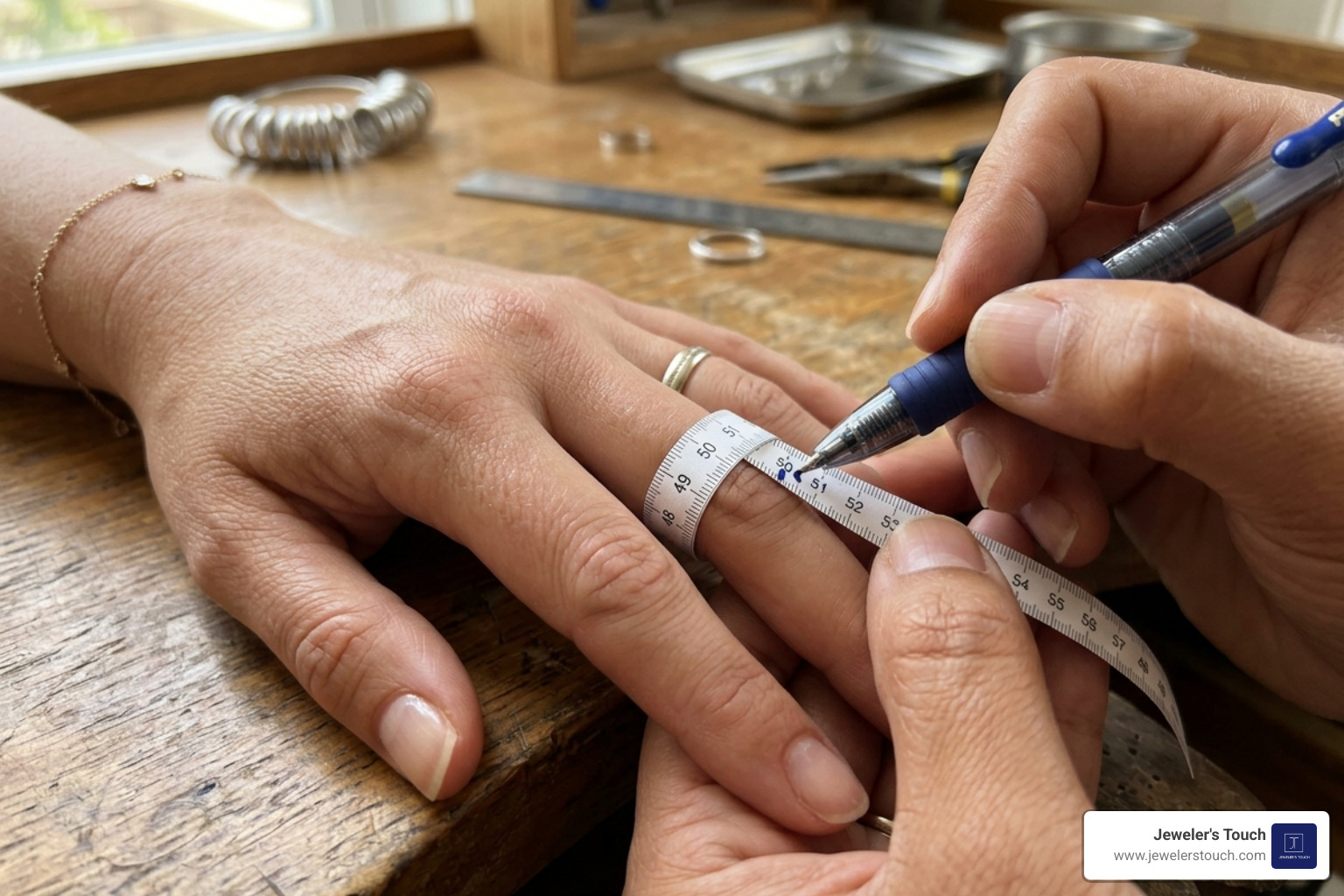
Getting an accurate measurement at home is entirely possible, but it requires a steady hand and the right tools. We always tell our clients that a 0.1cm difference might not seem like much on a ruler, but in rings, it can be the difference between a perfect fit and a ring that slides off while you're washing your hands.
To get started, you'll need a thin strip of paper (about 0.5cm wide), a fine-tip pen, and a metric ruler that shows millimeters clearly. Avoid using string or yarn; these materials are notorious for stretching, which can lead to an inaccurately large measurement.
Step-by-Step: Measuring for a 6cm Diameter Ring Size
- The Wrap: Wrap the paper strip around the base of the finger you intend to wear the ring on.
- The Knuckle Check: This is the most important step! Slide the wrapped paper up to your knuckle. Your ring must be able to pass over the knuckle comfortably. If your knuckle is significantly larger than the base of your finger, measure both and choose a size in between.
- The Mark: Use your fine-tip pen to draw a sharp line exactly where the paper overlaps.
- The Measurement: Lay the paper flat against your ruler. If the distance from the end to your mark is exactly 6cm, your circumference is 60mm.
- The Average: We recommend measuring three different times — once in the morning, once in the afternoon, and once in the evening. Your fingers change size throughout the day!
If you are trying to measure in secret to surprise someone, we have some "sneaky" professional tips in our guide on How To Get Your Partner's Ring Size Without Ruining The Surprise.
Using Existing Jewelry for Diameter Verification
If you already have a ring that fits perfectly, measuring its inner diameter is often more accurate than the paper strip method.
Place the ring on a flat surface and use a ruler (or better yet, digital calipers) to measure the distance across the inside edge. Do not include the metal of the band itself. If the measurement is approximately 1.91cm, you are looking at a 6cm circumference ring. You can cross-reference these diameter-to-circumference numbers using a Ring Size Chart in CM to ensure you haven't missed a fraction of a millimeter.
Factors That Influence Your 6cm Diameter Ring Size Fit

A measurement of 6cm is just the beginning. The "feel" of a ring depends heavily on the architecture of the piece itself. At Jeweler's Touch, we always ask our clients what style of ring they are looking at before finalizing a size.
Band Width and Comfort Fit
The wider the band, the tighter it will feel. A thin 2mm stackable ring in a 6cm circumference will feel loose and airy. However, a heavy 8mm wide wedding band in that same 6cm size might feel uncomfortably tight because it covers more surface area on your finger.
- Wide Bands: For bands wider than 6mm, we typically recommend "sizing up" by about a quarter or half size (moving from a 6.0cm to a 6.1cm or 6.2cm circumference).
- Comfort Fit: Many modern rings, especially plus-sized wedding bands, feature a domed interior known as a "comfort fit." These rings slide over the knuckle more easily and can sometimes feel about a half-size larger than standard flat-interior rings.
Environmental and Physiological Impacts on Sizing
Your body is dynamic, and your fingers are no exception. Several factors can make your "true" 6cm measurement fluctuate:
- Temperature: Heat causes blood vessels to dilate, making fingers swell. Cold causes them to shrink. We’ve seen rings that fit perfectly in the Brea summer feel like they’re going to fly off in the winter.
- Time of Day: Most people find their fingers are smallest in the morning and largest in the evening after a full day of activity.
- Diet: High sodium intake or alcohol consumption can cause temporary water retention and swelling.
- Physical Activity: Exercise increases blood flow and can temporarily increase your finger size.
Choosing Between Sizes: 5.9cm vs. 6.1cm
What happens if your measurement is "between the lines"? If you measure 5.95cm, should you go down to 5.9 or up to 6.1?
The golden rule in jewelry is: When in doubt, size up. It is significantly easier (and usually cheaper) for a professional goldsmith to resize a ring down than it is to stretch it larger. Stretching a ring can thin the shank or put stress on the stone settings. You can learn more about the technical side of this in our Complete Guide to How Ring Resizing Works.
Frequently Asked Questions About Ring Sizing
Is 6cm a common ring size for men or women?
A 6cm circumference (US Size 9) is a very common size for men. In fact, it's often considered the "average" starting point for men's wedding bands. For women, a 6cm circumference is on the larger side of the standard range, often fitting the middle or index finger, or serving as a comfortable size for plus-sized wedding bands.
How do I convert 6cm circumference to diameter?
To find the diameter, you divide the circumference by Pi (3.1415). 6.0cm ÷ 3.1415 = 1.909cm. In the jewelry industry, we usually round this to 19.1mm. If you are using a ruler, look for the 1.9cm mark; if the inner hole of the ring is just a hair past that mark, you’ve found a 6cm circumference ring.
What are common mistakes when measuring for 6cm rings?
The most common mistake is measuring the finger when it is too cold. Cold fingers can shrink by up to half a size! Another frequent error is using a thick piece of string. String can compress the skin or stretch out, giving you a reading that is 2-3mm off. Finally, many people forget to measure the knuckle. If the ring can't get past the knuckle, it doesn't matter how well it fits the base of the finger!
Conclusion: Finding Your Perfect Fit
While DIY measurements and online charts are fantastic starting points, nothing beats the precision of a professional fitting. At Jeweler's Touch, our family-owned studio in Orange County has been helping clients find their perfect fit since 1992.
Whether you are looking for a custom engagement ring or a simple gold band, our on-site GIA gemologists and expert goldsmiths are here to ensure your jewelry is as comfortable as it is beautiful. A 6cm diameter ring size might be a rare find, but a perfectly fitted 6cm circumference ring is just an appointment away.
Ready to find a piece that fits your life and your style? Find your perfect engagement ring today or visit us in Brea to experience the Jeweler's Touch difference.
Jeweler's Touch Serving Orange County and Brea, CA