

What Is the Average Male Ring Finger Size?
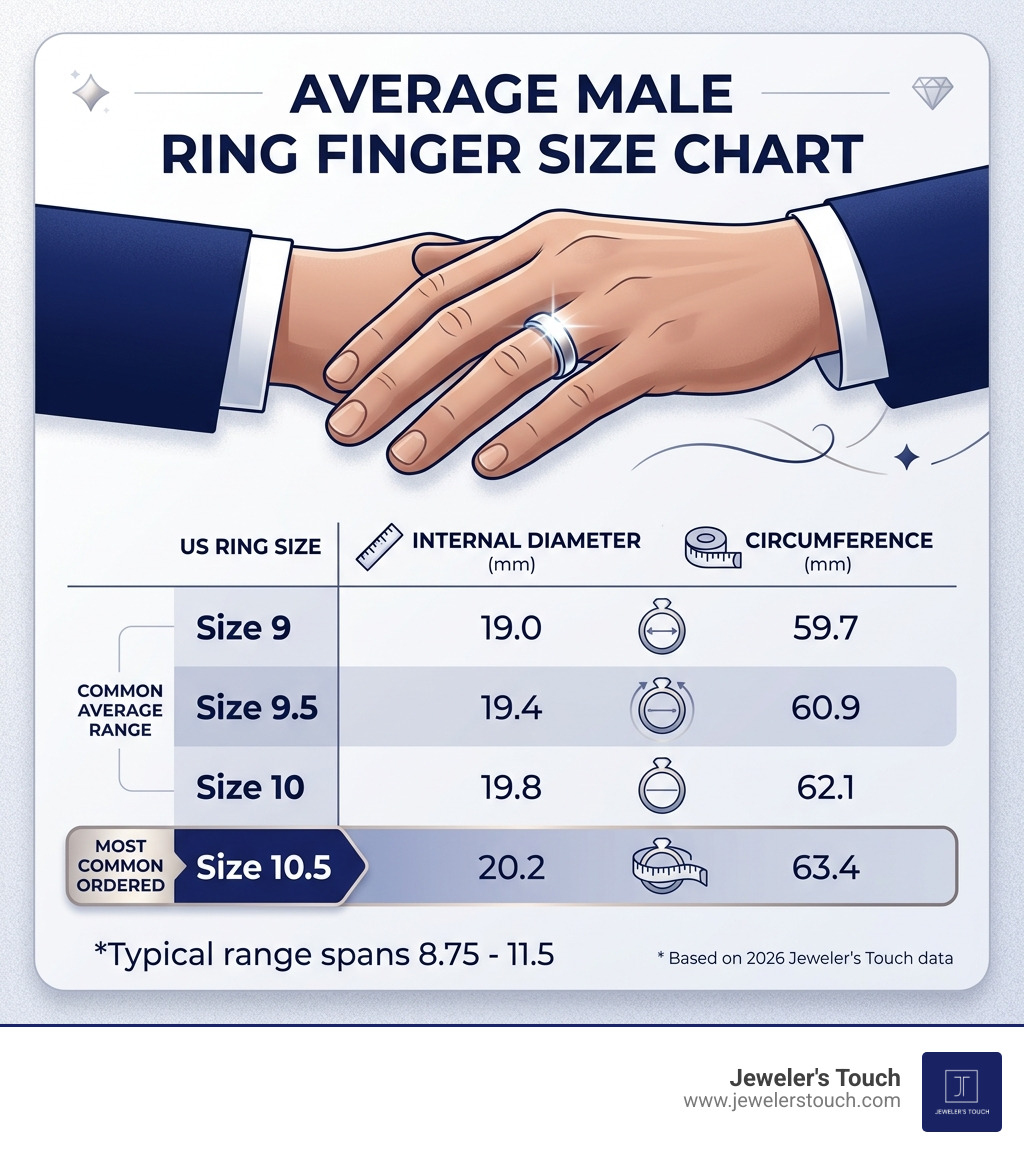
The average male ring finger size in the United States falls between size 9 and size 10, with size 10.5 being the single most commonly purchased size. Here's a quick-reference snapshot:
| Measurement | Value |
|---|---|
| Average US men's ring size | 9 – 10 |
| Most common US size ordered | 10.5 |
| Most common UK size ordered | S |
| Average internal diameter | ~19.4 mm |
| Average circumference | ~61 mm |
| Typical size range for most men | 8.75 – 11.5 |
Finding the right fit matters more than most people realize. A ring that slides off during a handshake or cuts off circulation at the end of a long day isn't just uncomfortable — it's a problem that's often avoidable with the right information upfront.
Whether you're shopping for your own wedding band or trying to secretly nail down your partner's size before a proposal, understanding where most men fall on the size scale gives you a solid starting point.
I'm Ken Rutz from Jeweler's Touch, and after years of helping customers across Orange County find their perfect fit, I've seen how much confusion surrounds the average male ring finger size — and how easy it is to get right with a little guidance. Let's walk through everything you need to know.
Understanding the Average Male Ring Finger Size in 2026
As we navigate through May 2026, the jewelry industry has seen a shift toward more personalized and wider bands, but the fundamental biology of the human hand remains the same. When we talk about the average male ring finger size, we are looking at a bell curve. While the median sits comfortably around a size 9 or 10, the "real world" range we see at Jeweler’s Touch usually spans from size 8.75 to 11.5.
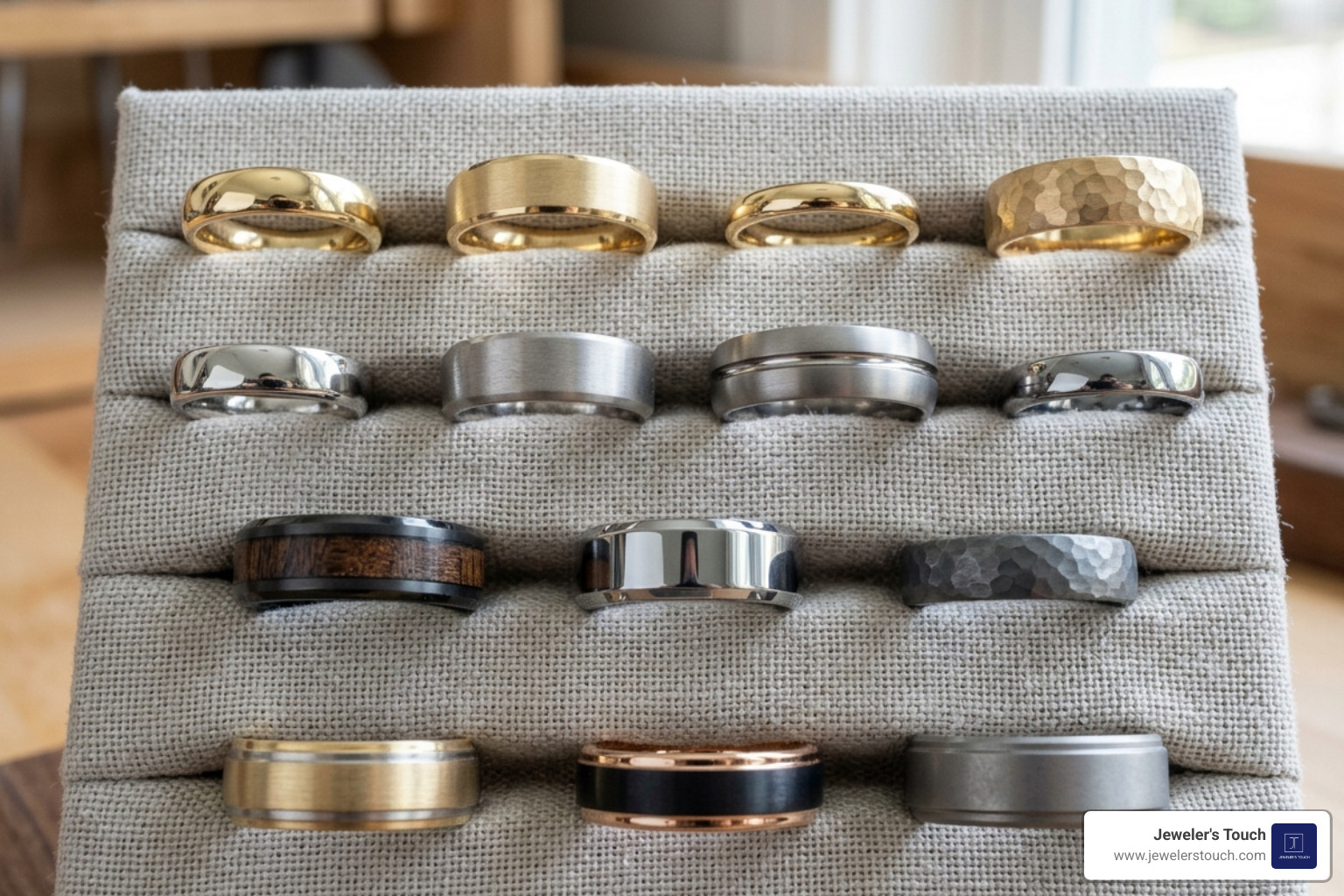
It is important to note that "average" is just a starting point. For instance, a man with a slender build who works as a software engineer in Brea might wear a size 8, while a construction worker with broader hands might require a size 13. According to Average Men's Ring Size - Guide for Sizing, the US and Canada average is specifically cited as 9.5, which corresponds to an internal diameter of roughly 19.4 mm.
Regional Differences in Average Male Ring Finger Size
If you are ordering a ring from overseas or looking at vintage pieces, you'll notice that the US numerical system isn't the only one in play. In the United Kingdom, sizes are represented by letters. A US size 9 is roughly equivalent to a UK size R, while the US size 10 aligns with a UK size T.
| US Size | UK Size | Internal Diameter (mm) | Circumference (mm) |
|---|---|---|---|
| 8 | Q | 18.1 | 57.0 |
| 9 | R 1/2 | 19.0 | 59.7 |
| 9.5 | S 1/2 | 19.4 | 61.0 |
| 10 | T 1/2 | 19.8 | 62.1 |
| 11 | V 1/2 | 20.6 | 64.7 |
Understanding these conversions is vital because even a 0.4 mm difference in diameter constitutes a full half-size. When you're shopping in Orange County, we stick to the US numerical standard, but our GIA gemologists are well-versed in international conversions to ensure your heirloom or imported ring fits perfectly.
How Body Frame Correlates with Average Male Ring Finger Size
There is a loose correlation between a man’s overall stature and his ring size, though it is far from a perfect science. Generally, taller men (over 6 feet) often gravitate toward sizes 10 through 12. However, weight and bone structure play a more significant role than height alone.
Research in the Journal of Anatomy indicates that finger growth is biphasic, meaning it has two distinct growth periods before stabilizing in the late teens. For adult men, weight fluctuations are the primary driver of size change. A shift of 10 to 15 pounds can actually change a ring size by a quarter to a half size. For a deep dive into how these measurements translate to physical space, check out our guide on The Perfect Fit Everything You Need To Know About A Size 10 Ring In Inches.
Biological and Environmental Factors Affecting Fit
Your finger is not a static object; it’s a living part of your body that reacts to your environment. We often tell our clients in Brea that their ring might feel perfect in our air-conditioned showroom but tight after a salty meal or a hike in the Orange County heat.
Several factors can cause your finger size to fluctuate throughout the day:
- Temperature: Heat causes blood vessels to dilate (to release heat), making fingers swell. Cold causes them to constrict, making the ring feel loose.
- Time of Day: Most men find their fingers are at their largest in the evening. Measuring first thing in the morning often leads to a ring that is too tight.
- Diet: High sodium intake leads to water retention. If you had a large pizza last night, your ring might feel snug today!
- Hydration: Dehydration can actually cause fingers to shrink slightly.
According to ScienceInsights, these variations are natural, but they mean you should never rely on a single measurement taken at one specific moment.
Hand Dominance and Lateral Asymmetry
Did you know your dominant hand is likely larger than your non-dominant hand? Because you use your dominant hand more frequently for gripping, lifting, and typing, the muscles and tendons are more developed, and the blood flow is often higher.
On average, the fingers on your dominant hand are about a half-size larger than those on your other hand. If you are right-handed and measuring for a wedding band (traditionally worn on the left hand), do not use a ring that fits your right hand as a reference. It will almost certainly be too big.
The Impact of Age on Finger Shape
As we age, the anatomy of our hands changes. While the "meat" of the finger might shrink slightly as skin loses elasticity, the knuckles often widen due to years of use or conditions like arthritis. This creates a "dumbbell" shape where the ring must be large enough to pass the knuckle but then sits loosely at the base of the finger.
For men dealing with these changes, we often recommend "comfort fit" bands or specialized Plus Sized Wedding Bands that account for larger joints without sacrificing security.
Professional vs. DIY Measurement Techniques
In the age of DIY, many people try to measure their ring size at home using string, paper, or even a ruler. We strongly advise against this for anything other than a "ballpark" estimate. String can stretch, and paper can tear or wrap at an angle, leading to errors of up to two full sizes.
At Jeweler's Touch, we use calibrated metal sizers that represent the actual thickness and shape of a real ring. If you can't make it into our Brea location, there are modern alternatives like augmented reality (AR) apps that perform a 3D scan of your hand. While better than string, even these don't account for the "feel" of the ring sliding over the knuckle.
Check out our comparison of Diy Vs Professional Watch Resizing For The Perfect Fit to see why professional tools are the gold standard for any jewelry adjustment.
Measuring for the Knuckle
The most common mistake men make is sizing for the base of the finger rather than the knuckle. A ring should slide over the knuckle with a bit of resistance—you should have to give it a slight "tug" to get it off. If it slides over the knuckle with no resistance, you risk losing it when your hands are wet or cold.
If you have particularly large knuckles, we might suggest a "comfort fit" ring, which has a domed interior. This allows the ring to glide more easily over the joint while still sitting snugly against the skin at the base.
Strategies for Discreet Sizing
Trying to pull off a surprise? It’s a classic challenge. If you’re trying to find your partner's size without them knowing, here are a few expert-approved tactics:
- The Ring Trace: Borrow a ring they already wear on their ring finger and trace the inside and outside circles on a piece of paper.
- The Friend Assist: Ask a friend or family member to casually bring up ring sizes in conversation.
- The Soap Impression: Press one of their rings into a bar of soap to create a physical template of the diameter.
For more creative ideas, read our guide on How To Get Your Partner S Ring Size Without Ruining The Surprise.
Choosing the Right Band Width and Material
The average male ring finger size is also heavily influenced by the width of the band you choose. Most men today opt for an 8mm band width, which is considered the modern standard. However, the wider the band, the tighter it will feel.
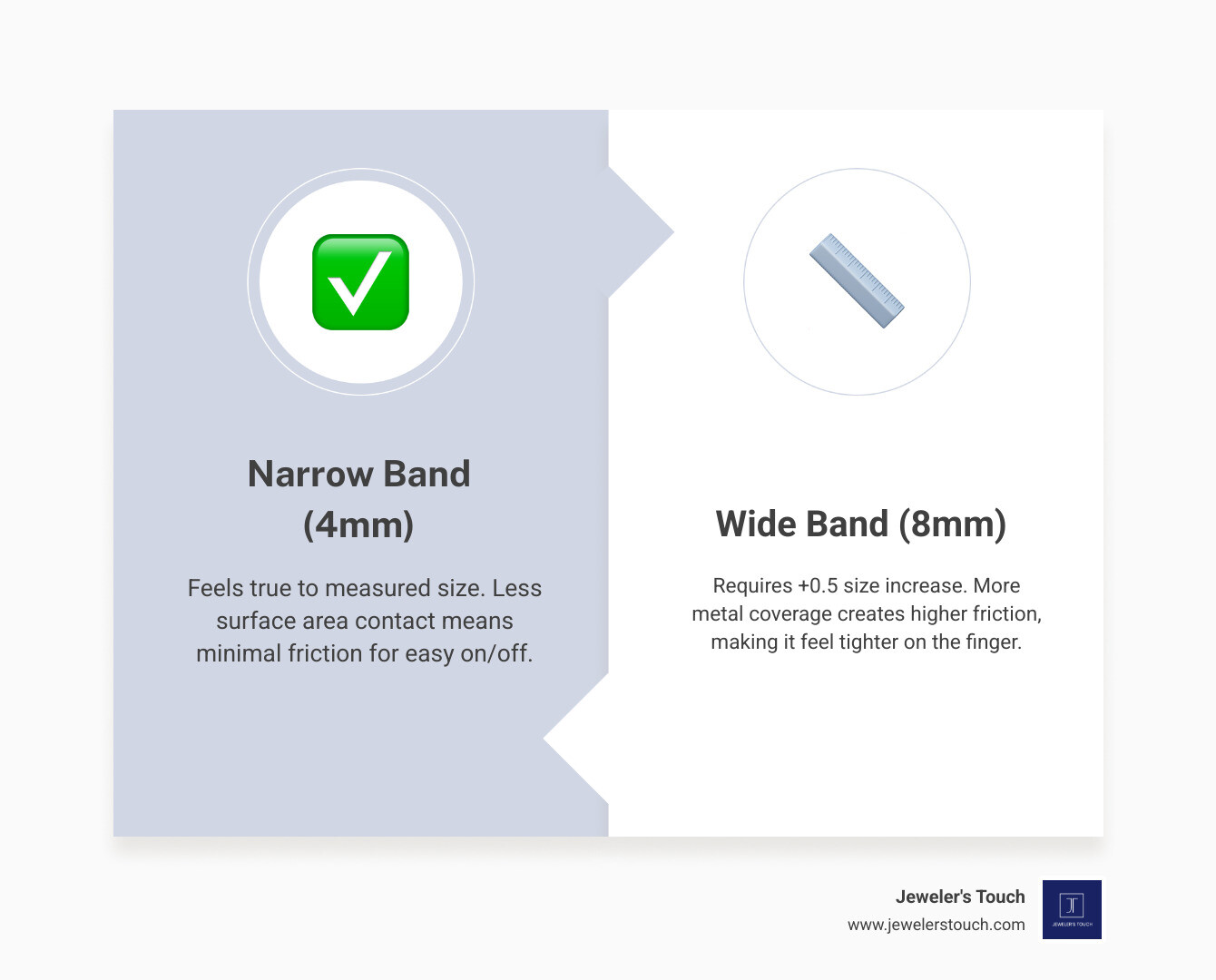
If you are moving from a standard 4mm sizer to an 8mm or 10mm band, you will likely need to increase your size by a half-step. A size 10 in a thin band feels like a size 10.5 in a wide band because the wider metal covers more surface area of the finger, creating more friction.
Resizing Limitations by Material
Before you commit to a size, you must consider the material. Not all rings are created equal when it comes to the workbench.
- Gold and Platinum: These are the "jeweler's favorites." We can easily upsize or downsize these metals by cutting and soldering the band.
- Tungsten and Titanium: These contemporary metals are incredibly hard—so hard that they cannot be resized. If your finger size changes, you will have to replace the entire ring.
- Inlays (Wood, Antler, Stone): Rings with organic inlays are very difficult to resize because the heat from a jeweler's torch or the pressure of a stretching machine can crack the inlay.
Understanding How Does Ring Resizing Work Your Complete Guide can save you a lot of heartache (and money) down the road. Similarly, if you're interested in how other jewelry is handled, you can read about What To Expect When Resizing Your Bracelet Professionally.
Frequently Asked Questions
What is the most common ring size for men in the US?
While the average is 9-10, our internal sales data shows that size 10.5 is the most frequently ordered size. This suggests that while many men measure at a 9 or 10, they prefer the slightly looser fit of a 10.5, especially when opting for the popular 8mm wide bands.
How much does a ring size change with weight loss?
Weight loss is one of the most common reasons for resizing. Generally, for every 10 to 15 pounds lost, you can expect your ring size to drop by about a quarter to a half size. If you are on a significant weight loss journey, we recommend waiting until your weight has stabilized for at least three months before investing in a permanent resizing or a non-resizable metal like tungsten.
Should a man's ring be loose or tight?
It should be "comfortably snug." You want enough resistance that it won't fly off if you shake your hand vigorously, but it shouldn't be so tight that it leaves a deep indentation in your skin or causes your finger to bulge around the edges. A good rule of thumb: it should go on easy, but come off with a little work.
Conclusion
Finding the perfect fit is a blend of science, biology, and personal preference. While the average male ring finger size gives us a great place to start, your lifestyle, the width of the band, and even the time of day you measure all play a role in ensuring your ring stays where it belongs.
At Jeweler's Touch, we’ve been the go-to experts in Orange County since 1992. Whether you're in Brea, Fullerton, or Anaheim, our on-site GIA gemologists and expert goldsmiths are here to ensure your wedding band or fashion ring fits perfectly from day one. Don't leave your comfort to chance or a piece of string—visit us for a professional fitting.
Ready to find the one? Shop our expert-curated collection of men's engagement rings and wedding bands today, or stop by our showroom to get measured by the pros.