

Why Getting Men's Ring Sizes Right Matters More Than You Think
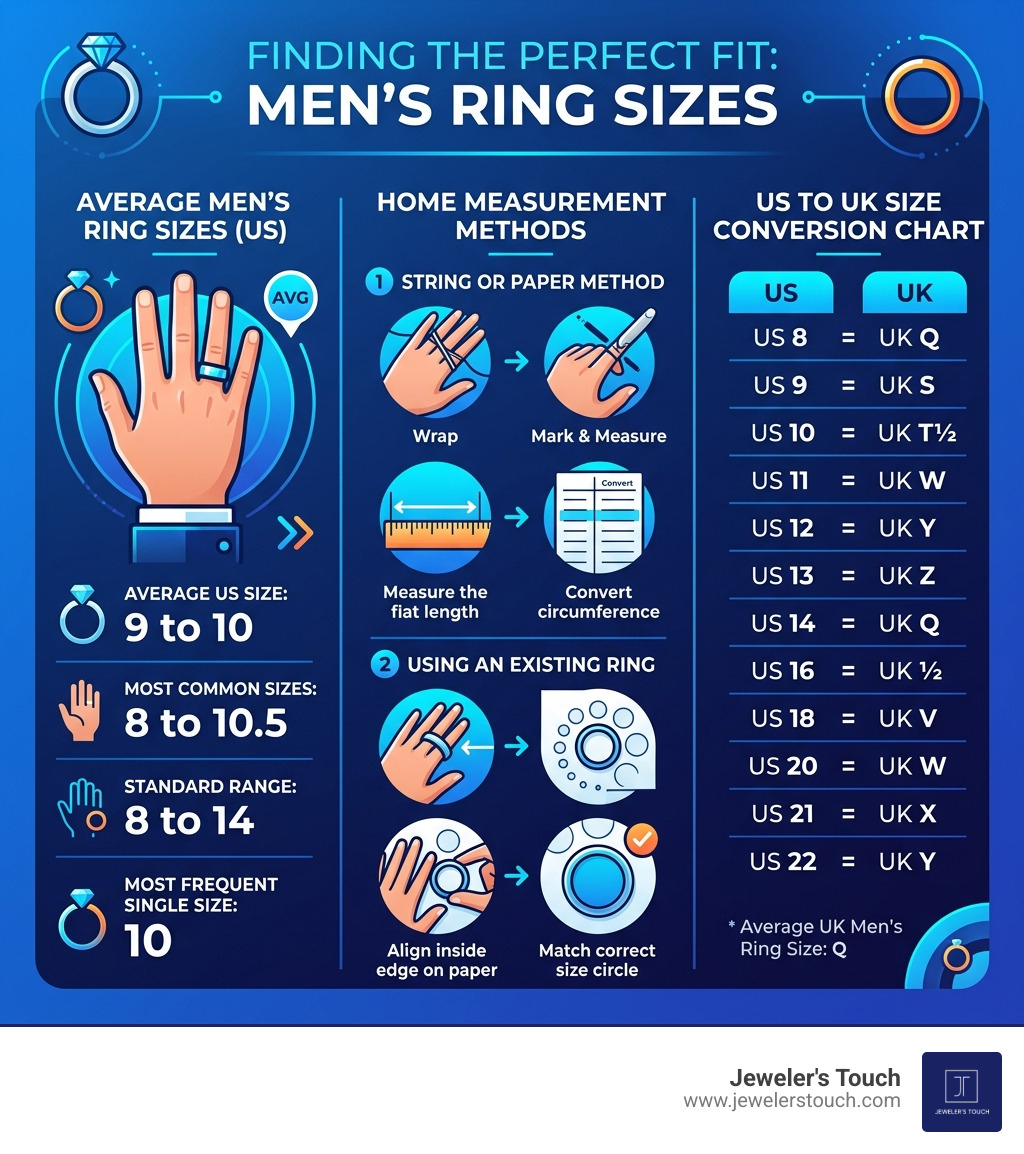
Mens ring sizes in the United States typically fall in this range:
| Detail | Value |
|---|---|
| Average US men's ring size | 9 to 10 |
| Most common sizes | 8 to 10.5 |
| Standard manufactured range | 8 to 14 |
| Most frequently worn single size | 10 |
| Average UK men's ring size | Q (57.6 mm circumference) |
Getting the right fit is not just about comfort. A ring that is too loose can slip off during daily activity. One that is too tight can cut off circulation or become impossible to remove. And if you choose a material like tungsten or titanium, resizing later is not an option.
Most men have never measured their ring size before shopping for a wedding band. That is completely normal — but it means there is a lot to learn before making one of the most meaningful purchases of your life.
This guide walks you through everything: average sizes, how to measure at home, what affects your fit, and which rings can (and cannot) be resized.
I'm Ken Rutz of Jeweler's Touch, a premier jewelry store where I've helped countless couples navigate mens ring sizes — from first-time buyers to those upgrading a decades-old band. With years of hands-on experience in custom ring design and expert jewelry craftsmanship, I'll make sure you walk away confident in your choice.
Understanding Average Mens Ring Sizes and Standards
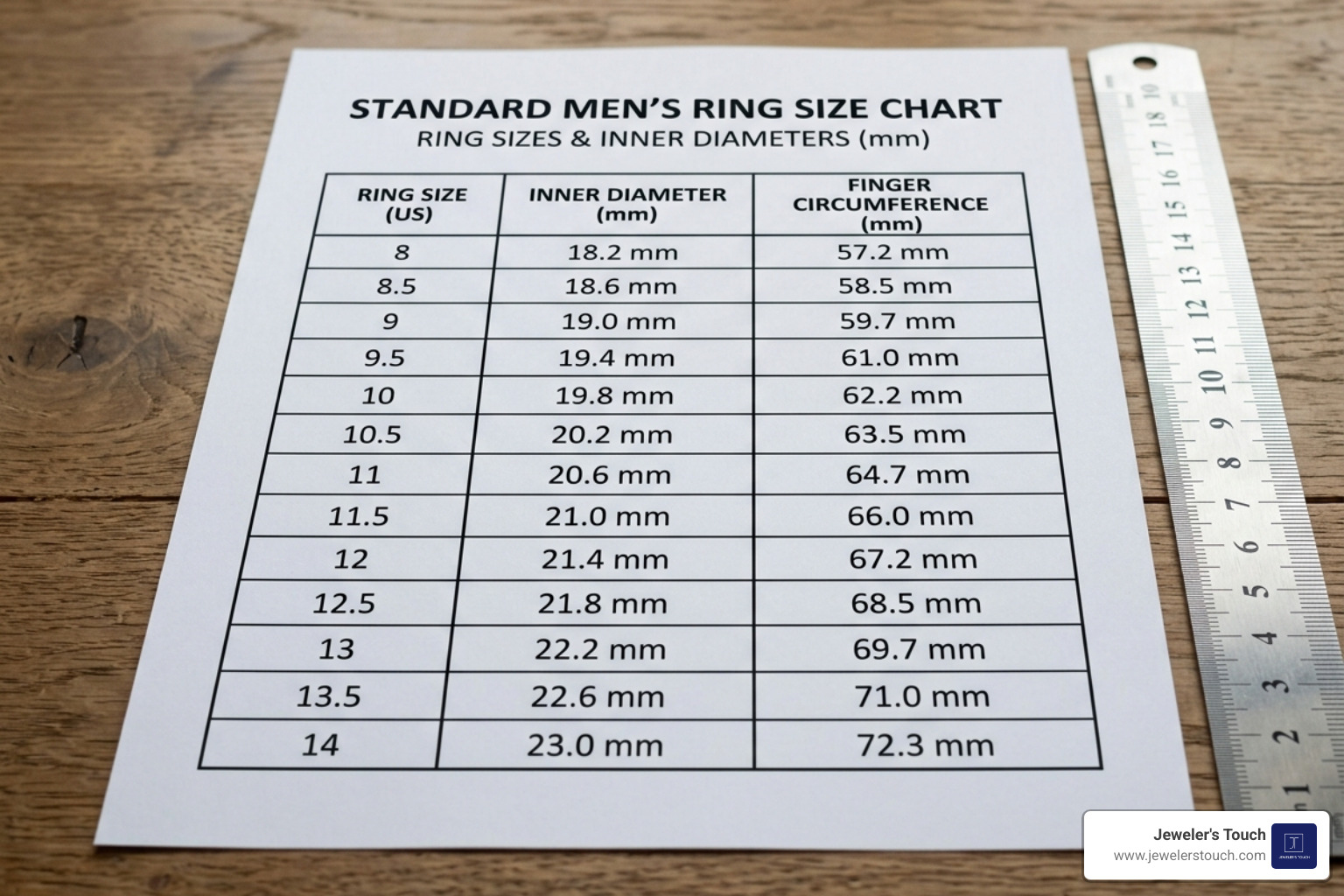
When we look at the data for May 2026, the landscape of mens ring sizes remains consistent with long-term jewelry trends. In our Orange County studio, we find that the vast majority of men fall into a predictable range. While the "average" is often cited as a size 9 or 10, the standard manufacturing range typically spans from size 8 to 14.
It is important to understand that a size 10 in the US is not just a random number; it represents a specific internal diameter. For those curious about the technical specs, you can explore The Perfect Fit: Everything You Need To Know About A Size 10 Ring In Inches to see how these measurements translate to the physical world.
While size 10 is the most frequently worn, we see plenty of variety. Taller men—specifically those over six feet—often require larger sizes, frequently landing between 10 and 12. On the other end of the spectrum, we also cater to those who need Plus Sized Wedding Bands, ensuring that every hand, regardless of size, can be adorned with a comfortable, stylish piece.
Differences Between Men's and Women's Ring Sizes
One of the most common misconceptions we hear at Jeweler's Touch is that ring sizes are "unisex." In reality, men's and women's rings differ significantly in both starting points and structural design.
- Starting Sizes: Women's ring charts often begin at size 3 or 4, whereas men's charts typically start at size 7 or 8.
- Band Width: This is a major differentiator. While a typical woman's band might be 2mm to 4mm wide, Popular Men's Wedding Rings usually range from 6mm to 8mm, or even 10mm.
- Physiological Shape: Men tend to have more pronounced knuckles relative to the base of their finger. This "knotty" finger shape requires a different approach to sizing than the more "tapered" fingers often seen in women.
International Conversion for Mens Ring Sizes
If you are shopping globally or looking at heritage designs from across the pond, you will encounter different systems. In Brea, CA, we primarily use the US numerical system, but we often help clients convert their sizes for international orders.
The UK uses an alphabetical system (where Q is the average), while much of Europe uses the actual inner circumference in millimeters. These international standards are often documented by the Gemological Institute of America (GIA) to help consumers navigate global markets. Japan and Switzerland have their own unique numerical scales that do not align with the US system.
| US/Canada (Numerical) | UK/Australia (Alphabetical) | European (Circumference mm) | Japan (Numerical) |
|---|---|---|---|
| 8 | P 1/2 | 57.0 | 16 |
| 9 | R 1/2 | 59.5 | 18 |
| 10 | T 1/2 | 62.1 | 20 |
| 11 | V 1/2 | 64.6 | 23 |
| 12 | X 1/2 | 67.2 | 25 |
| 13 | Z | 68.5 | 26 |
How to Measure Your Finger at Home
While visiting us in Orange County is the gold standard for accuracy, we know that sometimes you need a quick estimate from the comfort of your living room. You can use common household items to get a ballpark figure for mens ring sizes.
- The Paper Strip Method: Cut a thin strip of paper (about 1/2 inch wide). Wrap it around the base of the finger you intend to wear the ring on.
- Mark the Overlap: Use a pen to mark exactly where the paper meets.
- Measure in Millimeters: Lay the paper flat against a ruler. Accuracy is key here—even a single millimeter can shift you a full half-size.
- Check the Knuckle: Repeat this process for your knuckle. A ring must be able to slide over the joint with "friendly resistance."
If you find that your DIY measurements are giving you inconsistent results, don't worry. Just as there is a difference in Diy Vs Professional Watch Resizing For The Perfect Fit, professional ring sizing offers a level of precision that paper and string simply cannot match.
Secret Tactics for Finding Mens Ring Sizes
Planning a surprise? Getting a man's ring size in secret is a covert operation that requires some finesse. Here are our favorite "secret agent" tactics:
- The "Borrow" Maneuver: If he already wears a ring on his ring finger (or even a middle finger), "borrow" it for a few hours. Bring it to Jeweler's Touch and we can use a mandrel to get the exact size.
- The Sleeping Giant: If he's a heavy sleeper, you can try the paper strip method while he's out cold. It’s risky, but it makes for a great story later!
- Enlist an Accomplice: Ask his mother or a close friend if they happen to know his size or if they can casually bring up the topic.
- The "Try-On" Ruse: If you're out shopping together, stop by a jewelry counter "for yourself" and playfully encourage him to try on a few men's bands to see what styles he likes.
For more detailed strategies, check out our guide on How To Get Your Partner S Ring Size Without Ruining The Surprise.
Professional Sizing vs. DIY Methods
At our Brea Plaza location, we use specialized tools that eliminate the guesswork. A professional jeweler uses a set of metal sizing rings and a graduated mandrel. These tools account for the "heft" of the metal and the specific shape of the finger.
Unlike a piece of string, which can stretch, or paper, which can tear, metal sizers provide a real-world feel of how the ring will sit. We also take into account the "fleshiness" of the finger and how the ring interacts with the skin.
Factors That Influence Your Perfect Fit
Finding the right number on a chart is only half the battle. Several environmental and physiological factors can cause mens ring sizes to fluctuate throughout the day.
- Temperature: Fingers shrink in the cold and swell in the heat. If you measure your finger on a chilly morning in January, the ring might feel uncomfortably tight during an Orange County heatwave in July.
- Time of Day: Most people's fingers are at their largest in the evening. We recommend measuring at the end of the day for the most "realistic" fit.
- Diet: High salt intake or alcohol consumption can cause temporary water retention and swelling.
- Dominant Hand: For most men, the fingers on the dominant hand are about a half-size larger than the non-dominant hand due to increased muscle development.
Comfort Fit vs. Standard Fit
When browsing Plus Sized Wedding Bands or standard sizes, you'll encounter two main interior profiles:
- Standard Fit: The interior of the ring is flat. This is the traditional style.
- Comfort Fit: The interior is slightly domed or rounded. This reduces the surface area contact between the ring and the finger, making it easier to slide over the knuckle.
Pro Tip: Because Comfort Fit rings have a domed interior, they often feel a bit looser. We frequently recommend sizing down by about a half-size when choosing a Comfort Fit band compared to a Standard Fit.
Impact of Band Width on Sizing
The width of the band is a critical factor that many men overlook. A thin 4mm band has very little friction against the skin. However, once you cross the 6mm or 8mm threshold, the ring covers more "real estate" on your finger.
Wider bands trap more moisture and create more suction against the skin, which makes them feel tighter. If you are opting for a wide, bold style among Popular Men's Wedding Rings, you may need to go up a half-size to maintain comfort.
Material Limitations and Resizing Realities
Before you commit to a size, you must consider the metal. Not all rings are created equal when it comes to the "second chance" of resizing.
- Resizable Metals: Gold, Silver, and Platinum are the "kings" of resizing. Our expert goldsmiths can cut the band, add or remove metal, and solder it back together seamlessly.
- Non-Resizable Metals: Modern alternative metals like Tungsten, Titanium, Cobalt, and Ceramic cannot be resized. Because these metals are incredibly hard and have high melting points, they cannot be soldered. If you buy a Tungsten ring and your size changes, you will likely need to replace the entire ring.
- Organic Materials: Rings with wood inlays, antler, or bone are also generally impossible to resize without destroying the organic components.
Understanding How Does Ring Resizing Work Your Complete Guide is essential if you think your weight might fluctuate or if you are buying a ring as a long-term heirloom.
When to Seek Professional Resizing
If your ring has become uncomfortably tight or dangerously loose, it’s time to visit the experts. At Jeweler's Touch, we don't just "stretch" rings (which can thin the metal and weaken stone settings). We perform Professional Jewelry Repair and Resizing at Jeweler's Touch using precise measurements and high-heat soldering techniques that maintain the integrity of the piece.
Signs you need a resizing:
- The ring spins constantly to the palm side of your hand.
- You need soap or lubricant to get the ring off every single time.
- There is a visible "muffin top" effect where the skin bulges around the band.
Choosing the Best Metal for Longevity
Your lifestyle should dictate your metal choice as much as your style does. A man who works with his hands in construction or machinery might prefer the "shatter-proof" nature of a hard metal, while someone looking for an heirloom might prefer the flexibility of gold.
To dive deeper into this decision, read our expert take on How To Choose The Best Metal For A Mens Wedding Band. We'll help you balance durability with the practical reality of future size changes.
Frequently Asked Questions about Men's Rings
What should I do if my measurement falls between two sizes?
This is a very common scenario. As a general rule of thumb: size up. It is much easier (and often cheaper) for a jeweler to add a small sizing bead or insert to a ring that is slightly too large than it is to stretch a ring that is too small. Plus, your fingers are more likely to swell than shrink over the course of a long day.
Does the dominant hand have a different ring size?
Yes! As mentioned earlier, the dominant hand usually does more "heavy lifting," leading to slightly larger muscles and tendons. If you are right-handed, your right ring finger will likely be about a half-size larger than your left. Always measure the specific finger on the specific hand where the ring will live.
Can signet and pinky rings be sized the same as wedding bands?
Not necessarily. Pinky fingers are often more "tapered" than ring fingers, meaning there is less of a knuckle to "lock" the ring in place. Consequently, pinky rings often need to be sized a bit tighter to prevent them from sliding off. Signet rings, which are often top-heavy, also require a snug fit to keep the face of the ring from constantly spinning toward the side.
Conclusion
Finding the perfect fit in mens ring sizes is a blend of science, environment, and personal preference. Whether you are looking for a classic gold band or a modern alternative metal, the team at Jeweler's Touch is here to ensure your ring is as comfortable as it is meaningful.
As a family-owned jeweler in Orange County since 1992, we take pride in our on-site GIA gemologists and expert goldsmiths who handle every piece with care. From the initial measurement to custom design and future resizing, we are your partners in fine jewelry.
Ready to find your perfect fit? Browse our extensive collection of engagement rings and wedding bands, or visit us in Brea to get professionally sized today.
Jeweler's Touch Brea Plaza, Orange County, CA