

Complete Month-by-Month Birthstone Guide: History, Colors, and Symbolism
The tradition of assigning specific gemstones to each month weaves together thousands of years of human history, folklore, and mineralogy. According to historical scholars and the GIA birthstones educational archives, the modern calendar-based system evolved from ancient religious breastplates and astrological associations into the colorful spectrum of precious gems we cherish today.
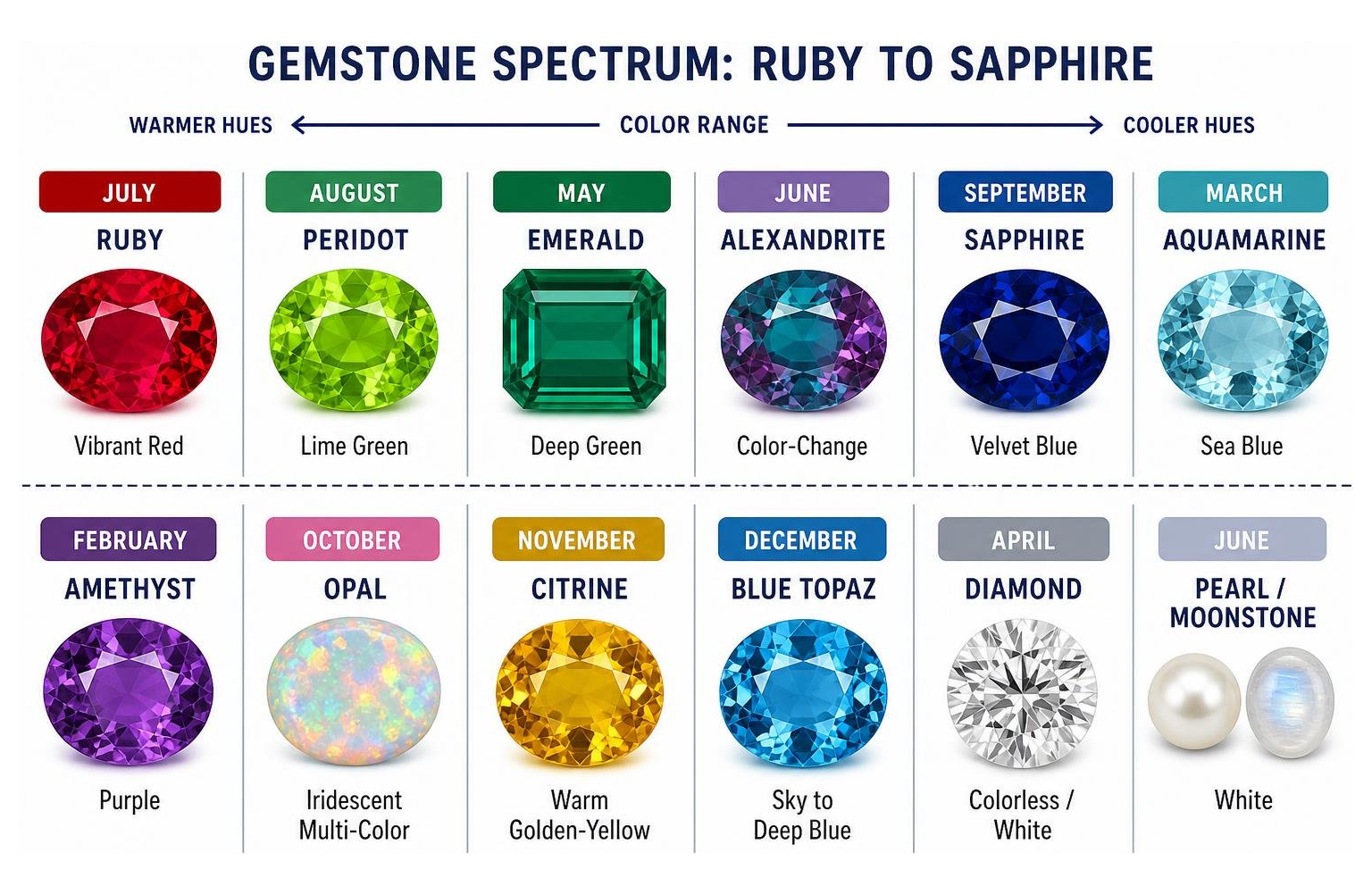
| Month | Primary Birthstone | Alternative Birthstones | Primary Color | Mohs Hardness | Core Symbolism |
|---|---|---|---|---|---|
| January | Garnet | Tsavorite, Rhodolite | Deep Red | 6.5 - 7.5 | Protection, Vitality, Loyalty |
| February | Amethyst | Jasper | Rich Purple | 7 | Clarity, Peace, Temperance |
| March | Aquamarine | Bloodstone | Sea-Blue | 7.5 - 8 | Serenity, Hope, Safe Travel |
| April | Diamond | White Sapphire | Colorless / White | 10 | Eternal Love, Strength, Invincibility |
| May | Emerald | Agate | Deep Green | 7.5 - 8 | Rebirth, Wisdom, Prosperity |
| June | Alexandrite | Pearl, Moonstone | Color-Change / White | 2.5 - 8.5 | Balance, Purity, Good Fortune |
| July | Ruby | Onyx | Vibrant Red | 9 | Passion, Courage, Royalty |
| August | Peridot | Spinel, Sardonyx | Lime Green | 6.5 - 8 | Light, Harmony, Resilience |
| September | Sapphire | Star Sapphire | Velvet Blue | 9 | Truth, Nobility, Faithfulness |
| October | Opal | Pink Tourmaline | Iridescent Multi-Color | 5.5 - 7.5 | Creativity, Hope, Magic |
| November | Citrine | Imperial Topaz | Warm Golden-Yellow | 7 - 8 | Joy, Abundance, Warmth |
| December | Blue Topaz | Tanzanite, Turquoise, Zircon | Sky to Deep Blue | 5 - 8 | Success, Protection, Tranquility |
January to April: Garnet, Amethyst, Aquamarine, and Diamond
January (Garnet): Garnet is beloved for its rich, pomegranate-red tones, though it naturally occurs in virtually every shade of the rainbow, including vivid green tsavorite and orange spessartite. In ancient times, warriors carried garnets into battle as talismans of protection, believing the stone could light up the night and ward off physical harm. It represents constancy, deep friendship, and grounded vitality.
February (Amethyst): This regal purple variety of quartz has adorned royal crowns and ecclesiastical jewelry for centuries. The word amethyst derives from the ancient Greek word amethystos, meaning "not drunken." Greek legends held that wearing the stone or drinking from amethyst-carved goblets prevented intoxication. Beyond ancient wine lore, amethyst symbolizes mental clarity, emotional balance, and peaceful introspection.
March (Aquamarine): Evoking the serene blues and greens of calm ocean waters, aquamarine is the gemstone variety of the beryl mineral family. Ancient mariners carried aquamarine amulets to ensure safe passage across stormy seas and to protect against shipwreck. Today, it remains a symbol of clear communication, youthfulness, and marital bliss.
April (Diamond): As the hardest naturally occurring substance on Earth, scoring a perfect 10 on the Mohs scale, the diamond stands as the ultimate emblem of eternal love, purity, and invincible strength. Formed deep within the Earth's mantle under intense heat and pressure over billions of years, diamonds offer unmatched brilliance, fire, and durability for daily wear.
May to August: Emerald, Alexandrite, Ruby, and Peridot
May (Emerald): Renowned for its lush, vivid green color, emerald is the classic gem of springtime, renewal, and royalty. Cleopatra famously adored emeralds, claiming royal mines across Egypt and adorning herself and her palaces with the vibrant stone. Emeralds represent wisdom, growth, and good fortune, though their characteristic internal inclusions (known as the jardin) require mindful setting and care.
June (Alexandrite, Pearl, Moonstone): June enjoys three distinct birthstone options. Alexandrite is a rare, color-changing chrysoberyl discovered in the Ural Mountains of Russia, famously described as "emerald by day, ruby by night." Pearls are organic treasures created inside living mollusks, celebrated for classic purity and elegance, while moonstone offers a mystical, billowy glow known as adularescence. For a deeper look at these diverse options, explore our june birthstones complete guide.
July (Ruby): Known in ancient Sanskrit as Ratnaraj or the "King of Gems," ruby is the fiery red variety of corundum. Historically worn by nobility as a mark of power and invulnerability, fine unheated rubies are among the rarest and most valuable gems in the world, with record auctions exceeding $1,000,000 per carat. Rubies represent fierce passion, courage, and enduring devotion.
August (Peridot, Spinel, Sardonyx): The primary august birthstone is peridot, a vibrant lime-green gem formed deep underground and occasionally carried to Earth inside pallasite meteorites from outer space. August also celebrates vibrant spinel, which was officially added to the modern list in 2016, and sardonyx, an ancient banded chalcedony historically carved into protective Roman signet rings.
September to December: Sapphire, Opal, Citrine, and Tanzanite
September (Sapphire): Blue sapphire has stood as the classic jewel of nobility, truth, and celestial wisdom for millennia. While cornflower and royal blue are the most famous hues, sapphire occurs in fancy colors like pink, peach, yellow, and green. Its exceptional hardness makes it an ideal center stone for treasured heirlooms.
October (Opal and Tourmaline): The mesmerizing opal birthstone displays a distinctive optical phenomenon called play-of-color, where microscopic silica spheres refract light into shifting flashes of neon fire. When selecting an october birthstone color, you can also choose tourmaline, a versatile mineral that comes in vibrant shades ranging from bubblegum pink to rich forest green.
November (Citrine and Topaz): November radiates with golden warmth. Citrine, the bright yellow-to-orange quartz variety, symbolizes joy, positive energy, and financial prosperity. Imperial topaz offers an exquisite alternative with shades of peachy-gold, apricot, and rich amber. In fact, the largest faceted gemstone ever discovered is the legendary 'El Dorado Topaz,' which weighs an astonishing 31,000 carats.
December (Blue Topaz, Tanzanite, Turquoise, Zircon): December boasts the most diverse collection of cool blue gemstones. Tanzanite is a striking violet-blue gem found in only one place in the world: a small mining area near Mount Kilimanjaro in northern Tanzania. Turquoise has been treasured for millennia by ancient Egyptian, Persian, and Native American artisans as an amulet of protection, while blue zircon delivers fiery diamond-like scintillation.
Modern vs. Traditional Birthstones and Zodiac Gemstone Connections
When shopping for birthstone jewelry, you will often encounter two distinct charts: modern and traditional. The traditional list developed between the 16th and 18th centuries in Central Europe, heavily emphasizing opaque cabochons and culturally accessible ornamental stones such as bloodstone, sardonyx, and turquoise.
In 1912, the American National Retail Jewelers Association (now Jewelers of America) standardized the official modern birthstone list. This modern system prioritized transparent, faceted gemstones that jewelers could easily source and set into contemporary engagement rings, pendants, and earrings.
Navigating Your Birthstone Guide by Zodiac Sign and Astrological Rulers
While calendar birthstones correspond directly to the twelve calendar months, zodiac gemstones align with the astrological positions of the sun, spanning across two consecutive months. Ancient astrologers linked specific minerals to planetary rulers and natural elements:
- Fire Signs (Aries, Leo, Sagittarius): Energizing gems like diamond, peridot, ruby, and citrine that complement high-energy planetary rulers like Mars and the Sun.
- Earth Signs (Taurus, Virgo, Capricorn): Grounding stones such as emerald, sapphire, and garnet that reflect stability and enduring structure.
- Air Signs (Gemini, Libra, Aquarius): Expressive minerals like agate, opal, and amethyst that support mental clarity. If you are exploring autumn air signs, read our october birthstone zodiac guide finding your cosmic gemstone match to discover how your astrological chart interacts with your birth month stone.
- Water Signs (Cancer, Scorpio, Pisces): Intuitive, light-refracting gems like pearl, aquamarine, and blue topaz that evoke ocean tides and emotional depth.
Why Certain Months Feature Multiple Gemstone Options
Months such as June, August, October, November, and December offer multiple recognized birthstones for several practical reasons:
- Budget Flexibility: A month like June offers precious alexandrite for collectors alongside cultured pearls and moonstones for accessible everyday styling.
- Color Preference: October allows you to pick between the rainbow iridescent fire of opal and the defined hues of pink or green tourmaline.
- Modern Additions: Gemological discoveries in the 20th and 21st centuries led industry leaders to add stones like tanzanite (added in 2002) and spinel (added in 2016) to provide vibrant, durable alternatives.
Gemstone Durability, Precious Metals, and Styling for Everyday Wear
Selecting the right birthstone jewelry requires balancing aesthetic charm with daily durability. Whether designing customized mothers rings featuring each child's birthstone, crafting bridal pieces like august birthstone engagement rings, or building a stackable ring collection, how you wear your stone determines how long it stays radiant.

A Practical Birthstone Guide to Durability and Mohs Ratings
The Mohs hardness scale measures a mineral's resistance to scratching, ranking from 1 (talc) to 10 (diamond). For rings worn every day, gemstones with a Mohs rating of 7 or higher offer the best defense against everyday contact with hard surfaces.
For softer or porous gems like pearls, turquoise, or opals, choosing a protective setting makes all the difference. A full bezel setting wraps a protective metal rim around the perimeter of the stone, shielding delicate edges from accidental bumps. Alternatively, wearing softer gems as an october birthstone necklace or a pair of earrings keeps them elevated away from the heavy contact that rings routinely face.
Matching Precious Metals to Birthstone Colors
The metal alloy you choose provides the backdrop for your gemstone's color:
- Yellow Gold (14K or 18K): The rich warmth of yellow gold beautifully enhances warm-toned gems like ruby, garnet, citrine, and peridot. It also creates a classic, regal contrast against rich green emeralds.
- White Gold and Platinum: Cool white metals provide an icy, crisp canvas that amplifies the vivid saturation of blue sapphire, aquamarine, blue topaz, and color-change alexandrite. Platinum offers natural hypoallergenic durability for lifetime wear.
- Rose Gold: The blush undertones of rose gold pair effortlessly with pink tourmaline, morganite, smoky garnets, and warm amethyst, delivering a romantic, vintage-inspired finish.
How to Care for, Clean, and Choose Birthstone Jewelry
Proper cleaning preserves the brilliance and longevity of fine colored gemstones. Because each gem possesses unique chemical properties and internal crystal structures, a single cleaning method does not suit all jewelry.
To maintain your fine jewelry safely at home:
- The Universal Cleaning Method: Soak hard gemstones (diamond, ruby, sapphire, amethyst, garnet) in a bowl of warm water mixed with a few drops of mild dish soap. Use a soft-bristled baby toothbrush to gently clean behind the setting where lotions and oils accumulate, then pat dry with a lint-free microfiber cloth.
- Avoid Ultrasonic Cleaners for Delicate Gems: Never place fracture-filled emeralds, opals, pearls, or tanzanite into ultrasonic or steam cleaners. The high-frequency sonic vibrations and rapid temperature changes can cause internal fractures or strip natural oils.
- Special Care for Porous Gems: If you own delicate cabochons, check out everything you need to know about opal birthstone jewelry in orange county for specialized hydration and care guidelines. For organic pearls, follow the golden rule of jewelry: make them the last thing you put on in the morning and the first thing you take off at night to protect them from perfumes and hairsprays.
- Proper Storage: Store gemstone jewelry in individual soft fabric pouches or lined jewelry box compartments so that harder stones (like diamonds) do not scratch softer gems.
Frequently Asked Questions About Birthstones
Can you wear a birthstone that is not from your birth month?
Yes. There are no rigid rules when it comes to wearing gemstones. Many people select stones that represent the birth months of their children, partners, or parents in multi-stone family jewelry. Others choose gems simply because they love a particular color, resonate with historic symbolism, or want to honor an important personal anniversary.
What is the rarest and most expensive birthstone?
Natural, fine-quality alexandrite is widely considered the rarest modern birthstone. Its remarkable optical ability to shift from emerald green in daylight to raspberry red under incandescent light makes top-tier, untreated specimens exceptionally scarce. Among colored stones, top-grade Burmese rubies and untreated Kashmir sapphires command the highest per-carat auction prices, often surpassing fine colorless diamonds.
Which birthstones are best suited for everyday rings?
Diamond (Mohs 10), ruby (Mohs 9), and sapphire (Mohs 9) are the most durable gemstones for daily ring wear. Spinel (Mohs 8) and topaz (Mohs 8) are also resilient choices. Softer stones like peridot, opal, and pearl are best set in low-profile protective bezel mountings or worn as pendants and earrings.
Conclusion
Birthstone jewelry remains one of the most personal and enduring ways to commemorate life's milestones, celebrate your family, and express your signature style. From the ancient lore of protective breastplate amulets to the sparkling precision of modern faceted designs, each month's gemstone carries a unique heritage that adds emotional depth to any collection.
Whether you are designing a custom family ring or searching for an everyday heirloom piece, taking the time to match gemstone durability, metal colors, and setting styles ensures your jewelry will last for generations. If you want to learn more about late-summer gems, explore our comprehensive August birthstone guide to peridot, sardonyx, and spinel.