

What Is the October Birthstone Zodiac Connection?
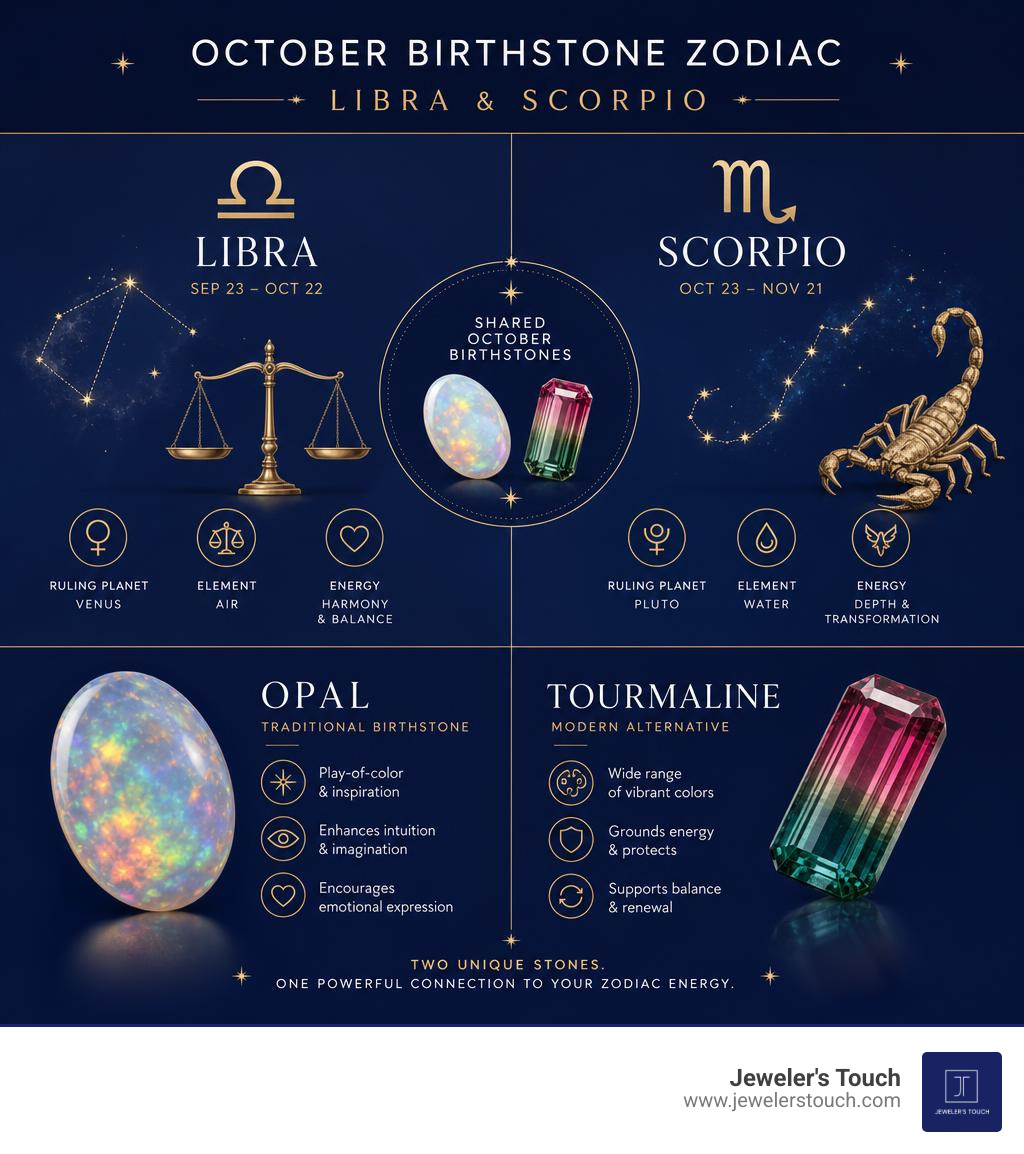
If you're curious about the october birthstone zodiac match, here's the quick answer:
| Zodiac Sign | Dates | Birthstones |
|---|---|---|
| Libra | September 23 – October 22 | Opal, Tourmaline |
| Scorpio | October 23 – November 21 | Opal, Tourmaline |
Both October birthstones, opal and tourmaline, are shared by Libra and Scorpio, but each stone connects differently to each sign's personality and energy.
October is one of the most interesting months in the gemstone world. Most months get one birthstone. October gets two, and they couldn't be more different from each other.
Opal is the traditional stone, famous for its rainbow "play-of-color" that shifts as you move it in the light. Ancient Romans described it as holding "the fire of ruby and the brilliance of diamond" all in a single gem. Tourmaline is the modern alternative, prized for its extraordinary range of colors, from electric pink to deep blue-green.
Both stones carry deep meaning for the two zodiac signs that claim October: Libra and Scorpio. And whether you're shopping for yourself or someone you love, understanding that cosmic connection can help you choose a piece that truly resonates.
I'm Ken Rutz of Jeweler's Touch, and my years of experience working with fine gemstones, including helping couples find the perfect october birthstone zodiac jewelry, give me a front-row seat to how meaningful these stones can be. Let's walk through everything you need to know to find your ideal cosmic gemstone match.
The Cosmic Connection: Your October Birthstone Zodiac Guide
The october birthstone zodiac connection is special because October bridges two very different astrological personalities.
Libra is an air sign ruled by Venus, the planet traditionally associated with beauty, harmony, relationships, and refinement. Scorpio is a water sign traditionally associated with intensity, depth, mystery, transformation, and emotional power.
That makes October birthstone jewelry wonderfully personal. The same gem can feel soft and romantic on a Libra, or bold and mysterious on a Scorpio. Opal and tourmaline both offer enough variety to suit either sign.
For a broader gemstone-focused overview of these stones, you can also learn more about October birthstones and zodiac signs.
How Libra Relates to the October Birthstone Zodiac
Libra is the sign of balance, elegance, diplomacy, and connection. If Libra had a jewelry box, we imagine it would be organized by color, occasion, and emotional significance. Probably alphabetized too.
Opal is a natural match for Libra because it reflects harmony through color. Instead of showing one fixed shade, opal moves between flashes of blue, green, orange, red, violet, and gold. That shifting effect mirrors Libra's ability to see many sides of a situation.
For Libras, opal often symbolizes:
- Balance and emotional reflection
- Creativity and artistic expression
- Romance and beauty
- Hope, optimism, and inspiration
- The ability to bring many colors of life into harmony
Tourmaline also suits Libra beautifully, especially pink tourmaline. Pink tourmaline is often associated with compassion, affection, and emotional warmth, making it a thoughtful gemstone for relationship-centered Libras.
From a jewelry standpoint, Libras often gravitate toward pieces that feel graceful rather than overpowering. Opal pendants, pink tourmaline rings, delicate earrings, and custom designs with soft metal tones can all feel very Libra.
If you want a deeper look at the two official October stones, our October Birthstone Guide: Opal & Tourmaline is a helpful companion.
How Scorpio Aligns with the October Birthstone Zodiac
Scorpio brings a different kind of energy to October birthstones. Where Libra is graceful and balanced, Scorpio is deep, magnetic, and transformative.
Tourmaline is an especially strong match for Scorpio because it comes in dramatic, saturated colors. Rubellite, deep pink tourmaline, green chrome tourmaline, and rare blue-green Paraiba-type colors all carry intensity. Scorpio is not usually looking for "cute." Scorpio wants meaning, depth, and maybe a little mystery.
Tourmaline connects well with Scorpio themes such as:
- Transformation and renewal
- Emotional strength
- Passion and loyalty
- Protection and grounding
- Inner power and resilience
Opal also works beautifully for Scorpio, especially black opal and boulder opal. Black opal is known for vivid color flashes against a dark body tone, which gives it a moody, powerful look. That contrast of darkness and light feels very Scorpio.
For Scorpio jewelry, we often recommend stronger design choices: bezel-set opal rings, deep pink tourmaline accents, darker metals, statement pendants, or custom pieces with bold contrast.
To explore the colors associated with October gems, visit our guide to October Birthstone Color.
Gemstone Science, Sourcing, and Varieties

Opal and tourmaline may share October, but scientifically they are very different gemstones.
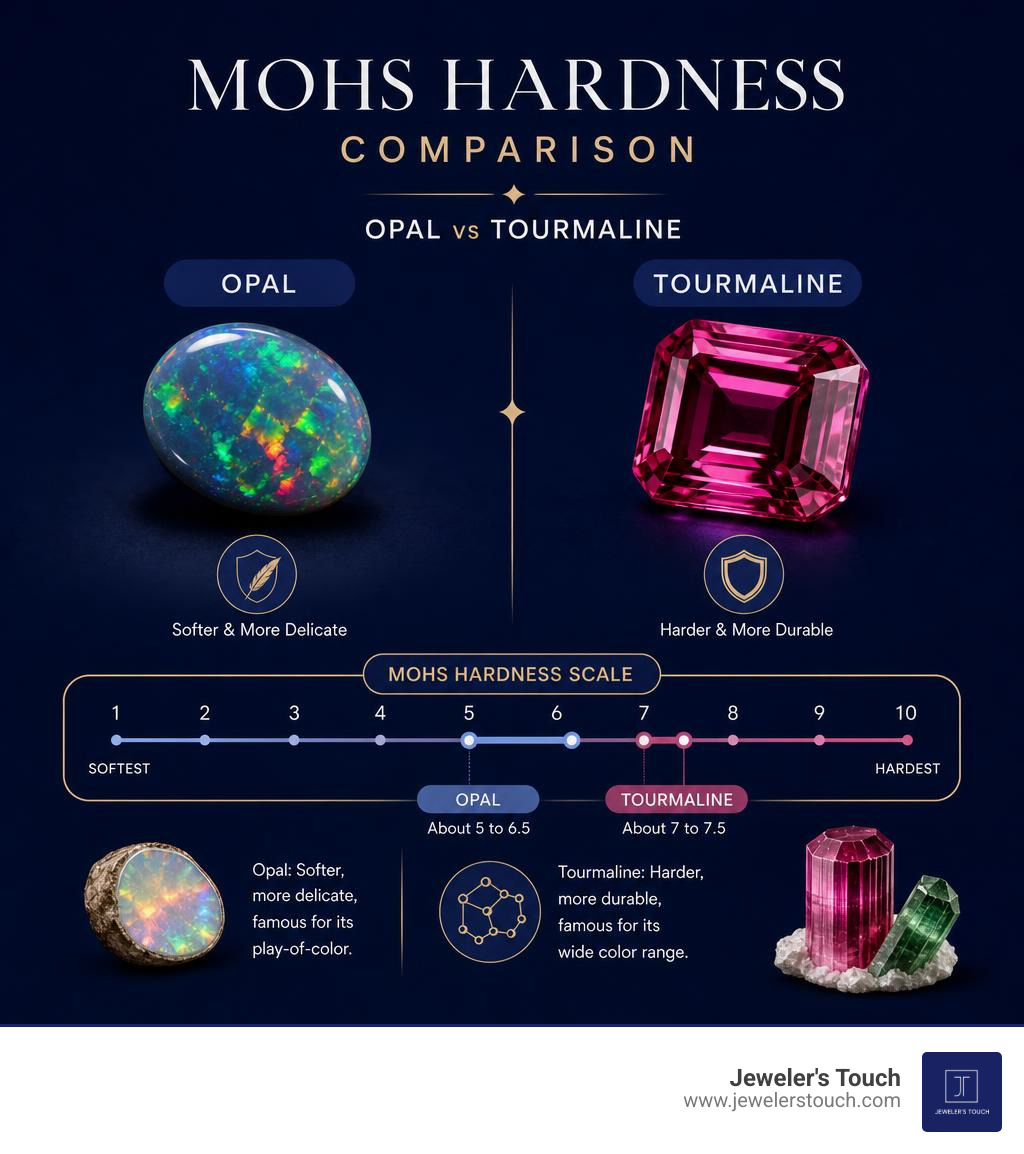
Opal is hydrated silica, while tourmaline is a complex borosilicate mineral group. In simpler language: opal is softer, more delicate, and famous for its light show; tourmaline is harder, more durable, and famous for its color range.
That matters when choosing jewelry. A gemstone's chemical makeup and hardness affect how it wears, how it should be cleaned, and whether it belongs in an everyday ring or a special-occasion pendant.
| Feature | Opal | Tourmaline |
|---|---|---|
| October status | Traditional October birthstone | Modern October birthstone |
| Chemical composition | Hydrated silica, SiO2-nH2O | Complex borosilicate mineral group |
| Mohs hardness | About 5 to 6.5 | About 7 to 7.5 |
| Best known for | Play-of-color | Wide color range |
| Durability | More delicate | Better for daily wear |
| Anniversary | 14th wedding anniversary | 8th wedding anniversary |
| Best jewelry uses | Earrings, pendants, protected rings | Rings, bracelets, earrings, pendants |
| Cleaning | Warm soapy water, gentle cloth | Warm soapy water, soft brush |
| Avoid | Heat, sudden temperature changes, ultrasonic cleaners, harsh chemicals | Ultrasonic and steam cleaners, harsh chemicals, extreme heat |
Opal: Science, Sourcing, and Varieties
Opal is made of hydrated silica, usually written as SiO2-nH2O. The "nH2O" part means opal contains water within its structure. Depending on the opal, that water content can vary, and it is one reason opal needs gentler care than many other gemstones.
Precious opal's famous play-of-color comes from microscopic silica spheres arranged in an orderly structure. As light passes through, it diffracts and separates into spectral colors. In plain English: tiny internal structures bend light into rainbow flashes. Nature really did decide to install a disco ball inside a gemstone.
Opal has a Mohs hardness of about 5 to 6.5. That makes it softer than quartz, sapphire, ruby, diamond, and tourmaline. It can absolutely be worn and loved, but it should be treated with care.
Major opal sources include:
- Australia, historically the most important source of precious opal
- Lightning Ridge in Australia, famous for prized black opal
- Ethiopia, known for vivid opals, including material from high-elevation deposits
- Mexico, especially known for fire opal
- Brazil and other locations that produce smaller amounts of opal
Origin can affect value, especially when a location is known for a desirable variety. For example, fine black opal from Lightning Ridge is highly prized because of its dark body color and vivid flashes. Mexican fire opal is valued for its glowing orange, yellow, and red body colors.
Common opal varieties include:
- White opal: Light body color with soft rainbow play-of-color. This is the classic October opal many people picture first.
- Black opal: Dark body tone with intense color flashes. Often considered the most valuable opal variety when quality is high.
- Boulder opal: Opal naturally attached to ironstone host rock. The matrix can add durability and dramatic patterning.
- Fire opal: Transparent to translucent opal in yellow, orange, or red. Some fire opals show play-of-color, but many are valued mainly for their body color.
- Crystal opal: Transparent to semi-transparent opal with visible play-of-color.
When shopping, look for bright, lively color flashes, attractive patterning, and overall stability. Opals with strong, evenly distributed play-of-color are generally more desirable than stones with dull or limited color.
You can read more in our Opal Birthstone guide, and if you love extraordinary specimens, explore The World's Finest Opals.
Tourmaline: Science, Sourcing, and Varieties
Tourmaline is not just one gemstone in one color. It is a complex mineral group with a wide range of chemical compositions. A common general formula includes sodium, calcium, magnesium, iron, lithium, aluminum, boron, silicon, oxygen, hydroxyl, and fluorine in varying amounts.
That complexity is exactly why tourmaline appears in so many colors.
Tourmaline has a Mohs hardness of about 7 to 7.5, making it noticeably more durable than opal. This is one reason tourmaline is often the better choice for everyday rings and bracelets.
Tourmaline also has two unusual scientific properties:
- Pyroelectricity: It can develop an electric charge when heated.
- Piezoelectricity: It can develop an electric charge under pressure.
Historically, this meant heated tourmaline could attract ash or dust. Today, it mostly gives us another reason to admire how strange and wonderful gemstones can be.
Major tourmaline sources include:
- Brazil, one of the most important and common sources
- Mozambique, known for vivid tourmalines, including copper-bearing stones
- Madagascar
- Afghanistan and Pakistan
- Kenya and other African sources
Origin can influence value, especially when a stone belongs to a rare color category. Paraiba-type tourmaline, originally famous for neon blue to green colors caused by copper, is among the most sought-after varieties. Fine copper-bearing tourmalines can command high prices because of their electric color.
Popular tourmaline varieties include:
- Pink tourmaline: A beloved October choice, ranging from soft blush to vivid pink.
- Rubellite: Deep pink to red tourmaline with rich saturation.
- Paraiba tourmaline: Neon blue, green, or blue-green tourmaline colored by copper. Rare and highly valued.
- Watermelon tourmaline: Pink center with green outer edges, resembling a slice of watermelon.
- Chrome tourmaline: Intense green tourmaline colored by chromium and/or vanadium.
- Indicolite: Blue tourmaline, ranging from lighter blue to deep teal-blue.
For technical details on both October stones, read about GIA's guide to October birthstones.
History, Symbolism, and Gifting Traditions

October birthstones are rich with symbolism. Opal has been tied to prophecy, hope, luck, invisibility, and lightning. Tourmaline has been linked with creativity, emotional healing, love, and insight.
Birthstone traditions themselves have a long and layered history. If you enjoy the origin stories behind gemstone customs, our article on The Secret History of Birthstones is a great next read.
Historical Meanings and Cultural Lore
Opal has one of the most dramatic reputations in the gemstone world.
Ancient Greeks associated opal with prophecy and protection. Some legends said opals came from the joyful tears of Zeus after victory over the Titans. Arabic lore connected opal with lightning, imagining the stone falling from the sky during thunderstorms. Ancient Romans admired opal for its many colors and considered it a gem of beauty and good fortune.
Then came the bad-luck rumors.
Much of opal's negative reputation in Europe is often connected to later literature and superstition, especially stories like Sir Walter Scott's 1829 novel Anne of Geierstein. Over time, the idea that opal was unlucky spread, even though earlier cultures often viewed it as highly fortunate.
Queen Victoria helped revive opal's reputation by wearing and gifting opals. If opals were good enough for a queen, that certainly helped.
Tourmaline's history is colorful in a different way. Because it occurs in so many colors, tourmaline was often mistaken for other gemstones. Green tourmaline was sometimes confused with emerald. Red tourmaline could be mistaken for ruby. In fact, some historic "rubies" in royal collections later turned out to be red tourmaline.
Pink tourmaline was famously loved in China during the Qing dynasty, especially by Empress Dowager Cixi, who admired the gem deeply. In the West, tourmaline became increasingly popular as gem identification improved and jewelers began appreciating it for what it truly was.
The word "opal" likely traces back to Sanskrit upala, meaning precious stone, later becoming opalus in Latin. "Tourmaline" comes from a Sinhalese word often translated as "mixed gems" or "stone with mixed colors," which is fitting for a gem family that seems to own the entire crayon box.
For more folklore and background, you can discover the history and folklore of October birthstones.
Milestone Anniversaries: 8th and 14th Years
October birthstones are also meaningful anniversary gifts.
Tourmaline is traditionally associated with the 8th wedding anniversary. Its symbolism of love, emotional healing, creativity, and strength makes it a thoughtful gift for couples who have built a life through change and growth.
Opal is traditionally associated with the 14th wedding anniversary. Its shifting colors can represent the many seasons of a long relationship: joy, challenge, growth, romance, and all the beautiful little flashes in between.
Gift ideas include:
- Pink tourmaline earrings for an 8th anniversary
- A custom tourmaline ring with diamond accents
- An opal pendant for a 14th anniversary
- A boulder opal bracelet for someone who loves organic designs
- A custom piece combining opal and tourmaline for an October birthday or anniversary
- A bezel-set opal ring for someone who wants extra protection around the stone
If you are exploring birthstones beyond October, our full Birthstone Guide can help you compare months, meanings, and gift ideas.
Frequently Asked Questions about October Birthstones
Choosing October birthstone jewelry is exciting, but it also comes with practical questions. Opal and tourmaline behave differently, so the right choice depends on lifestyle, setting, budget, and personal meaning.
Is opal or tourmaline better for everyday wear?
Tourmaline is generally better for everyday wear.
With a Mohs hardness of 7 to 7.5, tourmaline can handle daily jewelry use better than opal. It is a strong choice for rings, bracelets, earrings, and pendants, especially when set securely.
Opal, at about 5 to 6.5 on the Mohs scale, is more delicate. It can scratch or chip more easily, especially in rings that are worn every day. Opal is often better for:
- Earrings
- Pendants
- Occasional rings
- Bezel-set rings
- Jewelry worn with mindful care
For opal rings, we often recommend protective settings such as bezels or halos. A bezel wraps metal around the edge of the stone, helping shield it from bumps. Prong settings can be beautiful, but they leave more of the opal exposed.
For tourmaline rings, prong settings are usually more practical, though the design still matters. Any gemstone can be damaged by a hard hit, even a durable one.
Care tips:
- Clean opal with warm water, mild soap, and a soft cloth.
- Avoid ultrasonic cleaners, steam cleaners, harsh chemicals, heat, and sudden temperature changes with opal.
- Clean tourmaline with warm soapy water and a soft brush.
- Avoid ultrasonic and steam cleaners for tourmaline, especially if the stone has inclusions or treatments.
- Store both stones separately from harder gems like diamonds and sapphires.
What should I look for when buying opal jewelry?
When buying opal, focus on beauty, structure, and honesty in disclosure.
Important opal quality factors include:
- Play-of-color: Look for bright flashes that move across the stone.
- Color range: Red, orange, and full-spectrum flashes are often prized, but beauty is personal.
- Pattern: Some opals show pinfire, broad flash, harlequin-like patches, or rolling color.
- Body tone: Black opal has a dark background; white opal has a light background; crystal opal is more transparent.
- Brightness: A vivid opal is generally more valuable than a dull one.
- Stability: Avoid stones with visible cracks or crazing.
- Cut and setting: The stone should be well-polished and securely mounted.
Also ask whether the opal is solid, a doublet, or a triplet.
- Solid opal: A natural piece of opal cut from one piece of material.
- Doublet: A thin slice of opal attached to a backing, often dark material that enhances color.
- Triplet: A thin opal layer with a backing and a clear protective top, often quartz or glass.
Doublets and triplets can be attractive and more affordable, but they need special care. Avoid soaking them for long periods, because water can affect the adhesive layers over time.
Ask about treatments, too. Some opals may be smoked, dyed, sugar-acid treated, or otherwise enhanced to darken body color or improve appearance. Treatments are not automatically bad, but they should be disclosed so you know what you are buying and how to care for it.
Authenticity matters. At Jeweler's Touch, our on-site GIA gemologist can help evaluate gemstone jewelry and explain what you are seeing in plain language.
Why does October have two different birthstones?
October has two birthstones because birthstone lists have evolved over time.
Opal is the traditional October birthstone. It has been associated with October for generations and remains one of the most iconic birthstones of the year.
Tourmaline became the modern alternative. It offers more color options and better durability for everyday jewelry. It also gives October-born shoppers a choice if they love vibrant pinks, greens, blues, or multicolor stones.
That choice is part of what makes October so fun. If you love romance, mystery, and one-of-a-kind color flashes, opal may be your match. If you want durability, bold color, and everyday wearability, tourmaline may be the better fit.
From a zodiac perspective, both stones can work for Libra and Scorpio:
- Libra often connects with opal's harmony and pink tourmaline's loving energy.
- Scorpio often connects with tourmaline's intensity and black or boulder opal's depth.
- Anyone born in October can choose based on personal style rather than strict rules.
Astrology should feel meaningful, not restrictive. The best october birthstone zodiac jewelry is the piece you will actually wear, enjoy, and connect with.
Conclusion
October birthstones give us the best of both worlds: opal's magical play-of-color and tourmaline's incredible range and durability. Libra and Scorpio may share the same birthstones, but each sign brings out something different in them. Libra highlights beauty, harmony, and romance. Scorpio highlights depth, transformation, and power.
As of May 2026, we continue to see strong interest in personalized birthstone jewelry, custom zodiac-inspired designs, mixed-gem rings, meaningful anniversary gifts, and protective settings for softer gems like opal. People want jewelry that tells a story, not just something that looks pretty in a box.
At Jeweler's Touch, we are a family-owned jeweler in Orange County, proudly serving our community since 1992. With an on-site GIA gemologist and expert goldsmiths, we can help you choose, design, repair, appraise, or customize October birthstone jewelry with confidence.
Whether you are drawn to a Libra-inspired opal pendant, a Scorpio-worthy tourmaline ring, or a custom piece that blends both stones, we would love to help you find your cosmic gemstone match.
Visit us in Orange County or Brea, CA to start your October birthstone journey.
For more inspiration, explore our October Birthstone Guide: Opal & Tourmaline.