

What Are the June Birthstones?
June birthstones are three of the most distinctive gems in the world: pearl, alexandrite, and moonstone. June is one of only three months with three official birthstones (alongside August and December), giving June birthdays more gemstone options than almost any other month.
Quick Answer:
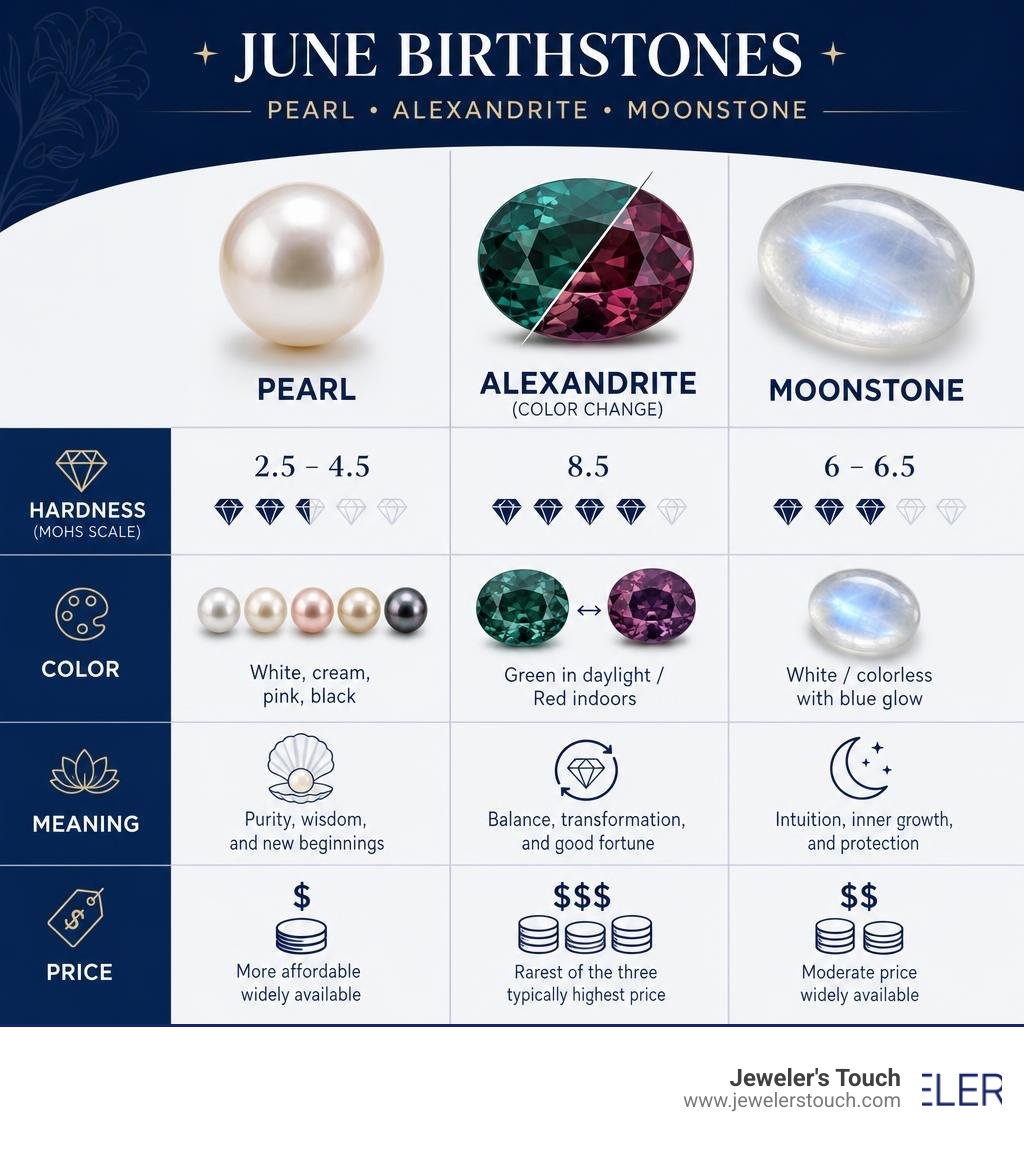
| Birthstone | Color | Mohs Hardness | Best Known For |
|---|---|---|---|
| Pearl | White, cream, pink, black | 2.5–4.5 | Purity, classic elegance |
| Alexandrite | Green in daylight / Red indoors | 8.5 | Dramatic color change |
| Moonstone | White/colorless with blue glow | 6–6.5 | Glowing adularescence |
Each stone is completely different in origin, appearance, and price. Pearl is the traditional choice, worn by royalty for thousands of years. Alexandrite is the rarest, famously called "emerald by day, ruby by night." Moonstone is the most mystical, prized for its inner billowing light.
Whether you're shopping for a June birthday gift, an engagement ring, or a personal keepsake, understanding all three options helps you make the right call.
I'm Ken Rutz from Jeweler's Touch, a fine jewelry specialist with years of experience helping customers find the perfect pieces, including June birthstone jewelry in every style and budget. In this guide, I'll walk you through everything you need to know about all three stones, from their history and meaning to care, pricing, and which one belongs on your finger.
The History and Evolution of June Birthstones
How did June end up with three distinct gemstones? The answer lies in the intersection of ancient folklore, jewelry industry standardization, and the natural scarcity of precious minerals.
For centuries, birthstone lists were highly localized and fluid, based on historical religious texts, regional availability, and cultural preferences. This changed in 1912 when the National Association of Jewelers met to standardize the birthstone calendar. During this meeting, the pearl was designated as the official, traditional birthstone for June.
However, as jewelry tastes evolved and certain gemstones became increasingly difficult to source, the list was updated. To learn more about how these lists were created, explore June Birthstone: Pearl & Alexandrite — Meaning, Color & History (2026 Guide) and our detailed June Birthstone Guide Alexandrite Pearl Moonstone.
Why June Has Three Official Gemstones
June is one of the very few months to boast three official birthstones because of how ancient astrological systems and modern commercial lists merged over time.
Initially, the pearl reigned supreme as the traditional June birthstone. However, because natural pearls are organic gems that require opening thousands of wild oysters to find a single matching strand, they were historically incredibly expensive, accessible only to royalty and the ultra-wealthy.
To provide more accessible, budget-friendly options for the general public, gemologists and jewelers introduced moonstone as an alternative traditional option. Later, in the 20th century, alexandrite was discovered and added to the modern birthstone list to provide a highly precious, durable, crystalline option for daily-wear jewelry.
The Secret History of June Birthstones
The story of how these stones earned their place on the June calendar is a fascinating journey through time. Traditional birthstone lists can be traced back to the breastplate of Aaron in biblical times, which featured twelve distinct gemstones. Over the centuries, these stones became associated with the twelve signs of the zodiac and, eventually, the twelve months of the calendar year. You can read more about this evolution in The Secret History of Birthstones.
The modern birthstone calendar we use today in 2026 was largely finalized in 1912, but it received a major update in 1952. The Jewelry Industry Council of America officially added alexandrite to the June lineup. This rare, color-changing chrysoberyl variety added a splash of modern magic to the traditional elegance of the pearl and the ethereal glow of the moonstone.
Pearl: The Organic Queen of June
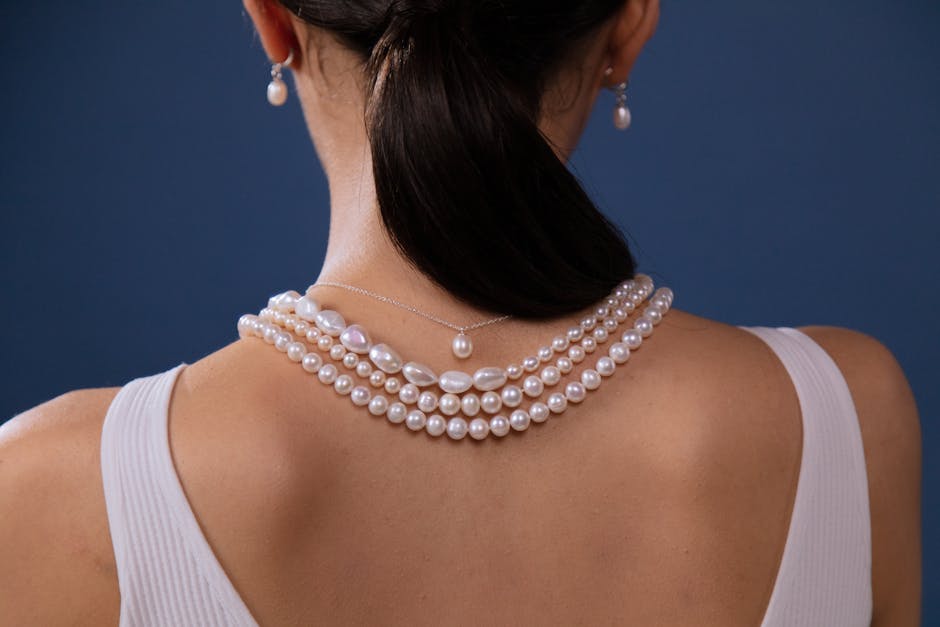
Unlike mineral gemstones like diamonds, emeralds, or sapphires that are mined from deep within the earth, the pearl is an organic gemstone. This means it is created by a living organism.
Pearls are formed when a tiny irritant, such as a parasite or a microscopic piece of debris, makes its way inside the shell of a mollusk (like an oyster or a mussel). To protect itself from the irritant, the mollusk begins secreting layers of calcium carbonate, also known as nacre. Over months or even years, these microscopic layers of nacre build up, reflecting light in a way that produces the pearl's signature soft, iridescent luster.
History, Symbolism, and Cultural Meanings of Pearls
For thousands of years, pearls have been prized as symbols of purity, innocence, humility, and wisdom gained through experience. In ancient Rome, pearls were the ultimate status symbol; Julius Caesar even passed a law restricting pearl ownership exclusively to the ruling class. In ancient Greece, people believed that pearls were the hardened tears of Aphrodite, the goddess of love.
Perhaps the most famous pearl in history is La Peregrina. Discovered in the Gulf of Panama in the 1500s, this massive 50.56-carat pear-shaped natural pearl was owned by Spanish royalty for generations. In 1969, actor Richard Burton purchased it as a gift for Elizabeth Taylor. In 2011, the historic pearl necklace sold at auction for a record-breaking $11.8 million.
Natural vs. Cultured Pearls: How They Form
If you walk into a jewelry store today, almost 99% of the pearls you see will be cultured pearls.
- Natural Pearls: These form in the wild without any human intervention. Because wild pearl beds have been severely depleted by overfishing and pollution, natural pearls are incredibly rare and expensive, mostly found today in antique jewelry or at high-end auctions.
- Cultured Pearls: In the 1890s, a visionary named Kokichi Mikimoto successfully developed a method for culturing pearls. By carefully inserting a tiny bead or tissue irritant inside the shell of a saltwater oyster or freshwater mussel, humans can prompt the mollusk to start producing nacre. Cultured pearls are real pearls; they simply start with a little help from human hands.
To tell if a pearl is real (whether natural or cultured) versus an imitation plastic or glass bead, you can perform the famous "grit test." Gently rub the pearl against the edge of your front teeth. A real pearl will feel slightly gritty or sandy due to the microscopic layers of natural nacre, while an imitation pearl will feel perfectly smooth.
Global Sources of Fine Pearls
While natural pearls were historically harvested from the Persian Gulf, the Red Sea, and the Strait of Mannar, modern cultured pearls are sourced from specialized aquatic environments around the world:
- Akoya Pearls: Primarily cultured in Japan and China, these saltwater pearls are famous for their perfectly round shapes and mirror-like luster.
- South Sea Pearls: Cultured in the warm waters of Australia, Indonesia, and the Philippines, these are the largest and rarest of all cultured pearls, prized for their luxurious golden and white hues.
- Tahitian Pearls: Grown in French Polynesia, these saltwater pearls are famous for their naturally dark, exotic colors, ranging from peacock green to deep charcoal black.
- Freshwater Pearls: Cultured in rivers and lakes across China, these pearls are highly durable, come in a wide variety of pastel colors, and offer an exceptional, budget-friendly option.

Alexandrite: The Color-Changing Phenomenon
If pearl is the queen of classic elegance, alexandrite is the king of optical illusions. Alexandrite is an incredibly rare variety of the mineral chrysoberyl. What makes it legendary is its dramatic, color-changing ability, often described by gemologists as the "alexandrite effect."
In natural daylight or fluorescent lighting, a fine alexandrite appears vibrant green or bluish-green. However, when you step indoors under incandescent light (like candlelight or warm yellow lightbulbs), the gemstone instantly shifts to a rich raspberry red or purplish-red.
This dramatic color change is caused by the presence of trace amounts of chromium within the crystal structure. The chromium absorbs light in a highly specific way, transmitting both green and red wavelengths. Whichever wavelength is more dominant in the ambient light source determines the color you see.
The Discovery and Royal History of Alexandrite
Alexandrite was first discovered in 1830 in the emerald mines of Russia's Ural Mountains. According to historical lore, the gemstone was discovered on the very day the future Tsar Alexander II came of age. Because the stone's dramatic red and green colors perfectly matched the imperial military colors of imperial Russia, it was named "alexandrite" in his honor.
Because of its royal connection and its mesmerizing light play, alexandrite became highly prized by the Russian aristocracy. However, the original Ural Mountain deposits were relatively small and are now nearly entirely depleted, making antique Russian alexandrite some of the rarest and most expensive collector's items in the world.
Natural vs. Lab-Grown Alexandrite
Because natural alexandrite is so exceptionally scarce, top-quality natural stones with a strong, distinct color change can command prices ranging from $10,000 to over $70,000 per carat.
Fortunately, modern science has made this magical stone accessible through lab-grown alexandrite.
- Lab-grown alexandrite is chemically, physically, and optically identical to natural alexandrite. It is grown in a controlled environment using methods like flame fusion or flux growth to replicate the natural crystallization process.
- The main difference is the price. While a natural one-carat alexandrite of fine quality might cost tens of thousands of dollars, a beautiful lab-grown alternative provides the exact same color-changing effect for a fraction of the cost.
Where Alexandrite is Sourced Globally
While the historic Russian mines are mostly empty, new deposits of natural alexandrite have been discovered in other parts of the world over the last few decades:
- Brazil: Discovered in the late 1980s, Brazilian deposits have produced some of the finest-quality alexandrite outside of Russia, showing a dramatic color change.
- Sri Lanka: Known for producing larger stones, though the color change often leans more toward yellowish-green to brownish-red.
- East Africa (Tanzania and Madagascar): These regions produce beautiful, jewelry-grade alexandrite with excellent clarity and strong color-shifting properties.
Moonstone: The Luminous Feldspar Gem
Moonstone is the most mystical of the three June birthstones. It is the most famous gemstone of the feldspar mineral group. What sets moonstone apart is its mesmerizing optical phenomenon known as adularescence.
When light hits a moonstone, it doesn't just reflect off the surface; instead, a soft, billowing blue or white light appears to glide across the gemstone, resembling moonlight glowing through a thin layer of clouds. This ethereal glow is caused by alternating, microscopic layers of two different feldspar minerals: orthoclase and albite. As light passes through these thin sheets, it scatters in all directions, creating the signature adularescent glow.
During the late 19th and early 20th centuries, moonstone became a darling of the Art Nouveau movement. Master designers like René Lalique and Louis Comfort Tiffany featured moonstone prominently in their custom, nature-inspired jewelry designs, cementing its place in modern fashion history.
The Mythology and Meaning of Moonstone
Moonstone has been steeped in folklore for thousands of years. In ancient Rome, people believed that moonstones were formed from solidified drops of actual moonbeams. In ancient India, the stone was considered sacred, associated with divine feminine energy, intuition, and emotional balance.
Known historically as the "Stone of New Beginnings," moonstone is believed to bring good fortune, harmony, and mental clarity to those who wear it. In European tradition, it was once believed that if two lovers placed a moonstone in their mouths during a full moon, they would be granted a glimpse into their shared future.
Sourcing Luminous Moonstones
The quality of a moonstone's adularescence depends heavily on where it was mined and how the layers of orthoclase and albite formed:
- Sri Lanka: Historically, the finest moonstones with a nearly transparent body and a vivid, electric blue sheen have come from Sri Lanka.
- Southern India: This region is famous for producing "rainbow moonstone," which displays a multi-colored, iridescent glow across the stone.
- Other Sources: Moonstone is also mined in Madagascar, Brazil, Myanmar, and parts of the United States.
Comparing the Physical Properties of June Birthstones
When choosing between the three June birthstones, it's important to look beyond their beauty and consider their physical properties. Each stone behaves differently when worn, styled, and cleaned.
To help you compare, check out the resources provided by the June Birthstones | Pearl, Alexandrite, Moonstone Birthstones | GIA and our guide on June's Two Rare Birthstones.
Here is a quick reference table comparing the physical properties of the three June gemstones:
| Property | Pearl | Alexandrite | Moonstone |
|---|---|---|---|
| Chemical Composition | Calcium carbonate (organic) | Beryllium aluminum oxide | Potassium sodium aluminum silicate |
| Mohs Hardness | 2.5 – 4.5 (Very soft) | 8.5 (Highly durable) | 6.0 – 6.5 (Moderate) |
| Toughness | Fair to poor (Vulnerable to scratching) | Excellent (Extremely tough) | Poor (Prone to cleavage cracks) |
| Optical Phenomenon | Luster/Iridescence | Color-change effect | Adularescence |
Choosing June Birthstones for Engagement Rings and Daily Wear
Because of the vast differences in Mohs hardness, some June birthstones are much better suited for daily-wear jewelry than others:
- Alexandrite is an absolute champion for daily wear. At an 8.5 on the Mohs hardness scale, it is nearly as scratch-resistant as a sapphire or ruby. It is an exceptional and highly unique choice for an engagement ring that you plan to wear every single day.
- Moonstone and Pearl require much more care. Pearl is extremely soft and can be easily scratched by common household dust or other jewelry. Moonstone has "perfect cleavage," meaning it can easily chip or crack if struck at the wrong angle.
- If you choose a pearl or moonstone for an everyday ring, we highly recommend a protective mounting, such as a bezel setting, which wraps a metal border completely around the stone to shield it from accidental bumps.
Price and Rarity of June Birthstones
The three June birthstones cover a wide spectrum of pricing and rarity, making it easy to find an option that fits your budget:
- Alexandrite is the most expensive and investment-grade option. Natural, high-quality alexandrite is incredibly scarce, making it a prized collector's gem. However, lab-grown alexandrite offers a beautiful, budget-friendly way to enjoy this color-changing miracle.
- Pearls offer incredible versatility in pricing. A strand of cultured freshwater pearls is highly accessible and makes a gorgeous gift for a graduate or bride, while a pristine strand of saltwater South Sea pearls represents a luxurious, high-end investment.
- Moonstone is generally the most budget-friendly of the three, allowing you to acquire a large, visually striking gemstone with a beautiful blue glow without breaking the bank.
Care and Cleaning Guide for June Jewelry
Proper jewelry maintenance is key to ensuring your birthstone jewelry lasts for generations. For more general tips on keeping your collection sparkling, take a look at our Birthstone Guide.
How to Clean and Store Delicate Pearls
Because pearls are organic, they are highly sensitive to chemicals, acids, and physical wear. To keep them looking lustrous, follow the golden rule of pearls: "Last on, first off."
- Always apply your hairspray, perfume, makeup, and lotions before putting on your pearl jewelry. The chemicals in these products can damage the delicate nacre.
- After wearing your pearls, wipe them gently with a soft, clean, damp cloth to remove body oils and perspiration.
- Never store your pearls in a plastic bag, as some plastics emit chemicals that can damage the surface. Instead, store them in a soft fabric pouch, separated from harder gemstones that could scratch them.
- Never use ultrasonic or steam cleaners on pearls.
Maintaining Alexandrite and Moonstone
While alexandrite is tough, moonstone requires a gentler touch:
- Alexandrite: You can safely clean untreated natural or lab-grown alexandrite using warm, soapy water and a soft-bristled brush. Ultrasonic and steam cleaners are generally safe for untreated alexandrite.
- Moonstone: Clean moonstone using only warm, soapy water and a soft brush. Never use ultrasonic or steam cleaners on moonstone, as the heat and vibrations can cause the stone to crack along its natural cleavage lines.
Frequently Asked Questions About June Birthstones
Which June birthstone is the most expensive?
Natural alexandrite with a strong color change is by far the most expensive of the three June birthstones. Fine-quality natural stones can cost upwards of $15,000 to $70,000 per carat, making them rarer and more expensive per carat than many diamonds.
What zodiac signs are associated with June birthstones?
June birthstones are associated with Gemini (May 21 – June 20) and Cancer (June 21 – July 22). Alexandrite, with its dual color-changing nature, is a perfect match for the adaptable, multi-faceted personality of Gemini. Pearl and moonstone, with their aquatic origins and connection to the moon, align beautifully with the intuitive, nurturing, water-sign energy of Cancer.
Can I wear moonstone or pearl in an engagement ring?
Yes, but you must take extra precautions. Because pearls are very soft (2.5–4.5 Mohs) and moonstones are prone to chipping (6–6.5 Mohs), they are not ideal for daily, heavy-duty wear. If you choose them for an engagement ring, opt for a protective bezel setting, remove the ring before doing dishes or physical work, and clean it gently.
Conclusion
June birthdays are truly spoiled for choice. Whether you fall in love with the timeless, organic elegance of the pearl, the modern, color-shifting magic of alexandrite, or the ethereal, moonlit glow of moonstone, there is a perfect June birthstone out there for you.
At Jeweler's Touch, we have been helping families in Orange County, CA, find and create their dream jewelry since 1992. Located in Brea, our team features on-site GIA gemologists and expert goldsmiths who specialize in everything from custom jewelry design and engagement rings to professional appraisals and repairs.
If you are looking to explore June birthstone jewelry or want to design a custom piece featuring one of these incredible gems, we would love to help. Stop by our showroom to speak with our team today.
Interested in exploring other unique gemstones? Check out our October Birthstone Guide Opal Tourmaline to learn more about another month with multiple incredible options!