

What Is the October Birthstone Color?
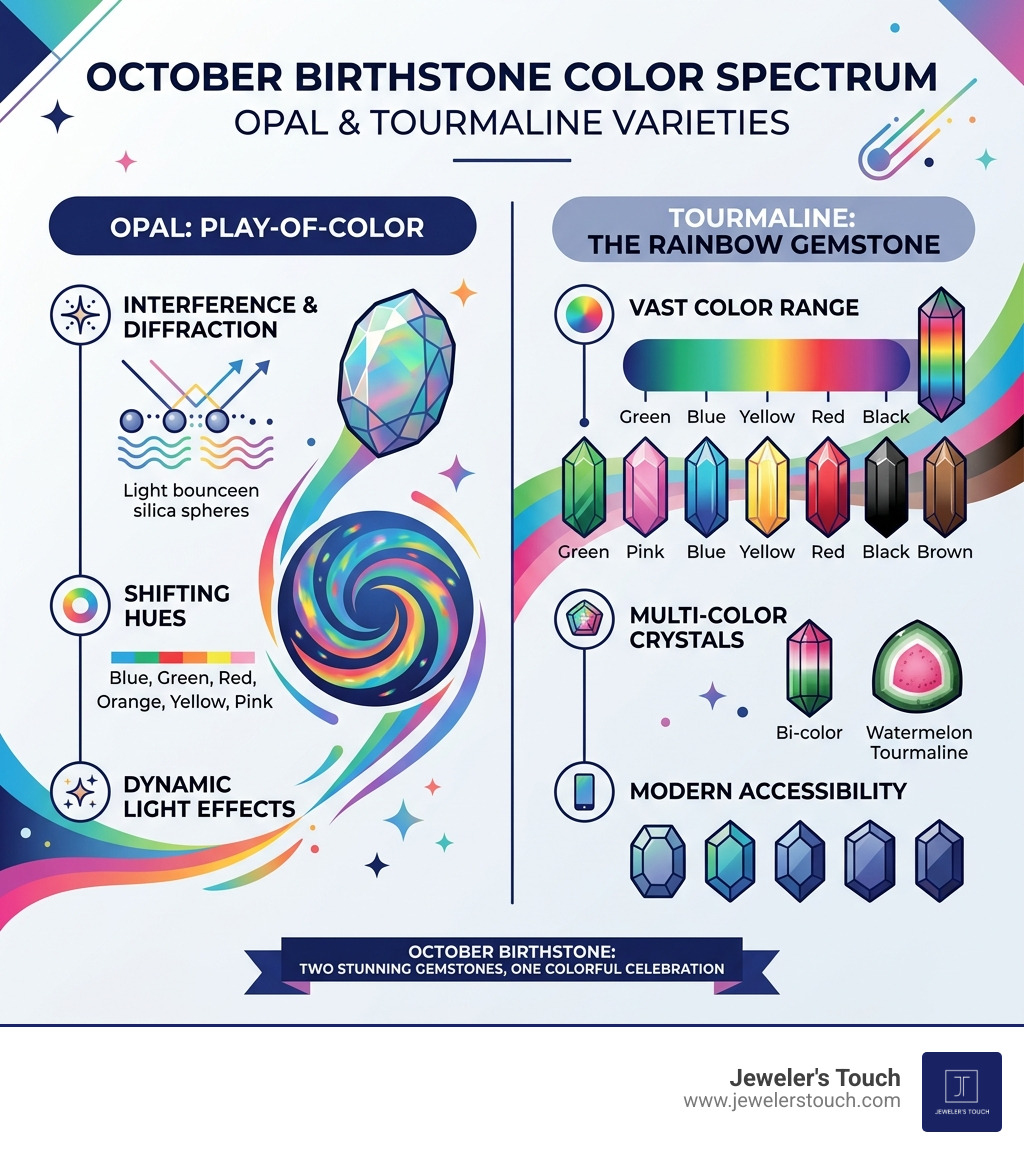
The october birthstone color is not just one shade — October actually has two official birthstones, each with its own stunning color story.
Here's a quick breakdown:
| Birthstone | Primary Color(s) | Color Theme |
|---|---|---|
| Opal | Multi-color (rainbow play-of-color) | Shifting hues of blue, green, red, orange, and pink |
| Tourmaline | Every color imaginable | Most popular in pink and green; also blue, red, and bi-color |
- Opal is famous for its "play-of-color" — a shifting, rainbow-like shimmer that moves as the stone catches light.
- Tourmaline is called the "rainbow gemstone" because it occurs in nearly every color found in nature.
- The traditional October birthstone color theme is best described as multi-color, making October one of the most colorful months on the birthstone calendar.
In ancient times, opal was called the "Queen of Gems" because it seemed to contain the colors of every other gemstone in a single stone. That reputation has held up well.
I'm Ken Rutz, and through my work at Jeweler's Touch — where we specialize in fine jewelry and custom design — I've helped countless clients navigate the vibrant world of october birthstone color to find pieces that feel truly personal. Whether you're drawn to the shifting fire of an opal or the bold spectrum of a tourmaline, there's a lot to explore here.
The Kaleidoscopic World of October Birthstone Color
When we talk about the october birthstone color, we are really talking about a celebration of the entire visible spectrum. Unlike months that claim a single hue—like the deep red of January’s garnet or the cool blue of March’s aquamarine—October offers a "choose your own adventure" experience.

This multi-color theme is driven by two distinct scientific phenomena. In opals, the color isn't caused by a pigment but by the diffraction of light. In tourmaline, the colors come from a complex cocktail of trace elements like iron, magnesium, and manganese. Because of this, tourmaline is often referred to as the "rainbow gemstone." It was even mistaken for other gems for centuries; Spanish conquistadors in the 1500s found green tourmaline in Brazil and were convinced they had discovered a massive emerald deposit!
To help you distinguish between these two powerhouses, we've put together a comparison of their color characteristics:
| Feature | Precious Opal | Tourmaline |
|---|---|---|
| Color Cause | Light diffraction through silica spheres | Trace chemical elements (iron, copper, etc.) |
| Visual Effect | Shifting "Play-of-Color" | Solid, saturated hues or color-zoning |
| Rarity | Black opal is the rarest variety | Paraíba (neon blue) is the rarest variety |
| Variety | White, Black, Fire, Boulder, Crystal | Rubellite, Indicolite, Paraíba, Watermelon |
For those looking for a deep dive into the history and meaning of these gems, you can explore the October Birthstone: Opal & Tourmaline — Meaning, Color & History (2026 Guide) for a comprehensive look at how these stones became the icons they are today.
The Shifting Hues of Precious Opal and October Birthstone Color
The magic of opal lies in its internal structure. Imagine billions of microscopic silica spheres stacked together like oranges in a crate. As light passes through the gaps between these spheres, it splits into the colors of the rainbow. This is what gemologists call "play-of-color."
Not all opals are created equal. In fact, only about 5% of all opals found are considered "precious opals" that display this iridescent dance. The rest are "common opals," which are beautiful but lack the rainbow flash.
Within precious opal, the background or "body" color determines the stone's type:
- Black Opal: These have a dark body tone (black, dark gray, or deep blue), which makes the play-of-color pop with incredible intensity. They are the rarest and most valuable.
- White Opal: These have a light or milky body color. They are the most common type of precious opal and offer a softer, more ethereal look.
- Fire Opal: Found primarily in Mexico, these are prized for their bright yellow, orange, or red body colors. Unlike other opals, they don't always have play-of-color; their value is often in their vivid, fiery hue.
One fascinating fact we often share at Jeweler's Touch is that opals are "living" gems in a sense—they can contain up to 20% water trapped within their structure. This high water content is why they are so sensitive to climate and heat. To learn more about the specific properties of these stones, check out October Birthstone - Opal & Tourmaline | History, Meaning & Properties | My Birthstone.
The Rainbow Spectrum of Tourmaline as an October Birthstone Color
If opal is the "Queen of Gems," tourmaline is the "Chameleon of Gems." It has one of the widest color ranges of any mineral species. Historically, this caused a lot of confusion. For example, the "Caesar’s Ruby" in the Russian crown jewels was actually a rubellite tourmaline!
Some of the most sought-after tourmaline color variants include:
- Rubellite: These are deep pink to red stones that maintain their color under different lighting.
- Paraíba: Discovered in the 1980s, these are the "neon" stars of the gem world. Colored by copper, they glow with an electric blue or green light and can command prices over $30,000 per carat.
- Watermelon Tourmaline: This is nature’s most fun trick. These crystals grow with a pink center and a green outer rim, separated by a white band. When sliced, they look exactly like a piece of fruit!
- Indicolite and Chrome: These represent the deep blues and vivid greens (colored by chromium) that rival sapphires and emeralds.
Beyond its beauty, tourmaline has unique physical properties. It is both piezoelectric and pyroelectric, meaning it can become electrically charged when heated or squeezed. In the 1700s, Dutch traders used heated tourmaline to pull ash out of their tobacco pipes, calling the stone "aschentrekker" or "ash puller." For more technical details on these varieties, the October Birthstones | Opal & Tourmaline Birthstone Information - GIA is an excellent resource.
Symbolism and Rarity: What Your October Birthstone Color Means
The colors of October aren't just pretty to look at; they carry centuries of meaning and lore. Throughout history, the october birthstone color has been associated with hope, creativity, and protection.
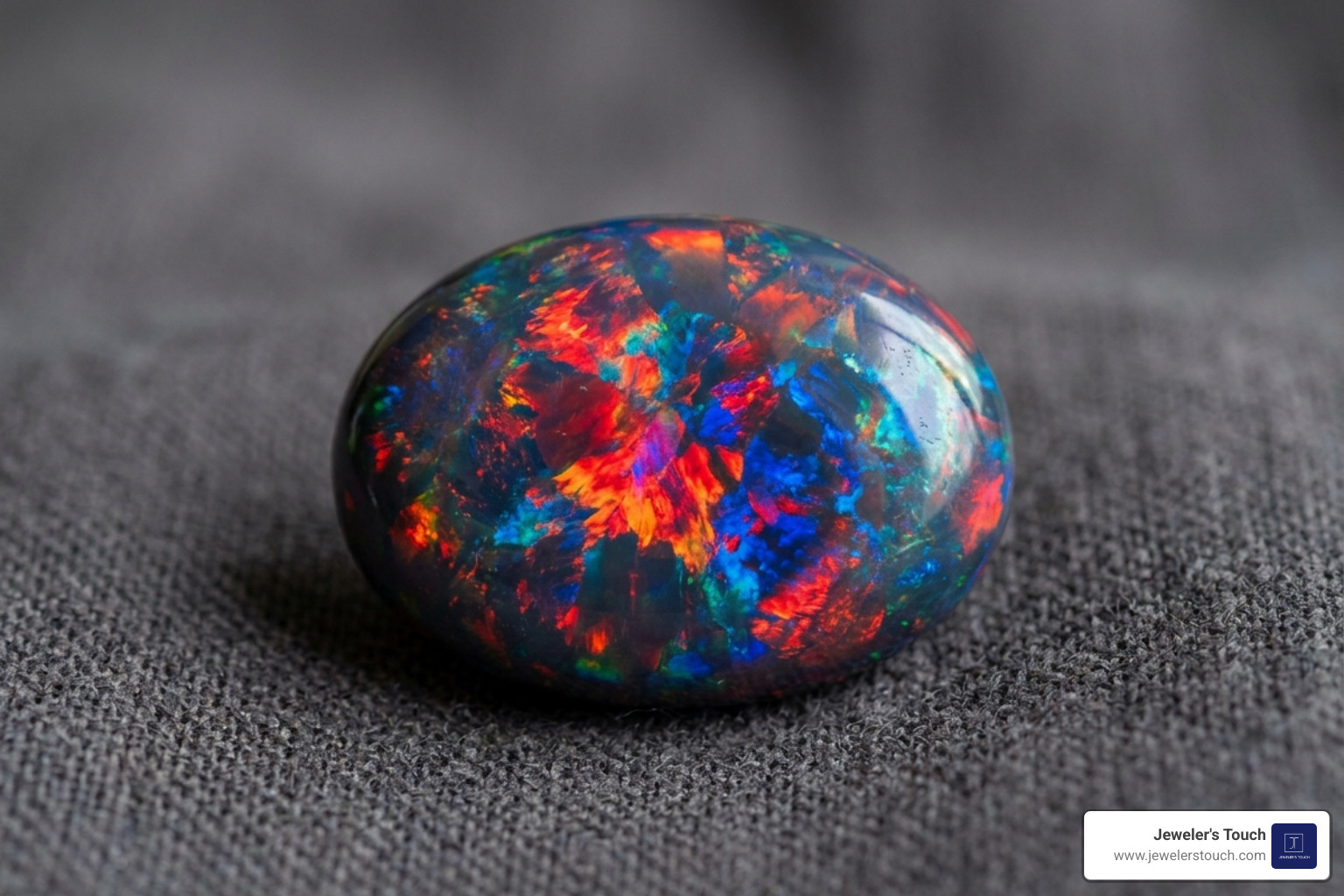
Ancient Romans believed opals were the luckiest gems because they contained the colors of all other stones. They saw them as symbols of purity and hope. In the Middle Ages, people even believed that an opal wrapped in a bay leaf could grant the wearer invisibility!
Tourmaline symbolism often depends on the specific color:
- Pink Tourmaline: Associated with compassion, love, and emotional healing.
- Green Tourmaline: Thought to promote courage, strength, and stamina.
- Black Tourmaline: Used as a protective stone to ward off negative energy.
These stones also align beautifully with the October zodiac signs. For Libras (Sept 23 – Oct 22), the multi-colored opal reflects their need for balance and harmony. For Scorpios (Oct 23 – Nov 21), the intense, deep hues of black opal or rubellite tourmaline match their passionate and mysterious nature.
Rarity plays a huge role in the value of these stones. While Australia produces 95% of the world's precious opal, the finest black opals from Lightning Ridge are incredibly rare and can fetch $10,000 to $20,000 per carat. Similarly, Paraíba tourmalines are so rare that for every 10,000 diamonds mined, only one Paraíba is found. You can read more about the fascinating origins of these traditions in The Secret History of Birthstones.
Caring for Your Colorful October Gems
Because of their unique compositions, October birthstones require a little extra "TLC" compared to diamonds or sapphires. At our Brea jewelry studio, we always emphasize the importance of understanding the Mohs scale of hardness.
Opal Care: Opals rank between 5 and 6.5 on the Mohs scale, making them relatively soft. They are also sensitive to "crazing"—a network of fine cracks that can occur if the stone dehydrates.
- Do: Clean with warm, soapy water and a soft cloth.
- Don't: Never use ultrasonic cleaners or steam. The vibration and heat can cause the stone to crack or the water content to evaporate.
- Storage: Store them separately from harder gems like diamonds to avoid scratches. Some collectors even keep them with a damp cotton ball in a sealed bag if the environment is very dry.
Tourmaline Care: Tourmaline is more durable, ranking 7 to 7.5 on the Mohs scale. This makes it suitable for everyday wear, though it should still be treated with care.
- Do: Use a soft brush and mild soap.
- Don't: Avoid sudden temperature changes (like going from a hot tub to a cold pool), which can cause fractures.
- Tip: Because tourmaline attracts dust (thanks to its electrical properties), it may need more frequent wiping than other gems.
For a deeper dive into maintaining your pieces, visit our October Birthstone Guide - Opal & Tourmaline.
Frequently Asked Questions about October Birthstone Color
Why does October have two different birthstones?
Originally, opal was the sole birthstone for October. However, in 1912, the American National Retail Jeweler’s Association standardized the birthstone list. Tourmaline was added as a modern alternative for two reasons: its incredible color variety and its superior durability. Some people also preferred tourmaline because of a lingering (and totally false!) 19th-century superstition that opals were bad luck. Today, we see it as a win-win—October babies get twice the options!
Which October birthstone color is the rarest and most expensive?
The two "heavyweights" are Black Opal and Paraíba Tourmaline.
- Black Opal: The most valuable specimens come from Lightning Ridge, Australia. Look for stones that show a full spectrum of color, especially red (the rarest color to find in an opal).
- Paraíba Tourmaline: These neon, copper-bearing stones from Brazil (and later Africa) are the most expensive tourmalines. Their glow is so intense they seem to be lit from within.
Can I wear my opal or tourmaline jewelry every day?
Tourmaline is generally safe for daily wear in rings and bracelets because it is harder (7–7.5 Mohs). Opal is much more fragile (5.5–6.5 Mohs). If you want an opal ring for daily wear, we recommend a protective bezel setting that guards the edges of the stone. Otherwise, opals are best suited for earrings and necklaces where they are less likely to be bumped or scratched.
Conclusion
Whether you are celebrating a birthday, an anniversary (8th for tourmaline, 14th for opal), or simply your love for vibrant gems, the october birthstone color spectrum offers something for everyone. From the "fireworks in a stone" look of a precious opal to the "neon glow" of a Paraíba tourmaline, these gems are as unique as the people who wear them.
At Jeweler's Touch, we’ve been helping the Orange County community find and create stunning birthstone jewelry since 1992. With our on-site GIA gemologist and expert goldsmiths, we can help you select the perfect loose stone or design a custom piece that highlights the "rainbow" of October.
If you're in Brea or the surrounding areas, stop by to see these kaleidoscopic colors in person. You can also browse our Birthstone Guide for more inspiration on every month of the year!