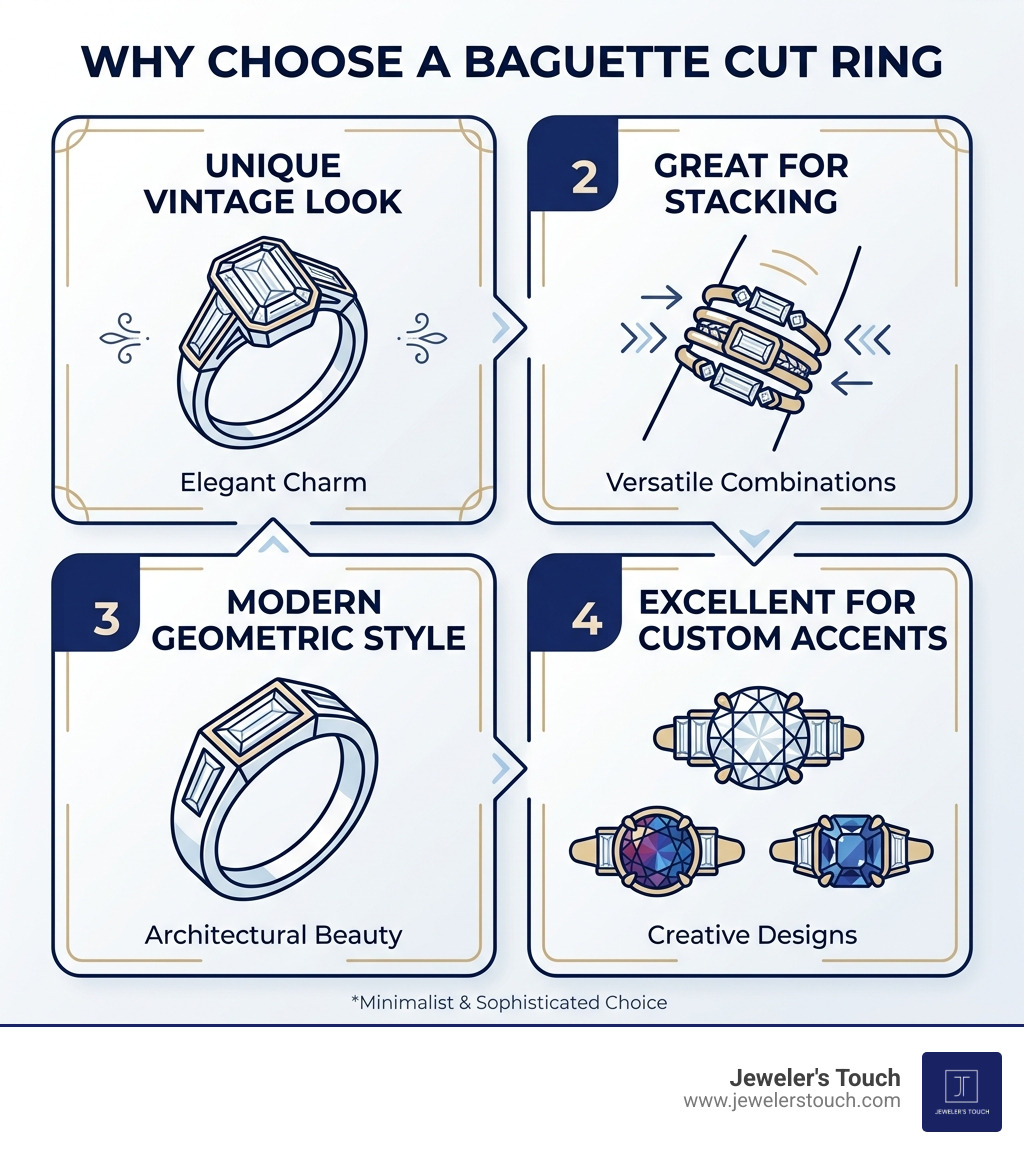
What Is a Baguette Cut Ring?
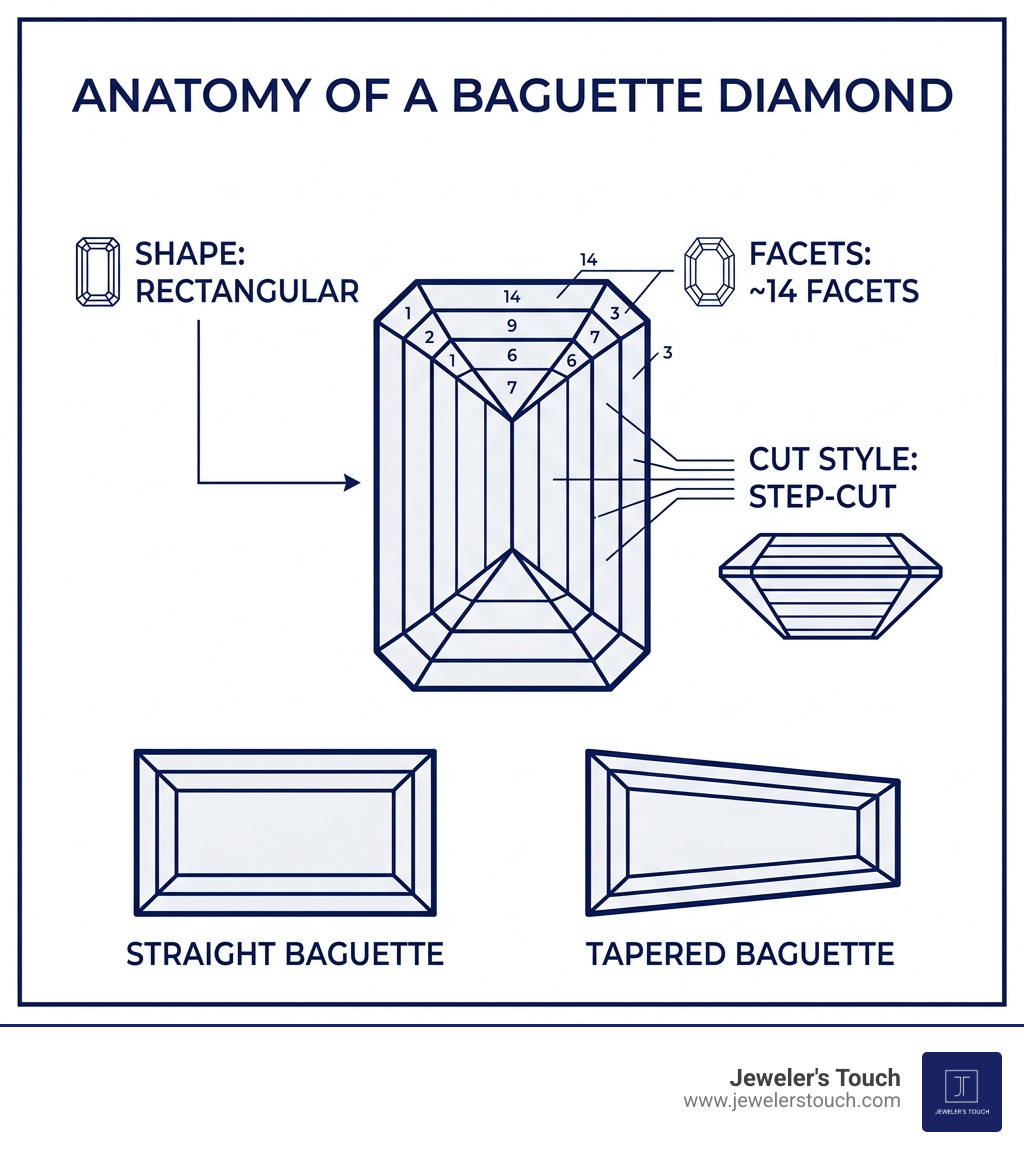
A baguette cut ring features a long, rectangular diamond (or gemstone) with clean, straight edges and a small number of flat, step-cut facets. Here's a quick overview of what makes it unique:
| Feature | Details |
|---|---|
| Shape | Rectangular or tapered rectangle |
| Facets | ~14 step-cut facets |
| Look | Sleek, geometric, architectural |
| Common uses | Side stones, eternity bands, solitaires |
| Style era | Art Deco — but very popular today |
Unlike round diamonds, baguettes don't throw off a lot of sparkle. Instead, they produce a quiet, mirror-like gleam that feels elegant and modern at the same time.
They work beautifully as standalone rings, stacking bands, or accent stones paired with a center diamond. The style suits people who want something refined and a little different from the classic round brilliant.
I'm Ken Rutz from Jeweler's Touch, a fine jewelry store specializing in custom engagement rings and diamond jewelry — and baguette cut rings are one of the most rewarding designs we work with. Whether you're drawn to the Art Deco geometry or the sleek minimalist look, this guide will help you find exactly what you need.
The Timeless Appeal of the Baguette Cut Ring
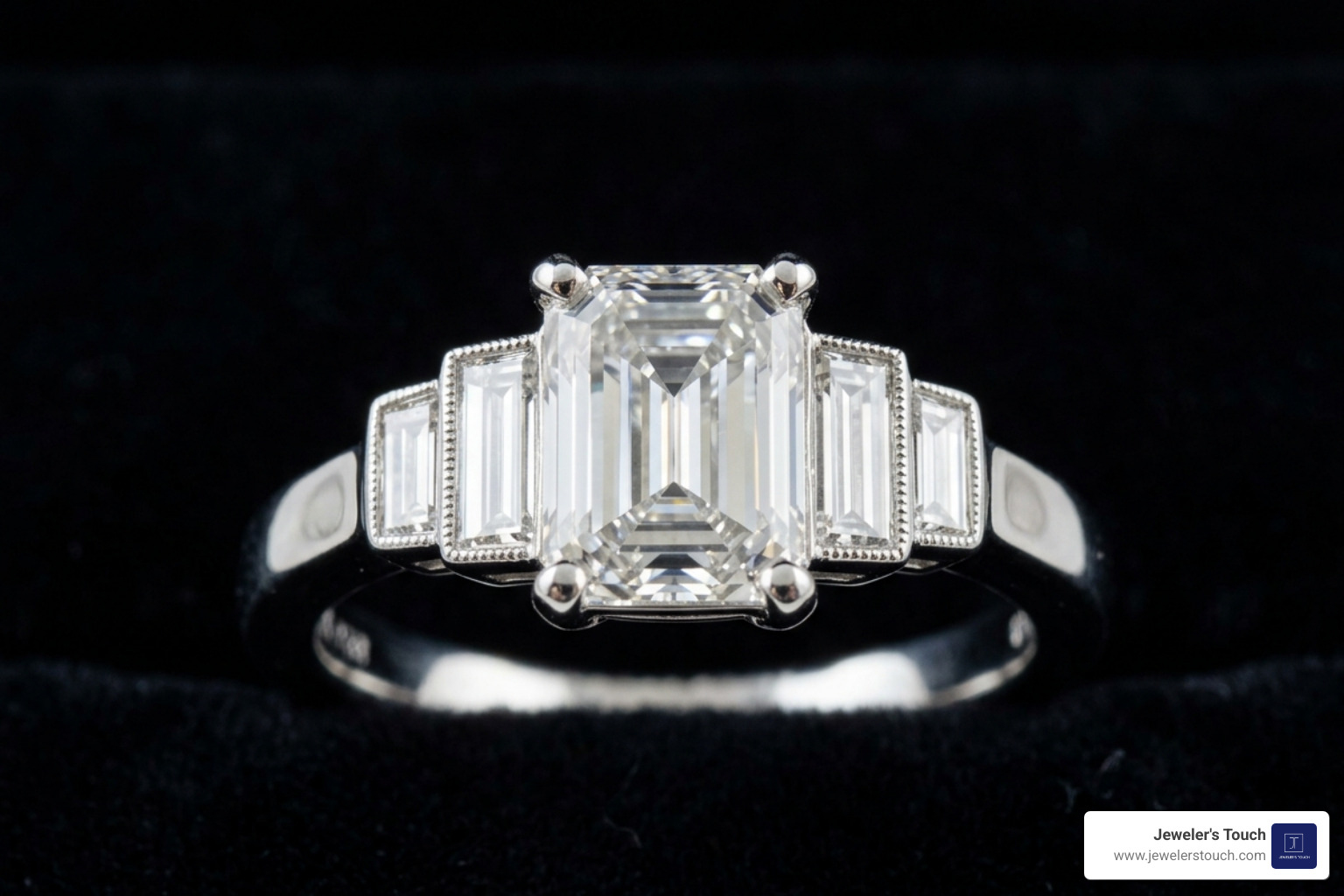
The allure of the baguette cut ring lies in its sophisticated simplicity. Emerging into the height of fashion during the Art Deco movement of the 1920s and 30s, this cut was a radical departure from the ornate, flowery designs of the Edwardian era. It embraced the machine age with clean lines, symmetry, and architectural forms.
Today, in May 2026, we see a massive resurgence in this style. Modern couples in Orange County are increasingly looking for jewelry that feels "intentional"—designs that value structure and clarity over sheer brilliance. A baguette diamond typically features 14 facets, which is significantly fewer than the 57 or 58 facets found in a round brilliant. This lack of complexity is actually its greatest strength; it doesn't hide behind "fire" or "scintillation." Instead, it offers a transparent, icy look that highlights the purity of the stone.
To understand why this look is so distinct, it helps to understand the category it belongs to. Baguettes are part of the "step-cut" family. You can learn more about this category in our guide on What Are Step-Cut Diamonds.
Defining the Baguette Cut Ring
When we talk about a baguette cut ring, we are usually referring to one of two variations:
- Straight Baguette: A perfect rectangle with parallel sides. These are often used in a row to create a "house-of-mirrors" effect.
- Tapered Baguette: These have sides that angle inward, meaning one end is narrower than the other. These are the classic choice for framing a center stone, as they follow the natural curve of the ring's band.
Symmetry is the name of the game here. Because the facets are long and flat, any misalignment is immediately visible to the naked eye. At Jeweler's Touch, our GIA gemologists pay close attention to the proportions of these stones to ensure they create a cohesive, balanced silhouette. If you are curious how this compares to other shapes, check out our article on 10 Different Diamond Shapes for Engagement Rings Explained.
Baguette vs. Emerald and Round Cuts
Choosing between a baguette and other popular cuts often comes down to what kind of "light show" you prefer. Round diamonds are engineered for maximum sparkle (brilliance), while baguettes are engineered for luster and geometric impact.
| Feature | Baguette Cut | Emerald Cut | Round Brilliant |
|---|---|---|---|
| Facet Style | Step-cut | Step-cut | Brilliant-cut |
| Light Performance | Mirror-like flashes | Broad "hall of mirrors" | Intense sparkle/fire |
| Corners | Sharp/Square | Clipped/Truncated | Curved |
| Clarity Importance | Extremely High | High | Moderate |
| Surface Area | Elongated/Narrow | Large/Open table | Circular/Compact |
For a deeper dive into how these shapes impact the overall look of your jewelry, see our Diamond Engagement Ring Guide.
Visual Differences in Step-Cuts
The "step-cut" faceting of a baguette is similar to an emerald cut, but with a few key differences. Emerald cuts usually have more facets and "clipped" corners, which makes them more durable for large center stones. Baguettes have sharp, 90-degree corners and a much narrower table (the top flat surface).
Because the facets are parallel to the girdle, they create what we call a "hall-of-mirrors" effect. However, because there are so few facets to break up the light, any inclusions or "clouds" inside the diamond are very easy to see. When selecting a baguette cut ring, you generally cannot compromise on clarity. While a round diamond might hide a small speck under its sparkle, a baguette will put it on center stage. This is why understanding What are the 5 Cs of Diamonds is vital before you buy.
Popular Settings and Styles
One of the reasons we love working with baguette diamonds at our Brea, CA showroom is their versatility. They can play the lead role or be the perfect supporting cast.
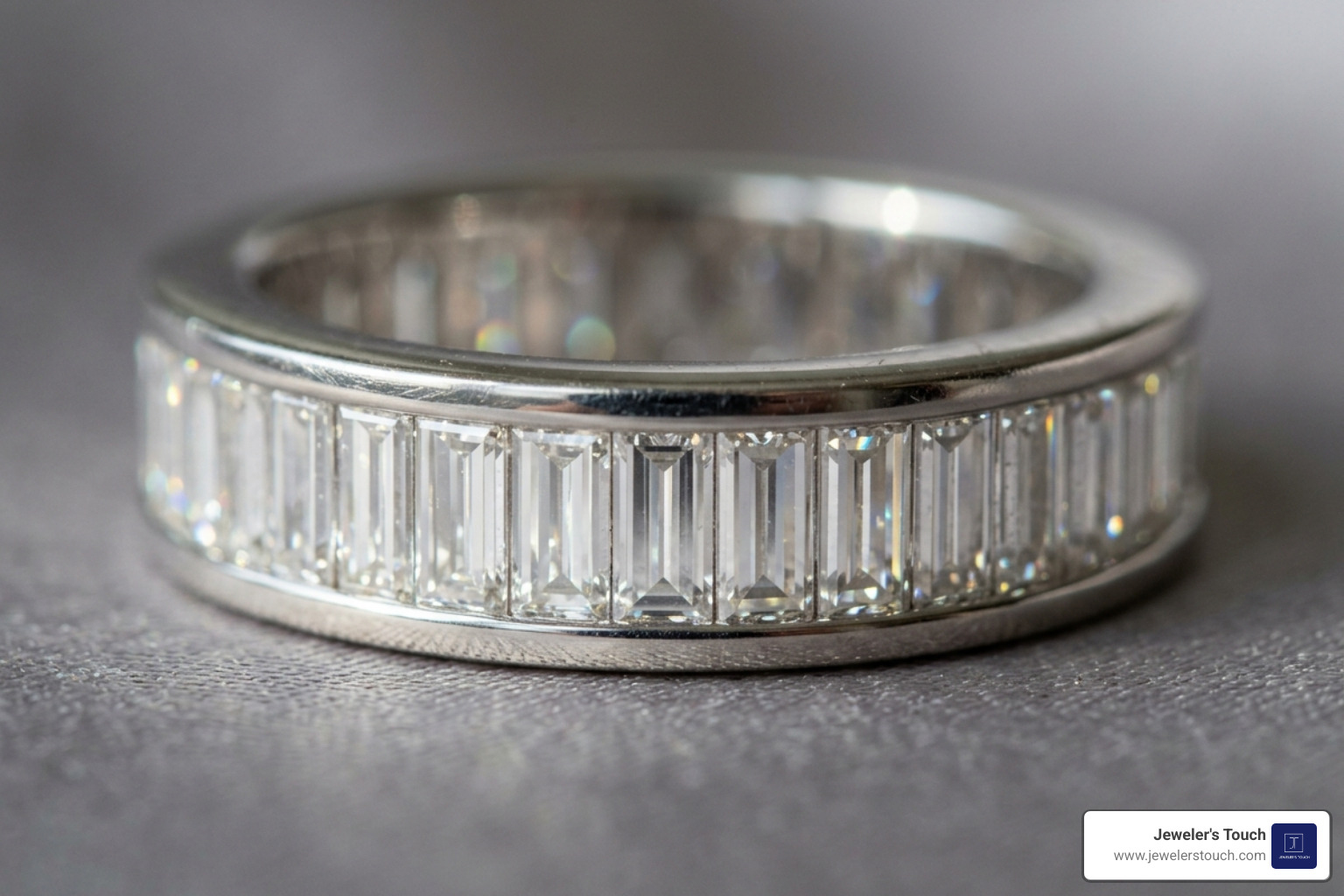
- Channel-Set Bands: This is perhaps the most iconic use of the baguette. The diamonds are set side-by-side between two rails of metal. This creates a continuous "river of light" and is incredibly popular for wedding bands and anniversary rings.
- Three-Stone Rings: A classic setting featuring a center stone (like a round or emerald cut) flanked by two tapered baguettes. This draws the eye toward the center while adding width to the design.
- Ballerina Settings: A vintage-inspired style where baguettes are set in a circular pattern around a center stone, mimicking the look of a tutu.
- Solitaire with a Twist: Using a single horizontal baguette as a minimalist statement piece is a major trend for 2026.
If you are looking for more volume, you might consider how baguettes look in a halo. Read more in our guide on What is a Halo Engagement Ring. For those who prefer a sleek, snag-free design, a bezel might be the way to go; learn more at What is a Bezel Setting.
Modern Trends in Baguette Cut Ring Design
As of May 2026, the "minimalist stack" is the reigning trend in Orange County. We are seeing many clients choose thin gold bands with a single, "discreet" baguette diamond bridging an open space in the band. It’s architectural, unexpected, and very chic.
Geometric bridal sets are also having a moment. Instead of a traditional round halo, designers are using "formations" of tapered baguettes to create V-shaped or sunburst silhouettes that fit perfectly against an engagement ring. If you have a specific vision that you can't find in a display case, our expert goldsmiths specialize in Custom Jewelry Design at Jeweler's Touch.
Quality Factors: The 4 Cs and Metal Choice
When you're shopping for a baguette cut ring, the rules of the "4 Cs" shift slightly.
- Clarity: This is the most important factor. We recommend staying in the VS1 to VS2 range at a minimum. Because the table of a baguette is like a clear window, SI1 or SI2 inclusions are often visible to the naked eye.
- Color: Baguettes tend to show color more than brilliant cuts. If you are setting them in platinum or white gold, aim for G-H color or better to ensure they look icy white. If you prefer yellow gold, you can sometimes drop to an I or J color for a warmer, vintage feel.
- Carat: Because baguettes are often small, they are usually sold by "total carat weight" (tcw) rather than individual stone weight. For example, a band might have 1.10 cts of total weight spread across 13 stones. Check out our Diamond Carat Guide for more on how weight affects size.
- Cut: Look for symmetry. The "steps" should be perfectly parallel, and the stone should not have a "leaky" or dull center.
Regarding metals, 14K gold is a fantastic choice for baguette rings because it is slightly harder and more durable than 18K, which is important for holding those sharp-cornered stones securely. Platinum is the ultimate choice for longevity, though it will develop a "patina" (a soft matte finish) over time. You can read more about these nuances in The Four Cs of Diamonds.
Maintenance and Sizing for Baguette Jewelry
Baguette diamonds require a little extra love. Because they have sharp corners, they are more prone to chipping if they aren't protected by the setting. This is why the channel setting is so popular—the metal rails protect the vulnerable edges of the stones.
Cleaning Your Ring
To keep that mirror-like shine, you’ll need to clean your ring frequently. Oils from your skin and lotion build up quickly on the flat facets, making the diamond look "flat" or greasy. A soft toothbrush, warm water, and mild dish soap are usually all you need for a home refresh.
The Sizing Challenge
Here is a "pro tip" from our goldsmiths: be very careful with sizing. Many baguette cut rings, especially eternity bands or channel-set designs, are difficult or even impossible to resize. The metal rails that hold the baguettes are under tension; if you bend the band to make it smaller or larger, you risk popping the stones out or warping the channels.
Always get professionally measured at Jeweler's Touch before ordering. If you are choosing a wide band (like a "cigar band" style), we usually recommend sizing up by at least a half-size, as wider rings feel tighter on the finger. For more details on how settings affect wearability, see our Official Guide to Engagement Ring Settings.
Frequently Asked Questions about Baguette Rings
Do baguette diamonds sparkle as much as round diamonds?
No, and they aren't meant to! Round diamonds use "brilliant" faceting to bounce light in every direction. Baguettes use "step" faceting to create long, elegant flashes of light. Think of a round diamond as a disco ball and a baguette as a sleek, polished mirror.
Are baguette cut rings more expensive?
Generally, baguettes can be more cost-effective per carat than large round diamonds because they are often used as smaller accent stones. However, because they require higher clarity (VS range), the price per stone can be higher than a lower-quality round diamond of the same size. Lab-grown options are also increasingly available, offering the same chemical structure at a more accessible price point.
Can you resize a channel-set baguette ring?
It depends on the design. If the diamonds go all the way around (eternity), it usually cannot be resized. If there is a plain gold section at the back of the band (a sizing bar), our goldsmiths can often adjust it. Always check with us before purchasing if you think your size might change.
Conclusion
The baguette cut ring is a masterclass in understated luxury. Whether it’s the centerpiece of a minimalist modern band or the geometric frame for a stunning sapphire, the baguette brings a unique "vintage character" that other cuts simply can't match.
At Jeweler's Touch, we’ve been helping the Orange County community find and create their dream jewelry since 1992. With our on-site GIA gemologists and expert goldsmiths, we can help you navigate the technical details of clarity and setting security to ensure your baguette ring lasts a lifetime.
Ready to see these architectural beauties in person? Explore Our Diamond Collection or visit us in Brea to start your custom design journey today.