

What Is the August Birthstone?
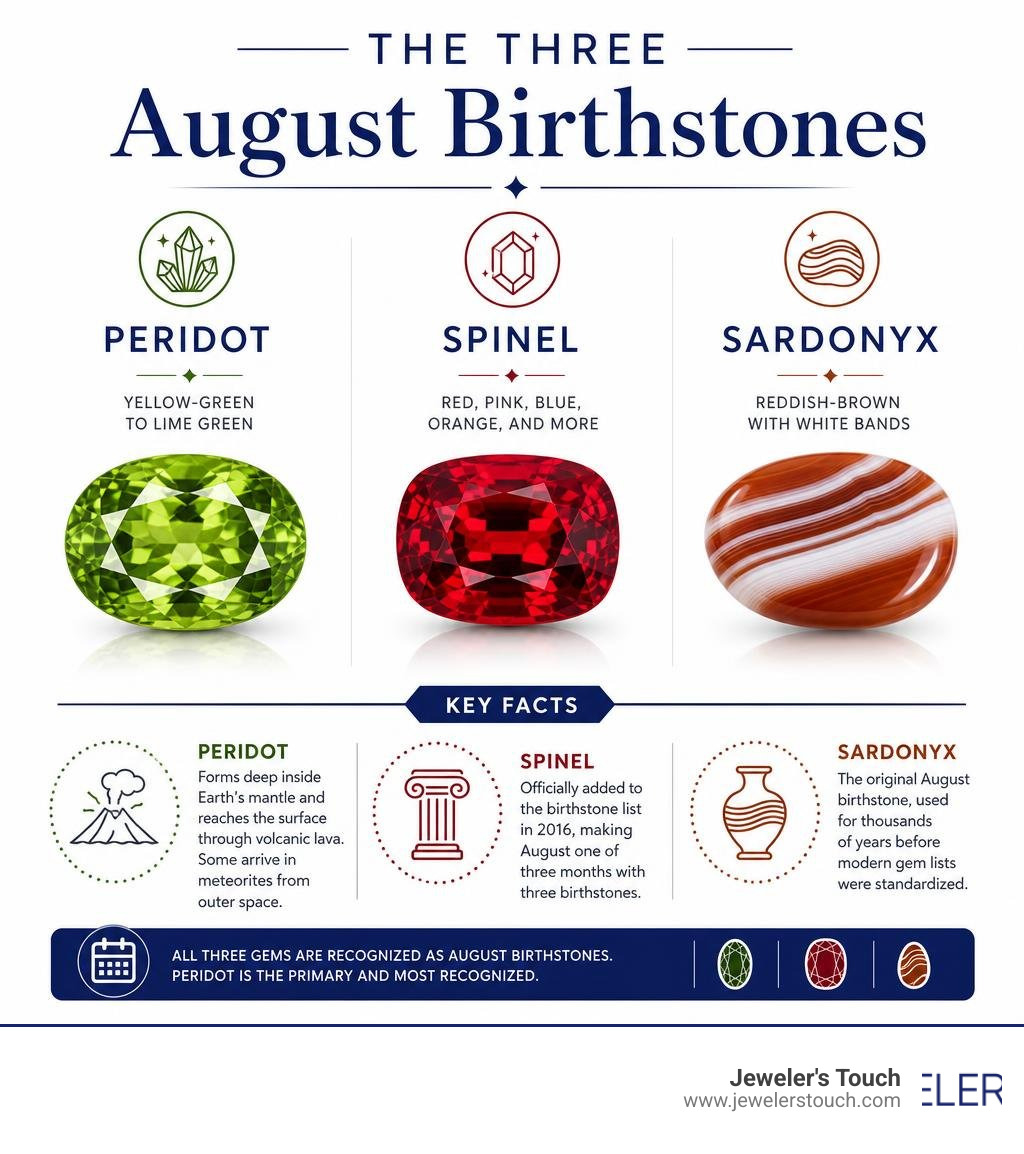
The August birthstone is not just one gem — it's three. People born in August can claim peridot, spinel, and sardonyx as their birthstones.
| Birthstone | Color | Added to Official List |
|---|---|---|
| Peridot | Yellow-green to lime green | Traditional |
| Sardonyx | Reddish-brown with white bands | Traditional (original) |
| Spinel | Red, pink, blue, orange, and more | 2016 |
Peridot is the primary and most recognized of the three. It's known for its vivid green glow — a color unlike any other gem. What makes it even more remarkable is its origin: peridot forms deep inside the Earth's mantle and rides volcanic lava to the surface. Some specimens have even arrived on Earth inside meteorites from outer space.
Spinel and sardonyx round out the trio, each with a rich history of their own. Sardonyx was the original August birthstone, used for thousands of years before modern gem lists were standardized. Spinel was officially added in 2016, making August one of only three months — alongside June and December — with three recognized birthstones.
I'm Ken Rutz, and at Jeweler's Touch I've helped countless customers find the perfect August birthstone jewelry, from custom peridot pendants to vintage-inspired spinel rings. Let's walk through everything you need to know about these three remarkable gems.
The Primary August Birthstone: Peridot

When most people think of the August birthstone, the shimmering, sun-drenched green of peridot is what immediately comes to mind. As a pure, vibrant expression of summer’s peak, peridot is one of the few gemstones that exists in only one color: green.
Unlike other gemstones that owe their color to trace impurities (such as chromium in emeralds or iron in sapphires), peridot's color is idiochromatic. This means the signature green is an inherent part of its own chemical structure. Peridot is the gem-quality variety of the mineral olivine, a magnesium iron silicate represented by the chemical formula $(Mg, Fe)2SiO4$.
The depth of its green depends entirely on how much iron is locked within its crystal structure. The higher the iron content, the richer and more saturated the green will be. This produces an exquisite color range:
- Lime Green: A bright, energetic, and youthful green.
- Olive Green: A deeper, sophisticated, and earthy tone.
- Yellowish-Green to Golden-Lime: A warm, sunny hue that catches the light beautifully.
The most highly prized peridot specimens display a pure, saturated "grass" green with no hints of yellow or brown. To learn more about how this incredible color influences the gemstone's appeal, explore the August Birthstone: Peridot | Color, Meanings, and Symbolism | The Old Farmer's Almanac.
Geological Origins: Volcanic and Meteorite Peridot
The geological journey of peridot is nothing short of miraculous. While most popular gemstones form within the Earth's crust, peridot is born much deeper. It is created under intense heat and pressure within the Earth's upper mantle, roughly 20 to 55 miles below the surface.
The only way peridot ever reaches human hands is through violent geological events. Volcanic eruptions shatter the mantle rocks and carry the olivine crystals to the surface inside hardened basalt lava flows. In places like Hawaii, volcanic activity has left behind beaches with sands that shimmer luminous green due to tiny, weathered peridot deposits. Locals sometimes refer to these tiny green crystals as "Pele's tears," named after the Hawaiian goddess of fire and volcanoes.
Even more mind-boggling is the existence of extraterrestrial peridot. Gem-quality olivine has been discovered inside pallasite meteorites—stony-iron space rocks that are remnants of our early solar system. When sliced open, these meteorites reveal a metallic nickel-iron matrix studded with translucent, golden-green peridot crystals. While meteorite peridot (sometimes called "palladot") is exceptionally rare and usually too small to facet into large jewelry pieces, it remains a highly coveted prize for collectors who want to wear a piece of the cosmos.
Back on Earth, the primary sources of peridot have shifted over the millennia. Historically, the tiny, remote island of Zabargad (historically known as Topazios) in the Red Sea was the premier source of large, high-quality peridots. Today, the world's most abundant source of commercial-grade peridot is the San Carlos Apache Indian Reservation in southeastern Arizona. Here, Apache families have worked the mines for decades, extracting beautiful stones from ancient basalt flows. Other notable sources of fine-quality peridot include Pakistan, Myanmar, Vietnam, and China.
History and Lore of the August Birthstone
Peridot has a history that stretches back more than 3,500 years. The ancient Egyptians were among the first to mine this stone on Zabargad Island, which they called the "gem of the sun." Because the island was surrounded by treacherous reefs, plagued by dense fog, and infested with venomous snakes, it earned ominous names like "Snake Island" and "Island of Death." Legend has it that Egyptian miners were forced to harvest the gems at night because they believed peridots became invisible during the day, only revealing their radiant glow under the cover of darkness.
Because of its bright green hue, peridot was frequently confused with emerald throughout history. Many historians believe that Cleopatra’s famous emerald collection was actually composed of peridots. This confusion persisted well into the medieval era. For centuries, the spectacular 200-carat green gemstones decorating the Shrine of the Three Holy Kings in Germany's Cologne Cathedral were believed to be emeralds, only to be identified later as magnificent peridots.
Throughout various cultures, peridot has been revered for its protective and healing folklore:
- Nightmare Protection: Ancient peoples believed that setting a peridot in gold would ward off the "terrors of the night," evil spirits, and terrifying nightmares.
- Emotional Healing: It is said to promote harmony, soothe anger, and bring peace and joy to the wearer.
- Wealth and Prosperity: Many believed the stone attracted good fortune and abundance.
Today, peridot is celebrated as the traditional gift for a 16th wedding anniversary, representing renewal, growth, and lasting harmony. If you are curious about how this stone's meaning has evolved over time, you can read more in this August Birthstone Peridot: Meaning, Color & History (2026 Guide).
How to Care for Your August Birthstone Jewelry
While peridot is a stunning option for jewelry, it requires a gentle touch. It rates a 6.5 to 7 on the Mohs scale of hardness. To put that into perspective, it is softer than sapphires, rubies, and diamonds, making it more susceptible to scratching if stored improperly or worn during heavy physical activity. You can learn more about how gemstone hardness impacts daily wear by reading our guide on Understanding the Mohs Scale and Gemstone Durability.
Because peridot is sensitive to rapid temperature changes (thermal shock), you must handle it with care:
- Avoid Harsh Environments: Never wear your peridot jewelry while swimming, showering, or using household cleaning chemicals.
- Skip the Machines: Never clean peridot in ultrasonic or steam cleaners. The intense vibrations and heat can cause the stone to fracture.
- The Safe Cleaning Method: The best way to clean your peridot is with warm water, a few drops of mild dish soap, and a soft-bristle toothbrush. Gently scrub away dirt, rinse thoroughly under warm running water, and pat dry with a lint-free cloth.
- Smart Storage: Store your peridot pieces in individual soft cloth pouches or separate compartments in your jewelry box so they don't get scratched by harder gemstones like diamonds or sapphires.
Alternative August Birthstones: Spinel and Sardonyx
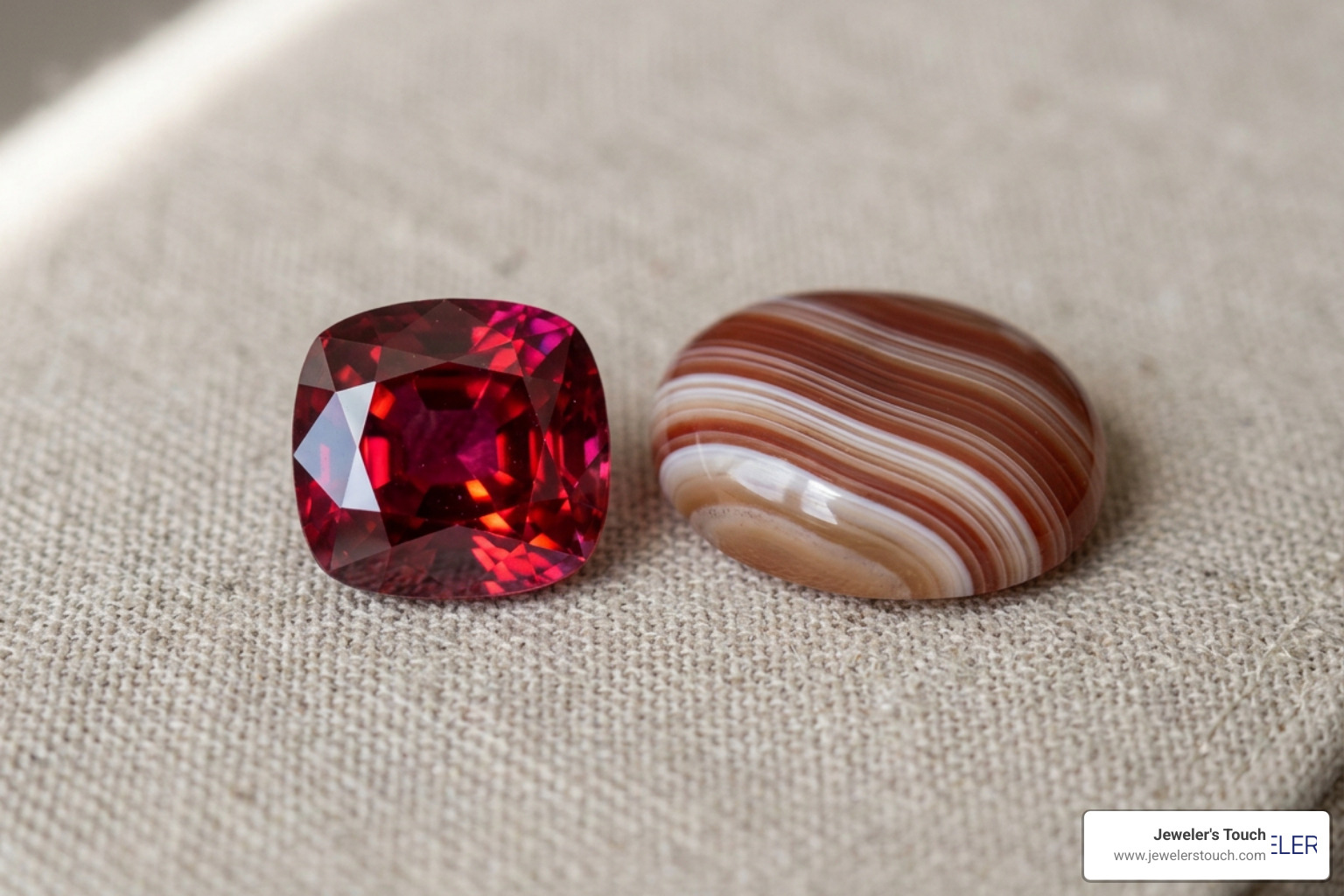
While peridot holds the crown as the primary August birthstone, those born in August are incredibly lucky to have two other distinct options: spinel and sardonyx. Whether you prefer the fiery brilliance of spinel or the earthy, striped patterns of sardonyx, these alternatives offer a spectacular range of styles. To dive deeper into how these stones were added to the official calendar, check out the August Birthstones | Peridot & Spinel Birthstone Information | GIA.
Spinel: The Great Imposter
Spinel is often referred to by gemologists as "the great imposter" of the gemstone world. For centuries, red spinel was mistaken for ruby because the two gems are often found in the same mining gravels and share a nearly identical, saturated red color.
The most famous example of this historical mix-up is the "Black Prince's Ruby." This legendary 170-carat gemstone has been set in Great Britain's Imperial State Crown since the 14th century, positioned directly above the massive Cullinan II diamond. It wasn't until the late 18th century, with the advent of modern chemical analysis, that scientists realized this historic "ruby" was actually a magnificent red spinel.
Unlike ruby, which is a aluminum oxide (corundum), spinel is a magnesium aluminum oxide mineral that crystallizes in the cubic system, often forming perfect octahedral (eight-sided) crystals. Because of its single refraction, spinel can actually appear more vivid and bright than ruby in certain lighting conditions.
Beyond fiery red, spinel occurs in an incredible rainbow of colors, including:
- Vibrant hot pinks
- Deep cobalt blues
- Rich purples and violets
- Warm oranges and metallic grays
With an impressive hardness of 8 on the Mohs scale, spinel is highly durable and excellent for everyday wear, including engagement rings. Historically sourced from the famous Mogok Stone Tract in Myanmar (where locals call the highly lustrous crystals "spirit polished"), spinel is also mined in Sri Lanka, Tajikistan, and Vietnam. Today, it is recognized as the traditional gift for a 22nd wedding anniversary. To see where spinel ranks among the world's most coveted treasures, take a look at our article on The World's Most Valuable Prized Gemstones.
Sardonyx: The Ancient Warrior's Talisman
Sardonyx is the oldest of the three August birthstones, with a documented history dating back more than 4,000 years. It is a unique variety of chalcedony, which is a cryptocrystalline form of quartz.
What makes sardonyx so visually striking is its banded structure. It is composed of alternating layers of two different chalcedony minerals:
- Sard: A rich, reddish-brown to brownish-red stone.
- Onyx: Typically white or black mineral bands.
This layering creates a beautiful, zebra-striped appearance. Because of these distinct layers, ancient Roman and Greek artisans used sardonyx to carve exquisite cameos and intaglios, where the figure was carved from one colored layer, leaving the contrasting color as the background.
Ancient Roman soldiers wore sardonyx signet rings carved with the likeness of Mars, the god of war, believing the stone would grant them courage, protection, and victory in battle. It was also highly prized for making wax seals because hot wax does not stick to chalcedony, allowing the user to stamp documents cleanly. In religious history, sardonyx is believed to be one of the sacred stones set into the High Priest's breastplate in the Old Testament. With a Mohs hardness of 6.5 to 7, sardonyx remains a bold, historically rich choice for statement jewelry.
Comparing the Three August Gemstones
Choosing between the three August birthstones comes down to personal style, lifestyle, and color preference. To help you decide, we've broken down their key differences in the table below. For a broader look at monthly options, you can also browse our complete Birthstone Guide.
| Feature | Peridot | Spinel | Sardonyx |
|---|---|---|---|
| Primary Color | Lime green, olive green, yellowish-green | Red, pink, blue, purple, orange, gray | Reddish-brown with white bands |
| Mohs Hardness | 6.5 to 7 | 8 | 6.5 to 7 |
| Durability | Moderate (sensitive to thermal shock) | Excellent (great for daily wear) | Moderate to Good (avoid harsh chemicals) |
| Rarity | Common in small sizes; rare in large, fine qualities | Rare (especially cobalt blue and vivid red) | Abundant and highly accessible |
| Best Jewelry Use | Pendants, earrings, protected ring settings | Everyday rings, wedding bands, fine jewelry | Statement rings, cameos, beads, carvings |
| Anniversary | 16th Wedding Anniversary | 22nd Wedding Anniversary | N/A |
Frequently Asked Questions About the August Birthstone
What are the three birthstones for August?
The three birthstones for August are peridot, spinel, and sardonyx. Peridot is the primary and most popular modern birthstone. Spinel was added to the official list in 2016 to offer a wider variety of colors, while sardonyx is the oldest, traditional birthstone with a history dating back over 4,000 years.
Why was spinel historically mistaken for ruby?
Spinel was mistaken for ruby for centuries because they look virtually identical to the naked eye, share a similar deep red color, and are frequently mined in the exact same geological deposits. It wasn't until the late 18th century that gemologists developed the chemical testing methods needed to distinguish spinel (magnesium aluminum oxide) from ruby (aluminum oxide).
Can peridot be worn as an everyday ring?
Yes, but with caution. Because peridot has a Mohs hardness of 6.5 to 7, it is softer than sapphire and diamond. If you want to wear a peridot ring every day, we highly recommend choosing a protective setting, such as a bezel setting or low-profile prongs, to shield the stone from impact. Always remove your peridot rings before doing heavy chores, exercising, or working with chemicals.
Finding Your Perfect August Birthstone in Orange County
Whether you are celebrating an August birthday, honoring a 16th or 22nd wedding anniversary, or simply falling in love with these vibrant colors, choosing the right gemstone is a deeply personal journey.
At Jeweler's Touch, we have been helping our community in Orange County find and design breathtaking jewelry since 1992. Our family-owned jewelry store in Brea, CA, features an on-site GIA graduate gemologist and expert goldsmiths who can help you select the perfect loose stone or bring your dream custom design to life.
If you are ready to explore the stunning world of peridot, spinel, or sardonyx, visit us in-store to view our collection. You can also read our detailed August Birthstone Guide Peridot Sardonyx and Spinel for more inspiration. Let us help you write your next jewelry story!