

What to Know Before You Buy Diamond Earrings
Diamond earrings are one of the most popular fine jewelry purchases, whether you're buying for yourself, a partner, or as a gift. But with so many options, knowing where to start can feel overwhelming.
Here's a quick breakdown of what matters most:
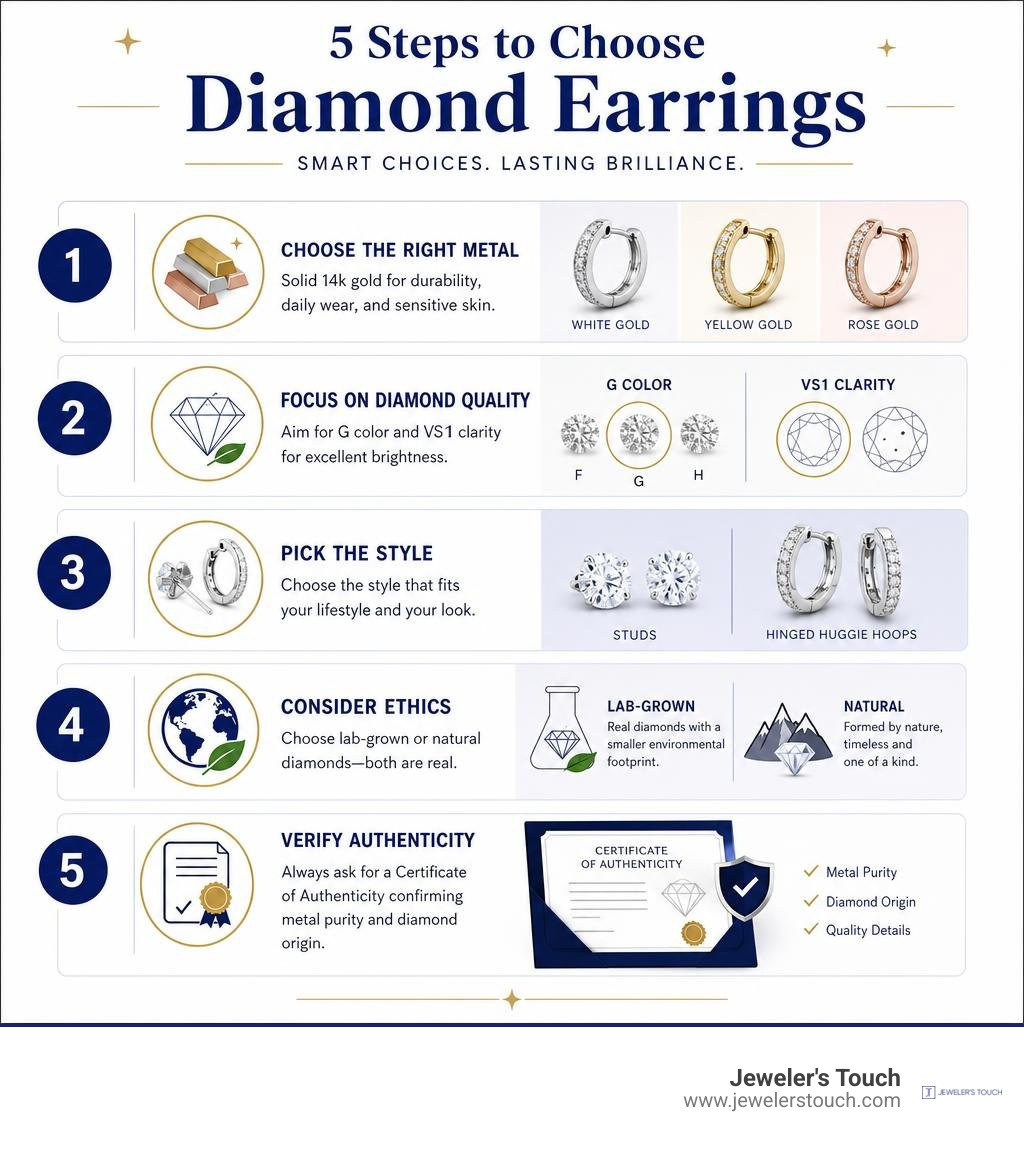
- Metal type: Solid 14k gold (white, yellow, or rose) is the best choice for daily wear and sensitive skin
- Diamond origin: Both lab-grown and natural diamonds are real; lab-grown costs less with a smaller environmental footprint
- Diamond quality: Look for G color and VS1 clarity for excellent brightness at a fair price
- Earring style: Hinged huggie hoops offer the most security for everyday wear; studs are the most classic choice
- Carat weight: A 0.18ct total weight pair (like pavé huggies) gives sparkle without bulk
- Verification: Always ask for a Certificate of Authenticity confirming metal purity and diamond origin
This guide walks you through every factor so you can compare your options clearly and confidently.
I'm Ken Rutz, and at Jeweler's Touch I've spent years helping customers find the right diamond earrings for their style, budget, and lifestyle. In the sections below, I'll break down everything from metal quality to setting styles so you can shop with confidence.
Understanding Metal Options and Quality Factors for Diamond Earrings
Selecting the perfect pair of diamond earrings starts with understanding the foundation of the piece: the metal. While stones capture attention with their shimmer, the precious metal holding them determines comfort, allergic reactivity, and long-term durability. Solid 14k gold stands out as the ultimate sweet spot in fine jewelry. It offers a ideal balance between purity and structural durability, blending 58.3% pure gold with durable alloy metals to resist scratching, bending, and daily wear.
For sensitive skin, choosing the right metal is crucial. Plated jewelry or base metals treated with cheap coatings can wear off over time, exposing skin to nickel and trigger painful irritations or allergic breakouts. Solid 14k gold is naturally hypoallergenic, making it ideal for daily wear. When exploring options, understanding The Difference Between White and Yellow Gold Earrings will help you pick a shade that complements your personal wardrobe and skin tone. Yellow gold offers timeless warmth, while 14k white gold provides a sleek, modern backdrop that seamlessly highlights white diamond brilliance.
Many jewelry makers utilize rhodium plating to give white gold a bright silvery finish, but premium fine jewelry can also be crafted using unplated solid 14k white gold. Specially alloyed to maintain a cool tone naturally, unplated white gold eliminates the need for future re-plating sessions, giving you a smooth, low-maintenance piece built for generations. Whether you are building an earring stack or investing in a standout staple, insist on solid gold rather than vermeil or plated options to ensure your fine jewelry stays pristine over decades of continuous enjoyment.
Evaluating Color, Clarity, and Carat Weight in Diamond Earrings
When evaluating small accent stones or centerpiece diamonds, assessing quality through the 4 Cs (Color, Clarity, Cut, and Carat Weight) ensures you achieve breathtaking brilliance without overpaying for subtle details invisible to the naked eye. To learn more about how gemological standards apply across different fine pieces, browse our comprehensive educational index on Diamonds.
In luxury fine jewelry, particularly delicate designs like pavé huggie hoops, choosing G color and VS1 clarity offers an ideal sweet spot.
- Color (G Grade): G color sits near the top of the near-colorless range. To the casual viewer, it displays bright, icy whiteness without the expensive price tag of colorless (D-F) grades.
- Clarity (VS1 Rating): Very Slightly Included (VS1) diamonds feature microscopic inclusions that cannot be detected without 10x magnification. This ensures every individual stone looks completely clear and crisp to the naked eye.
- Carat Weight (0.18ct Total Weight): Carat weight measures the total weight of the diamonds across the piece. For refined daily wear, a pair featuring 0.18ct total weight (0.09ct per ear) delivers continuous radiance while keeping the overall profile delicate, lightweight, and easy to wear all day long.

The Role of Pavé Settings in Light Reflection
The term "pavé" comes from the French word for "paved," referencing a design technique where small gemstones line the surface of a metal framework like tiny, gleaming cobblestones. In high-end pavé settings, precise micro-prongs secure small accent stones extremely close together, minimizing exposed metal and maximizing total surface brilliance.
For example, when a design features eighteen 1.4mm micro diamonds precisely set along each hoop, the cumulative light reflection is breathtaking. Rather than relying on a single focal point, thirty-six individual faceted diamonds across a pair bounce light in every direction as you move. This seamless ribbon of light creates continuous radiance, proving that smaller, flawlessly arranged diamonds can produce just as much visual impact as larger single solitaire stones.
Comparing Lab-Grown vs Natural Diamonds and Ethical Metal Options
As you evaluate fine Diamond Jewelry, one of your primary decisions involves choosing between lab-grown and natural mined diamonds. Modern technology allows gemologists to recreate the high-heat, high-pressure conditions found deep within the earth's mantle, growing gem-grade diamonds inside state-of-the-art laboratory environments.
It is essential to understand that lab-grown diamonds are not synthetic imitations or cubic zirconia; they are optically, chemically, and physically identical to mined diamonds. They register a 10 on the Mohs hardness scale, exhibit identical light refraction, and display matching fire and brilliance.
| Feature | Lab-Grown Diamonds | Natural Mined Diamonds |
|---|---|---|
| Chemical Composition | Pure Crystallized Carbon | Pure Crystallized Carbon |
| Mohs Hardness | 10 | 10 |
| Reflective Brilliance | Identical Optical Performance | Identical Optical Performance |
| Environmental Footprint | Lower land disturbance & lower emissions | Traditional mining extraction impact |
| Value & Pricing | Exceptional value per carat | High rarity value premium |
Choosing between lab-grown and natural diamonds ultimately comes down to personal values and preferences. Lab-grown options deliver remarkable brilliance with a significantly reduced environmental impact and a lower price point, allowing buyers to maximize diamond size and clarity within their budget. Natural mined diamonds carry billions of years of geological history and traditional sentimental value. Both options provide permanent beauty and enduring physical durability for daily wear.
Benefits of Recycled Solid Gold and Conflict-Free Stones
Ethical craftsmanship extends beyond the gems to encompass the metals holding them. Responsible fine jewelry design prioritizes conflict-free diamond procurement in strict compliance with the Kimberley Process, ensuring stones are responsibly sourced from conflict-free regions.
Combining ethically sourced diamonds with recycled solid gold represents a major step forward for eco-conscious luxury. Recycled 14k gold is refined from existing precious metal stocks without sacrificing purity, color, or structural integrity. By choosing recycled solid metals and conflict-free stones, consumers protect delicate global ecosystems while supporting fair labor conditions. Furthermore, because solid recycled gold contains no irritating base contaminants, it remains entirely safe and soothing for sensitive skin.
Fine Earring Styles: Huggies, Studs, and Hoops
The silhouette you choose determines how your jewelry interacts with your hair, face shape, and daily activities. Exploring different design categories allows you to select pieces suited for active lifestyles, formal events, or everyday wear. For instance, learning How to Choose and Wear Diamond Hoop Earrings with Style can help you decide between standard drop hoops and snug-fitting huggies.
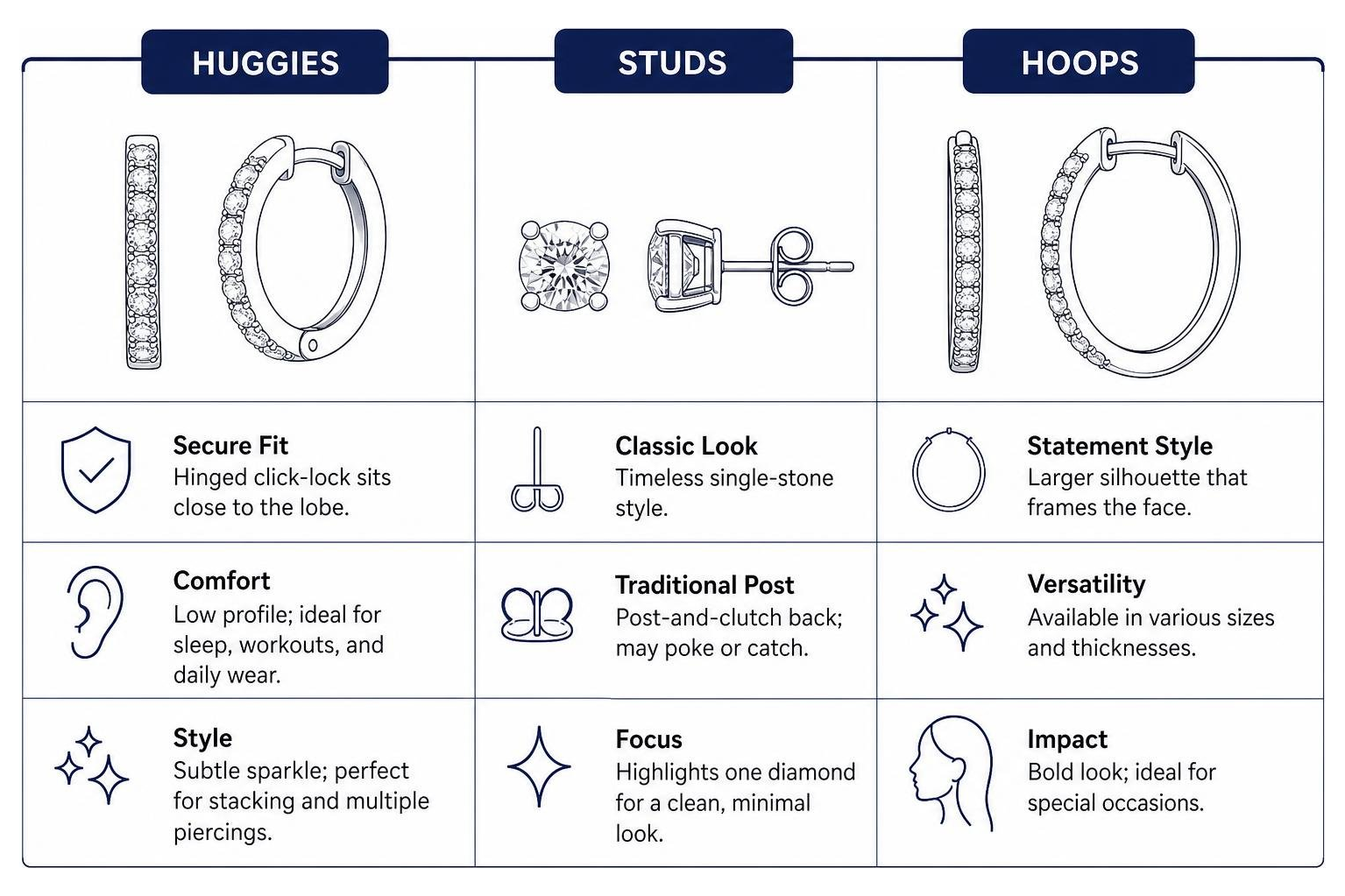
Hugging the earlobe tightly, hinged huggie earrings offer an exceptional combination of modern refinement and practical functionality. Unlike larger statement hoops that risk catching on clothes, scarves, or hair, huggies sit flush against the lobe. This low-profile fit keeps them secure during workouts, phone calls, or sleep, making them ideal for multi-piercing stacks or low-maintenance daily jewelry routines.
Hinged Huggie Security Versus Traditional Studs
While traditional studs remain an iconic choice, exploring Why Diamond Stud Earrings Never Go Out of Style, their post-and-clutch closures can occasionally poke the neck or catch during sleep. Modern hinged huggie hoops eliminate uncomfortable post protrusions through integrated click-lock mechanisms.
A precision-engineered hinge at the base of the hoop allows the earring to open smoothly, while the curved post clicks securely into the back channel of the hoop. This internal catch provides reliable retention without requiring removable butterfly backings that are easily lost. The sleek contour stays comfortable all day and night, offering a secure fit for active lifestyles.
Dimensions and Weight Specifications
Understanding exact physical dimensions and total weights ensures your earrings feel light and comfortable without causing lobe fatigue over time.
| Earring Style | Standard Height | Outer Diameter / Width | Weight (Per Single / Pair) | Security Closure Type |
|---|---|---|---|---|
| Diamond Huggie Hoops | 13.50 mm | 1.40 mm width | 0.7 g / 1.4 g pair | Integrated Hinged Click-Lock |
| Solitaire Diamond Studs | ~5.00 mm depth | 5.00 mm face diameter | 0.4 g / 0.8 g pair | Friction post & butterfly clutch |
| Medium Diamond Hoops | 25.00 mm | 2.00 mm width | 2.1 g / 4.2 g pair | Latch back or wire hook |
| 5-Stone Band Earrings | 12.00 mm length | 2.50 mm width | 1.1 g / 2.2 g pair | Post with threaded screw back |
A single diamond huggie hoop weighing just 0.7 grams (1.4 grams for the pair) delivers a featherlight feel on the lobe. Paired with a compact 13.50mm height and a slender 1.40mm width, this structural proportion guarantees comfortable, non-sagging wear throughout the day.
Craftsmanship, Verification, and Long-Term Care
High-end diamond jewelry demands exceptional artisanal skill and meticulous quality assurance. While mass-produced pieces are often stamped out by automated factory machines, fine artisanal jewelry relies on multi-generational goldsmithing traditions where master jewelers personally hand-set every stone, polish every bevel, and test every hinge mechanism.

When investing in fine jewelry, verifying build quality and material authenticity is paramount. High-profile financial advisors like Suze Orman often warn consumers against overpaying for mass-market retail markups, stressing the importance of verifying certified diamond specs and solid metal weights before purchasing. Check out this insightful clip on $11K DIAMOND EARRINGS? Suze Orman Says… to hear her take on making smart jewelry purchases. You can also explore detailed artisan craftsmanship in fine pieces like 14k White Gold Diamond Pavé Hinged Huggie Earrings.
Authentication, Packaging, and Warranty Expectations
Every high-quality fine jewelry purchase should arrive with complete provenance documentation and protective packaging. Expect your items to be accompanied by a formal Certificate of Authenticity specifying:
- Metal Purity: Solid 14k gold stamp verification
- Stone Specifications: Diamond count, color grade (e.g., G), and clarity rating (e.g., VS1)
- Total Carat Weight: Exact gemological weight (e.g., 0.18ct TW)
- Source Guarantee: Eco-conscious recycled gold and conflict-free diamond origin confirmation
Fine earrings should always be presented in a plush signature display case to protect delicate prongs and settings during storage or travel. Reputable jewelers stand behind their work with robust limited warranties that cover structural manufacturing defects, loose prong adjustments, and complimentary professional cleaning services.
Versatile Styles and Caring for Fine Diamond Earrings
Maintaining fine jewelry requires simple, routine care to preserve maximum radiance. Fine pavé settings can collect soaps, skin oils, and lotions inside tiny crevices over time, dulling the natural sparkle of the diamonds.
To clean your diamond earrings safely at home:
- Soak the piece in warm water mixed with a few drops of mild dish soap for 10 to 15 minutes.
- Gently brush around the diamond settings using a clean, extra-soft toothbrush to remove trapped particles.
- Rinse thoroughly under lukewarm running water (ensure the drain is securely covered!).
- Pat dry with a lint-free microfiber polishing cloth.
Avoid exposing diamond jewelry to harsh household chemicals like chlorine or bleach, which can weaken precious metal alloys. Furthermore, if an earring gets accidentally bent or stepped on, never attempt to bend it back with pliers at home. Seek professional repair services immediately. Read our detailed guide on Why Bent Earrings Should Be Professionally Reshaped to see how master goldsmiths restore delicate geometry without compromising structural integrity.
Expanding your jewelry wardrobe is seamless when combining versatile fine pieces. You can pair classic diamond huggies with complementary styles, such as exploring our guides on:
- 5 Stone Diamond Earrings Guide
- 24k Gold Stud Earrings Guide
- Male Stud Earrings
- Top 8 Stylistic Ideas for Sterling Silver Earrings
- How to Choose Pearl Earrings for a Modern Look
- How to Choose Bridal Earrings to Complement Your Look
- How to Choose Gemstone Earrings to Match Your Skin Tone
Frequently Asked Questions About Fine Jewelry
Are 14k white gold diamond earrings safe for sensitive ears?
Yes, solid 14k white gold is safe for sensitive skin. Irritation and allergic reactions are typically caused by cheap base metals or nickel coatings found in plated jewelry. Solid 14k gold is naturally hypoallergenic, ensuring comfortable, irritation-free wear even during extended, all-day use.
How do lab-grown and natural diamonds compare in daily wear?
Lab-grown and natural diamonds perform identically during daily wear. Both consist of pure carbon organized in a crystal lattice structure, scoring a maximum 10 on the Mohs hardness scale. They offer identical resistance to scratching, chipping, and dullness, retaining their brilliant shine forever.
What authentication documentation should accompany diamond earrings?
High-quality diamond earrings should include a Certificate of Authenticity detailing metal purity (such as solid 14k gold), diamond carat weight, color grade (e.g., G), clarity grade (e.g., VS1), and confirmation of conflict-free sourcing.
Conclusion
Finding the ideal pair of diamond earrings comes down to prioritizing lasting quality, comfortable design, and exceptional craftsmanship. Choosing solid 14k gold, brilliant G color and VS1 clarity diamonds, and secure hinged huggie closures ensures you receive a timeless piece built for everyday beauty and durability.
At Jeweler's Touch, our family-owned business has served Orange County and Brea, CA since 1992. Our team of certified GIA gemologists and expert goldsmiths is dedicated to helping you select fine jewelry that perfectly fits your style and budget. Whether you prefer custom designs or classic collections, we provide the expert guidance and care you deserve.
Ready to find your ideal pair of diamond earrings? Explore The Complete Guide to Buying Diamond Stud Earrings or visit our team in Orange County, CA today!