

How Big Is a Size 10 Ring?
A US size 10 ring measures about 19.8 mm (0.78 inches) across the inside. Its inner circumference is about 62.1 mm (2.44 inches). Size 10 is near the upper end of the common range for men and larger than the common range for women, but the measurement matters more than the label.
If you're shopping for a wedding band or engagement ring, check the fit over your knuckle before ordering. A ring should slide on easily and take a little effort to remove. Band width can change how snug that same size feels.
I'm Ken Rutz of Jeweler's Touch, where my experience with fine jewelry, custom engagement rings, and repairs has taught me the value of a good fit. If you're asking "how big is a size 10 ring," the measurements above are your starting point; the rest of this guide will help you use them.
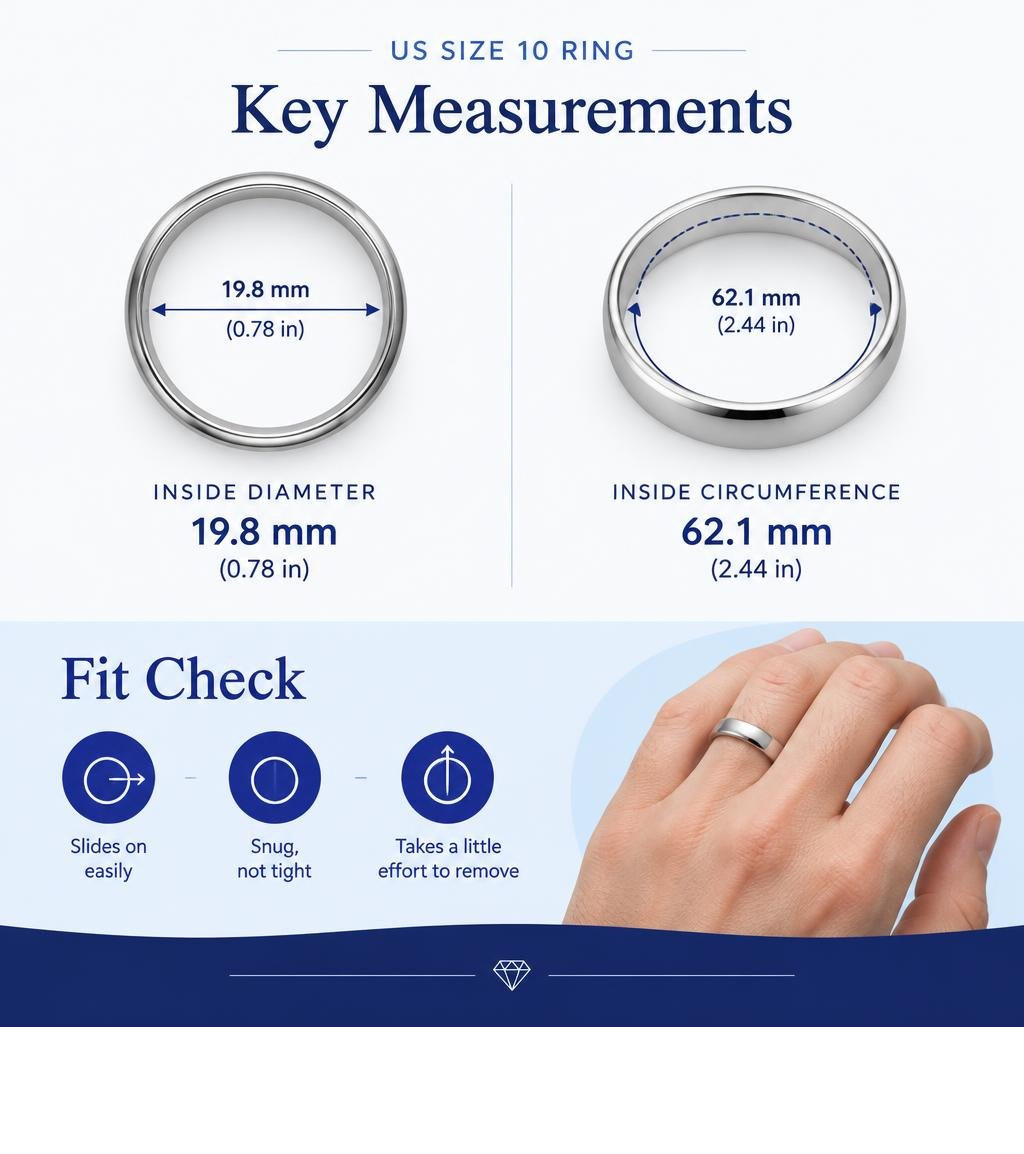
Exact Dimensions: How Big Is a Size 10 Ring?
When we talk about ring measurements in the jewelry world, we rely on two core metrics: inside diameter and inside circumference. The inside diameter is the straight line across the inner opening of the band, while the inside circumference is the total distance around the inner wall where your finger rests.
In the United States and Canada, standardized numerical sizing corresponds directly to these physical dimensions. Reviewing US ring size 10: diameter, mm & conversions shows that standard jewelers use tightly defined metric targets to ensure consistent sizing across different styles.
| Sizing Region / Standard | Size Equivalent | Inside Diameter (mm) | Inside Circumference (mm) | Inside Diameter (Inches) | Inside Circumference (Inches) |
|---|---|---|---|---|---|
| United States & Canada | 10 | 19.8 mm | 62.1 mm | 0.780 in | 2.445 in |
| United Kingdom & Australia | T ½ | 19.8 mm | 62.1 mm | 0.780 in | 2.445 in |
| European Union (ISO 8653) | 62 | 19.8 mm | 62.1 mm | 0.780 in | 2.445 in |
| Japan & East Asia | 20 | 19.8 mm | 62.1 mm | 0.780 in | 2.445 in |
| Germany | 62 | 19.8 mm | 62.1 mm | 0.780 in | 2.445 in |
| India | 22 | 19.8 mm | 62.1 mm | 0.780 in | 2.445 in |
How Big Is a Size 10 Ring in Millimeters and Inches?
In metric measurements, a standard US size 10 features an inside diameter of 19.8 millimeters and an inner circumference of 62.1 to 62.2 millimeters. When converted to imperial units, exploring the dimensions of a size 10 ring in inches reveals an inside diameter of roughly 0.78 inches and a circumference of about 2.44 inches.
To visualize this, 19.8 millimeters is almost 2 centimeters across, which is roughly the diameter of a standard US penny (19.05 mm) or the width of an average adult thumb. Because jewelry requires exceptional precision, even a fraction of a millimeter changes how a ring feels. A quarter-size shift alters the inside diameter by merely 0.16 to 0.20 millimeters, making millimeter-level accuracy essential when selecting your fine jewelry.
How Big Is a Size 10 Ring Compared to Average Men's and Women's Sizes?
Ring sizes vary across demographics, hand shapes, and lifestyles:
- Men's Baseline: The typical average men's ring size in the US spans between size 9 and size 10. A size 10 is considered standard to slightly above average for men, fitting comfortably on medium to large hands.
- Women's Baseline: The standard average women's ring size falls between size 6 and size 7. A size 10 is noticeably larger than average for a woman's traditional ring finger, often functioning as an index finger ring, thumb ring, or an option within plus sized wedding bands.
Finger proportions depend heavily on overall frame, knuckle structure, and genetics. Size 10 simply represents a physical circumference of 62.1 mm, offering a balanced, comfortable fit for many wearers across different fingers.
International Conversions for US Size 10
Shopping for an international designer or traveling abroad requires converting between different regional sizing scales:
- UK, Ireland, and Australia: These regions utilize an alphabetical scale. A US size 10 aligns with size T ½. If you encounter half sizes labeled as size T, that equates roughly to a US 9.75.
- European Union (ISO Standards): Most EU countries use the ISO 8653 standard, which reflects the inner circumference in millimeters. A US size 10 converts directly to EU size 62.
- Japan and East Asia: The Asian numbering system starts smaller and scales upward; a US size 10 corresponds to a Japanese size 20.
- Germany: German jewellers typically rely on the inside circumference or exact inside diameter, meaning you will see this size marked as 62 (circumference) or occasionally 19.8 (diameter).

How to Accurately Determine Your Ring Size at Home
Finding your ring size at home can help you narrow down your options before visiting a professional showroom. While home methods give you a solid baseline, taking your time and avoiding common measurement mistakes will ensure accurate results.
Learning how to size a ring properly prevents the hassle of returns and resizing delays. Below are the most reliable methods to test your finger size at home.
Using a Printable Ring Sizer and Calibration Line
Printable charts offer a quick visual way to compare existing rings or wrap a paper scale around your finger. However, printer scaling issues can introduce significant sizing errors. A print job scaled down by just 5% can reduce your reading by an entire ring size.
- Consult a reliable Printable Ring Size Chart guide and set your printer dialog to "100%" or "Actual Size" rather than "Fit to Page."
- Always check the printed page's calibration line with a physical ruler; the reference bar must measure exactly 50 mm.
- If you do not have a printer, utilize a screen-calibrated digital ring sizer that uses a standard credit card (which measures 53.98 mm globally) against your screen to calibrate the display accurately.
Measuring with a Tailor's Tape or String
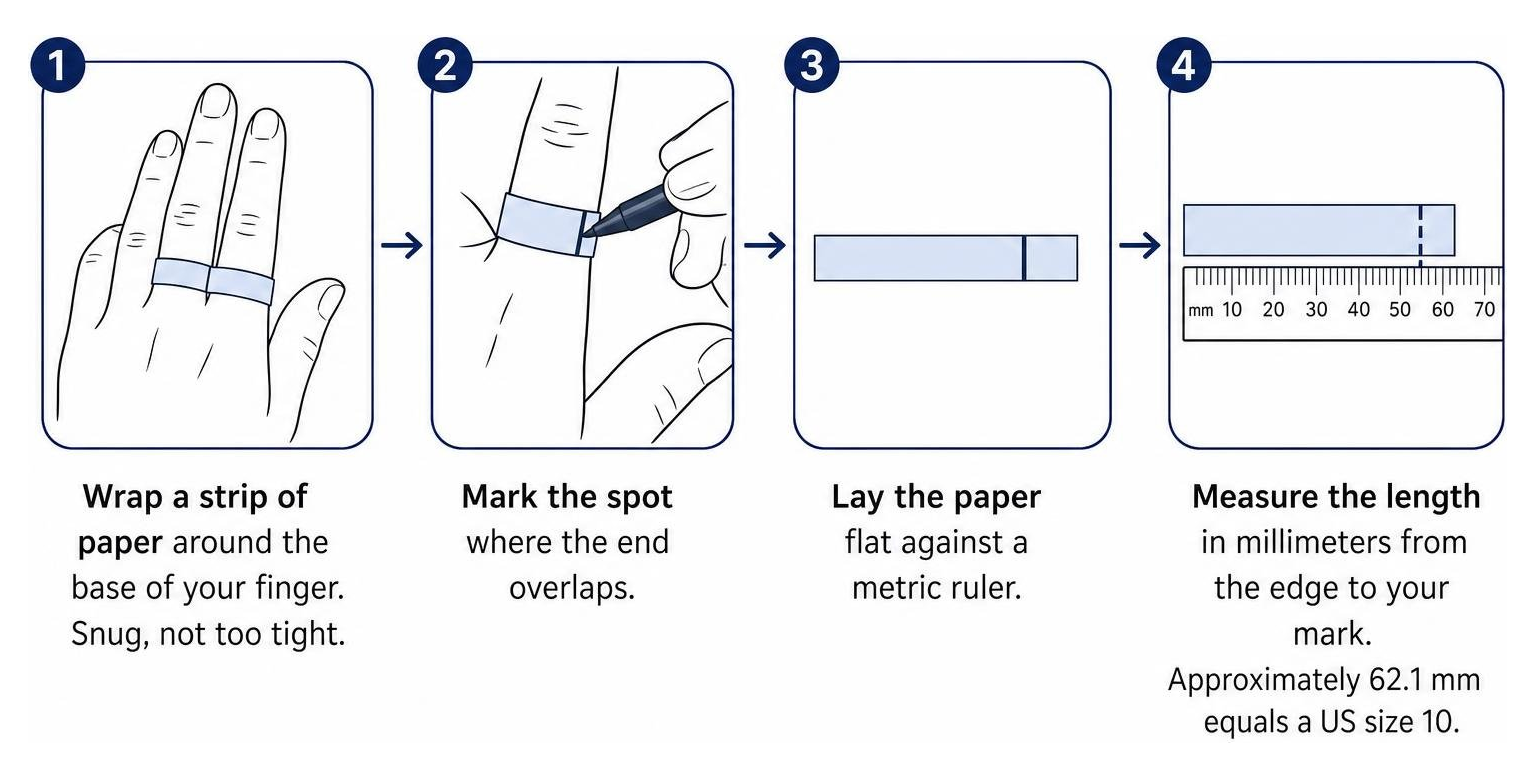
If you are wondering how can I work out my ring size using everyday household items, a flexible tailor's tape or a strip of paper is your best option:
- Wrap a flexible, non-elastic measuring tape or narrow strip of paper snugly around the base of your chosen finger.
- Mark the exact spot where the end overlaps without pulling the material too tightly.
- Lay the paper flat against a metric ruler and record the length in millimeters.
- If your measurement reads approximately 62.1 mm, you need a US size 10.
- Avoid using stretchy yarn or thin sewing thread, as elasticity can cause you to underestimate your actual finger size.
Key Factors That Influence How a Size 10 Ring Fits
A ring's numerical size tells only part of the story. Physical hand dynamics, daily environmental changes, and band architecture all affect how a size 10 feels on your hand.
Our average male ring finger guide emphasizes that ring fit is a dynamic balance between security and comfort.
Band Width and the Half-Size Rule
The width of your band changes how much surface area touches your skin:
- Narrow Bands (2 mm to 4 mm): These slide over knuckles easily and displace minimal skin, fitting true to standard sizing.
- Wide Bands (6 mm to 10 mm+): Wider rings trap more friction across the finger. A wide band in size 10 will feel noticeably tighter than a thin 2 mm solitaire in size 10.
- The Rule of Thumb: If your band is 6 mm wide or broader, we recommend ordering a half-size up (size 10.5) to maintain all-day comfort.
- Interior Profile: Rings with a "comfort-fit" domed interior glide over the knuckle more smoothly than flat "standard-fit" bands, offsetting some of the snugness of wider designs.
Knuckle Size, Temperature, and Daily Fluctuations
Your finger size naturally fluctuates throughout the day based on temperature, physical exertion, and hydration levels:
- Temperature Swings: Cold temperatures cause blood vessels to constrict, making rings feel loose. Warm weather, hot showers, or workouts cause fingers to swell.
- Time of Day: Measure your finger in the late afternoon or evening when your hands are at their natural resting size.
- Knuckle Obstacles: If your knuckle is significantly broader than the base of your finger, choose a size that slides over the joint with gentle resistance. Sizing solely for the finger base may result in a ring that cannot clear the knuckle.
- Dominant Hand Differences: Your dominant hand is almost always a half-size to a full size larger than your non-dominant hand due to muscle development and daily activity.
Resizing and Adjusting a Size 10 Ring
Even with careful measurements, you may occasionally need a size adjustment. Whether you inherit an heirloom or experience natural changes in finger size over time, most fine jewelry can be resized safely.
Understanding how are gold rings resized provides clarity on what can be achieved at the jeweler's bench.
How Jewelers Alter Ring Dimensions
Professional jewelers use time-tested bench techniques to alter ring dimensions:
- Sizing Down: The goldsmith cuts a precise section of metal from the back of the shank, brings the ends together, solders the seam with gold solder or a laser welder, and polishes the ring smooth.
- Sizing Up: For minor adjustments (up to a quarter size), simple bands can sometimes be stretched on a mandrel. For larger increases, the jeweler cuts the band, inserts an matching bridge of precious metal, solders the joints, and blends the contour seamlessly.
- Safe Thresholds: Most traditional gold, platinum, and silver rings can be adjusted up or down by 1 to 2 full sizes without compromising structural integrity or loosening gemstone prongs.
Alternative Solutions for Non-Resizable Metals
Certain contemporary metals and specialized ring designs cannot be resized through traditional cutting and soldering:
- Tungsten Carbide and Titanium: These metals are too hard or brittle to be cut and soldered. Rings made from these materials typically need to be exchanged for a new size rather than altered.
- Full Eternity Bands: Because gemstones encircle the entire band, cutting into the ring disrupts prong settings and diamond spacing.
- Sizing Beads: If your size 10 ring spins because of a large knuckle, a jeweler can solder two small precious metal beads inside the lower shank to hold the ring upright without changing the overall diameter.
- Silicone Adjusters and Ring Guards: Flexible silicone coils provide an immediate, non-invasive temporary fix if your band feels loose during winter months.
Frequently Asked Questions About Size 10 Rings
Is a size 10 ring considered large for a woman?
Yes, a US size 10 is larger than the standard average women's ring size (which is size 6 to 7). However, hand structures vary widely. A size 10 is common for women wearing statement rings, thumb rings, or index finger bands, as well as those with larger bone structures or arthritis in the knuckles.
What should I do if my size 10 ring spins on my finger?
If a ring clears your knuckle comfortably but spins at the base, it is usually top-heavy due to a large center diamond or gemstone. Adding internal sizing beads, an inner spring insert, or using an inexpensive clear ring guard will stabilize the ring without preventing it from sliding over your knuckle.
Is a US size 10 the same as a UK size 10?
No. The UK sizing system uses letters rather than numbers. A US size 10 corresponds to a UK size T ½. If you order an item labeled "size 10" from a British jeweler, you may receive a ring calibrated to an entirely different regional system. Always verify the inner diameter (19.8 mm) or circumference (62.1 mm) when ordering internationally.
Conclusion
Finding the right ring size is essential for daily comfort and peace of mind. A US size 10 ring offers an inner diameter of 19.8 mm and an inside circumference of 62.1 mm, serving as a reliable standard for men's wedding bands and broader women's fashion rings alike. While home sizing guides give you a helpful starting point, nothing replaces the precision of professional sizing tools and hands-on guidance.
If you have questions about custom adjustments or want to learn how ring resizing works, our family-owned team at Jeweler's Touch is here to help. Serving Southern California clients from our Brea showroom since 1992, our expert goldsmiths ensure every piece fits securely and feels exceptional on your hand. Visit us in person or reach out to our team today to find your ideal fit.