

Understanding US Ring Sizes and Sizing Standards
To work out your ring size at home, wrap a non-stretch paper strip snugly around the base of your finger, mark where it overlaps, and measure that length in millimeters. Then compare the measurement to a US ring size conversion chart. If you already have a ring that fits, measure its inner diameter in millimeters and match that number to the chart instead. This gives you a reliable starting point before considering fit factors like knuckle clearance and band width.
In the United States, ring sizes operate on a standardized numerical scale running from size 3 up to size 13 and beyond, using quarter and half-size increments. Each whole size step represents an increase of roughly 0.8 millimeters in inner diameter or about 2.5 millimeters in circumference. Because tiny fractions of a millimeter determine the boundary between sizes, absolute precision matters.
Standard jewelry manufacturing aligns closely with the international standard (ISO 8653:2016), which defines ring size by inner circumference in millimeters. To help you translate your raw measurements into a standard US size, use this comprehensive conversion table:
| US Ring Size | Inside Diameter (mm) | Inside Circumference (mm) | UK / Australia Size | EU / ISO Size |
|---|---|---|---|---|
| 3.0 | 14.1 mm | 44.2 mm | F | 44 |
| 3.5 | 14.5 mm | 45.5 mm | G | 45.5 |
| 4.0 | 14.9 mm | 46.8 mm | H | 47 |
| 4.5 | 15.3 mm | 48.0 mm | I | 48 |
| 5.0 | 15.7 mm | 49.3 mm | J½ | 49 |
| 5.5 | 16.1 mm | 50.6 mm | L | 50.5 |
| 6.0 | 16.5 mm | 51.9 mm | L½ | 52 |
| 6.5 | 16.9 mm | 53.1 mm | N | 53 |
| 7.0 | 17.3 mm | 54.4 mm | N½ | 54 |
| 7.5 | 17.7 mm | 55.7 mm | P | 56 |
| 8.0 | 18.1 mm | 57.0 mm | P½ | 57 |
| 8.5 | 18.5 mm | 58.3 mm | R | 58 |
| 9.0 | 18.9 mm | 59.5 mm | R½ | 60 |
| 9.5 | 19.4 mm | 60.8 mm | S½ | 61 |
| 10.0 | 19.8 mm | 62.1 mm | T½ | 62 |
| 10.5 | 20.2 mm | 63.4 mm | U½ | 63.5 |
| 11.0 | 20.6 mm | 64.6 mm | W | 65 |
| 11.5 | 21.0 mm | 65.9 mm | X | 66 |
| 12.0 | 21.4 mm | 67.2 mm | Y | 67 |
| 12.5 | 21.8 mm | 68.5 mm | Z | 68.5 |
| 13.0 | 22.2 mm | 69.7 mm | Z½ | 70 |
Average Ring Sizes for Men and Women
If you are shopping for a surprise proposal or starting from scratch, knowing national averages gives you a sensible baseline. For women, the most common ring size for women across the country is size 6, with most women falling in the size 4 to 8 range.
When it comes to gentlemen, the average mens ring size is a size 9, with standard sizing typically spanning from 8 to 12. While these baselines help when narrowing down your options, you should always aim to take custom measurements rather than relying on statistical averages alone.
Key Differences: Diameter vs. Circumference
When calculating your size, you will work with two primary geometric properties: inner diameter and inner circumference.
- Inner Diameter: The straight line across the widest inside center of the ring opening. Checking a ring size inner diameter is ideal when measuring a ring you already own. Never measure from outer edge to outer edge, because the thickness of the metal band will throw off your numbers.
- Inner Circumference: The total distance wrapped around the outside of your finger. This is what you measure when using a strip of paper or a flexible tailor's tape.
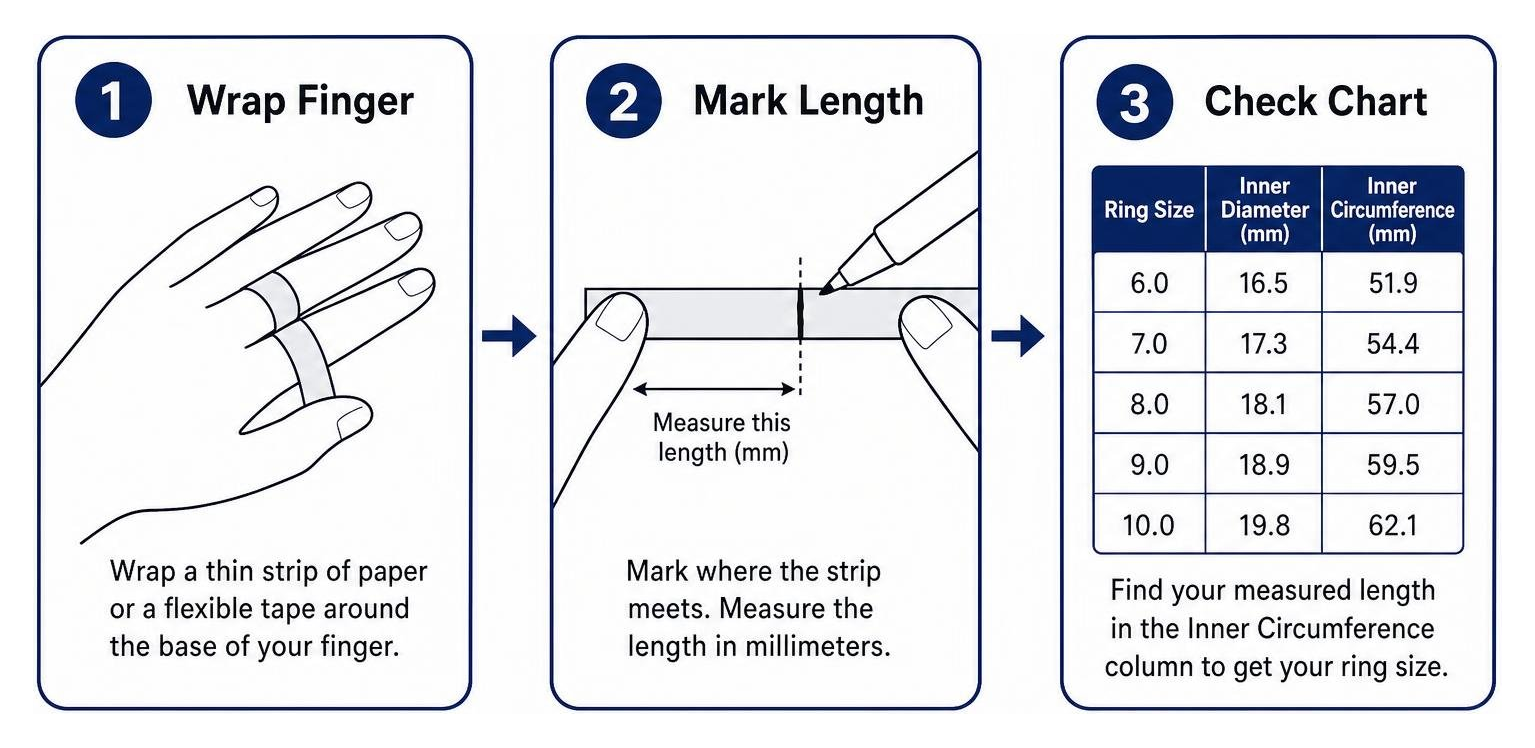
A single millimeter change in diameter corresponds to more than three millimeters in circumference ($\pi \times \text{diameter}$). That tiny difference can shift your band by an entire full size, making a millimeter-precise ruler essential.
How Can I Work Out My Ring Size at Home?
Learning how to size a ring using everyday items is straightforward when you use the right materials and technique. To get the most accurate results at home, keep the following checklist in mind:
- Use a firm, non-elastic material: Flexible paper, thin craft ribbon, or tailor's tape work best.
- Rely on millimeters: Never round to the nearest eighth or sixteenth of an inch; tiny fractions translate to substantial fit differences.
- Test at room temperature: Cold fingers shrink and warm fingers swell.
- Measure two to three times: Take separate measurements across morning, afternoon, and evening to determine your true average.
- Check your knuckle clearance: The band must comfortably glide over the knuckle without intense friction.
How Can I Work Out My Ring Size Using Paper or String?
The paper strip method remains the most consistent DIY home technique. While string is commonly suggested, many types of household yarn or baker's twine stretch easily, which leads to ordering a ring that is far too tight. If you prefer thread, review our guide to string ring sizing techniques to ensure you choose non-elastic craft cord.
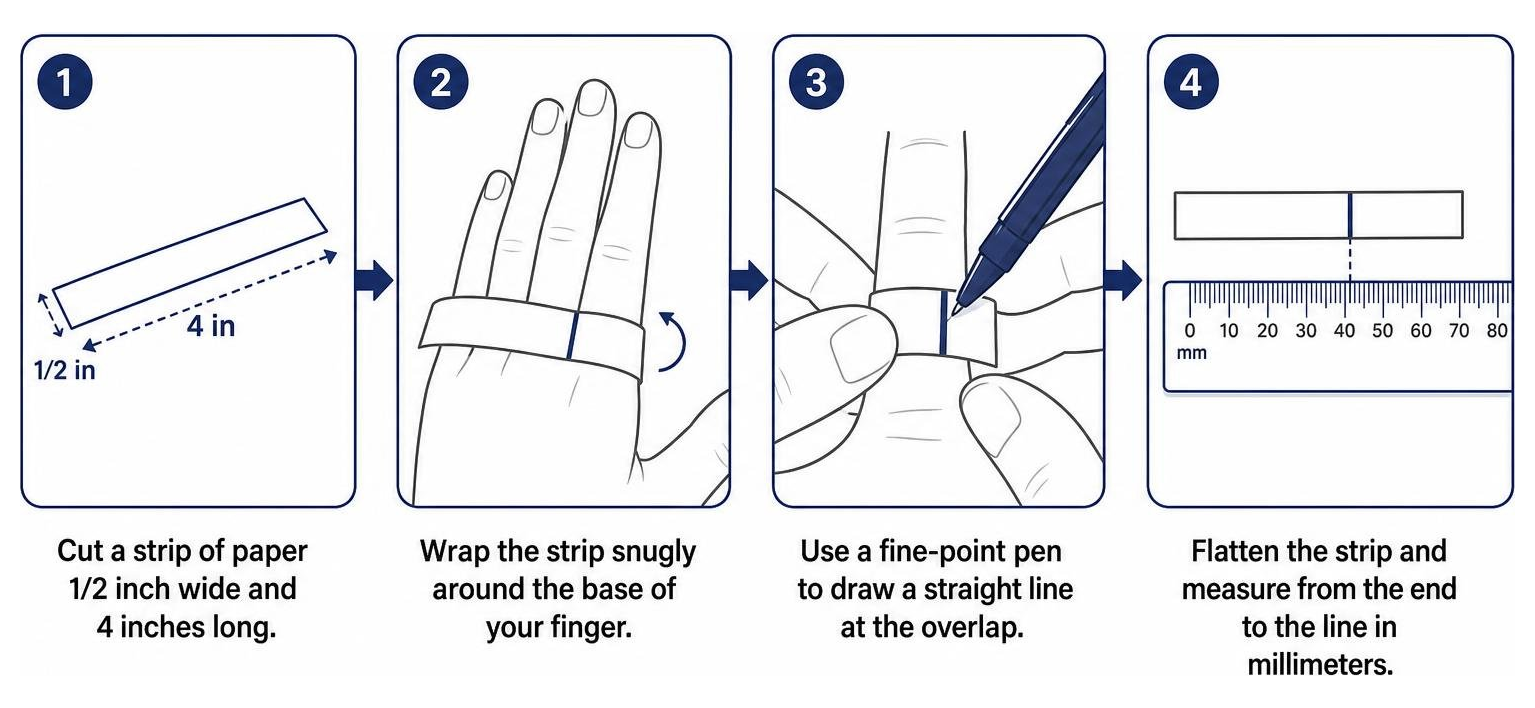
Follow these steps for the paper method:
- Cut a clean, straight strip of paper roughly 1/2 inch wide and 4 inches long.
- Wrap the strip snugly around the base of your intended finger without pulling it so tight that it pinches the skin.
- Use a fine-point pen to draw a sharp, straight line across the overlapping edge.
- Flatten the strip against a flat ruler and record the distance from the end to your line in exact millimeters.
- Cross-reference that circumference reading with our sizing chart above (for example, 54.4 mm equals a US size 7).
How Can I Work Out My Ring Size with an Existing Ring?
If you already own a band that fits the exact finger you are shopping for, you can use it to determine your size quickly.
- Place the ring flat over a sturdy metric ruler.
- Align the zero line with the inner left metal wall of the ring.
- Read the measurement straight across the widest open center directly to the inside right edge.
- Record the inside diameter in millimeters. For instance, an inner diameter of 16.5 mm corresponds to a standard US size 6. If you have access to digital calipers, they provide an even more exact measurement.
Calibrating with Digital Tools and Bank Cards
You can also use an online interactive ring sizing tool right on your smartphone, tablet, or laptop screen.
These digital tools rely on physical calibration using an ordinary bank card. All standard payment cards follow the ISO/IEC 7810 ID-1 specification, measuring exactly 85.60 mm wide by 53.98 mm tall. By placing your card against the screen and adjusting the on-screen slider until the outline matches your card, the software sets an exact pixel-to-millimeter ratio. When properly calibrated, digital sizers provide accurate readings within 0.5 mm, allowing you to rest an existing ring directly on the screen circle to verify your size.
Critical Factors That Alter Your Ring Fit
Your ring size is not a permanent, static number. Human fingers change in size throughout the day based on biological and environmental factors.

Knuckle Clearance and Daily Swelling
Fingers expand and contract due to temperature, diet, and physical activity:
- Time of Day: Hands are naturally slightly smaller upon waking and swell toward the end of the day as fluid settles. Late afternoon or evening is generally the most reliable time to measure.
- Temperature: Cold air constricts peripheral blood vessels, causing fingers to shrink. Warm summer weather, hot showers, or intense workouts cause fingers to swell.
- Prominent Knuckles: If your knuckle is notably wider than the base of your finger, take two separate measurements: one at the base and one directly over the widest part of the knuckle. Choose a size halfway between the two measurements so the ring slides over the joint while remaining stable at the base.
- Dominant Hand: Your dominant hand is almost always a half-size larger than your non-dominant hand due to greater muscle development. Never measure your left hand and assume the right hand is identical.
Impact of Band Width on Fit
The width of the ring profile alters how tight it feels on your hand. Because wider bands displace more skin surface area, they create more friction against your finger:
- Narrow Bands (under 3 mm): Order your true measured size without any adjustments.
- Medium Bands (3 mm to 5 mm): Often fit true to size, though some people prefer ordering a quarter-size up for comfort.
- Wide Bands (6 mm and wider): You will generally need to add a half-size to a full size up for everyday comfort. This is particularly important when reviewing our men's wedding band sizing considerations, as wider profiles are common in men's jewelry styles.
Frequently Asked Questions About Ring Sizing
Should I size up or down if I am between ring sizes?
When your measurement falls between two standard sizes, we recommend sizing up to the larger half or quarter size. A slightly loose ring remains wearable throughout summer swelling or post-workout changes. If needed, a temporary silicone ring adjuster, clip-on sizing coil, or jeweler-installed sizing beads can keep it comfortably snug without permanent modification. A ring that is too small, by contrast, can trap circulation and cause discomfort.
Can all ring styles and metals be resized?
While traditional precious metals like yellow gold, white gold, and platinum are straightforward to adjust, understanding how gold rings are resized helps set realistic expectations. Most precious metal rings can easily shift 1 to 2 sizes up or down.
However, certain designs and metals have resizing limitations:
- Eternity Bands: Rings featuring diamonds continuous around the entire perimeter cannot be cut or resized without disrupting the stone seats.
- Alternative Metals: Contemporary metals like tungsten, titanium, and cobalt chrome are too hard and brittle to solder or stretch using standard goldsmithing equipment.
- Tension Settings: These rely on precise physical pressure from the metal band to hold the center gem in place, so alterations risk loosening the stone.
How tight should a ring comfortably feel on my finger?
A properly sized ring should slide over the knuckle with a gentle push, requiring light resistance to pull back off. Once seated at the base of your finger, it should turn without pinching and should not leave deep indentations or restrict circulation. You should feel secure knowing the ring will not slide off during hand movements, while still being able to remove it comfortably at the end of the day.
Conclusion
Finding your ring measurement at home using a paper strip, existing ring diameter, or digital screen calibration gives you a reliable starting point. Always remember to take multiple readings at different times of day, account for the width of the band, and factor in knuckle clearance.
For complete peace of mind, professional in-person sizing remains the gold standard. At Jeweler's Touch, our family-owned jewelry store in Orange County has served clients since 1992. Our team of expert on-site goldsmiths and staff GIA Graduate Gemologists are dedicated to helping you achieve an effortless fit. If you ever need adjustments down the road, explore our complete guide on how ring resizing works, or stop by our showroom for a complimentary professional sizing fitting today.