

Types of At-Home Sizing Tools Compared
Finding your ideal ring size at home does not have to feel like a guessing game. Today, several at-home measuring tools exist, ranging from quick printable charts to durable physical ring gauges. Selecting the right tool depends on your timeline, whether you have an existing ring to compare, and how precise you need the measurement to be.
| Tool Type | Accuracy Level | Material & Durability | Cost | Best For |
|---|---|---|---|---|
| Plastic Multi-Sizer Belt | High (within 0.5 size) | Flexible, reusable plastic | Free to ~$0.01 (or offset by credit) | Daily finger measuring, tracking knuckle clearance |
| Calibrated Printable Chart | Moderate to High | Standard printer paper | Free (Instant download) | Immediate measurements, matching existing rings |
| Metal Ring Gauge Set | Very High (Jeweler grade) | Stainless steel / zinc alloy | $8 – $15 | Heavy use, multi-finger projects, broad collections |
| Metal Ring Mandrel | Professional Standard | Solid aluminum / steel | $10 – $20 | Verifying inner diameters of finished rings |
Each method comes with clear trade-offs. A printable ring size calibration tool provides immediate answers if you own a printer and need a measurement tonight. However, flexible plastic belt sizers give you the tactile sensation of sliding a band over your knuckle, helping you judge real-world daily comfort. For ongoing jewelry projects, standalone metal gauges provide rigid accuracy that closely mirrors the feel of a solid precious metal band.
What Comes Inside a Standard Free Ring Sizing Kit
When you order a physical kit online, it typically arrives in a compact envelope. Most kits feature a flexible plastic multi-sizer belt that functions much like a miniature zip-tie or belt strap. The strap contains precise raised notches or printed increments representing standard US ring sizes, typically spanning from size 1 through size 17 in half-size gradations.
Some specialty kits designed for men's ring sizing feature wider gauge bands or individual plastic loop rings. Each plastic loop mimics a distinct band width, letting you test how wider profiles sit against the finger base. The primary advantage of these plastic loops and belts is reusability: you can store them in your jewelry box to check measurements whenever temperatures change or when shopping for gifts.
Physical Gauge Kits vs. Printable Paper Templates
Printable templates are popular because they require no waiting for postal delivery. You can cut out a paper measuring strip or place an existing ring over printed diameter circles to find a match. However, paper strips present significant accuracy risks. Paper can easily stretch, bend, or tear, leading to inaccurate readings that might cause you to purchase an ill-fitting band.
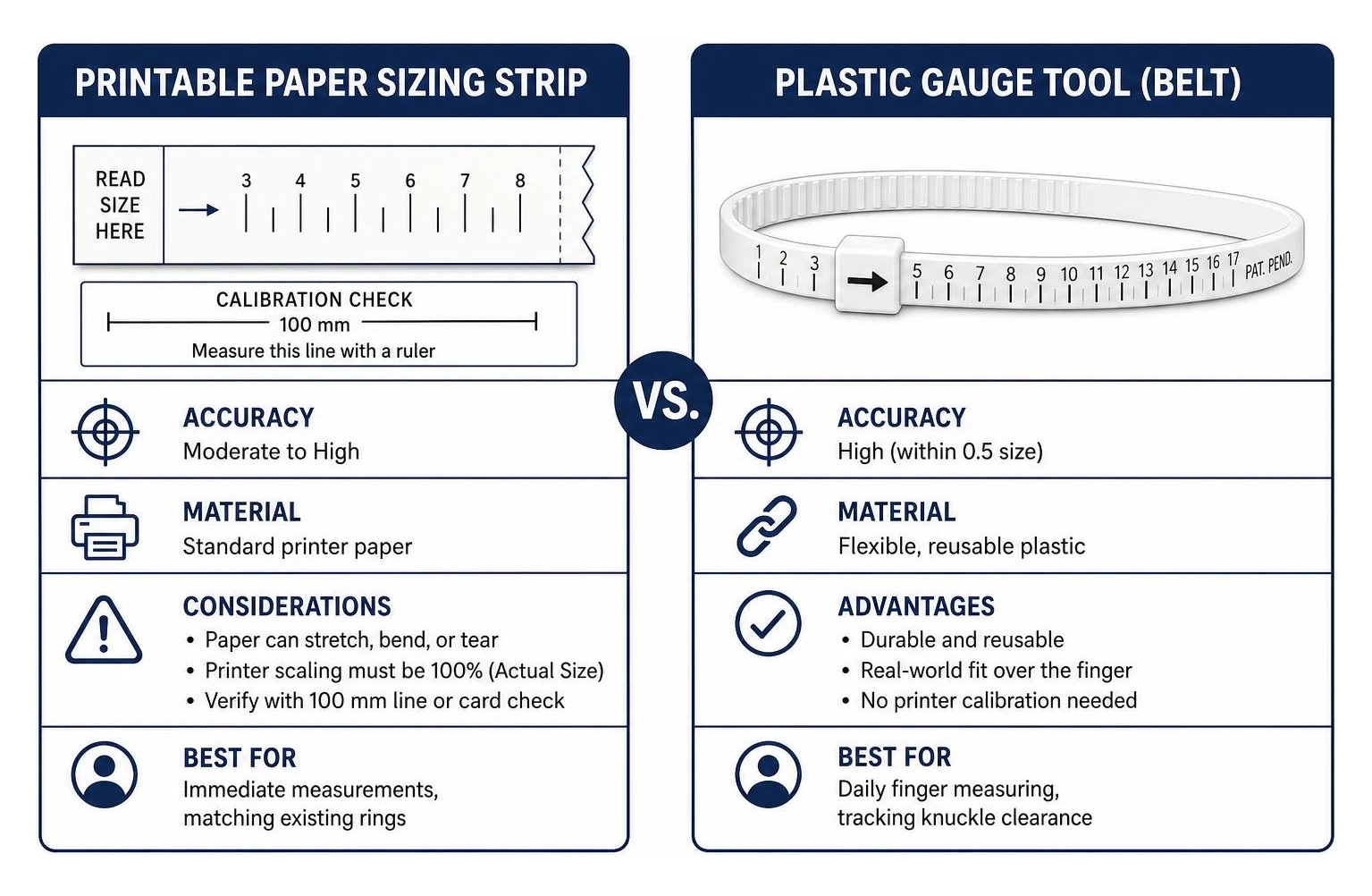
Furthermore, printable sheets rely entirely on your printer settings. If your printer defaults to "Scale to Fit" rather than "Actual Size (100%)," the entire scale will be skewed. Calibrated printable guides solve this by providing an on-screen credit card calibration box (standard cards measure 85.6 mm wide) or a physical 100 mm ruler bar on the printed sheet. Verifying that the 100 mm line measures exactly 100 mm with an actual ruler is essential before wrapping any paper around your finger.
For baseline context, the most common ring size for women in the United States ranges between a size 6 and size 7. If your printed test reads as a size 4 or a size 10 when your fingers appear average, your print scaling may be off. Physical plastic sizers eliminate this calibration hassle entirely because their molded graduations do not change scale.
How to Choose the Best Free Ring Sizing Kit for Your Needs
Not all complimentary sizing kits are structured the same way. When browsing online jewelry retailers, you will generally encounter three promotional approaches:
- 100% Free with Free Shipping: The brand covers the tool and postage completely (often limited to one per household for US residents).
- Nominal Cost ($0.01): The brand lists the item for one penny on their e-commerce platform to track inventory and shipping through standard checkout systems.
- Credit-Offset Kits ($10 to $15): You pay a small upfront fee for a physical kit containing plastic sizers or ring loops, and the company emails you an equivalent store credit code to apply toward your future ring purchase.
Evaluating the durability and intended use of the tool helps you pick the best option. If you are shopping for a classic band where the average mens ring size tends to land between size 9 and size 10, a multi-sizer belt that accommodates larger knuckles without pinching will deliver the most dependable result.
Reusable Plastic Belt Sizers
The multi-sizer belt remains the most common physical tool sent directly to consumers. To use it, you thread the pointed end through the buckle loop to create a circular ring. Slip your finger through the loop, pull the end until the belt fits comfortably around your finger base, and read the size indicated by the small marker arrow.
The crucial step with a belt sizer is testing knuckle clearance. A ring must fit comfortably over the widest part of your knuckle while remaining snug enough at the base so it does not slip off during daily hand movements. Once adjusted, slide the closed loop on and off your finger several times to verify that it moves smoothly with slight resistance over the knuckle.
Sizing Ring Loop Sets and Mandrels
If you prefer testing rigid circles rather than flexible straps, individual plastic or metal loop sets offer an authentic ring-wearing feel. These sets feature individual rings attached to a central wire cable or ring holder.
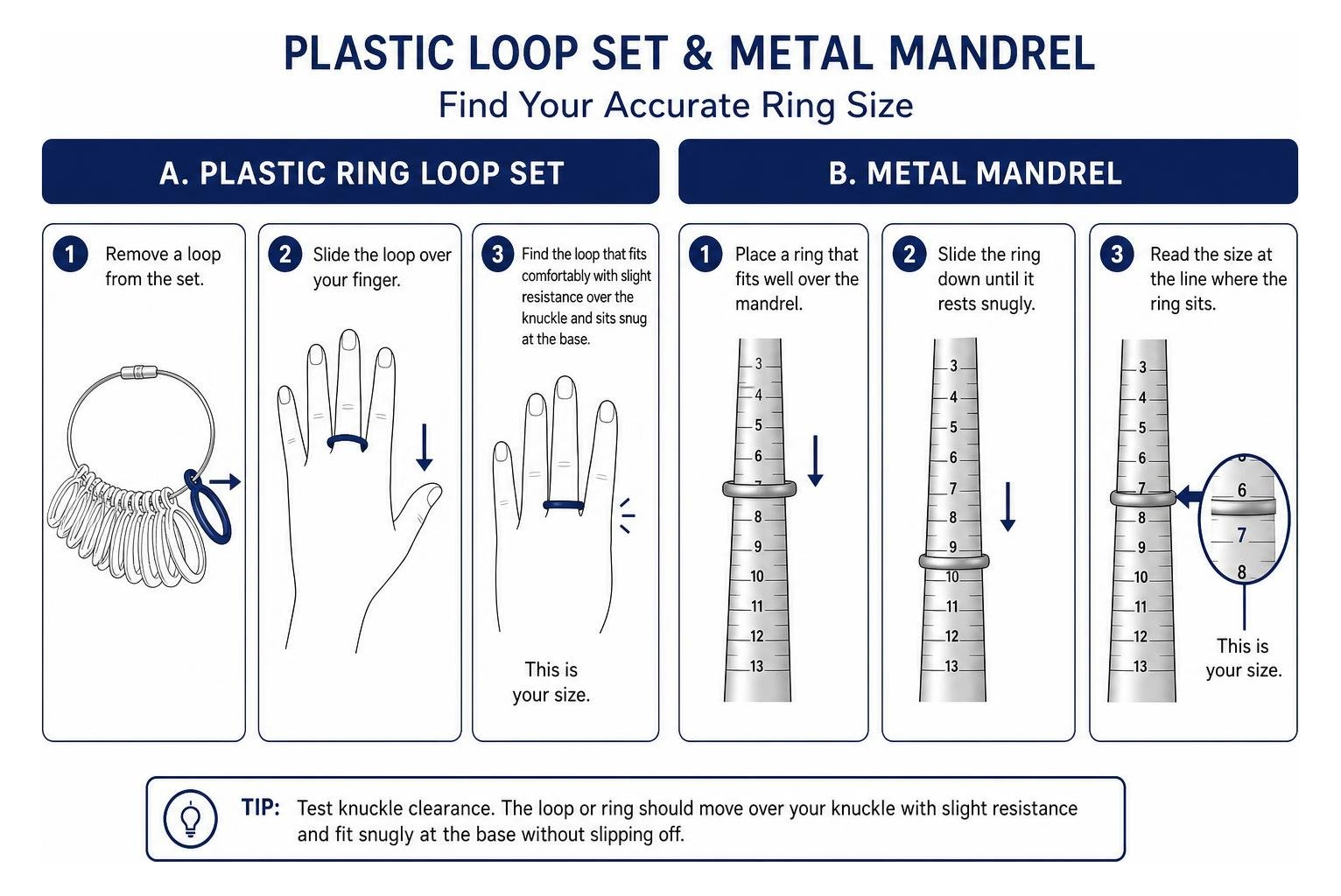
Using a set of rigid loops allows you to evaluate how different ring widths feel on your hand. A thin 2mm band feels lighter and looser than a thick 8mm band in the exact same finger size. When preparing to order a wider band, referencing a dedicated mens wedding band size guide helps ensure you select a size that accounts for the added metal contact along the finger.
Step-by-Step Measurement Guide and Expert Accuracy Tips
Human fingers are not static cylinders; their circumference fluctuates throughout the day based on hydration, activity, and climate. Following a structured measurement protocol prevents you from ordering a ring based on temporary swelling or shrinkage.
Fingers contract in cold weather and expand in high heat or after strenuous physical exercise. For the most dependable results, take measurements at room temperature during the late afternoon or evening when your hands are at their typical daily size.
When evaluating proportions, center stone dimensions also play a visual role in how a ring sits. As noted in our one carat ring size guide, band proportions and stone settings influence how top-heavy a ring feels, making a precise fit at the finger base essential to prevent spinning.
How to Use a Free Ring Sizing Kit for Maximum Accuracy
To obtain the most accurate measurement at home using your physical kit, follow these actionable best practices:
- Take Multiple Readings: Measure your target finger across two to three consecutive days at different times. If the size consistently reads the same mark, you have found your baseline.
- Test the Knuckle Transit: Adjust the sizer snugly around the base of your finger, then attempt to remove it without loosening the buckle. It should offer mild resistance over the knuckle without causing pain.
- Perform the Shake Test: With the sizing loop resting in place, point your hand downward toward a soft surface and gently shake your hand. If the sizer slides off effortlessly, it is too loose.
- Account for Hand Dominance: Your dominant hand is often half a size larger than your non-dominant hand. Always measure the specific finger on the exact hand where you intend to wear the ring.
What to Do If You Fall Between Two Sizes
When your measurement lands directly between two distinct sizes on the gauge, deciding whether to size up or down depends on the ring style and finger anatomy.
In general, standard practice is to choose the larger size for daily comfort. A ring that is slightly roomy is far more comfortable than one that cuts off circulation during warmer summer months. Furthermore, sizing down a slightly loose ring later is often simpler than stretching or expanding a tight band.
Ring band width is a primary determining factor. Delicate bands narrower than 3mm have minimal surface contact with your skin and slide on easily, meaning your true measured size or half-size down will fit well. Conversely, wide bands measuring 6mm or wider create greater surface friction against your skin. For broad bands, going up a quarter or half size provides the breathing room you need. Reviewing our comprehensive diamond rings ultimate guide can give you deeper insights into how different shank profiles, cathedral settings, and eternity styles impact daily wearability.
Frequently Asked Questions About Home Ring Sizing
How accurate are plastic ring sizing kits compared to professional jeweler tools?
Plastic multi-sizer belts and ring loops are accurate to within approximately one-quarter to one-half of a standard US size when used correctly. While they offer a reliable estimate for most online purchases, they lack the rigid precision of calibrated steel jeweler mandrels and solid metal sizing rings. Professional jewelers use precision metal gauges calibrated to exact national standards, ensuring that custom-crafted mountings and stone settings match your finger perfectly.
How do international ring sizes convert to US sizes?
Ring sizing systems vary across regions, though all derive from the inner circumference and inner diameter of the ring band (standardized internationally under ISO 8653:2016). In the United States and Canada, ring sizes follow a numerical scale ranging from 1 to 16 with half and quarter increments.
| US Size | Inside Diameter (mm) | Inside Circumference (mm) | UK / Australia Size | EU / ISO Size |
|---|---|---|---|---|
| 4 | 14.86 mm | 46.68 mm | H 1/2 | 47 |
| 5 | 15.70 mm | 49.32 mm | J 1/2 | 49 |
| 6 | 16.51 mm | 51.87 mm | L 1/2 | 52 |
| 7 | 17.35 mm | 54.51 mm | N 1/2 | 55 |
| 8 | 18.19 mm | 57.15 mm | P 1/2 | 57 |
| 9 | 19.00 mm | 59.69 mm | R 1/2 | 60 |
| 10 | 19.84 mm | 62.33 mm | T 1/2 | 62 |
| 11 | 20.68 mm | 64.97 mm | V 1/2 | 65 |
| 12 | 21.49 mm | 67.51 mm | X 1/2 | 68 |
The United Kingdom, Australia, and New Zealand use an alphabetical letter system (from A to Z+), while European countries typically reference the inner circumference in millimeters (where a 52 mm circumference equals a European size 52). Standard industry conversion tables, such as Hoover & Strong charts, map these dimensions directly to standard US sizes.
Does ring band width change your required size?
Yes, band width has a direct effect on how tight a ring feels. A wide band covers more surface area on your finger, trapping skin and encountering greater friction as you move your joints. If you are ordering a ring with a band width of 6mm or wider, jewelers typically recommend ordering one-quarter to one-half size larger than your measured size on a standard narrow plastic sizer.
Additionally, bands manufactured with a "comfort-fit" interior (a slightly domed inner surface) slide over the knuckle more easily than "standard-fit" flat bands, often allowing you to stick closer to your standard measured size even in wider designs.
Finding Your Flawless Fit
At-home sizing tools and complimentary physical kits offer a convenient starting point for online shoppers, giving you the clarity needed to explore ring designs with peace of mind. Whether you use a flexible belt gauge or verify an existing ring against a calibrated chart, taking the time to measure your finger accurately protects your investment and helps avoid the inconvenience of post-purchase resizing.
When you are ready to explore heirloom-quality bands or design a bespoke piece, professional measurement remains the gold standard. At Jeweler's Touch, we have served clients across Southern California since 1992. Our team of expert goldsmiths and certified staff can verify your exact size and ensure your dream piece fits comfortably for a lifetime of daily wear.
If you are beginning your bridal journey, take a moment to start exploring engagement rings or visit our showroom in Brea, CA, to experience personalized fitting, custom design, and fine jewelry care firsthand.