

Spinel, Peridot, and August's Colorful Birthstones
Spinel is an August birthstone, alongside peridot and sardonyx. Added to the modern birthstone list in 2016, spinel offers colors from vivid red and pink to blue and violet. Its hardness of 8 on the Mohs scale also makes it a practical choice for rings.
Peridot brings a fresh green option, while spinel gives August birthdays a wider range of colors to explore. Some famous royal jewels once called rubies are actually red spinels.
I'm Ken Rutz of Jeweler's Touch, where our work in fine jewelry and custom engagement rings has given me a close view of how color shapes a piece. I'll help you get to know the spinel august birthstone, starting with the history and qualities that set it apart.

Understanding the Spinel August Birthstone: History and Recognition
For generations, jewelry lovers associated August primarily with the sunny lime-green hues of peridot and the reddish-banded patterns of sardonyx. That changed in 2016 when the American Gem Trade Association (AGTA) and Jewelers of America (JA) officially added spinel to the modern birthstone lineup. This update marked only the third time the official modern list had expanded since its creation in 1912, following the inclusions of alexandrite, citrine, tourmaline, and zircon in 1952, and tanzanite in 2002. As noted in the American Gem Society overview on August birthstones, August joined June and December as one of only three months represented by three distinct gemstones.
Long before earning its official birthstone status, spinel held an illustrious place in royal treasuries under a completely different identity: the "balas ruby." Because red spinel and ruby frequently formed in the same gravel deposits and displayed similarly intense crimson saturation, ancient and medieval merchants grouped them together.
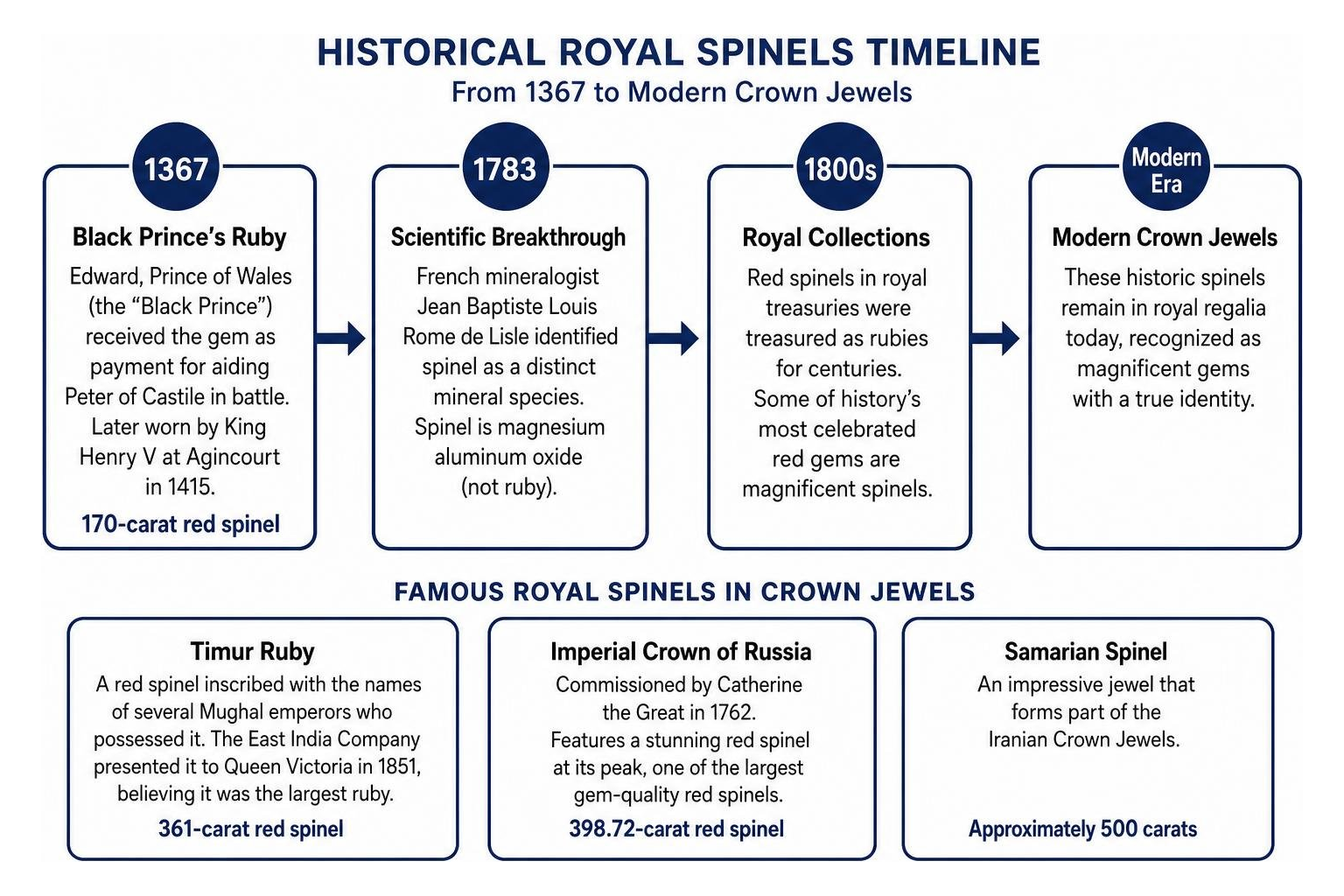
The scientific breakthrough that separated the two minerals did not occur until 1783, when French mineralogist Jean Baptiste Louis Rome de Lisle identified spinel as a distinct mineral species. While ruby is aluminum oxide (corundum), spinel is magnesium aluminum oxide. This pivotal discovery did not diminish spinel's prestige; instead, it helped launch modern gemology and revealed that some of history's most celebrated red gems were magnificent spinels.
Royal Mistaken Identities: Crown Jewels and Famous Gems
History's most famous royal collections feature extraordinary red spinels that were treasured for centuries as rubies. The most celebrated example is the Black Prince's Ruby, a massive 170-carat crimson cabochon mounted prominently on the Imperial State Crown of Great Britain, set directly above the 317.40-carat Cullinan II diamond. Edward, Prince of Wales (the "Black Prince") received the gem in 1367 as payment for aiding Peter of Castile in battle. King Henry V later wore the same jewel on his battle helmet at the Battle of Agincourt in 1415.
Other legendary spinels in royal regalia include:
- The Timur Ruby: A 361-carat red spinel inscribed with the names of several Mughal emperors who possessed it over centuries. The East India Company presented the gem to Queen Victoria in 1851, believing at the time that it was the largest ruby in existence.
- The Imperial Crown of Russia: Commissioned by Catherine the Great in 1762, this masterwork features a stunning 398.72-carat red spinel resting at its peak, regarded as one of the largest gem-quality red spinels in the world.
- The Samarian Spinel: Weighing approximately 500 carats, this impressive jewel forms part of the Iranian Crown Jewels.
- The Carew Spinel: A 133.5-carat gem etched with historical royal provenance, now housed in London's Victoria and Albert Museum.
As highlighted in the GIA guide to August birthstones, these iconic royal stones proved that spinel has always possessed the fiery beauty and durability required of history's greatest heirloom gems.
The Symbolism and Meaning Behind the Spinel August Birthstone
Beyond its royal pedigree, spinel carries rich symbolism. Throughout history, red and pink spinels were believed to revitalize energy, inspire passion, and banish negative thoughts. Ancient scholars considered spinel a stone of rejuvenation and mental balance, helping its wearer overcome exhaustion and stress.
In modern fine jewelry traditions, spinel is the celebratory gemstone for the 22nd wedding anniversary. Its vibrant, unyielding nature represents enduring strength and deep commitment. Whether you wear it for metaphysical harmony, an anniversary milestone, or as an August birthstone, you can discover more about its cultural place in our comprehensive guide to selecting birthstones in 2026.
Colors, Origins, and Gemological Properties of Spinel
Gemologically, spinel is an isometric mineral belonging to the cubic crystal system. It crystallizes primarily as regular octahedrons, often resembling two pyramids joined at their bases. Its crystal habit is so sharp and pointed that its name is believed to derive from the Latin word spina, meaning "thorn."
One of spinel's most remarkable physical characteristics is its singly refractive optical nature. Unlike doubly refractive gems such as ruby, sapphire, and tourmaline, which split light into two rays as it enters the stone, light travels through spinel at the same speed in all directions. This single refraction gives fine spinel pure, uninterrupted color and exceptional clarity. Detailed research on its internal structures is available in the GIA gemological analysis of spinel micro-features, showing that natural spinels form through contact metamorphism when magnesium-rich limestone and dolomite marble undergo intense heat and geological pressure.
The Vibrant Color Spectrum of Spinel

Pure spinel is chemically colorless, but natural trace element substitutions during crystallization produce a rich spectrum of shades.
- Red and Crimson: Caused by chromium impurities, vibrant red spinels rival top-grade Burmese rubies in fire and saturation.
- Hot Pink and Neon Pink: Chromium combined with low iron levels yields electric pinks, such as the famous gems mined in Tanzania.
- Cobalt Blue: Trace amounts of cobalt produce an intense, electric blue that is among the rarest and most sought-after colors in the gem trade.
- Violet, Purple, and Lavender: Combinations of iron and chromium create soft pastels, moody lilacs, and rich royal purples.
- Gray and Metallic Silver: Highly modern and increasingly popular for contemporary rings, gray spinels display cool undertones caused by iron concentrations.
- Orange and Flame (Rubicelle): Blends of chromium and iron produce warm sunset hues.
To see how these hues compare to other monthly gems, review our overview of gemstone colors by month.
Global Sources of the Spinel August Birthstone
Fine gem-quality spinel comes from a select few geological deposits around the globe:
- Mogok, Myanmar (Burma): Renowned for centuries for producing deep crimson and flame-red spinels. Burmese crystals are frequently so lustrous and well-formed directly from the ground that local miners refer to them as Nat Thwe, or "spirit-polished."
- Luc Yen, Vietnam: A rugged mountainous region famous for producing neon pinks, purples, and rare electric cobalt blue spinels.
- Mahenge, Tanzania: Discovered in the early 2000s, this deposit transformed the gemstone market by yielding high-clarity spinels in vivid hot pink, red-orange, and fuchsia.
- Ratnapura, Sri Lanka: Known as the "City of Gems," Sri Lanka produces fine pastel pink, lavender, deep blue, and violet spinels from historic alluvial gravels.
- Pamir Mountains, Tajikistan: The ancient source of the legendary historic "balas rubies," still producing large, clean pink and red spinel crystals.
Trade groups such as the AGTA showcase these diverse geographic origins during their annual gem showcases, as discussed in the AGTA overview of August gemstones.
Spinel vs. Ruby, Sapphire, and Peridot: Value and Durability
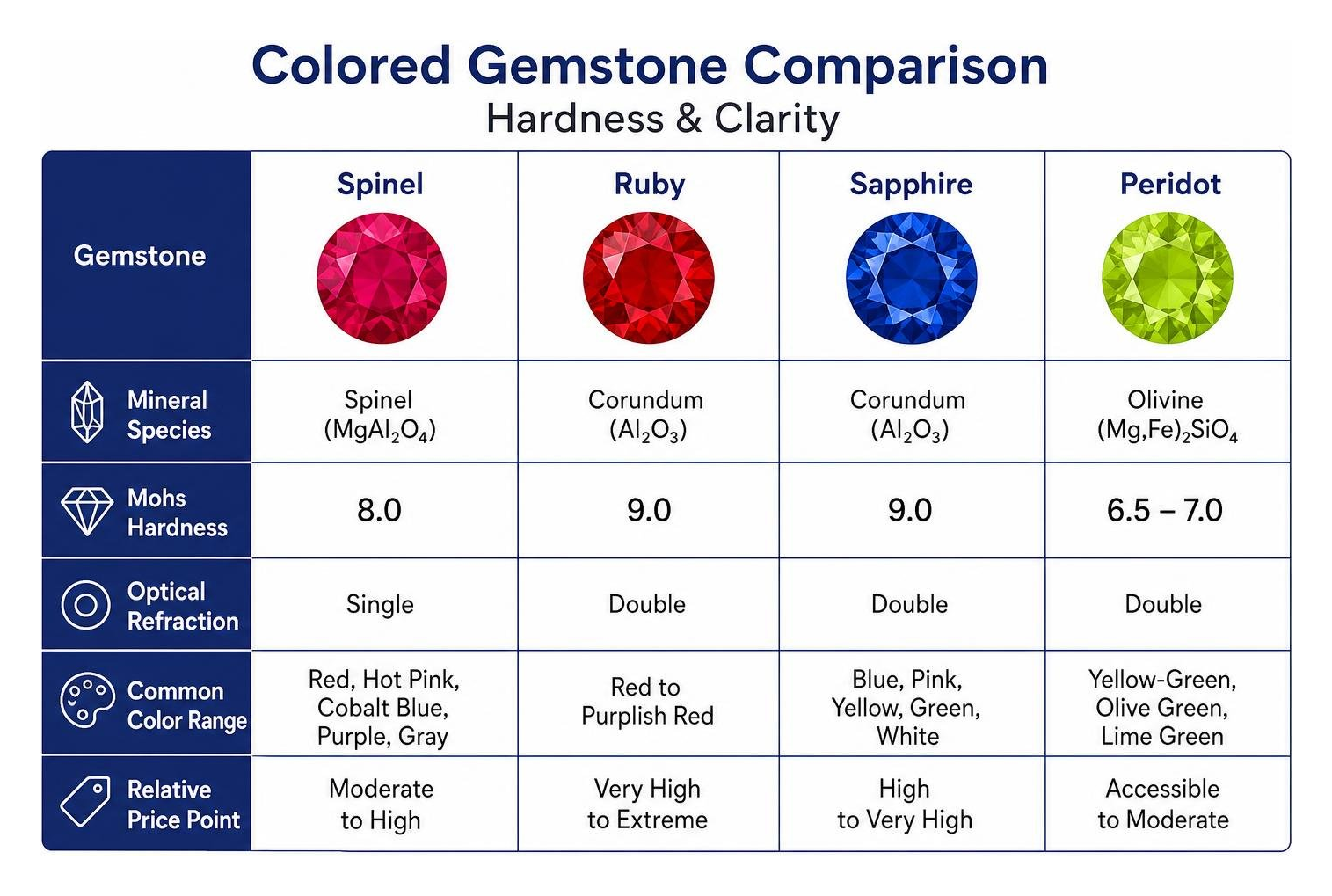
When selecting an August birthstone or building a custom colored gemstone ring, it is helpful to understand how spinel compares to other popular fine gems. Ranking an 8 on the Mohs scale of hardness, spinel is significantly harder than peridot (6.5 to 7.0) and closely approaches ruby and sapphire (9.0).
| Gemstone | Mineral Species | Mohs Hardness | Optical Refraction | Common Color Range | Relative Price Point |
|---|---|---|---|---|---|
| Spinel | Spinel (MgAl2O4) | 8.0 | Single | Red, Hot Pink, Cobalt Blue, Purple, Gray | Moderate to High |
| Ruby | Corundum (Al2O3) | 9.0 | Double | Red to Purplish Red | Very High to Extreme |
| Sapphire | Corundum (Al2O3) | 9.0 | Double | Blue, Pink, Yellow, Green, White | High to Very High |
| Peridot | Olivine (Mg,Fe)2SiO4 | 6.5 - 7.0 | Double | Yellow-Green, Olive Green, Lime Green | Accessible to Moderate |
One major advantage of natural spinel is that it is rarely subjected to routine heat treatments. While the vast majority of commercial rubies and sapphires on the market undergo high-temperature heat treatment to improve color and clarity, fine spinels emerge from the earth with their natural color and fire fully developed. Spinel is rarer in nature than diamond and ruby, yet it often commands a more approachable price per carat in comparable sizes, representing exceptional value for jewelry collectors.
If you are exploring fine birthstone options for a proposal or milestone gift, check out our creative design ideas for August birthstone engagement rings.
Spinel in Fine Jewelry and Engagement Rings
Spinel's high hardness rating, combined with its lack of distinct cleavage planes, makes it resistant to chipping, cracking, and surface abrasions. These qualities make it an ideal center stone for daily-wear jewelry, including custom engagement rings, cocktail rings, and fine pendants.
Because gem cutters often work with natural octahedral rough crystals to retain maximum carat weight, natural spinels are frequently cut into custom cushion shapes, ovals, and radiant cuts rather than calibrated commercial sizes. Spinel pairs beautifully with both warm yellow gold and cool white metals such as platinum or 18K white gold, particularly when framed by brilliant diamond halos. You can view custom styling concepts in our gallery of custom August birthstone engagement rings.
Essential Care, Cleaning, and Maintenance for Spinel
Caring for fine spinel jewelry is straightforward due to the gemstone's natural chemical stability and physical toughness. To maintain your jewelry's brilliance for decades:
- Routine Cleaning: Mix lukewarm water with a few drops of mild dish soap. Soak your jewelry for 10 to 15 minutes, then use a soft-bristle toothbrush to gently clean behind the setting where oils and dust accumulate. Rinse thoroughly with clean water and dry with a lint-free microfiber cloth.
- Mechanical Cleaning: Ultrasonic and steam cleaners are generally safe for natural spinel, provided the gemstone is untreated and free from open internal surface fractures. If you are unsure about your stone's internal clarity, stick to gentle hand washing.
- Heat and Chemicals: While spinel resists everyday household chemicals and light exposure, avoid exposing it to extreme, sudden temperature shifts (thermal shock), which can cause internal tension fractures.
- Proper Storage: Store your spinel jewelry in individual soft fabric pouches or separate jewelry box compartments to prevent it from rubbing against harder gems, like diamonds, or scratching softer stones, like peridot and pearls.
For a broader look at caring for all monthly stones, explore our complete August gemstone birthstone guide.
Frequently Asked Questions About August Birthstones
Why was spinel added as an August birthstone alongside peridot and sardonyx?
The American Gem Trade Association and Jewelers of America officially added spinel to the August birthstone list in 2016 to give consumers a wider range of colors, from rich reds and neon pinks to cool blues and modern grays, while honoring a gemstone with centuries of royal history.
How does spinel compare to ruby in terms of price and quality?
Spinel offers brilliance comparable to ruby due to its single refraction, high clarity, and natural color, which rarely requires heat treatment. Although fine spinel is geologically rarer than ruby, it is generally available at a more accessible price per carat, making it an outstanding fine jewelry value.
Is spinel durable enough for everyday ring wear?
Yes. With a Mohs hardness rating of 8 and no cleavage planes, spinel resists chipping, scratching, and everyday wear, making it a durable choice for engagement rings and daily jewelry.
Conclusion
The addition of spinel has elevated August's birthstone lineup into one of the most versatile in the entire jewelry world. Whether you are drawn to the classic green glow of peridot or the fiery reds, electric pinks, and cool cobalt blues of spinel, these gemstones provide endless inspiration for personalized gifts and custom jewelry pieces.
At Jeweler's Touch, our family-owned business has served clients across Orange County and Brea, California since 1992. Our on-site team of expert goldsmiths, along with our 3 GIA Graduate Gemologists on staff who oversee our quality and appraisal standards, work dedicatedly to bring your custom jewelry visions to life. From selecting loose, ethically sourced spinels to crafting heirloom-quality mountings, we are here to help you celebrate every milestone. To discover more about styling and pairing these gemstones, explore our comprehensive August birthstone guide.