

January Born Birthstone: Garnet Colors, Types, and Properties
The birthstone for people born in January is garnet. Deep red is its best-known color, but garnet also comes in orange, purple, and green. Its range of colors makes it a personal choice for January birthstone jewelry.
Garnet takes its name from the pomegranate, whose red seeds resemble the gem. It has long been linked with love and protection, though those meanings are traditions, not proven benefits.
I'm Ken Rutz of Jeweler's Touch, a family-owned Orange County jeweler specializing in fine and custom jewelry and repairs. From that jewelry background, I'll explain the january born birthstone and what to know when choosing garnet jewelry.

When most people think of a garnet, they picture a rich, velvety dark red gem. However, gemologically speaking, garnet is not just a single mineral species. It is a diverse mineral group composed of closely related species, each offering distinct optical properties, densities, and chemical structures.
According to GIA's garnet guide, this crystal family includes some of the most vibrant and varied gemstones in the world. Learning about its physical characteristics helps you appreciate why it has remained a staple in fine jewelry for thousands of years.
January born birthstone colors: What shades does garnet come in?
Garnet forms in nearly every color imaginable. While deep crimson and purplish-red remain classic staples, nature produces garnets in vivid mandarin oranges, sunny yellows, rich royal purples, and intense emerald greens.
Among the most fascinating varieties are color-change garnets. These rare specimens shift their hue depending on the light source, appearing blueish-green or blue under daylight or fluorescent lighting, and transitioning into a rich purple or reddish-pink under incandescent warm light. Transparent, colorless grossular garnets also exist, though they are quite rare.
January born birthstone varieties: What makes each garnet distinct?
The garnet group contains over twenty recognized species, but five primary species are commercially important as gemstones: pyrope, almandine, spessartine, grossular, and andradite. A sixth variety, uvarovite, forms consistently bright green crystals due to high chromium content, though it usually occurs as tiny drusy coatings rather than large cuttable gems.
- Pyrope: Magnesium-rich and typically characterized by an intense, fiery red to purplish-red hue. The name comes from the Greek word pyrōpos, meaning "fiery-eyed."
- Almandine: An iron-aluminum silicate that produces classic deep red, brownish-red, and violet-red stones. It is the most common garnet species.
- Spessartine: A manganese-rich species celebrated for its warm palette, ranging from brilliant yellow-orange to fiery mandarin orange and earthy brown.
- Grossular: A calcium-rich variety with one of the broadest color ranges in the family, spanning colorless, yellow, and warm orange-red (hessonite), up to the vivid, saturated green known as tsavorite.
- Andradite: Rich in calcium and iron, andradite produces yellow-green and brown stones. Its most famous variety is demantoid, an exceptional green gem with a high refractive index and dispersion that rivals diamond fire.
| Garnet Gem Species | Common Varieties | Typical Color Range | Key Distinguishing Elements |
|---|---|---|---|
| Pyrope | Bohemian Garnet, Rhodolite (blend) | Fiery red, purplish-red, dark crimson | Magnesium, Aluminum |
| Almandine | Common Garnet, Rhodolite (blend) | Deep red, violet-red, brownish-red | Iron, Aluminum |
| Spessartine | Mandarin Garnet | Bright orange, yellow-orange, reddish-brown | Manganese, Aluminum |
| Grossular | Tsavorite, Hessonite | Vibrant green, golden-yellow, cinnamon-orange | Calcium, Aluminum |
| Andradite | Demantoid, Topazolite | Bright yellow-green, emerald green, brown | Calcium, Iron |
On the Mohs scale of mineral hardness, garnets range from 6.5 to 7.5. This ranking gives them reasonable scratch resistance, though they are softer than corundum (sapphire and ruby at 9) and diamond (at 10).
Because of this moderate hardness, garnets perform exceptionally well in pieces that encounter lower friction. A January garnet halo ring or a classic garnet pendant creates a stunning statement while keeping the stone protected in everyday environments.
Garnet Meaning, History, and Notable Jewelry
The word garnet derives from the medieval Latin granatus, meaning "seed-like," referencing its close resemblance to the juicy red arils of a ripe pomegranate. Artifacts studded with red garnet beads date back to the Bronze Age, where they served as functional trade items, protective talismans, and decorative abrasives.
In ancient Egypt, pharaohs wore heavy necklaces featuring red garnets as symbols of life, vitality, and power in the afterlife. Ancient Roman officials carved detailed intaglios into garnet signet rings, using the hard gems to press wax seals onto official state documents without sticking. Throughout the Middle Ages, European clergy and nobility favored red garnets for rings and liturgical objects. During the Victorian era (1837 to 1901), cluster jewelry featuring Bohemian pyrope garnets reached peak popularity, adorning everything from elaborate tiaras to hair accessories.
What does the January birthstone symbolize?
Across cultures, garnet has carried deep symbolic weight:
- Love and Passion: As an emblem of the heart, red garnet represents deep commitment, enduring love, and emotional warmth.
- Protection and Safe Travel: Medieval travelers and Crusaders carried garnets or wore them on armor, believing the stone acted as a protective talisman that lit the darkness and ensured a safe journey home.
- Prosperity and Vitality: Many ancient cultures associated the gem with physical vigor, abundance, and steady career growth.
- Mental Balance: In Indian astrological traditions, garnet is believed to help dispel feelings of self-doubt and negativity while fostering mental clarity and self-confidence.
While these historical beliefs make for wonderful lore, modern wearers appreciate them as traditional folklore rather than verified medical or psychological remedies.
What are some famous or notable garnet jewelry pieces?
One of the most celebrated examples of antique garnet craftsmanship resides in the Smithsonian Institution's National Gem Collection: an antique Bohemian pyrope garnet hair comb from the Victorian era. The comb's crest is crowned with a large, rose-cut pyrope garnet that sits prominently above tiers of smaller garnets, showcasing the tiered cluster style popular in 19th-century Europe.
In modern high jewelry, green garnets take center stage. Notable pieces include designer cocktail rings featuring rare tsavorites, such as a famous 5.55-carat untreated tsavorite set in platinum with fancy yellow and brilliant round diamonds. These modern masterworks highlight the gem's exceptional natural saturation without artificial enhancement.
Where Garnet Is Found, and How to Care for It
Historically, the Bohemian mines in what is now the Czech Republic served as the primary global source for pyrope garnets. Today, garnet mining is a truly global effort, with major deposits spread across Africa, Asia, and the Americas.
Africa produces a vast share of the world's finest gem garnets. Namibia is famous for brilliant green demantoid and fiery orange spessartine, while Kenya, Tanzania, and Madagascar supply magnificent green tsavorite. Additional fine deposits exist in Myanmar, Brazil, Iran, Afghanistan, Pakistan, India, Sri Lanka, and historically in Southern California's Little Three mining area.
An estimated 80% of the world's colored gems, including garnets, are unearthed by small-scale artisanal miners working local claims, such as those near Voi, Kenya.
How should garnet jewelry be cleaned and stored?
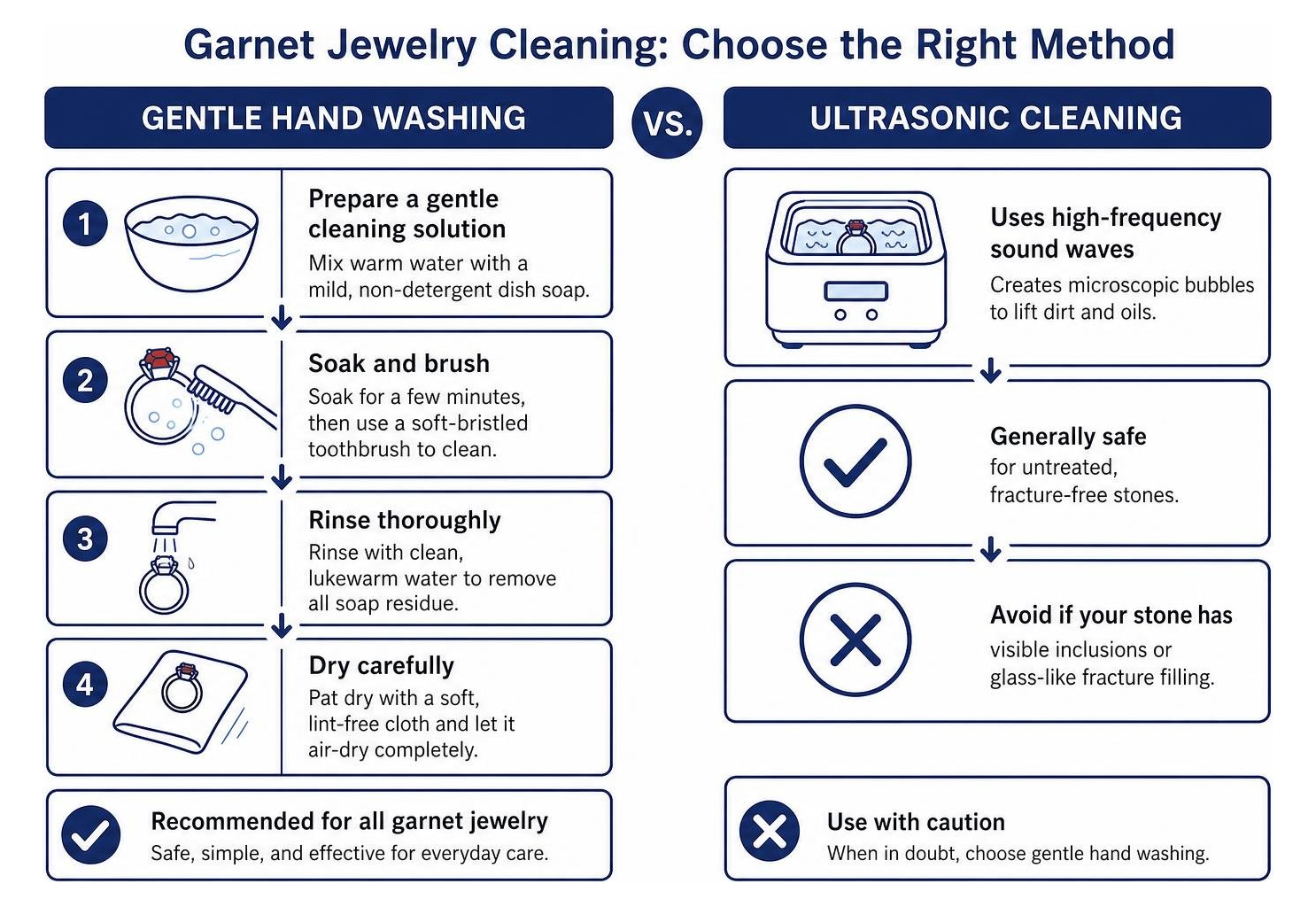
Most gem-quality garnets are entirely untreated, making routine maintenance straightforward. To keep your jewelry sparkling, follow these basic steps:
- Prepare a gentle cleaning solution: Mix warm water with a mild, fragrance-free, non-detergent dish soap.
- Soak and brush: Submerge your piece for a few minutes, then use a soft-bristled toothbrush to clean behind the setting and remove trapped lotions or oils.
- Rinse thoroughly: Rinse with clean, lukewarm water to remove all soap residue.
- Dry carefully: Pat dry using a soft, lint-free cloth and let it air-dry completely before storing.
Store garnet jewelry in individual fabric pouches or separate jewelry box compartments. Because harder stones like diamonds, sapphires, and rubies can scratch garnet (and garnet can scratch softer gems like pearls and opals), physical separation is essential.
Is garnet suitable for everyday jewelry?
Thanks to its 6.5 to 7.5 hardness rating, garnet is well-suited for regular wear in earrings, brooches, and pendants, which naturally experience fewer knocks.
For rings and bracelets, choose protective mountings like bezels, halos, or secure prongs that shield the gemstone's edges from accidental impacts. Pieces like a low-profile garnet band ring or a flexible flex bracelet allow you to enjoy your birthstone comfortably.
Never subject garnet jewelry to steam cleaning, as rapid temperature shifts can cause fractures. While ultrasonic cleaners are generally safe for untreated, fracture-free stones, avoid them if your stone contains visible inclusions or glass-like fracture filling.
Other January Symbols, Birthstone Traditions, and FAQs
Beyond its signature gemstone, the first month of the year has several rich symbolic traditions that celebrate renewal and new beginnings.
What other symbols are associated with January?
January is packed with cultural, astronomical, and natural emblems:
- The Roman God Janus: January is named after Janus, the Roman god of doorways, gates, and transitions, who possesses two faces to look backward into the past and forward into the future simultaneously.
- Birth Flowers: The primary birth flower is the carnation, symbolizing devotion, admiration, and love. The secondary flower is the delicate snowdrop, one of the earliest blooms to pierce winter soil as a sign of hope. You can explore more seasonal connections in this guide to January symbols and birth flowers.
- Zodiac Signs: January is shared by Capricorn (December 22 to January 19), an ambitious earth sign, and Aquarius (January 20 to February 18), an innovative air sign.
- Birth Bird and Night Sky: The traditional birth bird is the owl, representing wisdom and keen perception. Overhead, January night skies feature peak visibility of the Orion constellation and host the annual Quadrantid meteor shower, which can produce between 60 and 200 meteors per hour at peak.
How do modern and traditional birthstone lists differ?
The tradition of assigning specific stones to each month traces back to the biblical breastplate of Aaron described in Exodus, though wearing a single stone corresponding to one's birth month developed centuries later.
The traditional birthstone list originated in Poland between the 16th and 18th centuries, relying on historical gem availability and color associations. In 1912, the National Association of Jewelers (now Jewelers of America) established the standardized modern birthstone list in the United States. This update prioritized transparent gems suited for modern faceting and personalized mother's rings.
| Feature | Traditional Birthstone List | Modern Birthstone List |
|---|---|---|
| Origin Period | 16th to 18th Century (Poland) | 1912 (Standardized in the US) |
| Establishing Body | European Jewelers and Folk Tradition | National Association of Jewelers |
| Stone Selection Focus | Broad cultural availability and opacity | Transparent, durable, facet-grade gems |
| January Representation | Garnet | Garnet |
| Subsequent Updates | Static historical assignments | Periodic additions (e.g., Tanzanite, Spinel) |
While months like June, August, and December have multiple modern and traditional options, garnet holds the rare distinction of being the undisputed January birthstone across both historical and modern charts. You can review a complete birthstone list comparison to see how other months evolved.
What is the January birthstone?
The official birthstone for January is garnet. While best recognized for its deep red hue, it occurs naturally in vibrant shades of green, orange, yellow, purple, and color-changing varieties.
What does the name garnet mean?
The name comes from the medieval Latin word granatus, meaning "grain" or "seed." It was named for its visual similarity to the deep red seeds of a pomegranate.
What are garnet’s reputed benefits?
Throughout history, folklore held that garnets protected travelers from harm, strengthened self-confidence, promoted restful sleep, and attracted prosperity. These qualities remain cherished historical traditions, though they have no proven scientific or medical backing.
Conclusion
Whether you prefer the fiery red of classic Bohemian pyrope, the sunny warmth of mandarin spessartine, or the lush green brilliance of tsavorite, garnet is one of the most versatile gems in the world. Its rich history, global origins, and natural durability make it a meaningful way to celebrate a January birthday or a second wedding anniversary.
For more inspiration on styling and selecting the right gemstone, read our detailed January birthstone guide. At Jeweler's Touch, we have served our Orange County community since 1992 with custom jewelry design, certified appraisals, expert repairs, and flexible financing. Stop by our Brea, California showroom to explore fine garnet jewelry crafted for a lifetime of wear.