

What Is a Professional Ring Sizing Bar and How Does It Work?
A professional ring sizing bar is a calibrated, precision-machined metal stick used to measure the exact internal diameter and circumference of a ring. While it looks like a simple metal wand, it is an essential piece of hardware designed to eliminate guesswork between the customer's hand, the showroom counter, and the jeweler's bench.
When you slide a ring down a sizing bar, gravity stops the band at the exact point where the bar's outer diameter matches the ring's inner diameter. Laser-engraved or etched lines along the bar display standard sizing increments. Professional systems adhere to international calibration standards, such as ISO 8653, which defines ring size based on the internal circumference in millimeters. Maintaining this strict standard prevents communication breakdowns across the jewelry industry.
Key Components of a Precision Ring Sizing Bar Kit
A complete, professional ring sizing bar kit goes beyond a lone measuring stick. Premium packages, such as the True Size Ring Sizing System with Mandrel, include several matched components:
- A Stepped or Tapered Sizing Stick: Typically constructed from lightweight, anodized aluminum for comfortable showroom handling, featuring crisp markings for full, half, and quarter sizes.
- Individual Precision Finger Gauges: Sets containing 31 to 47 dedicated metal rings that allow clients to physically test different sizes on their fingers.
- Laser-Etched Markings: Durable exterior facets on the gauges that resist wear over decades of handling.
- Conversion Reference Tables: Built-in charts that translate standard US numerical sizes into millimeter diameter, inner circumference, and international sizing metrics.
These calibrated systems range in price based on their scope and band widths. For instance, basic kits like the Deluxe Ring Gauge Kit with Mandrel cost around $72.99 with 31 wide gauges, while comprehensive systems like the True Size Ring Sizing System with 6mm Wide Bands run closer to $198.00 with 47 precision rings.
Ring Sizing Bars vs Individual Finger Gauges and Mandrels
It is easy to confuse sizing bars, finger gauges, and workshop mandrels because they all deal with ring dimensions. However, they serve very distinct roles in the jewelry process:
- Individual Finger Gauges: These are metal sample loops used solely on your hand to determine what size your finger requires.
- Ring Sizing Bars (Measuring Sticks): These are tapered aluminum or brass sticks used to read the existing size of an already-formed ring.
- Workshop Forming Mandrels: These are heavy, solid steel bars used by goldsmiths on the bench to forge, stretch, round, and hammer precious metals.
Using mismatched tools can lead to disastrous sizing errors. If a showroom uses an uncalibrated gauge and the repair bench uses an unverified steel mandrel, the final ring might be off by a half size or more. Professional systems like the Durston 15242628US PrecisionFit Ring Sizing Set solve this by pairing a lightweight aluminum showroom stick with a matching hardened steel bench mandrel, guaranteeing identical ISO 8653 readings across the entire shop.
Temporary Resizing Bars vs Permanent Ring Resizing
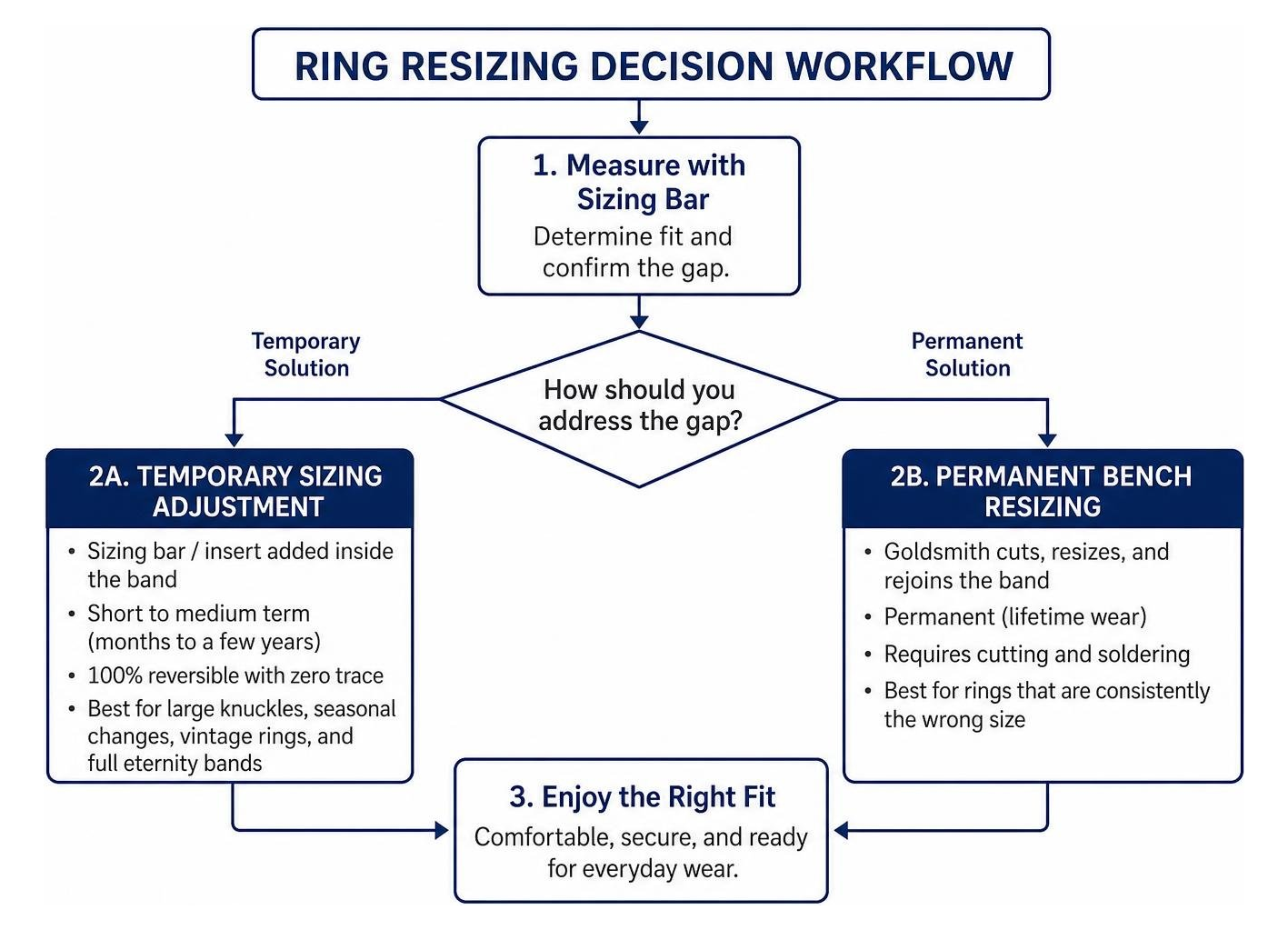
Once we use a sizing bar to determine that your ring does not fit your finger, you must decide how to address the gap. You have two main routes: applying a temporary sizing mechanism (often called a sizing bar, guard, or insert) or having an expert goldsmith perform permanent bench resizing.
| Feature | Temporary Sizing Adjustments (Bars/Inserts) | Permanent Bench Resizing |
|---|---|---|
| Durability | Short to medium term (months to a few years) | Permanent (lifetime wear) |
| Cost | Low ($20 to $100 depending on metal) | Moderate ($50 to $200+ based on metal & complexity) |
| Ring Integrity | 100% preserved; no cutting or torch heat | Cut, shaped, soldered, and polished by hand |
| Reversibility | Fully reversible with zero trace | Requires another cutting process to reverse |
| Best Used For | Large knuckles, seasonal changes, vintage rings | Rings worn daily that are consistently the wrong size |
When Temporary Sizing Adjustments Make Sense
Permanent alteration is not always the best initial step. A temporary sizing bar or interior mechanism is ideal under specific conditions:
- Large Knuckles with Slender Bases: If your ring must be large to clear your knuckle but spins wildly at the base of your finger, an internal spring bar or sizing beads create tension without preventing you from taking the ring off.
- Seasonal Fluctuations: Cold winter air can make your fingers shrink by half a size, while summer humidity causes swelling.
- Delicate Vintage Heirlooms: Antique jewelry with worn hallmarks, delicate filigree, or heat-sensitive gemstones often should not be cut.
- Full Eternity Bands: Rings with diamonds encircling the entire shank cannot be cut without disrupting stone settings.
Reviewing engagement ring sizing tips will help you determine whether your mounting allows for structural adjustments or requires a non-invasive insert.
When Permanent Bench Resizing Is Necessary
If your ring consistently feels uncomfortable, rolls around your finger, or pinches your skin regardless of the season, permanent bench resizing is the gold standard.
Permanent resizing involves an expert goldsmith physically cutting the bottom of the shank (the band). To size a ring down, the jeweler cuts out an exact segment of precious metal, brings the ends together, and solders or laser-welds the seam. To size a ring up, the jeweler expands the metal or splices in an additional piece of matching gold or platinum before fusing, blending, and polishing the seam. This restores full structural integrity and creates a seamless, custom fit that lasts.
Step-by-Step Guide: How Jewelers Measure Your Finger
Achieving a comfortable fit requires a structured measurement process. When you visit our showroom, we follow an exact workflow to ensure your ring feels natural every day.
To explore these steps on your own, you can learn more about how to work out your ring size before coming into the store.
How to Properly Use a Ring Sizing Bar to Measure Finger Size
When measuring a finger and verifying the measurement on a sizing bar, jewelers follow precise industry practices:
- Check Environmental Conditions: Fingers swell in the heat and shrink in the cold. We ensure your hands are at normal room temperature.
- Select the Right Gauge: We test individual sizing rings from our kit, sliding each one over your knuckle.
- Assess Knuckle Resistance: The gauge should slide over your knuckle with slight resistance, requiring a gentle wiggle to pull off, but sitting comfortably at the base of the finger without pinching.
- Cross-Check on the Ring Sizing Bar: The chosen gauge is slid down the calibrated sizing bar to verify its exact numerical size.
- Read the Leading Edge: The true size is read where the leading edge (the bottom rim of the ring) rests against the calibrated line, not the center of the band, unless using specialized center-line gauge sticks.
Understanding these dimensions is helpful, especially when evaluating how big a size 10 ring is or comparing larger sizes across different band styles.
Band Width and Fit: Comfort Fit vs Standard Fit
A common mistake is assuming that your ring size is a single, unchangeable number. The width and internal profile of the ring dramatically alter how it sits on your hand:
- Standard Fit: Flat along the interior surface, creating maximum contact area with your skin.
- Comfort Fit: Slightly domed and rounded on the inside, reducing surface friction and sliding over the knuckle much more easily.
- Narrow Bands (2mm to 3mm): Displace very little skin and slide on with minimal friction.
- Wide Bands (6mm to 8mm): Trap more skin underneath the metal, covering a larger surface area.
Because wide rings encounter more friction, you typically need to order a quarter to a half size larger than your measurement on a standard narrow sizing gauge.
Comparing Sizing Accuracy: Professional Bars vs At-Home Methods
While at-home sizing hacks are popular online, their accuracy varies wildly compared to calibrated jewelry hardware.
| Measurement Method | Typical Accuracy Tolerance | Primary Risk Factor | Recommended Purpose |
|---|---|---|---|
| Calibrated Ring Sizing Bar | ± 0.05 mm (Quarter-size precision) | Minimal (Tool wear over decades) | Professional bench work & fine jewelry |
| Plastic Ring Sizer Belt | ± 0.25 mm (Half-size precision) | User over-tightening or uneven pulling | Rough home estimation |
| On-Screen Card Calibrated App | ± 0.50 mm (Full-size variance) | Screen DPI variance, card tilt angle | Emergency estimates |
| Printable Paper Strips | ± 1.00 mm (1 to 2 full sizes off) | Paper stretching, printer scaling errors | Fun craft projects only |
Professional Sizing Hardware vs DIY Printable Tools
Paper strips and string stretch when pulled around a finger, and desktop printers often skew document margins, changing the physical scale of the page. Even an on-screen tool calibrated against a credit card can introduce pixel-ratio errors.
If you must estimate your size at home, using a verified ring sizing printable with scale checklines is a helpful starting point, but you should always confirm your final measurement on physical jewelry tools before ordering precious metals.
Navigating International Sizing Standards and Conversions
Jewelry sizing systems vary across the globe, but all translate back to millimeter measurements of diameter and circumference:
- United States & Canada: Uses a numerical scale from 1 to 16, with half and quarter increments.
- United Kingdom & Australia: Uses an alphabetical scale from A to Z, with half sizes denoted as fractions (e.g., M 1/2).
- European Union (ISO 8653): Directly reflects the inner circumference in millimeters (e.g., a size 52 has a 52 mm circumference).
- Japan: Uses whole numerical sizes that correspond to specific millimeter diameter intervals.
For reference, common US ring sizes run from size 4 (14.9 mm diameter, 46.8 mm circumference) up to size 10 (19.8 mm diameter, 62.2 mm circumference).
Frequently Asked Questions About Ring Sizing Bars
What is the difference between a ring sizing bar and a traditional ring mandrel?
A ring sizing bar is an aluminum, brass, or plastic measuring stick designed strictly to read sizes without scratching polished precious metals. A traditional ring mandrel is a heavy, hardened steel tool built to withstand hammer strikes during shaping, stretching, and repair work at the jeweler's bench.
Why does a wide ring fit tighter than a narrow band of the same size?
Wide bands (6mm and wider) cover more surface area on your finger. This traps more skin and increases friction across the knuckle and finger base, requiring you to increase your ring size by a quarter to a half size for a comfortable fit.
Can using a ring sizing bar scratch or damage delicate rings?
Professional showroom sizing bars are machined with smooth aluminum finishes that will not harm gold, platinum, or silver. Furthermore, grooved sizing sticks feature hollowed tracks along the back to allow stone culets and delicate channel settings to slide through without coming into contact with the metal.
Conclusion
Finding the perfect ring size is both an art and a science. Because a tiny 1 mm diameter miscalculation results in a noticeable 3.14 mm shift in circumference, relying on calibrated hardware is the only way to avoid loose mountings, spinning stones, or painful pinching.
Whether you need a non-invasive sizing bar insert for an heirloom piece or full bench resizing for a new band, having your jewelry evaluated by experienced professionals makes all the difference. At Jeweler's Touch, our family-owned team in Orange County has provided expert repairs, precision fittings, and custom craftsmanship since 1992. Stop by our Brea, CA showroom or explore our custom engagement rings to ensure your most cherished pieces fit comfortably for a lifetime.