

Why Knowing the Average Men's Ring Size Matters Before You Shop
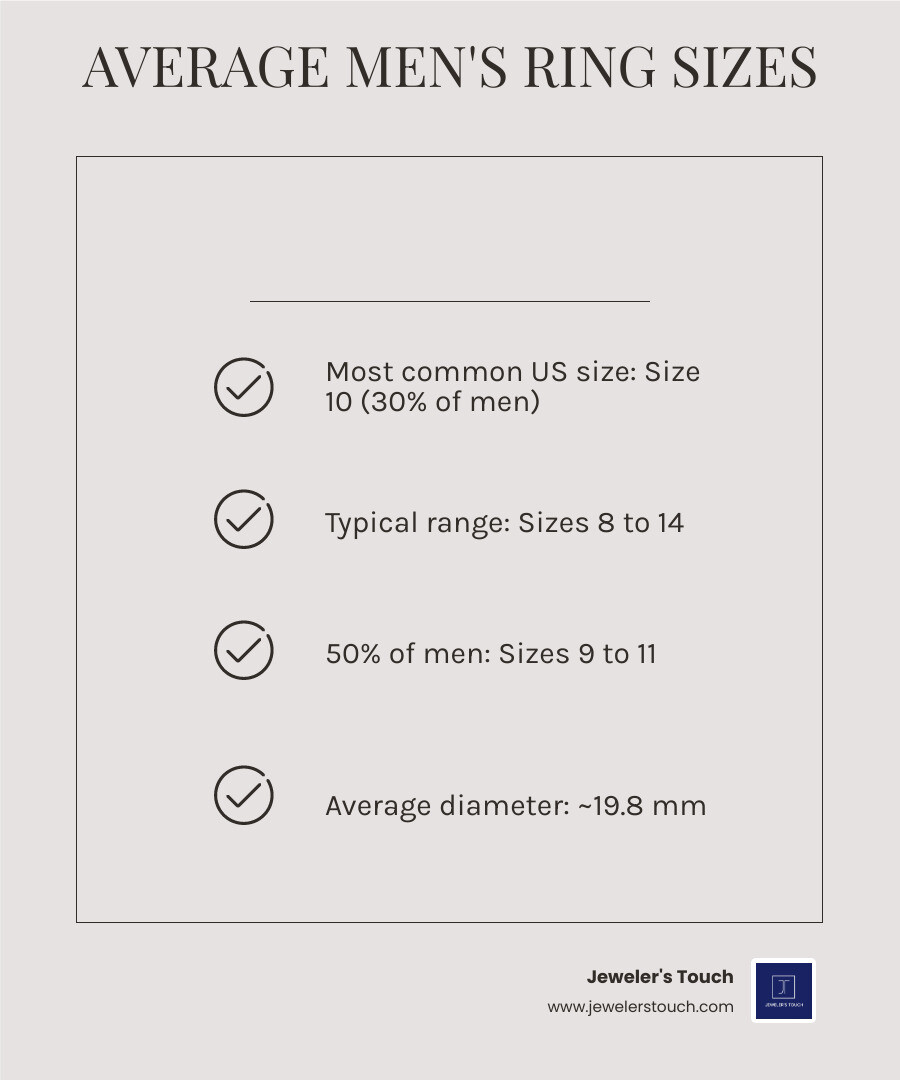
The average men's ring size in the United States is size 10, though sizes 9 through 11 cover roughly half of all men. Here's a quick-reference snapshot:
| Metric | Value |
|---|---|
| Most common size (US) | Size 10 |
| Typical range | Sizes 8 to 14 |
| 50% of men fall between | Sizes 9 and 11 |
| Average diameter | ~19.8 mm |
If you're buying a surprise ring and can't measure, size 10 is the safest starting point for most adult men in the US.
Getting the right ring size feels stressful, especially when the purchase is a surprise. Miss by even half a size and the ring won't fit comfortably, or worse, it slides right off. The stakes are high when you're shopping for a wedding band or engagement ring.
The good news? Understanding where most men fall on the size scale gives you a reliable starting point. From there, small adjustments based on body type, finger shape, and ring style can get you very close, even without a professional measurement in hand.
I'm Ken Rutz, and at Jeweler's Touch I've spent years helping customers find rings that fit perfectly, which means fielding questions about the average men's ring size every single day. That hands-on experience, combined with working alongside expert goldsmiths and GIA-certified gemologists, gives me a practical perspective on what the numbers really mean for real shoppers.
What is the Average Men's Ring Size in the US?
When we look at the data from thousands of ring orders as of May 2026, a clear pattern emerges. While men’s rings are typically manufactured in sizes ranging from 6 to 16, the vast majority of our customers in Orange County fall into a much narrower window.
The average men's ring size is widely considered to be a size 9 or 10. Specifically, statistics show that size 10 is the most frequently purchased size, accounting for approximately 30% of the male population. If you expand that to include sizes 9 and 11, you have covered over 50% of all men.
According to the Average Ring Size for Men and Women – Complete Guide, the typical range for adult males is between size 8 and size 14. While we do see sizes as small as 7 or as large as 15 or 16, these are considered outliers. For jewelry designers, size 10 is often used as the "standard" or baseline when creating showroom samples.
To help you visualize what these numbers mean in physical terms, here is a comparison of US numerical sizes to their inner diameter:
| US Ring Size | Inner Diameter (mm) | Inner Circumference (mm) |
|---|---|---|
| 8 | 18.1 mm | 57.0 mm |
| 9 | 18.9 mm | 59.5 mm |
| 10 | 19.8 mm | 62.1 mm |
| 11 | 20.6 mm | 64.6 mm |
| 12 | 21.4 mm | 67.2 mm |
| 13 | 22.2 mm | 69.7 mm |
| 14 | 23.0 mm | 72.3 mm |
Comparing the Average Men's Ring Size to Women's Sizes
It is a common misconception that men and women use different scales. In the US and Canada, we use a standard unisex scale. However, because men generally have larger hands and more robust bone structures, their "average" sits much higher on that scale.
For context, the average women’s ring size is a size 6 or 7. When you compare this to the average men's ring size of 10, you can see a significant jump in finger circumference. While a woman with a size 7 finger has a circumference of about 54.4mm, a man with a size 10 finger measures roughly 62.1mm.
When browsing Popular Men's Wedding Rings, you’ll notice that men’s bands are not just larger in diameter, but often wider in "millimeter width" to accommodate these larger proportions.
International Sizing Systems
If you are shopping abroad or looking at vintage pieces, you might encounter different scales. Unlike the US numeric system, the UK, Ireland, and Australia use an alphabetical scale.
- US Size 9 is roughly equivalent to a UK Size R.
- US Size 10 is roughly equivalent to a UK Size T.
- US Size 11 is roughly equivalent to a UK Size V.
European systems often use the actual inner circumference in millimeters. So, a US size 10 (which has a 62.1mm circumference) might be labeled as a "Size 62" in France or Germany. Always check a conversion chart if you aren't shopping within the North American numeric system to ensure the average men's ring size you're looking for translates correctly.
Factors That Influence a Man’s Ring Size
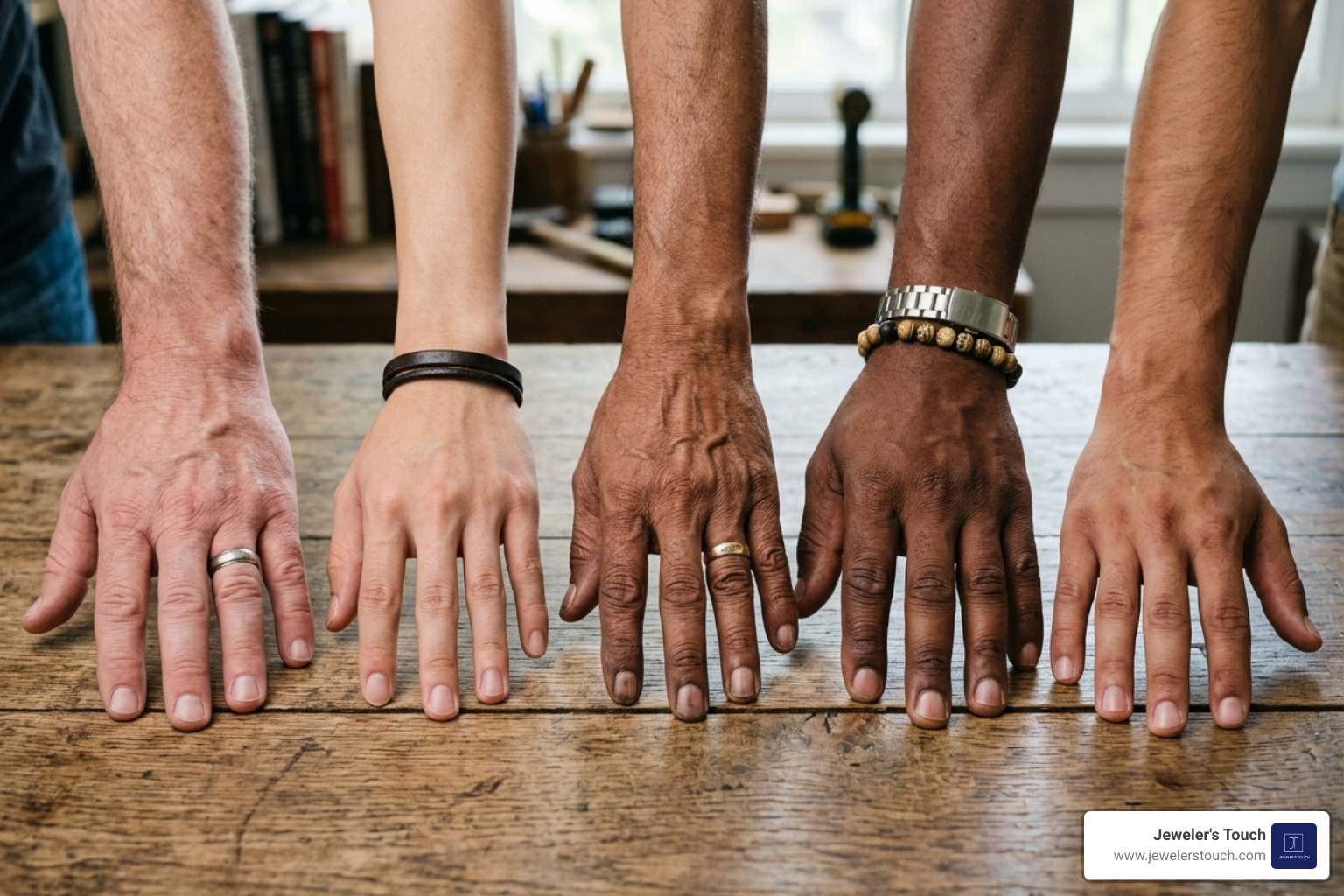
Predicting a ring size isn't just about looking at the palm of a hand. Several biological and lifestyle factors play a role in how a ring actually sits on the finger. As noted in this Average Ring Size for Men: A Comprehensive Guide - Diamondrensu, a man’s hand anatomy is the primary driver of his size.
The Dominant Hand Factor Did you know your dominant hand is usually larger? If a man is right-handed, the fingers on his right hand are often a half-size larger than those on his left. This is due to increased muscle development and blood flow from daily use. Always measure the specific finger on the specific hand where the ring will be worn.
The Knuckle Hurdle For many men, the knuckle is the widest part of the finger. A ring must be large enough to slide over the knuckle with some resistance but small enough that it doesn't spin or fall off once it reaches the base of the finger. If a man has "tapered" fingers (where the base is wider than the knuckle), the fit needs to be much more snug to prevent the ring from sliding off.
Physical Correlation and Body Type
While there is no "perfect" mathematical formula to determine ring size based on height or weight, there are some general correlations we see at our Brea showroom.
- Height: Taller men (over 6'2") often have larger frames and may lean toward sizes 11 to 13. Conversely, shorter men may find their average closer to an 8 or 9.
- Weight: Weight fluctuations of 10–15 pounds can actually change a ring size by a quarter or half size. For those looking for Plus Sized Wedding Bands, we often see sizes ranging from 13 to 16.
- Manual Labor: Men who work with their hands, such as mechanics, construction workers, or athletes, often develop larger knuckles and thicker fingers over time due to the physical demands of their profession.
The Impact of Time and Weather
Finger size is not static; it’s a moving target. Your fingers can fluctuate up to a full size depending on several environmental factors:
- Temperature: Heat causes blood vessels to dilate, making fingers swell. In the summer or after a workout, a ring might feel tight. In the winter, fingers shrink, and that same ring might feel dangerously loose.
- Time of Day: Most people find their fingers are smallest in the morning and largest at the end of the day.
- Diet: High salt intake or alcohol consumption can lead to water retention, causing temporary swelling.
For the most accurate reading of the average men's ring size, we recommend measuring at the end of the day when the hands are warm.
How to Measure Your Ring Size at Home and Professionally
If you can't make it into our Orange County store for a professional fitting, there are ways to estimate size at home. However, precision is key. Because jewelry doesn't stretch like a t-shirt, being off by even a millimeter can make a ring unwearable.
The String or Paper Method You can wrap a piece of non-stretchy string or a thin strip of paper around the base of the finger. Mark the point where the ends meet, then measure that distance against a ruler in millimeters. Use a conversion chart to find the corresponding US size.
The Existing Ring Method If you are trying to learn How to Get Your Partner's Ring Size Without Ruining the Surprise, borrowing a ring he already wears on his ring finger is the best "secret" method. You can trace the inside of the ring on paper or use a digital caliper to measure the inner diameter.
Professional Sizing vs. DIY Methods
While DIY methods are helpful for a ballpark estimate, they are notoriously prone to error. Paper can crinkle, and string can stretch.
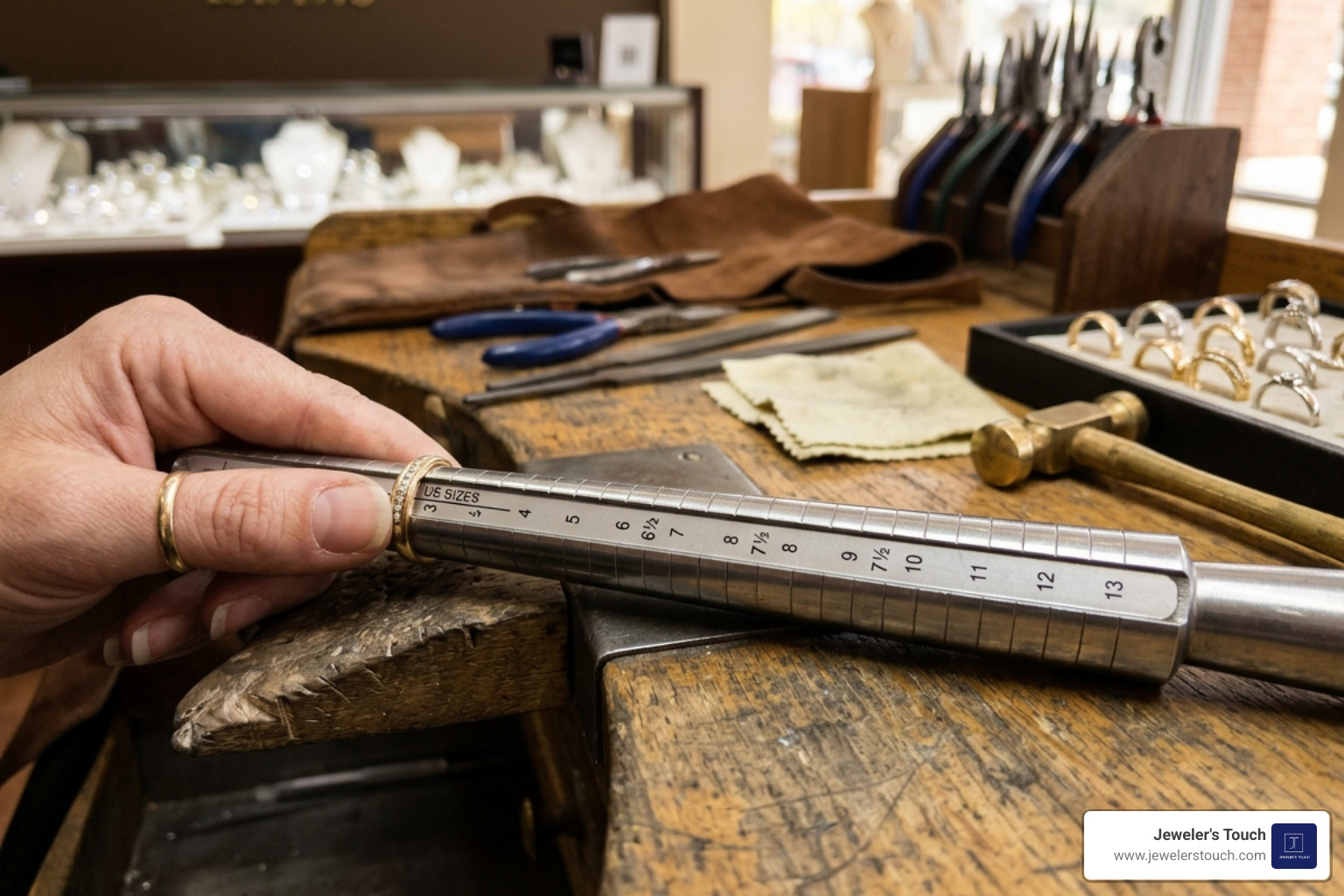
At Jeweler's Touch, we use professional tools like:
- Metal Ring Sizers: A collection of metal bands in every half and quarter size that the customer tries on until the "Goldilocks" fit is found.
- The Mandrel: A tapered metal rod used to measure the exact size of an existing ring.
Visiting a jeweler is especially important when you are deciding How to Choose the Best Metal for a Men's Wedding Band. Different metals feel different on the skin, and a professional can help you account for the "heft" of the piece.
Sizing for Success: Width, Materials, and Resizing
The average men's ring size is only one part of the equation. The physical design of the ring significantly impacts how that size feels on the finger.
Comfort Fit vs. Standard Fit
- Standard Fit: The inside of the ring is flat.
- Comfort Fit: The inside of the ring is slightly domed or rounded. Because there is less metal touching the finger, comfort-fit rings often feel a bit larger. We often recommend going down a half-size for comfort-fit bands.
Choosing the Right Average Men's Ring Size for a Surprise
If you are guessing for a surprise, always size up. It is much easier for a goldsmith to remove metal to make a ring smaller than it is to add metal or stretch a ring to make it larger.
However, you must be careful with your choice of metal.
- Resizable: Gold, Silver, and Platinum can generally be resized by our expert goldsmiths. You can learn more about this process in How Does Ring Resizing Work: Your Complete Guide.
- Non-Resizable: Modern "alternative" metals like Tungsten, Ceramic, Titanium, and Cobalt cannot be resized. Because these metals are so hard, they cannot be cut and soldered. If you get the size wrong on a Tungsten band, you usually have to replace the entire ring.
How Band Width Affects the Fit
The wider the band, the tighter it will feel. This is because a wide band (like an 8mm or 10mm band) displaces more of the finger's skin and sits higher up toward the knuckle.
If a man measures as a size 10 using a standard thin sizing tool, but he is buying a wide 8mm wedding band, he may actually need a size 10.5 to be comfortable. As a rule of thumb, if the band is wider than 6mm, consider moving up a half-size from the average men's ring size measurement.
Frequently Asked Questions about Average Men's Ring Size
Is it better to size up or down when guessing?
It is almost always better to size up. From a sentimental standpoint, it’s much better for the ring to be a little loose during a proposal or wedding ceremony than for it to not fit over the knuckle at all. From a technical standpoint, downsizing a ring is a simpler and less expensive repair than upsizing.
Can a man's ring size change over time?
Absolutely. Beyond the daily fluctuations caused by weather and salt, long-term changes are common. As men age, knuckles can become larger due to arthritis. Significant weight gain or loss will also change finger circumference. We recommend having your ring fit checked every few years to ensure it remains secure.
How reliable are averages for predicting an individual's size?
Averages are a great starting point, but they aren't a guarantee. While size 10 is the most common, we regularly see men with size 7 fingers and men with size 15 fingers. Using an average is helpful if you have no other clues, but combining that average with other data points — like his height, his glove size, or a borrowed ring — will yield a much more accurate result.
Conclusion
Finding the right fit doesn't have to be a guessing game. While the average men's ring size of 10 is a helpful benchmark for shoppers in Orange County and Brea, every hand is unique. Whether you are dealing with large knuckles, seasonal swelling, or the complexities of a wide comfort-fit band, the right information makes all the difference.
At Jeweler's Touch, we’ve been a family-owned fixture in the community since 1992. Our on-site GIA gemologists and expert goldsmiths are here to ensure that your ring doesn't just look incredible, but fits perfectly for a lifetime of wear. If you’re unsure about sizing or ready to browse our collection, find your perfect fit with our expert team today.
Stop by our Brea location, we're here to take the stress out of your jewelry shopping experience.
Jeweler's Touch Orange County / Brea, CA