

The Signature Elements of Art Deco Jewelry Design
An Art Deco wedding ring is defined by bold geometric symmetry, sharp architectural lines, and a confident, modernist spirit. To select one for your bridal stack, look for stepped silhouettes, repeating polygons, and crisp metalwork in platinum or white gold, then pair it with a contoured or chevron band so the profiles sit flush against your engagement ring. The Art Deco movement officially captured the world's imagination in 1925 at the Exposition Internationale des Arts Décoratifs et Industriels Modernes in Paris. This international fair showcased a dramatic shift away from organic, flowing motifs toward bold, forward-looking aesthetics. The style defined the era between 1920 and 1935, echoing the energy of the Machine Age, the rise of modern skyscrapers, and the vibrant rhythms of the Jazz Age.
When you look at an Art Deco design, you will immediately notice sharp geometric symmetry, rectilinear shapes, and clean architectural lines. Designers replaced the delicate bows and garlands of earlier periods with repeating polygons, dramatic stepped silhouettes, and striking contrasts.
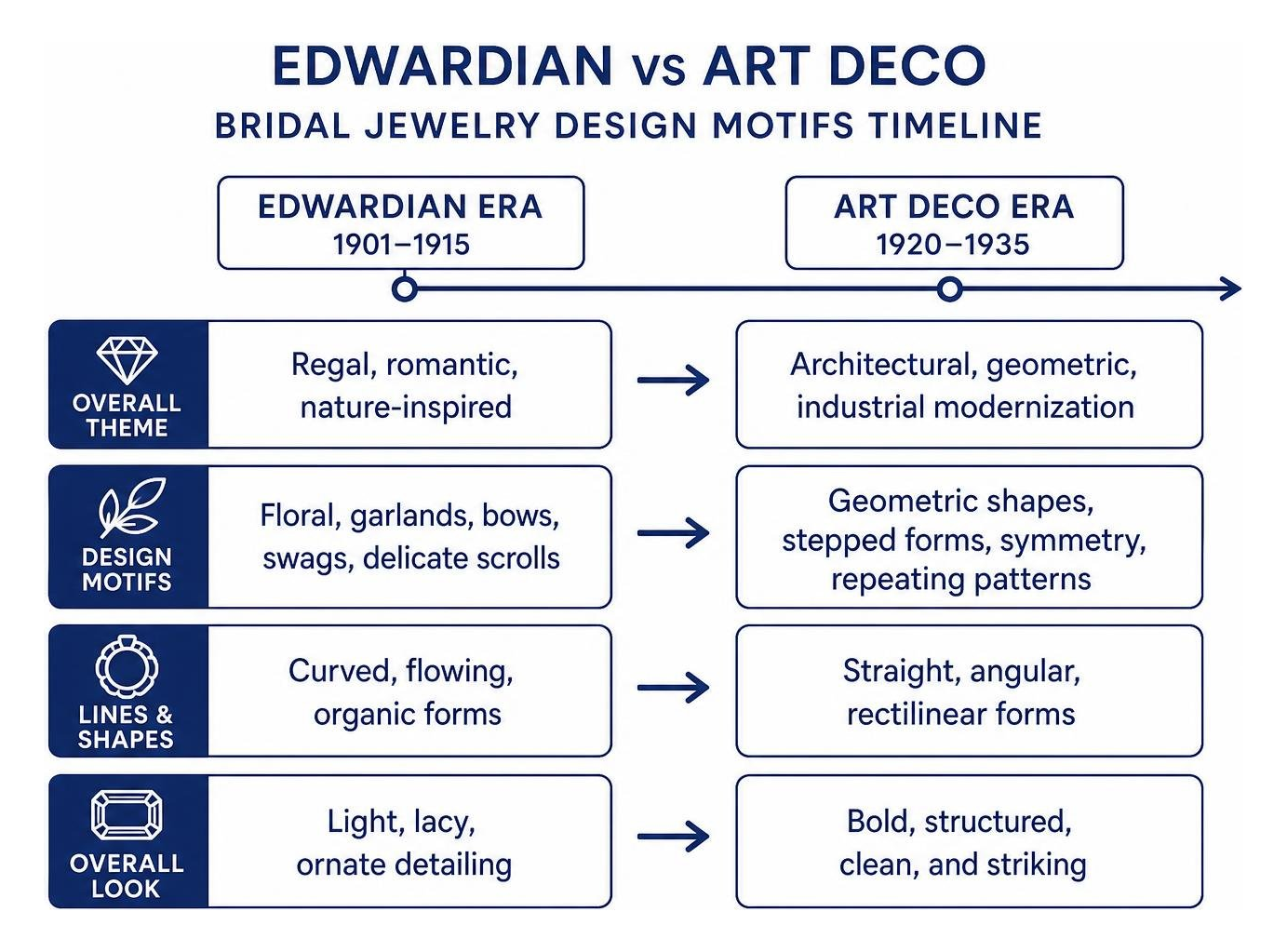
Understanding the transition from the Edwardian era to the Art Deco movement helps highlight what makes Deco bridal pieces so unique:
| Design Feature | Edwardian Era (1901–1915) | Art Deco Era (1920–1935) |
|---|---|---|
| Primary Theme | Regal, romantic, nature-inspired | Architectural, geometric, industrial modernization |
| Common Motifs | Bows, garlands, lace, delicate ribbons | Stepped borders, triangles, chevrons, octagons |
| Metalwork Style | Flowing filigree resembling fine lace | Crisp, die-struck filigree with repeating linear patterns |
| Diamond Cuts | Old Mine cuts, early Old European cuts | Old European, Asscher, emerald, and baguette cuts |
| Accent Stones | Subtle pearls, small diamond clusters | Calibré-cut sapphires, emeralds, rubies, and onyx |
| Overall Mood | Soft, aristocratic, delicate | Bold, confident, symmetrical |
Antique Diamond Cuts and Distinctive Settings
Art Deco jewelry celebrated innovative diamond shapes alongside time-honored antique cutting techniques. The Old European cut, known for its high crown, small table, and open culet, was exceptionally popular during this time. These hand-cut gems draw light differently than modern machine-cut stones, producing broad, dramatic flashes of fire that feel warm and romantic under candlelight.
Square and rectangular step cuts also rose to fame. The Asscher cut, with its cropped corners and deep pavilion, created a mesmerizing "hall of mirrors" optical effect that perfectly matched the architectural craze of the 1920s. Baguette and trapezoid accent diamonds were frequently placed along the shoulders of the band to create smooth, tapered transitions into the central gem. Jewelers also utilized calibré-cut accent gemstones. These custom, hand-cut rubies, sapphires, emeralds, and black onyx stones were set tightly against one another to trace the sharp outline of the main setting.
Settings in this era focused on security and clean presentation. Protective bezel settings, which encase the stone's perimeter in a smooth rim of precious metal, were widely utilized to maintain sharp geometric silhouettes. Delicate milgrain borders (tiny beaded metal edges) were hand-applied or rolled onto the settings to soften the industrial lines with subtle sparkle. To explore more about how these mounting methods secure your gems, explore our breakdown of classic vintage settings.
Precious Metals: Platinum, White Gold, and Two-Tone Combinations
Platinum became the premier metal of the Art Deco era due to its remarkable strength and cool, white luster. Jewelers could fashion fine, intricate openwork and open galleries without sacrificing structural durability.
The high demand and cost of platinum also catalyzed the commercial perfection of white gold during the 1920s. By alloying yellow gold with metals such as nickel or palladium, jewelers created an accessible, durable alternative that mirrored the sleek look of platinum.
Two-tone combinations were another favorite stylistic technique. Many rings featured an 18k yellow gold band topped with a cool platinum or white gold gallery, maximizing the contrast between the warm shank and the icy diamond setting. A classic example is an authentic vintage 18k gold and platinum diamond solitaire ring, which highlights stepped shoulders and rectilinear contours that seamlessly integrate yellow gold and platinum.
How to Style an Art Deco Wedding Ring with Modern Engagement Rings
Building a cohesive bridal stack with Art Deco rings allows you to combine historical charm with contemporary individuality. Modern bridal trends celebrate distinctive stacks that showcase contrasting textures, mixed shapes, and personal expression.
When pairing rings, consider how the profiles sit together against your finger. If your engagement ring features a lower-profile bezel or an extended geometric basket, standard straight bands might leave a noticeable gap. Many brides love this open look, but if you prefer a flush fit, contoured or notched wedding bands are excellent choices.
Chevron bands (also known as V-shaped or wishbone bands) are especially well-suited for Art Deco styling. Their sharp angles echo the geometric facets of step-cut diamonds and point naturally around elongated center stones such as emerald or marquise cuts. For an extensive look at profiles, widths, and contours, take a look at our comprehensive wedding ring styles.
Pairing an Art Deco Wedding Ring with Solitaires and Halos

An Art Deco wedding band can transform a traditional engagement ring into a complex, layered statement:
- Solitaire Rings: Pairing an Art Deco band with a modern round brilliant or oval solitaire creates instant contrast. The band's milgrain borders, baguette diamonds, or geometric engraving frame the understated solitaire, giving the entire set a vintage feel.
- Halo Rings: If your engagement ring has a modern diamond halo, an Art Deco band with alternating geometric shapes (such as repeating squares and marquisette links) adds visual rhythm. Aligning the metal type keeps the stack unified, while choosing contrasting stones creates a custom designer aesthetic.
- Mixed-Metal Stacks: Do not hesitate to combine white gold or platinum with warm yellow or rose gold. The 1920s frequently embraced two-tone styles. A yellow gold Art Deco band stacked beneath a platinum engagement ring pays direct tribute to authentic antique designs.
To discover practical tips on balancing stone sizes and band widths, read through our expert band styling strategies.
Timeless Appeal vs. Passing Bridal Trends
Trends come and go, but the enduring popularity of Art Deco jewelry spans more than a century. Why does this era continue to captivate modern couples?
The answer lies in its structural integrity and balanced proportions. Unlike designs rooted in short-lived fads, Art Deco jewelry relies on core architectural principles: symmetry, balance, clean geometry, and high-quality metalwork. These pieces feel vintage without looking dated, and modernist without feeling cold. For a deeper look into the cultural roots of these designs, explore our 1920s wedding ring history.
Authenticity Guide: Vintage Originals vs. Modern Reproductions
Whether you are hunting for an original antique or having a custom reproduction crafted, knowing the differences in manufacturing techniques will help you evaluate quality and value.
Original 1920s and 1930s pieces were often created using die-striking machines combined with meticulous hand-piercing and engraving. Die-striking compressed the metal under immense pressure, resulting in dense, durable mountings with crisp edges. In contrast, many modern reproductions are made using lost-wax casting. While casting allows for beautiful, complex designs, low-quality modern reproductions can sometimes suffer from porosity (tiny internal air bubbles) or soft, rounded details that lack the sharpness of authentic hand-finished work.
When inspecting a piece, look closely at:
- Filigree Construction: Genuine antique filigree is crisp, thin, and integrated into the structure. Mass-produced cast reproductions often look slightly thick or uneven on the underside.
- Milgrain Precision: Authentic milgrain consists of tiny, individually pressed beads. On cast copies, these beads may appear melted or blurry under magnification.
- Wear Patterns: True vintage pieces should show gentle, natural wear on the bottom of the shank and along the edges of the gallery, consistent with decades of love and use.
Hallmarks, Era Stamps, and Sizing Considerations
Antique jewelry often carries stamps on the inside of the shank that reveal its origin, metal purity, and maker. Look for:
- Platinum Marks: Stamps such as "PLAT," "900 PLAT," or "950 PLAT" were standard.
- Gold Purity: Common American stamps include "14K" or "18K," while European items often feature official assay office stamps.
- Maker's Marks: Trademarks or initials of prominent early 20th-century jewelry houses provide valuable provenance.
That resizing an original antique ring requires extra care. If an Art Deco band features continuous engraving or an eternity pattern of calibré-cut stones wrapping around the band, resizing it can disrupt the pattern or loosen the stones. Bands that taper (for example, from a wider 5.5mm top down to a 2mm bottom) are generally easier to resize if the plain sizing area at the base has sufficient metal thickness. Always have a qualified bench jeweler inspect the mounting before attempting any sizing adjustments.
Caring for Your Authentic Art Deco Wedding Ring
Antique jewelry requires thoughtful care to ensure it lasts for generations to come:
- Prong and Bezel Checks: Have an experienced bench jeweler examine your prongs and bezels every six to twelve months. Over time, friction can thin bezel walls and flatten delicate prongs.
- Safe Cleaning Methods: Clean your ring at home using warm water, mild liquid dish soap, and a soft-bristle toothbrush. Avoid ultrasonic cleaners if your ring contains fragile gemstones such as emeralds or pearls, or if the piece has pave-set stones that might be loosened by sonic vibrations.
- Mindful Wear: Remove your vintage rings before heavy lifting, vigorous workouts, gardening, or cleaning with harsh chemicals.
Frequently Asked Questions About Art Deco Rings
What is the main difference between Edwardian and Art Deco rings?
Edwardian rings (popular from 1901 to roughly 1915) focus on soft, romantic, feminine motifs such as lace, bows, garlands, and flowing curves. In contrast, Art Deco rings (1920 to 1935) feature bold geometric patterns, sharp angles, stepped silhouettes, and vibrant calibré-cut colored gemstones.
Can I resize an original vintage Art Deco wedding ring?
Yes, but it depends on the ring's design. If the band has a solid, unadorned section at the back of the shank, resizing is usually straightforward. However, if the ring features engraving or accent diamonds that wrap entirely around the finger (a true eternity band), sizing can be difficult and may require adding sizing beads inside the band or rebuilding a section of the design.
Are modern Art Deco reproduction rings as durable as authentic antiques?
A well-made custom reproduction crafted by skilled goldsmiths using quality precious metals is exceptionally durable and fully suited for daily wear. While original die-struck antiques are very dense, modern CAD technology and hand-finishing techniques allow us to recreate the exact aesthetic of the 1920s while ensuring structural security for modern lifestyles.
Conclusion
An Art Deco wedding ring brings history, architectural beauty, and timeless romance to your bridal stack. Whether you fall in love with the warm sparkle of an Old European cut diamond, the sharp geometry of stepped shoulders, or the delicate texture of hand-applied milgrain, these pieces make an unforgettable statement.
At Jeweler's Touch, our family-owned team in Orange County has been helping couples find and create their dream bridal jewelry since 1992. With three GIA Graduate Gemologists on staff evaluating fine gemstones and master goldsmiths working in our on-site workshop, our team can help you choose an authentic vintage treasure, restore a family heirloom, or craft a custom ring inspired by the 1920s.
Ready to design your dream stack? Visit our showroom or browse our complete collection to explore timeless wedding ring designs that reflect your unique love story.