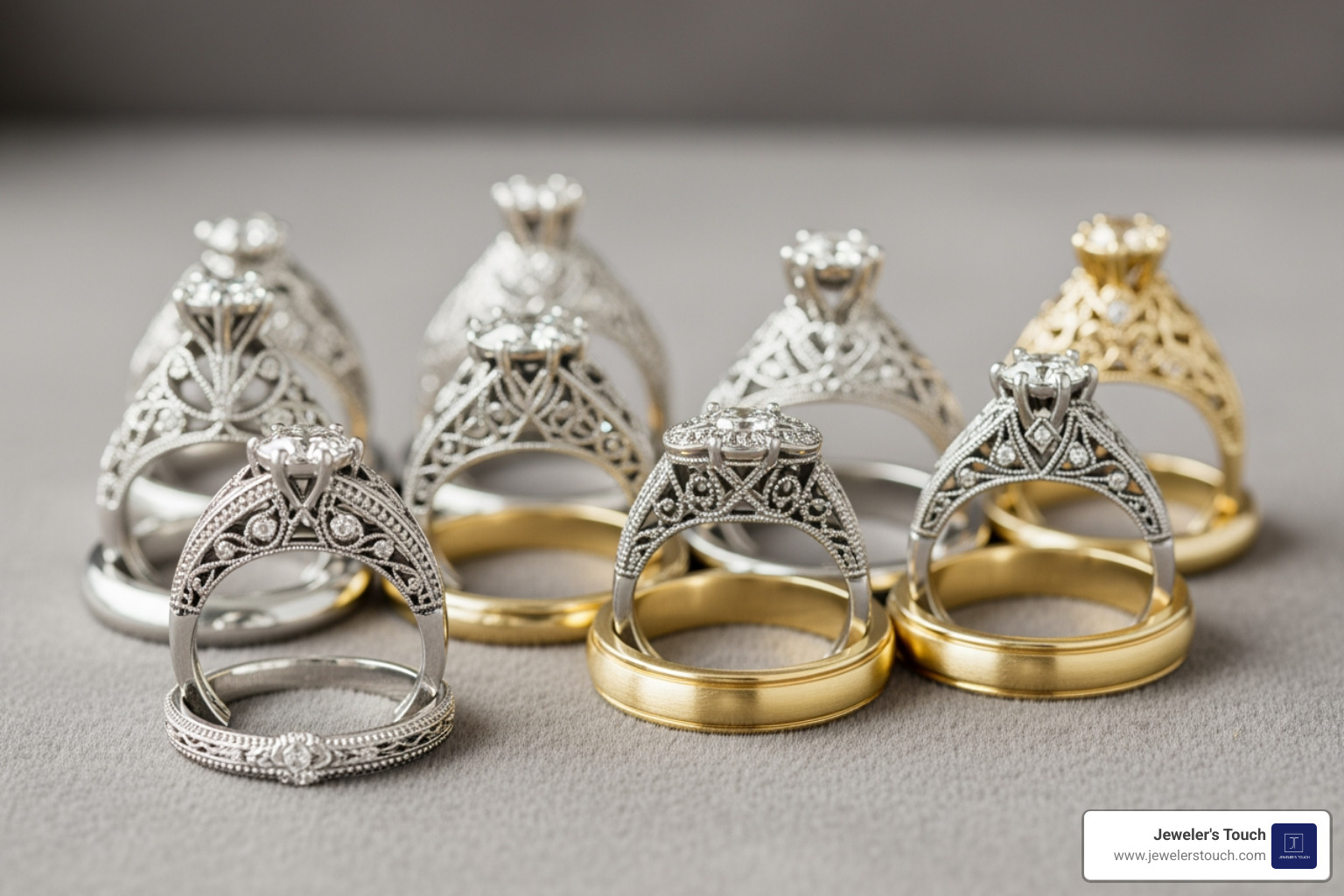
What Makes a 1920s Wedding Ring So Special?
A 1920s wedding ring is one of the most distinctive styles in jewelry history — and for good reason. Here's a quick overview of what defines it:
- Era: Art Deco period (roughly 1920–1935)
- Key materials: Platinum, white gold, and 18K yellow gold
- Signature look: Geometric shapes, filigree work, milgrain edges, and hand engraving
- Popular stones: Old European cut diamonds, sapphires, emeralds, rubies, and zircons
- Defining trait: Entirely handcrafted before 1930 — making true examples genuinely antique today
- Price range: Authentic pieces typically run from $2,000 to $50,000+
Picture the Roaring Twenties — jazz clubs, flappers, and a culture exploding with boldness and creativity. That energy poured directly into jewelry design. The Art Deco movement transformed wedding and engagement rings from soft, romantic Victorian pieces into sharp, confident works of geometric art. Colored gemstones sat alongside diamonds. Platinum replaced yellow gold as the metal of choice. Every detail was cut and set by hand.
More than 100 years later, these rings remain some of the most sought-after pieces in the vintage jewelry market — beloved for their craftsmanship, their history, and their undeniable personality.
I'm Ken Rutz from Jeweler's Touch, a fine jewelry specialist with hands-on experience sourcing, restoring, and crafting pieces inspired by the 1920s wedding ring tradition. Our team works with couples every day who want that same Art Deco magic — whether through an authentic antique or a custom-designed reproduction.
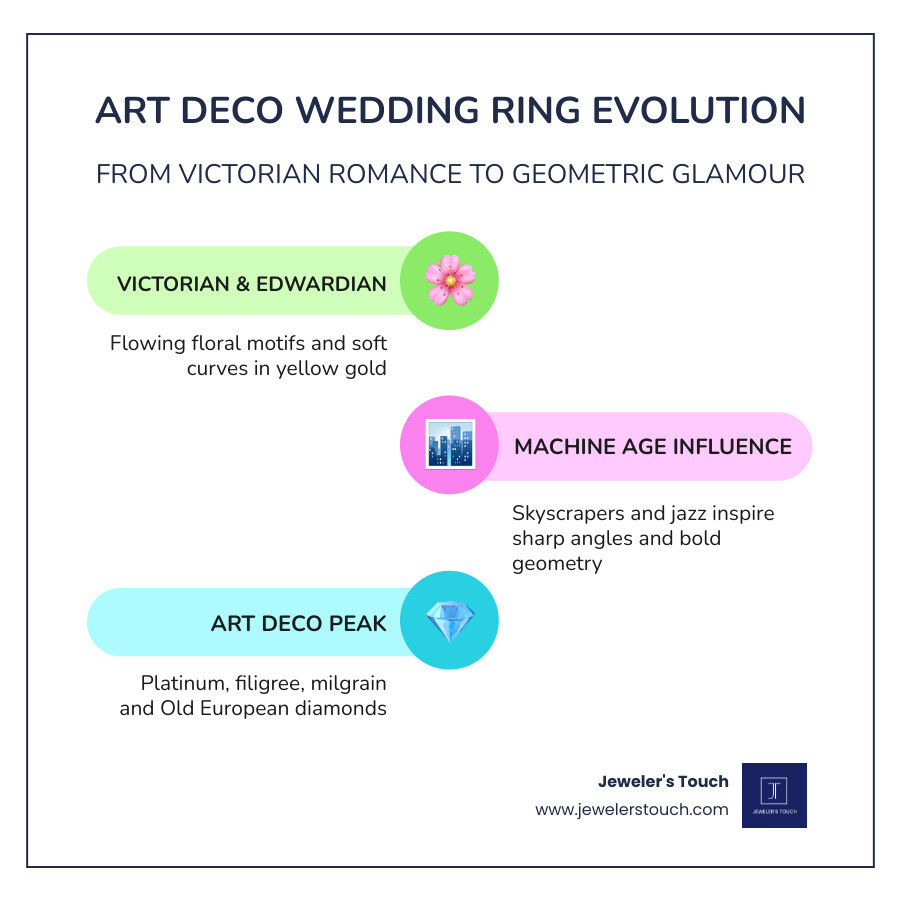
Defining the 1920s Wedding Ring: Art Deco and Beyond
When we talk about a 1920s wedding ring, we are talking about the height of the Art Deco movement. This era was a radical departure from the flowing, floral motifs of the Victorian and Edwardian periods. Instead of nature-inspired curves, the 1920s embraced the machine age-think skyscrapers, airplanes, and jazz.
In Wedding Ring Styles Explained, the 1920s stand out because of their bold geometry and clean lines. This was a time when jewelry became "architectural." Designers weren't just setting stones; they were building miniature structures of platinum and gold. The broader Art Deco movement influenced everything from buildings to fine jewelry, which helps explain why rings from this era feel so graphic and modern even today.
One of the most fascinating aspects of this period is that rings made before 1930 were almost entirely handcrafted. This means each ring is a unique artifact of history. To understand how we got here, it helps to look at The History of Diamonds & Diamond Engagement Rings. In the 1920s, the diamond became the ultimate symbol of the "modern" woman, but it was often paired with vibrant colored gemstones to create high-contrast, striking visuals that were a far cry from the dainty rings of the past.
Signature Design Features of a 1920s Wedding Ring
If you're looking at a ring and wondering if it's a true Art Deco piece, there are several "tells" to look for. The craftsmanship of this era was incredibly labor-intensive. Here are the hallmark features:
- Filigree Work: This is the delicate, lace-like metalwork you often see on the sides of the setting. In the 1920s, jewelers used thin threads of platinum or gold to create intricate patterns.
- Milgrain Edges: Derived from the French "mille-grain" (a thousand grains), this technique involves creating tiny beads of metal along the edges of a setting. It gives the ring a textured, antique finish that looks like fine embroidery in metal.
- Hand-Engraving: Whether it's wheat patterns, floral scrolls, or geometric chevrons, 1920s rings were often engraved by hand, even on the inside of the band. Some even featured personalized dates, like a 1922 hallmark we recently encountered.
- Low-Profile Settings: Unlike modern rings that often sit high off the finger, many 1920s designs were low-profile. This made them more comfortable for the active, "modern" lifestyle of the Jazz Age.
- Illusion Halos: Jewelers often used clever metalwork to make a smaller diamond look much larger. A "box" or "hexagon" setting could frame a round stone in a way that gave it a much more substantial presence.
For a deeper look at how these historical elements influence today's choices, check out our Guide to Women's Wedding Band Styles.
Popular Gemstones and the 1920s Wedding Ring
While diamonds were certainly the star of the show, the 1920s were famous for their love of color. The era's trend toward vibrant contrast meant that diamonds were frequently flanked by sapphires, emeralds, and rubies.
The diamonds themselves were different back then. You won't find the modern "Round Brilliant" cut in an authentic 1920s ring. Instead, you'll see the Old European Cut. These stones were cut by hand and designed to glow under candlelight rather than sparkle under LED shop lights. They have a smaller table, a higher crown, and a large "culet" (the flat facet at the bottom), giving them a deep, soulful look.
Beyond the "Big Four" (diamonds, sapphires, emeralds, and rubies), 1920s rings often featured:
- Aquamarines and Opals: For a softer, ethereal look.
- Zircons: Not to be confused with cubic zirconia, natural zircons are actually some of the oldest minerals on Earth-approximately 4 billion years old! They were highly prized in the 20s for their high refractive index and fire.
Interestingly, while the 1920s focused on natural stones, today's couples often look for sustainable alternatives. If you're curious about modern options, we have a guide on Everything You Need to Know About Lab Grown Diamonds, which can be cut into vintage styles to mimic that 1920s glow.
Materials and Craftsmanship of the Jazz Age

The 1920s marked a major shift in the metals used for bridal jewelry. Before this era, yellow gold was king. However, as the Art Deco movement took hold, "white" metals became the height of fashion.
The Rise of Platinum and White Gold
Platinum became the "it" metal of the 1920s. Its incredible strength allowed jewelers to create those paper-thin filigree designs without the ring becoming too fragile. Because platinum is naturally white, it didn't cast any yellow tint onto the diamonds, making them appear brighter and whiter.
However, platinum was (and is) expensive. This led to the popularization of white gold, which was developed as a more affordable alternative that still offered that sleek, industrial look. We often see 18K white gold in 1920s rings, providing a durable and beautiful foundation for complex engravings.
While white metals dominated, yellow gold didn't disappear entirely. In fact, finding an antique 1920s 14K yellow gold plain wedding band is considered quite a special find today, as they were less common for bridal sets during the peak of the Art Deco craze. Some designers even experimented with "Toi et Moi" (You and Me) designs that combined different metals for a striking contrast.
If you’re trying to decide which metal is right for your lifestyle, you might find our breakdown of the Differences Between Yellow and White Gold Wedding Bands helpful. And for those with sensitive skin, platinum is one of the best Hypoallergenic Wedding Rings and Bands available.
The durability of these metals also made them popular for men. While men's rings in the 20s were often simpler, they still carried that heavy, substantial feel. You can see how these trends evolved in our article on Popular Men’s Wedding Rings.
Buying Guide: Authentic Vintage vs. Modern Reproductions
As we move through May 2026, the demand for 1920s styles has never been higher. But should you buy a 100-year-old antique or a modern "vintage-inspired" ring? Both have their merits.
| Feature | Authentic 1920s Ring | Modern Reproduction |
|---|---|---|
| Craftsmanship | Entirely handmade; unique tool marks | Often cast using CAD/CAM; very symmetrical |
| Gemstones | Old European or Old Mine cuts | Usually modern Round Brilliant or Lab-Grown |
| Sustainability | Highly sustainable (recycled history) | Varies; new mining or lab-grown |
| Durability | May require restoration/prong work | Brand new; high structural integrity |
| Value | Collectible; holds value as an antique | Value based on materials and labor |
| Price | $2,000 - $50,000+ | $1,500 - $15,000+ |
If you are looking for original 1920s Art Deco rings, you are buying a piece of history. These rings have a "soul" that modern machines can't quite replicate. However, reproductions allow for more customization and often come with the peace of mind that the metal hasn't seen a century of wear and tear.
How to Verify Authenticity and Condition
When shopping for an authentic 1920s wedding ring, you need to be a bit of a detective. Here is what we recommend:
- Check for Hallmarks: Look for stamps inside the band. A British ring might have an assay office mark (like Birmingham) and a date letter. A US ring might have a maker's mark like "J.B. Bowden & Co."
- Examine the "Wear": On a 100-year-old ring, the engraving should be slightly softened. If the lines are razor-sharp and perfectly symmetrical, it might be a modern cast reproduction.
- Look at the Diamonds: Authentic rings will almost always have Old European or transitional cuts. If the ring has a modern brilliant-cut diamond, the stone was likely replaced later.
- Professional Appraisal: Always ask for a GIA report for the center stone and a professional appraisal that confirms the era. At Jeweler's Touch, our on-site GIA gemologists specialize in this kind of verification.
Knowing How to Wear Your Wedding Rings is also important when dealing with antiques, as you may want to avoid "stacking" them against sharp modern bands that could scratch the delicate filigree.
Frequently Asked Questions about 1920s Wedding Rings
What is the price range for an authentic 1920s ring?
The market for these rings is broad. You can find simple Art Deco heavy 22ct gold wedding bands for around $1,200 to $2,000. However, for an engagement ring featuring a high-quality Old European cut diamond of 1 carat or more, prices typically start around $5,000 and can climb to $50,000 or more for rare "signed" pieces or exceptional gemstones. Factors like the rarity of the design and the condition of the filigree play a huge role in the final price. Even if you need Plus Sized Wedding Bands, vintage pieces can often be resized by an expert goldsmith, though this may add to the cost.
Are 100-year-old rings durable enough for daily wear?
Yes, but they require respect! Platinum rings from the 1920s are remarkably resilient. However, white gold can become brittle over time, and filigree is essentially "metal lace." We recommend an expert inspection every six months to ensure the prongs are secure. If you're looking for Diamond Wedding Band Ideas for Your Oval Engagement Ring and want to pair it with a vintage band, make sure the two rings don't rub against each other in a way that wears down the antique metal.
How do I find a wedding band to match a 1920s engagement ring?
This can be a challenge because 1920s engagement rings often have unique, angular shapes. You have a few options:
- The "Gap" Look: Many people embrace the small gap between the engagement ring and a straight band—it’s very period-correct!
- Custom Contoured Bands: We can create a "shadow" band that follows the exact geometric curves of your vintage ring.
- Vintage Stacks: Look for thin, milgrained bands from the same era to create a cohesive antique and vintage engagement ring look.
Conclusion
The allure of a 1920s wedding ring lies in its ability to tell a story. Whether it’s the whisper of a hand-engraved date from 1922 or the bold geometry of a platinum shield setting, these rings are more than just jewelry—they are wearable art.
At Jeweler's Touch, we’ve been serving the Orange County community since 1992. Our family-owned studio in Brea, CA, is staffed with expert goldsmiths and GIA gemologists who understand the nuances of the Art Deco era. Whether you are looking for a Vintage, 1920s diamond solitaire engagement ring or want to custom-build a modern tribute to the Jazz Age, we are here to help.
Ready to find a piece of history? Find your perfect 1920s wedding ring at Jeweler's Touch today.