

How to Calculate Ring Size From the Inside Diameter
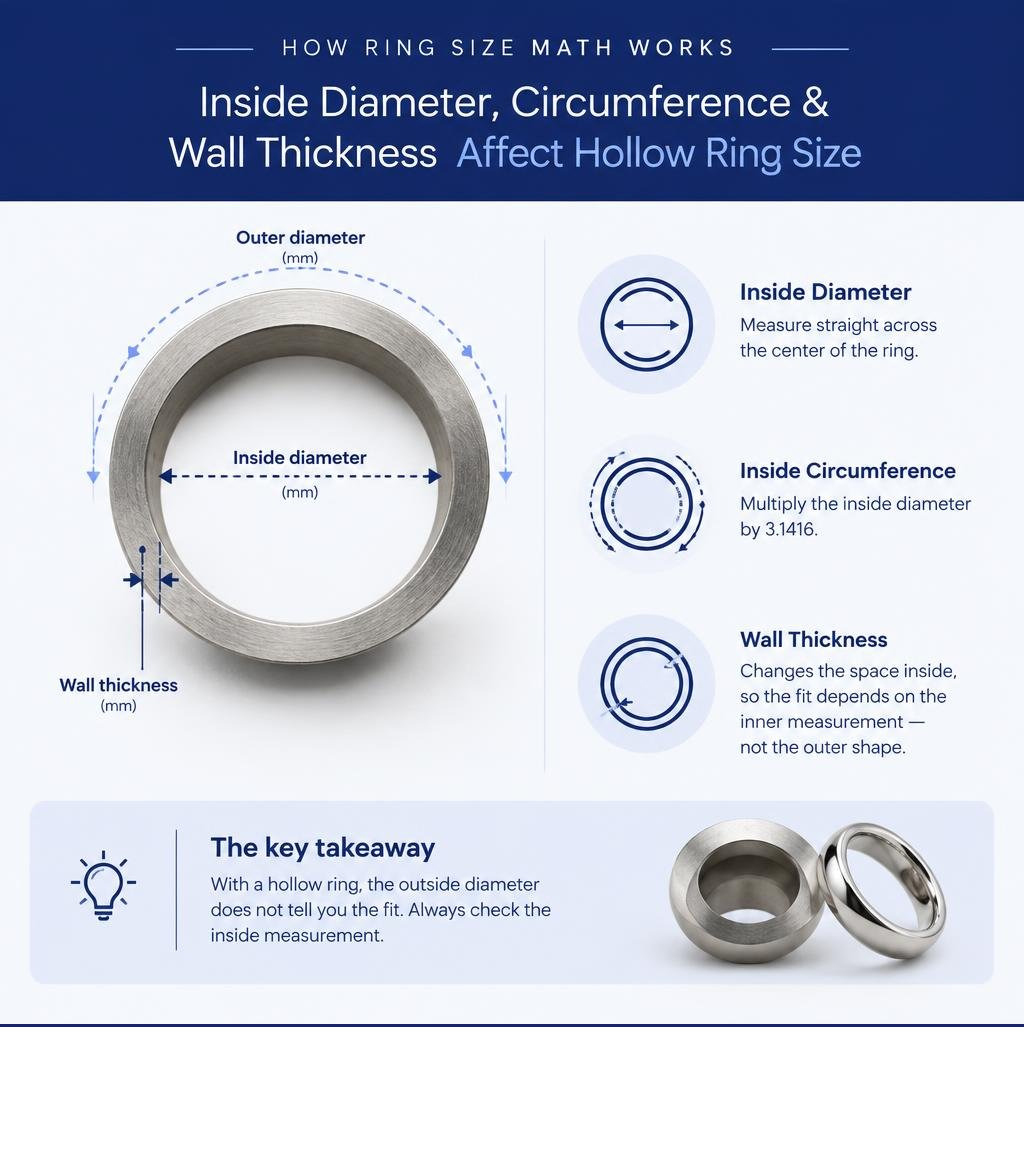
Measure the ring's inside diameter in millimeters, straight across its center. To find its inside circumference, multiply that diameter by 3.1416. For example, a ring with a 17.3 mm inside diameter has an inside circumference of about 54.4 mm, close to a US size 7. If you measure around your finger instead, divide that circumference by 3.1416 to estimate the inside diameter you need.
With a hollow ring, the outside diameter does not tell you the fit. Wall thickness changes the space inside, so check the finished ring's inside measurement rather than relying on its outer shape.
I'm Ken Rutz, and I write about fine jewelry, custom engagement rings, and jewelry repair for Jeweler's Touch. That experience informs this guide to how to calculate ring size and why hollow forms need an inside-fit check.
Why ring size math goes wrong on hollow forms
Calculating the correct size for a ring should feel like basic geometry, but hollow forms introduce physical dynamics that standard math often overlooks. When working with hollow ring blanks or tubing, jewelry makers manipulate an outer wall, an inner wall, and an empty core. Measuring from the outside edge distorts the true size of the opening where your finger rests.
When a flat hollow blank curves into a closed circle, the inner metal wall compresses while the outer wall stretches. This physical distortion alters the final inside diameter. Furthermore, metals possess natural springback, meaning they slightly resist permanent bending. During torch work and soldering, heating and cooling can shift the inner void, causing the finished inner circumference to shrink more than expected. Understanding the exact mechanical reference points prevents severe sizing errors.
Why how to calculate ring size starts with the inside measurement
Every reliable sizing method relies exclusively on inside measurements. Your finger only interacts with the interior boundary of the band. The outer dimensions, decorative bezels, and hollow chambers do not determine fit.
If you evaluate a hollow ring by its outer profile, a band with a 22 mm exterior might seem enormous, yet thick internal walls could leave an inside diameter of only 16.5 mm (a US size 6). To achieve an accurate fit, measure the open internal void across its widest central line.
How to calculate ring size from diameter and circumference
The mathematical relationship between diameter and circumference relies on the constant pi (approximately 3.1416).
- To find circumference from inside diameter: Circumference = Inside Diameter × 3.1416
- To find inside diameter from circumference: Inside Diameter = Circumference ÷ 3.1416
In standard US jewelry sizing, precision matters down to fractions of a millimeter:
- Each whole US ring size adds 0.8128 mm to the inside diameter.
- Each whole US ring size adds 2.55 mm to the inside circumference.
- A measurement error of just 1.0 mm around the finger shifts your result by approximately half a US ring size.

How to calculate ring size at home
Measuring your finger at home provides a solid baseline when shopping for rings or planning a custom piece. While precision tools at a jewelry store offer the highest accuracy, simple household methods yield strong results when performed correctly. For an easy reference sheet, you can use our ring sizing printable to verify common dimensions.
How to calculate ring size with paper, string, or a ring that fits
To measure your finger using a strip of paper:
- Cut a narrow strip of paper roughly 1/2 inch wide and 4 inches long. Avoid stretchy string or elastic cords, as stretching distorts the final measurement.
- Wrap the paper flat around the base of your intended finger. Ensure a comfortable, snug wrap without pinching the skin.
- Draw a crisp pencil line across the overlapping paper layers.
- Unwrap the strip and lay it flat against a metric ruler. Measure the distance from the starting edge to your pencil mark in exact millimeters. This number represents your inside circumference.
- Repeat this process three times to ensure consistency, then calculate your average measurement.
If you already own a ring that fits the target finger comfortably, place it flat over a ruler and measure the widest internal distance edge-to-edge. Alternatively, use digital calipers across the inside opening for maximum precision.
How to calculate ring size when your knuckle or finger size changes
Human fingers expand and contract constantly. Temperature shifts, physical activity, sodium consumption, and hydration levels cause finger sizes to fluctuate by up to a full size in a single day.
- Measure in the late afternoon or evening: Fingers reach their peak natural volume late in the day after normal movement and fluid intake.
- Avoid cold hands: Cold environments cause blood vessels to constrict, resulting in an artificially small measurement.
- Accommodate the knuckle: Wrap your paper strip around the widest part of your knuckle as well as the base of your finger. A ring must slide over the knuckle with gentle resistance while staying secure at the base. If your knuckle measures significantly larger than your finger base, choose a size midway between the two points to balance stability and clearance.
For additional guidance on finger variations across different styles, explore our comprehensive ring size guide.
Convert ring size measurements
Different regions define ring sizes through distinct scales. The United States and Canada use a numerical system, the United Kingdom, Ireland, and Australia use letters, and European standards (ISO 8653) use the inside circumference in millimeters. You can test your dimensions using an interactive ring size calculator to compare worldwide systems instantly.
How to convert ring size measurements
Converting between millimeters and standard US numbers requires applying fixed scaling factors:
- US Size from Diameter: (Inside Diameter in mm - 11.63) ÷ 0.8128
- US Size from Circumference: (Inside Circumference in mm - 36.54) ÷ 2.55
When your calculated number produces an unrounded decimal, round to the nearest whole, half, or quarter size. For instance, a measured circumference of 54.4 mm divided by 3.1416 gives an inside diameter of 17.32 mm. Applying the US conversion formula places this directly at a standard US size 7.
Common US ring sizes by inside diameter and circumference
| US Ring Size | Inside Diameter (mm) | Inside Circumference (mm) |
|---|---|---|
| 3.0 | 14.1 mm | 44.2 mm |
| 4.0 | 14.9 mm | 46.8 mm |
| 5.0 | 15.7 mm | 49.3 mm |
| 6.0 | 16.5 mm | 51.9 mm |
| 7.0 | 17.3 mm | 54.4 mm |
| 8.0 | 18.1 mm | 57.0 mm |
| 9.0 | 18.9 mm | 59.5 mm |
| 10.0 | 19.8 mm | 62.3 mm |
| 11.0 | 20.7 mm | 65.0 mm |
| 12.0 | 21.5 mm | 67.5 mm |
| 13.0 | 22.3 mm | 70.1 mm |
| 14.0 | 23.2 mm | 72.8 mm |
Calculate ring blank length and adjust for fit
Jewelers cutting flat sheet metal or fabricating hollow forms must determine the flat length of metal before forming and soldering it into a ring. Using a simple circumference calculation on raw stock will produce a ring that finishes too small because metal thickness displaces volume during bending.
Calculate a ring blank length from the finished inside diameter
When you roll metal into a circle, the neutral axis (the center layer of the sheet) remains at its original length, while the inner surface compresses. To account for this displacement, add the thickness of the metal to the target inside diameter before multiplying by pi:
Blank Length = (Target Inside Diameter + Metal Thickness) × 3.1416
Example: To make a US size 7 ring (17.3 mm inside diameter) out of 1.5 mm thick stock:
- Add the thickness to the diameter: 17.3 mm + 1.5 mm = 18.8 mm
- Multiply by pi: 18.8 mm × 3.1416 = 59.06 mm blank length
For bands wider than 4.0 mm, add an extra 0.5 mm of length to compensate for enhanced friction and internal metal crowding.
Adjust for wide bands, stacking rings, and in-between measurements
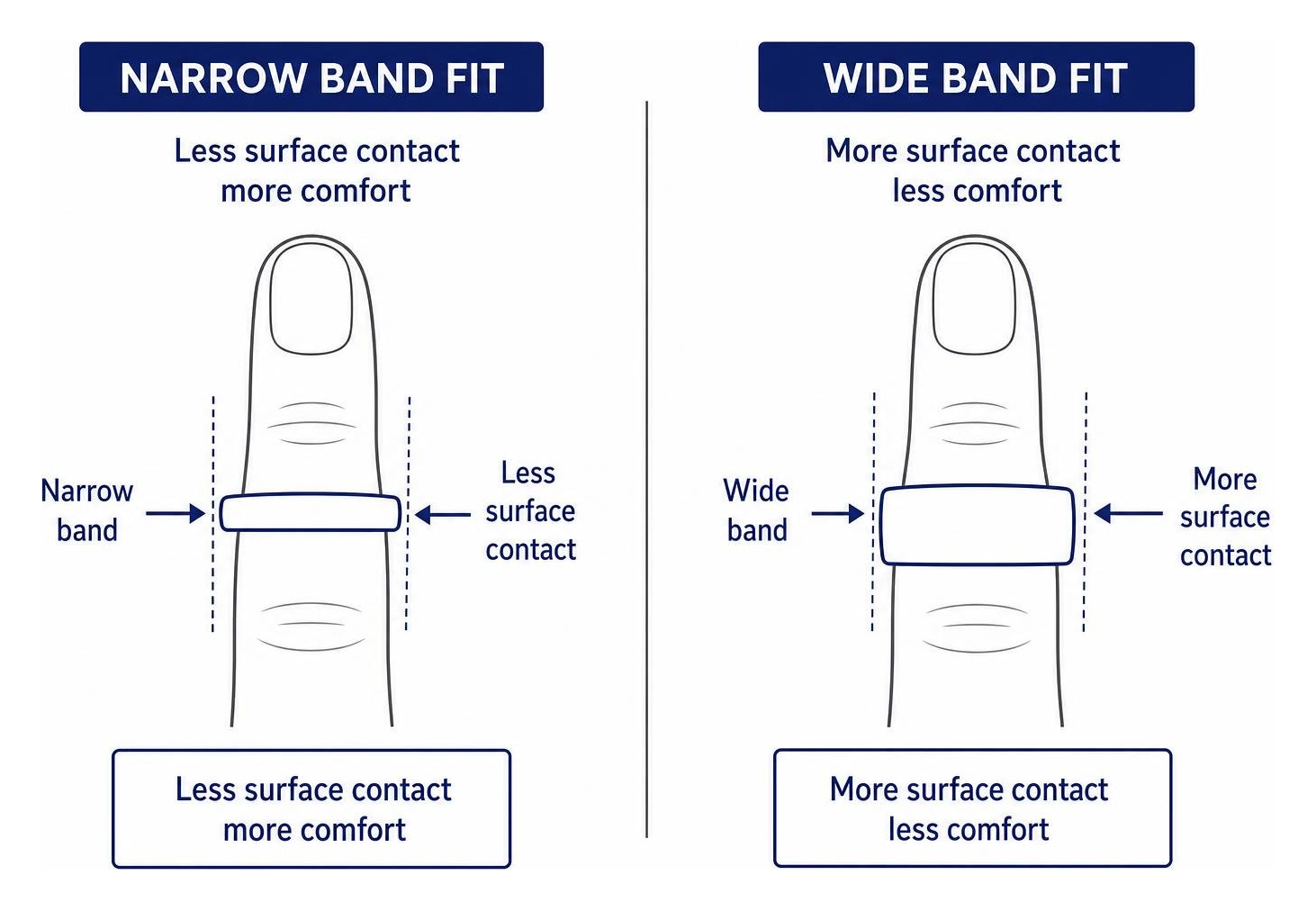
Band width significantly affects the physical perception of ring fit:
- Bands 6 mm and wider: Wide rings trap more moisture, cover more skin, and restrict fleshy movement along the finger. Most individuals need to go up by a half size (or occasionally a full size) for wide wedding bands and statement cuffs.
- Stacking Rings: Multiple slim bands stacked together create the same surface friction as a single wide band. When stacking three or more rings, sizing up a quarter to half size on the upper rings ensures comfort.
- Between Sizes: When a measurement lands evenly between two sizes, select the larger size if the band is medium-to-wide or if your knuckle is prominent.
For targeted advice on balancing stone settings with band proportions, review our engagement ring sizing tips guide, look through our average men's ring size overview, check our dedicated men's wedding band size guide, or read our one carat ring size guide.
Frequently asked questions about calculating ring size
Is a ring sizer or online chart always accurate?
Online printable tools and plastic gauge loops provide good approximations, but calibration discrepancies exist across different manufacturers. Minor printer scaling errors can distort a printed chart by several millimeters. For absolute certainty, professional evaluation on calibrated metal mandrels remains the industry benchmark.
What should I do if my measurement falls between two sizes?
If you land between two quarter or half sizes, evaluate your daily lifestyle, climate, and the ring's design. In warm environments or for bands over 4 mm wide, sizing up prevents tight pinching. For narrow bands under 2 mm, choosing the smaller size prevents the ring from spinning.
What is the formula for converting inside diameter to circumference?
Multiply the inside diameter in millimeters by pi (3.1416) to find the inside circumference. Conversely, divide the inside circumference by 3.1416 to find the inside diameter.
Conclusion
Calculating the true size of a ring always requires focusing on its interior geometry. On hollow forms and complex fabrication blanks, outside dimensions and simple wall measurements fail to reflect the space your finger actually occupies. Metal compression, wall thickness, and band width all reshape how a piece rests against your hand.
If your favorite band fits uncomfortably or an old piece needs professional adjustment, review our guide to how ring resizing works. At Jeweler's Touch, our family-owned team in Brea, California has served Southern California clients since 1992. Our on-site team of expert goldsmiths ensures every custom piece, diamond setting, and ring sizing achieves an exacting, comfortable fit. Stop by our showroom or call us today to perfect your jewelry sizing.