

What Month Is the Opal Birthstone For?
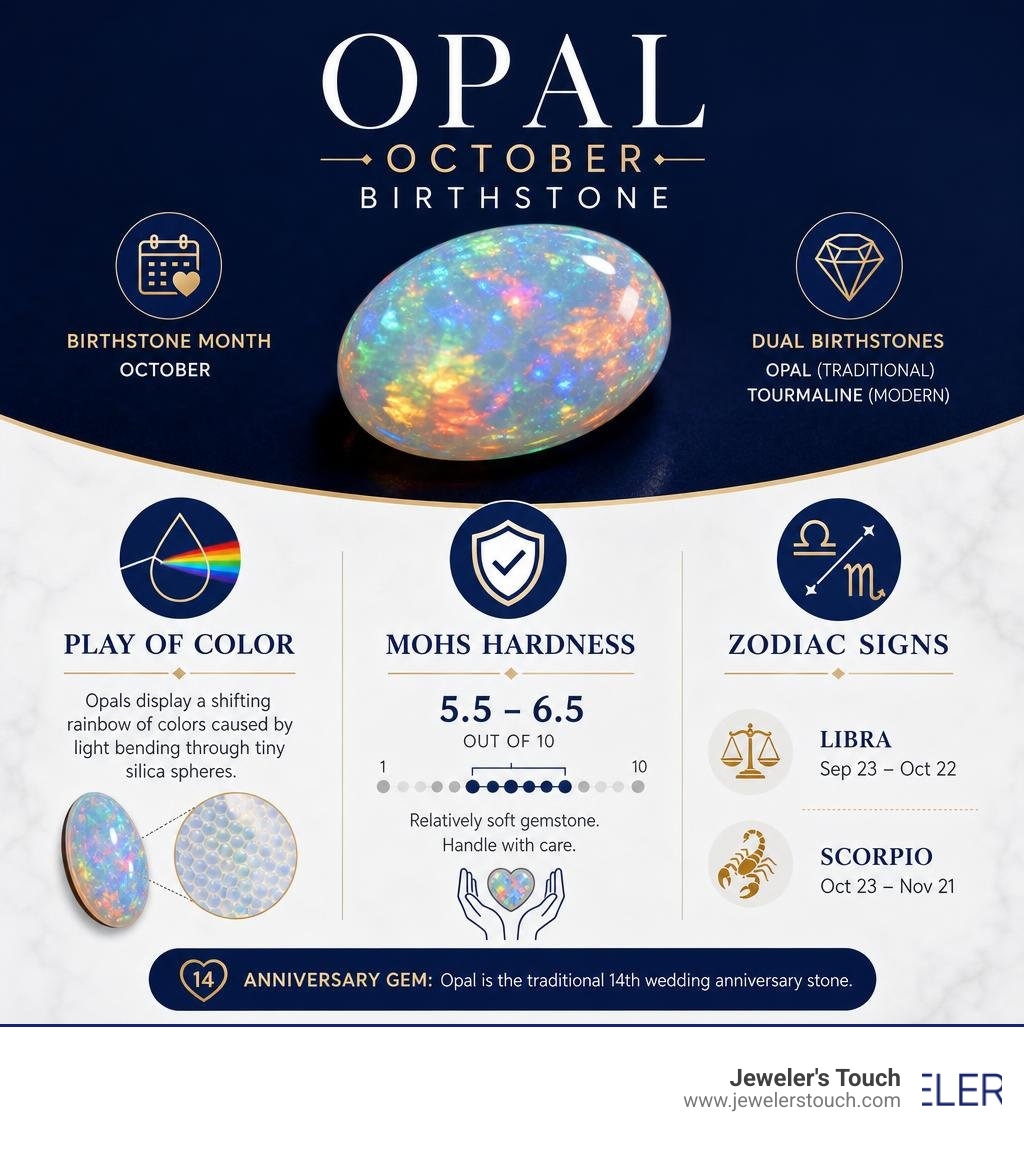
The opal birthday month is October. If you or someone you love was born in October, opal is your traditional birthstone.
Quick facts:
- Traditional birthstone: Opal
- Modern alternative: Tourmaline (added in 1952)
- Zodiac signs covered: Libra (Sep 23 – Oct 22) and Scorpio (Oct 23 – Nov 21)
- Anniversary gem: Opal is the traditional 14th wedding anniversary stone
October is one of the few months with two officially recognized birthstones. Opal has held the title since the National Association of Jewelers formalized the modern birthstone list in 1912. Tourmaline joined the list in 1952 as a colorful alternative.
What makes opal so special? No two opals look alike. Each one displays a shifting rainbow of color called play of color, a phenomenon caused by light bending through microscopic silica spheres inside the stone. It is one of the most visually dramatic effects in the entire gem world.
As the Romans once called it, opal was the "King of Gems" because it seemed to hold every color of the rainbow in a single stone.
I'm Ken Rutz of Jeweler's Touch, and helping customers find the perfect gem for their opal birthday month is something I've been passionate about for over 30 years as a fine jeweler in Orange County. Whether you're shopping for a gift or a personal piece, this guide will give you everything you need to make a confident, informed choice.
Understanding the Opal Birthday Month and Its Dual Gems
The history of birthstones is a tapestry woven from ancient traditions, astrology, and modern jewelry design. For centuries, people associated specific gemstones with the twelve months of the year, often linking them to the breastplate of Aaron described in the Bible. However, it was not until 1912 that the National Association of Jewelers met in the United States to standardize the official list of birthstones.
During this meeting, opal was designated as the traditional, primary birthstone for October. This choice celebrated the stone's timeless appeal and historical significance. In 1952, the American National Retail Jewelers Association (now Jewelers of America) updated the list, introducing tourmaline as a modern alternative for October.
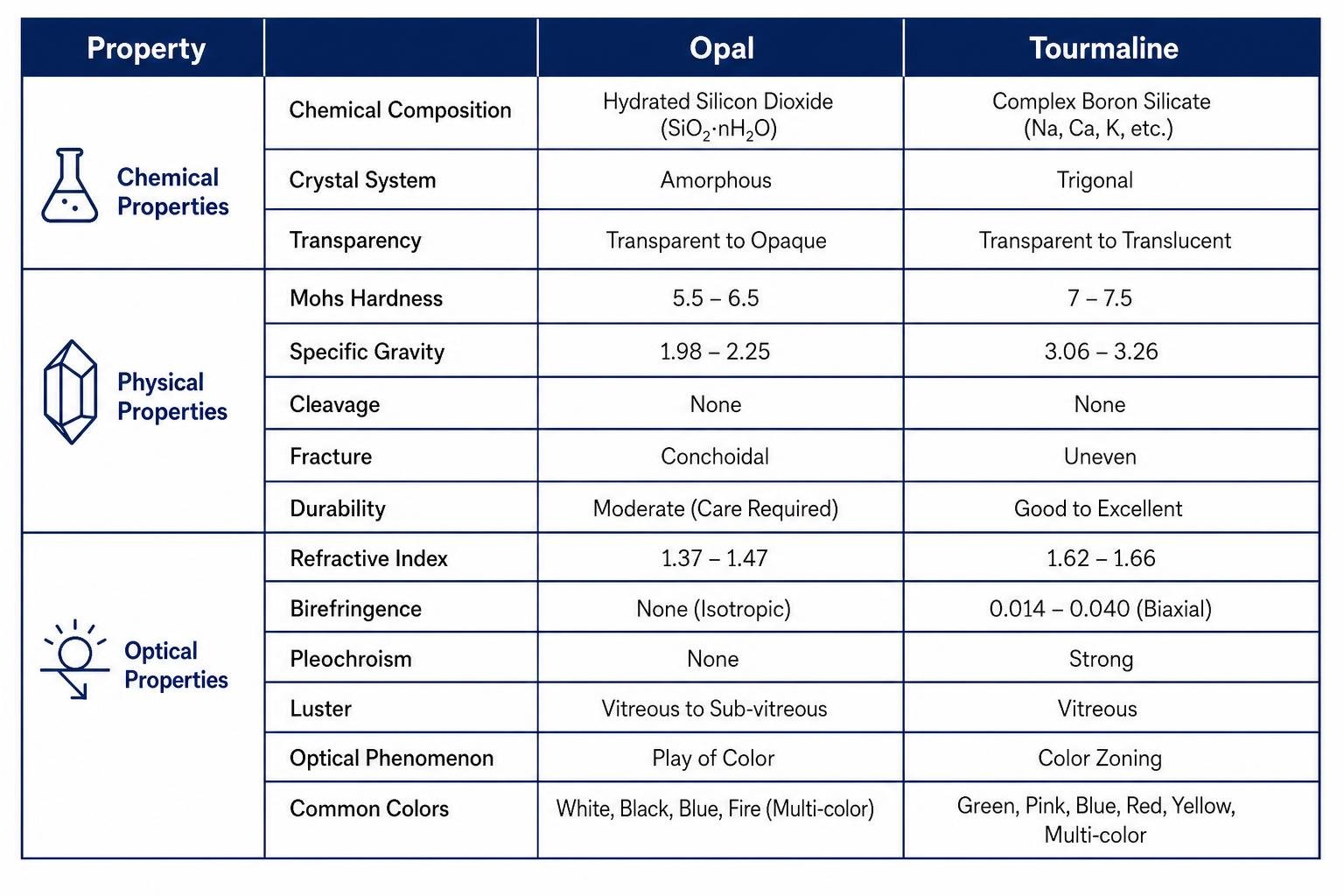
This addition was highly practical. While opals are widely adored, they are delicate. Tourmaline offered a more durable option for daily wear while maintaining the vibrant, multi-colored theme that October babies love. To help you understand the physical and aesthetic differences between these two spectacular gemstones, we have compiled a quick comparison below.
Why October is Celebrated as the Opal Birthday Month
The celebration of October as the opal birthday month is deeply tied to both traditional folklore and Western astrology. For those born under the autumn sky, the opal serves as a personal talisman. It aligns beautifully with the zodiac signs of Libra (September 23 to October 22) and Scorpio (October 23 to November 21).
Libras, known for their love of harmony, beauty, and balance, are naturally drawn to the symmetrical play of color in precious opals. Scorpios, on the other hand, appreciate the intense depth and mysterious flashes of color found in darker varieties like black opal. If you want to explore how these cosmic alignments influence gemstone choices, you can read our comprehensive October Birthstone Zodiac Guide Finding Your Cosmic Gemstone Match.
Metaphysically, opal is believed to act as an emotional amplifier. It is said to reflect the wearer's feelings back to them, helping to foster self-awareness, emotional balance, and confidence. Many cultures also associate the stone with heightened creativity and imagination, making it a favorite among artists, writers, and designers. By wearing an opal during your birth month, you are celebrating both your personal history and the rich symbolic legacy of this emotional anchor.
Opal vs. Tourmaline: Choosing Your October Gem
When choosing between the two October birthstones, it helps to consider the recipient's lifestyle, style preferences, and the specific occasion. Both gems are magnificent, but they serve very different purposes in a jewelry collection.
Tourmaline is celebrated as the most color-diverse gemstone in the mineral world. It occurs in almost every color imaginable, from the delicate pastel pinks of rubellite to the electric neon blues of copper-bearing Paraiba tourmaline. There is even watermelon tourmaline, which features a green outer layer and a pink center. With a Mohs hardness of 7 to 7.5, tourmaline is tough enough to withstand the bumps and scrapes of daily wear, making it an excellent choice for everyday rings and bracelets.
Opal, by contrast, is a delicate beauty. Ranking at 5.5 to 6.5 on the Mohs hardness scale, it requires a gentle hand and protective settings. However, no tourmaline can replicate the ethereal, shifting glow of a fine opal. For a deeper dive into how these two gems compare, check out our October Birthstone Guide Opal Tourmaline.
Gift-givers should also keep anniversary traditions in mind. While tourmaline is the modern gift for the 8th wedding anniversary, opal is the traditional stone given to celebrate the 14th wedding anniversary. Whether you choose the fiery, shifting colors of an opal or the durable brilliance of a tourmaline, both stones make unforgettable gifts for those born in October.
Opal Varieties, Colors, and Geological Science
To truly appreciate the October birthstone, it is helpful to look at the fascinating geological process that creates it. Unlike most gemstones, such as diamonds or sapphires, opal is not a crystal. Instead, it is an amorphous mineraloid. This means it lacks a structured, repeating crystal lattice.
Opal is formed over millions of years through a natural process involving water and silica. As seasonal rains soak into dry ground, they carry dissolved silica down into the cracks and cavities of ancient underground rocks. When the dry season arrives, the water evaporates, leaving behind a gel-like deposit of silica. Over immense periods of time, this gel hardens into opal.
Because of this unique formation process, opals contain a significant amount of water trapped inside their silica structure. Typically, this water content ranges from 3% to 10% by weight, but in some specimens, it can be as high as 20% to 30%. This high water content gives opal a unique physical quality: it feels noticeably warmer to the touch compared to colder crystalline gemstones. To learn more about these chemical properties, read our detailed guide on Opal: Meaning, Properties, Uses & Value - My Birthstone Guide.
The Science Behind the Play of Color
The most famous characteristic of precious opal is its play of color, the optical phenomenon that causes flashes of multi-colored light to dance across the stone's surface as it moves. For centuries, this effect baffled scientists. It was not until the invention of the electron microscope in the 1960s that the mystery was finally solved.
An opal's internal structure consists of billions of microscopic silica spheres stacked in a highly regular, grid-like pattern. When light enters the gemstone, it passes through the tiny gaps between these spheres. As it does, the light waves bend and break apart into their component spectral colors. This process is known as Bragg diffraction.
The specific colors you see in an opal depend entirely on the size of these silica spheres:
- Small spheres: Spheres measuring around 150 nanometers in diameter diffract shorter wavelengths of light, producing cool blues, violets, and greens. These are the most common colors in precious opals.
- Large spheres: Spheres measuring up to 300 nanometers diffract longer wavelengths of light, producing vibrant oranges, yellows, and reds.
Because larger, perfectly uniform spheres are much rarer in nature, opals that display prominent red and orange flashes are highly prized and command much higher prices on the market.
Major Types of Precious Opal
Not all opals are created equal. The background color, known as the body tone, and the way the stone forms determine its classification. Understanding these varieties is key to finding the perfect piece for your collection. If you want to explore the history of these incredible varieties, take a look at our article on The World S Finest Opals.
Here is a breakdown of the primary precious opal varieties:
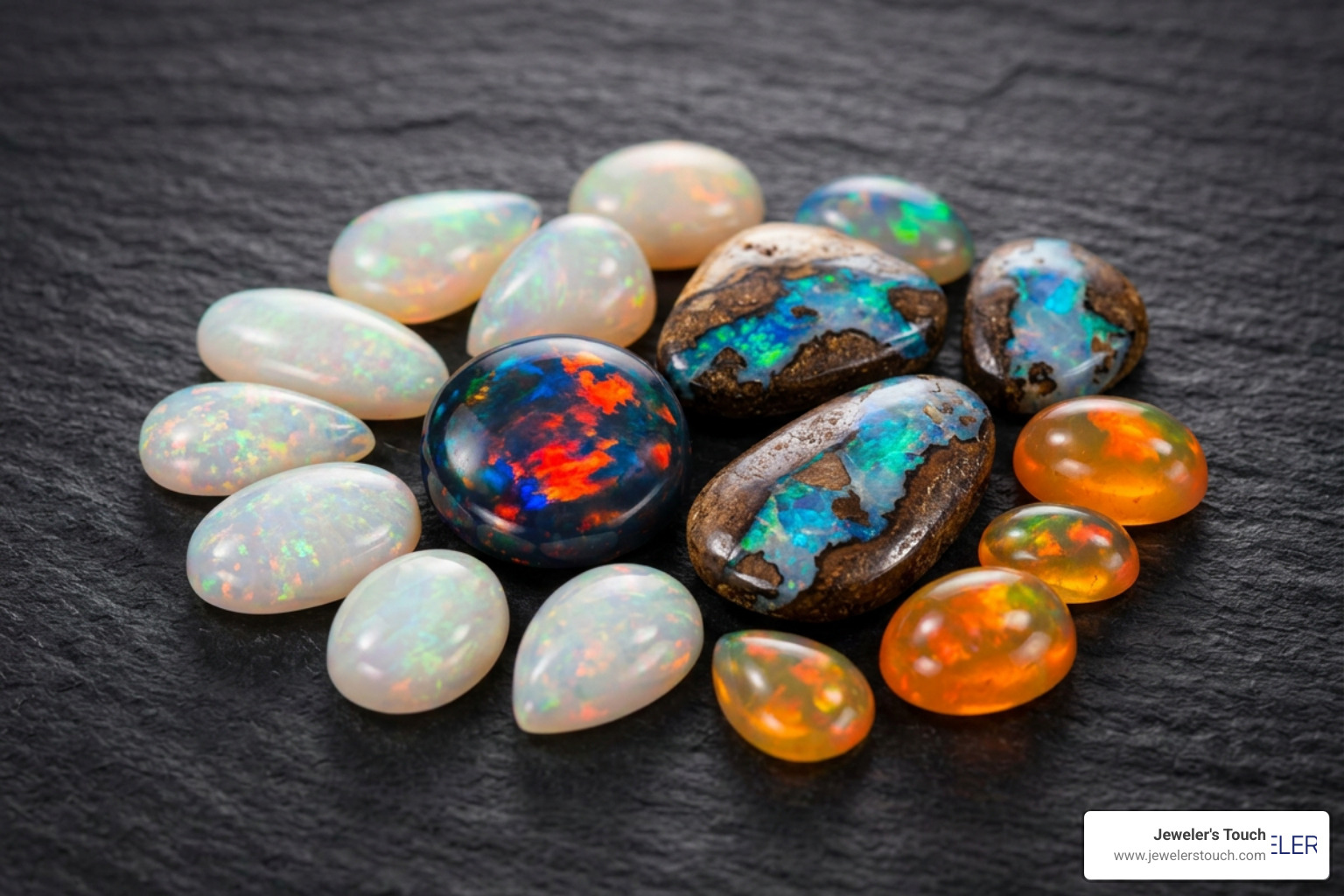
- Black Opal: This is the absolute king of the opal world. Sourced almost exclusively from Lightning Ridge in New South Wales, Australia, black opals have a dark gray, blue, or jet-black body tone. This dark background acts like a theater screen, making the play of color appear incredibly vibrant and dramatic.
- White Opal: Also known as light opal, this variety has a white, cream, or pale gray body tone. While white opals display a beautiful, pastel-like play of color, the overall effect is softer and more subdued than black opal. It is the most common and affordable type of precious opal.
- Boulder Opal: Formed in ironstone cracks, boulder opal is mined primarily in Queensland, Australia. Jewelers cut these stones with the natural ironstone backing left intact. This dark backing naturally enhances the play of color, creating a striking contrast that resembles black opal but at a more accessible price point.
- Crystal Opal: This variety has a transparent or semi-transparent body. Because light can pass completely through the stone, the play of color seems to float in mid-air, creating a dreamy, three-dimensional effect.
- Fire Opal: Sourced mainly from the volcanic highlands of Mexico, fire opal is famous for its warm yellow, orange, or cherry-red body color. Unlike other opals, fire opals are often faceted like traditional gemstones and may or may not display a play of color.
History, Folklore, and Symbolism of the October Birthstone
The human love affair with opal spans thousands of years. The very name "opal" is believed to have originated from the Sanskrit word upala, which translates directly to "precious stone." This term eventually evolved into the Greek opallios (meaning "to see a change in color") and the Latin opalus.
In the ancient world, opals were revered above almost all other gems. The Roman scholar Pliny the Elder wrote eloquently about the stone, describing it as containing the fiery red of the ruby, the brilliant purple of the amethyst, and the sea-green of the emerald, all shining together in an incredible union.
Ancient Greeks believed that opals were formed from the tears of joy shed by Zeus after his victory over the Titans, and they believed the stone bestowed the gift of prophecy upon its owner. To explore the deeper historical context of these beliefs, you can read October Birthstones: Opal & Tourmaline | Color, Meaning, Symbolism | The Old Farmer's Almanac.
Myths, Legends, and the Invisibility Shield
Because of their shifting colors, opals have inspired some of the most imaginative legends in human history. Nomadic Bedouin tribes believed that opals fell from the heavens during thunderstorms, trapping flashes of lightning inside the cold stone. In Australian Indigenous Dreamtime stories, the Creator came down to Earth on a rainbow to deliver a message of peace, and where his feet touched the ground, the rocks came alive with the brilliant colors of the rainbow, creating the first opals.
During the Middle Ages, the opal was considered a stone of immense good luck. Because it displayed the colors of every other gemstone, people believed it carried the virtues and protective powers of all of them combined.
However, this shifting nature also gave rise to stranger superstitions. In medieval Europe, the stone was sometimes called the patronus furum (the patron of thieves). It was believed that if you wrapped an opal in a fresh bay leaf, it would render the wearer invisible, allowing thieves to escape into the shadows unnoticed.
The Sir Walter Scott Effect and Queen Victoria's Revival
While opal was celebrated for centuries as a symbol of hope and purity, its reputation took a dramatic turn in 1829. The Scottish author Sir Walter Scott published a highly popular novel titled Anne of Geierstein. In the book, a mysterious princess wears a magical opal hairpin that reflects her moods, flashing brilliant red when she is angry and sparkling when she is happy. However, when a drop of holy water touches the gem, it loses its color, and the princess shortly collapses and turns to ash.
Although the story was entirely fictional, readers associated the opal with bad luck and tragedy. This single novel caused a massive panic in the European jewelry market, causing opal prices to crash by nearly 50% almost overnight.
The gemstone remained misunderstood for decades until Queen Victoria of the United Kingdom stepped in. A passionate admirer of opals, the Queen openly defied the superstition by wearing magnificent opal jewelry throughout her reign. She also gifted exquisite opal jewelry to each of her five daughters on their wedding days.
This royal endorsement, combined with the discovery of massive, high-quality opal deposits in the British colony of Australia, successfully shattered the bad luck myth and restored the opal to its rightful place as one of the world's most desired gemstones.
How to Care for and Clean Opal Jewelry
Because opals are unique in their water-based composition and relatively low hardness, they require specialized care to keep them beautiful for generations. Unlike durable diamonds, opals are susceptible to scratching, chipping, and environmental damage.
One of the primary risks to an opal is dehydration. Because they contain water, exposing them to extreme dry heat, prolonged direct sunlight, or sudden temperature changes can cause them to lose their moisture. When an opal dehydrates, it can develop a network of fine, microscopic cracks across its surface, a devastating damage known as crazing. Once an opal has crazed, the damage is permanent and cannot be reversed. To protect your investment, we recommend reading our expert advice on the Opal Birthstone.
Safe Cleaning Practices for Solid Opals and Composites
Cleaning your opal jewelry does not require complex equipment or harsh chemicals. In fact, using the wrong cleaning methods is the fastest way to ruin a beautiful stone.
Here is our step-by-step guide to safely cleaning solid opals:
- Prepare a gentle solution: Mix lukewarm water with a few drops of mild, additive-free dish soap in a small bowl.
- Use a soft cloth: Dip a soft microfiber cloth or a very soft-bristled toothbrush into the soapy water. Gently wipe the surface of the stone to remove dirt and skin oils.
- Rinse briefly: Wipe the stone with a cloth dampened with clean, lukewarm water. Avoid soaking the stone in water for long periods.
- Dry thoroughly: Pat the jewelry dry with a clean, lint-free towel and let it air-dry completely before storing.
Crucial Warning: Never use ultrasonic cleaners, steam cleaners, or boiling water on opal jewelry. The high-frequency vibrations and intense heat can easily crack the delicate stone. Additionally, avoid harsh chemical jewelry cleaners, bleach, or abrasive scrubs.
If your jewelry features an opal doublet or triplet, you must exercise even greater caution. These are composite stones where a thin slice of opal is glued to a dark backing and sometimes topped with a clear quartz dome. Soaking a doublet or triplet in water can dissolve the adhesive holding the layers together, causing the stone to turn cloudy or fall apart. For these pieces, simply wipe them down with a damp, soft cloth.
Storing and Wearing Gems from the Opal Birthday Month
Proper storage and daily wear habits are essential to preserving the beauty of your October birthstone jewelry. Because opal is soft, it can easily be scratched by harder gemstones like diamonds, sapphires, and rubies.
Always store your opal jewelry in a separate compartment of your jewelry box, or wrap each piece individually in a soft velvet pouch. If you live in an exceptionally dry climate or plan to store your opals in a safe for a long period, place a small, damp cotton ball or a small glass of water inside the storage area to maintain a healthy level of humidity.
When wearing your opal jewelry, remember the golden rule: it should be the last thing you put on in the morning and the first thing you take off at night. Apply your perfumes, hairsprays, and cosmetics before putting on your jewelry, as the chemicals in these products can dull the stone's polished surface.
Remove your opal rings and bracelets before washing dishes, swimming in chlorinated pools, exercising, gardening, or doing heavy housework. For more tips on wearing these delicate gems safely in Southern California, check out our guide on Everything You Need To Know About Opal Birthstone Jewelry In Orange County.
Frequently Asked Questions
What is the Mohs hardness of opal and is it suitable for everyday wear?
Opal has a hardness of 5.5 to 6.5 on the Mohs scale, making it relatively soft compared to other popular gemstones. Because it can be scratched by common dust particles (which often contain quartz, ranking at 7 on the Mohs scale), it requires extra care.
Opal is highly suitable for everyday wear in pieces that are less exposed to direct impact, such as earrings, necklaces, and brooches. If you choose to wear an opal ring daily, we highly recommend selecting a protective setting, such as a bezel setting, which wraps the metal entirely around the edge of the stone, or a halo setting, which surrounds the opal with a protective ring of harder diamonds.
Where is the majority of the world's precious opal mined?
Australia is the undisputed capital of the opal world, historically producing more than 90% of the global supply of precious opal. The country's unique geological history has created the perfect conditions for producing stable, highly vibrant stones.
Famous Australian mining regions include Lightning Ridge (the home of the black opal), Coober Pedy (famous for white and crystal opals), and Queensland (known for boulder opals). Other notable global sources include Ethiopia, which produces beautiful, water-absorbing hydrophane opals, and Mexico, which is famous for its fiery volcanic opals. To learn more about these global mining regions, you can visit the October Birthstones | Opal & Tourmaline Birthstone Information | GIA.
What is the difference between solid opals, doublets, and triplets?
The difference lies in how the gemstone is constructed:
- Solid Opal: This is a 100% natural gemstone cut and polished as a single piece of opal. It is the most valuable and durable option.
- Doublet: A doublet consists of a thin slice of precious opal glued to a dark, durable backing, usually black industrial glass, ironstone, or common potch opal. The dark backing makes the play of color stand out dramatically, mimicking a black opal.
- Triplet: A triplet adds a third layer, a clear, domed cap of quartz or hard glass, over the opal slice and backing. This clear cap protects the delicate opal from scratches and magnifies the color play, making it a highly affordable option for those on a budget.
Conclusion
The opal birthday month of October offers a wonderful opportunity to celebrate one of the most magical, colorful, and historically rich gemstones in existence. From its incredible geological formation to its journey through royal courts and ancient legends, the opal remains a symbol of hope, creativity, and individuality.
At Jeweler's Touch, we have been helping families across Orange County celebrate their special moments since 1992. As a family-owned jeweler based in Brea, California, we are proud to offer the expertise of our on-site GIA gemologists and master goldsmiths. Whether you are looking to design a custom opal ring, restore a beloved family heirloom, or find the perfect birthday gift, we are here to guide you every step of the way.
If you are ready to explore birthstones further, we invite you to browse our comprehensive Birthstone Guide or visit our showroom to experience the shifting, magical beauty of the October birthstone in person.