

How Big Is Ring Size 11?
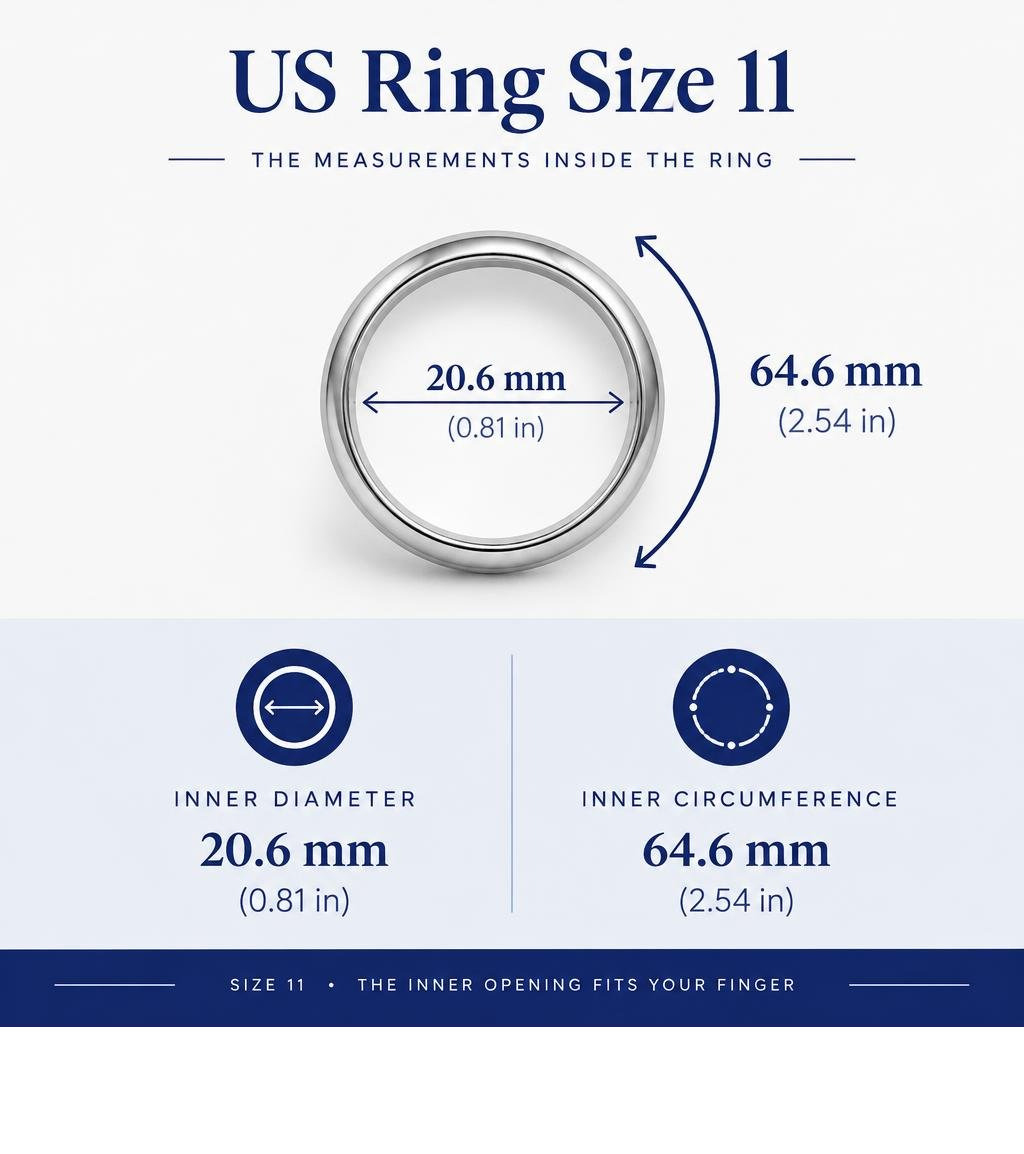
How big is ring size 11? A US size 11 ring has an inner diameter of about 20.6 mm (0.81 inches) and an inner circumference of about 64.6 mm (2.54 inches). These measurements describe the opening inside the ring, not its outside edge. Size 11 means the same thing for men's and women's rings, though band width can change how it feels on your finger.
I'm Ken Rutz of Jeweler's Touch. When customers ask "how big is ring size 11," I draw on our experience with fine jewelry, custom engagement rings, and repairs to help explain the measurements and fit.
Exactly How Big Is Ring Size 11 in Millimeters and Inches?
When you look at fine jewelry dimensions, understanding the difference between the outer rim and the inner opening is crucial. Jewelers always determine size based on the inner boundary because that is what directly touches your skin. If you are comparing your personal measurements to a master chart, reviewing the ring size inner diameter helps clarify how fractional millimeters translate into standard American sizing.
Measuring Diameter and Circumference: How Big Is a Ring Size 11?
In the United States and Canada, ring sizing follows a precise numerical scale calibrated against specific physical dimensions:
- Inner Diameter: 20.6 millimeters (approximately 0.811 inches). This is the straight-line measurement across the widest part of the inside circle.
- Inner Circumference: 64.6 millimeters (approximately 2.54 inches). This is the total distance around the interior loop, matching the surface of your finger.
Under global standards such as ISO 8653:2016, which specifies ring dimensions based on interior perimeter in millimeters, a size 11 closely aligns with standard European designations around 64.5 to 65 millimeters. Precision matters greatly here; a variation of just 0.8 millimeters in diameter represents an entire full-size jump in the American sizing scale.
Comparing Size 11 to Adjacent Sizes 9, 10, and 12
Finger sizes progress in quarter, half, and full-size increments. Seeing size 11 placed directly beside surrounding common sizes shows how subtle these measurement shifts are to the eye, even though your finger easily detects the difference in comfort.
| US Ring Size | Inner Diameter (mm) | Inner Diameter (inches) | Inner Circumference (mm) | Inner Circumference (inches) |
|---|---|---|---|---|
| Size 9 | 19.0 mm | 0.75 in | 59.5 mm | 2.34 in |
| Size 9.5 | 19.4 mm | 0.76 in | 60.8 mm | 2.39 in |
| Size 10 | 19.8 mm | 0.78 in | 62.1 mm | 2.44 in |
| Size 10.5 | 20.2 mm | 0.80 in | 63.4 mm | 2.50 in |
| Size 11 | 20.6 mm | 0.81 in | 64.6 mm | 2.54 in |
| Size 11.5 | 21.0 mm | 0.83 in | 65.9 mm | 2.59 in |
| Size 12 | 21.4 mm | 0.84 in | 67.2 mm | 2.65 in |
Each full size step increases the inner diameter by roughly 0.8 millimeters (0.032 inches) and the circumference by about 2.55 millimeters (0.10 inches). While two-tenths of an inch around your finger might sound tiny, it represents the clear boundary between a band that slides smoothly and one that stays stubbornly stuck at the knuckle.
International Conversion Guide for Size 11 Rings
Different regions around the world use unique sizing systems. While the United States and Canada rely on numeric values ranging from 0 to 16, other nations employ alphabetical letters or direct metric circumference readings. If you are exploring international pieces, referencing the official Ring size standards will keep you on track.
Global Standards: How Big Is Ring Size 11 Worldwide?
When consulting a comprehensive international ring size chart, you will discover that a US size 11 translates into several regional metrics:
- United Kingdom, Australia, & South Africa: Size V½ (alphabetical scale).
- France & Continental Europe: Size 64¼ or 65 (measured by inner circumference in millimeters).
- Germany: Size 20.6 (direct inner diameter in millimeters).
- Italy & Spain: Size 24 (traditional European scale).
- Japan & East Asia: Size 23 (East Asian numerical scale).
- Switzerland: Size 24.6 (Swiss standard circumference minus 40 mm).
Navigating European vs. US Sizing Variations
If you are buying fine jewelry created abroad or referencing European designers, you can easily verify equivalent sizes using standard international conversion benchmarks.
| Country / Standard | Size 11 Equivalent | Measurement Basis |
|---|---|---|
| United States & Canada | 11 | Numerical (Quarter-step scale) |
| United Kingdom & Australia | V½ | Alphabetical letter sizing |
| ISO 8653 / France | 64.6 (or 65) | Circumference in millimeters |
| Germany | 20.6 | Inner diameter in millimeters |
| Italy & Spain | 24 | Regional numeric scale |
| Japan | 23 | Regional numeric scale |
| Switzerland | 24.6 | Standard circumference offset |
Shoppers looking at East Asian specialty sizing frameworks can also compare regional millimeter tables directly against standard North American sizing.
Is Ring Size 11 Common for Men and Women?
A size 11 ring is completely standard, but its relative frequency varies significantly depending on whether it is worn on a man's or woman's hand.
Average Sizing Context for Men's Bands
For men in the United States, average ring sizes typically range between size 9 and size 10. A size 11 is on the upper end of the average spectrum, making it extremely common for men with broader builds, muscular hands, or wider knuckles.
Men selecting wedding bands frequently pick size 11 for standard wear on their left ring finger. Because men's bands often feature heavier profiles (between 6 mm and 8 mm wide), size 11 provides the necessary surface clearance to ensure daily comfort without squeezing the finger pad.
How Size 11 Fits on Women's Fingers
For women, the most common ring size for women typically sits between size 6 and size 7 for the traditional ring finger. Consequently, a size 11 is relatively rare for a woman's left ring finger, but it is popular for other fingers.
Many women wear size 11 bands comfortably as thumb rings, index finger pieces, or bold statement rings on the middle finger. Finger circumferences naturally vary across your hand; your thumb and middle finger often measure two to three full sizes larger than your traditional ring finger.
How to Accurately Measure Your Finger for a Size 11 Ring
Proper measurement guarantees a comfortable, secure fit from day one. When planning an important purchase, keeping standard engagement ring shopping dos and don'ts in mind will prevent sizing surprises later.
Step-by-Step DIY Measurement Methods
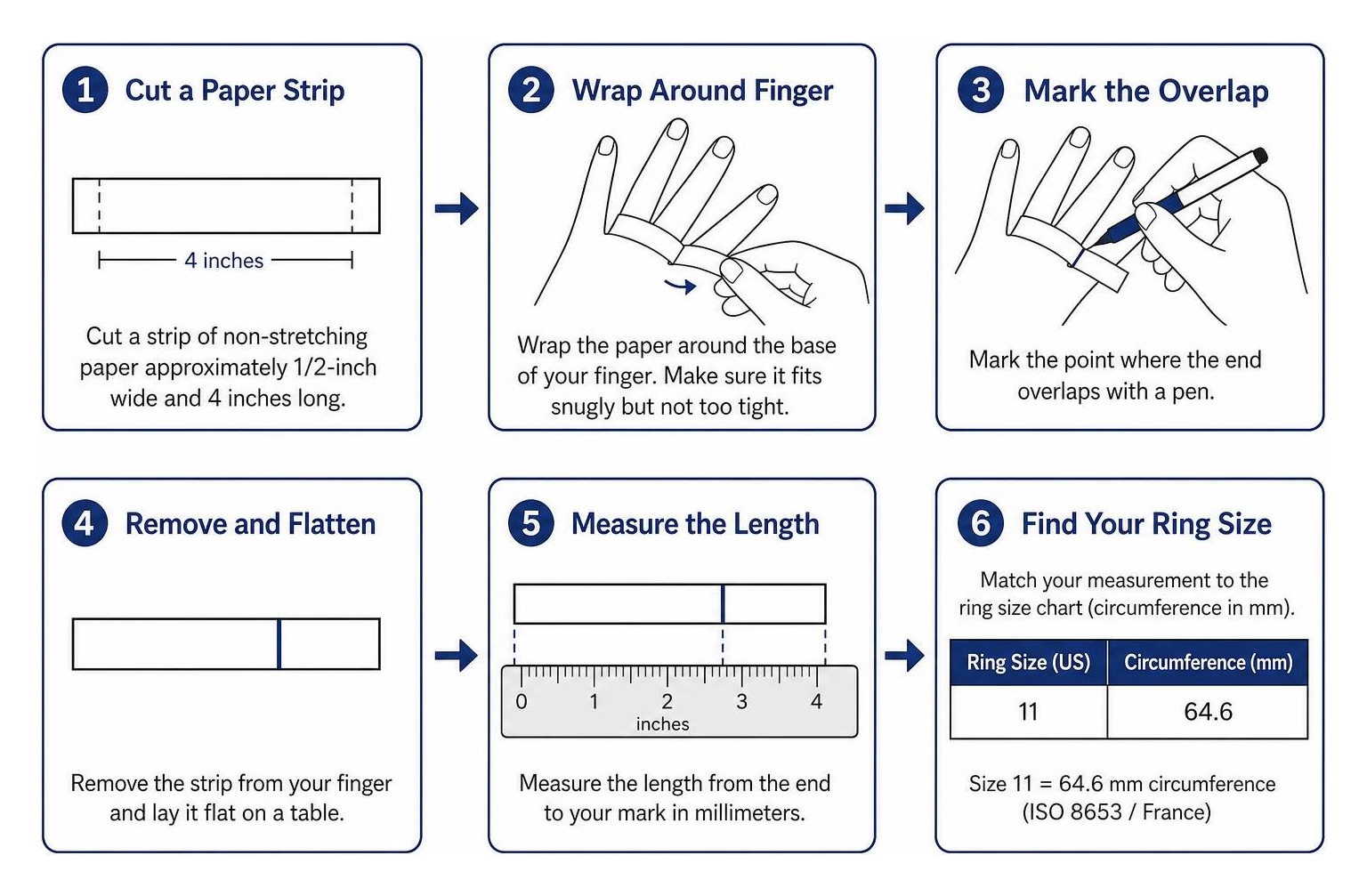
To check your ring size at home, follow these steps:
- The Paper Strip Method: Cut a strip of non-stretching paper approximately 1/2-inch wide and 4 inches long.
- Wrap Snugly: Wrap the paper around the base of your intended finger. Ensure it wraps evenly without buckling.
- Account for the Knuckle: Slide the wrapped loop over your knuckle to make sure it clears the joint without tearing.
- Mark and Measure: Mark the exact spot where the paper overlaps using a fine-point pen. Lay the strip flat against a ruler calibrated in millimeters.
- Verify the Dimensions: If your strip measures 64.6 mm, you are an exact US size 11.
- The Existing Ring Method: Take a ring that already fits the target finger comfortably. Place it flat on a ruler and measure the inside opening at its widest point. If the inside distance spans 20.6 mm, the ring is a size 11.
Key Factors Affecting Fit: Temperature, Time, and Band Width
Finger size is not static; it fluctuates throughout the day based on several physical variables:
- Time of Day: Fingers are generally smaller in the morning and reach their maximum circumference late in the evening. Always measure at the end of the day.
- Temperature: Cold environments cause blood vessels to constrict, making fingers temporarily shrink. Measure when your hands are at a comfortable room temperature.
- Band Width: Narrow bands (2 mm to 4 mm) slide across the finger with minimal resistance. Wide bands (6 mm to 10 mm) cover more skin surface and feel tighter. If you are choosing a wide cigar band or a thick men's wedding ring, jewelers recommend ordering a half-size larger (size 11.5 instead of size 11) for equivalent comfort.
- Dominant Hand: Your dominant hand is almost always a half-size to a full size larger than your non-dominant hand due to muscle development.
Sizing Dilemmas: In-Between Sizes and Ring Resizing Options
Finding out you measure right on the line between sizes is a very common scenario. Understanding your adjustment options gives you confidence when placing an order.
What to Do When Measuring Between Size 10.5 and 11
If your finger measures approximately 64.0 mm, you fall halfway between a size 10.5 (63.4 mm) and a size 11 (64.6 mm). In nearly all situations, sizing up to the larger size is the recommended choice.
A ring must be able to slide over your knuckle comfortably. If your knuckle is significantly larger than the base of your finger, a size 11 ensures smooth passage, while small interior additions can keep the ring from spinning once seated:
- Sizing Beads: Two tiny metal spheres soldered onto the inside lower shank that stabilize the ring without changing its structural diameter.
- Spring Inserts / Ring Guards: Semi-flexible internal bridges that expand over the knuckle and gently contract at the base of the finger.
- Temporary Silicone Adjusters: Clear coils wrapped around the lower shank for an immediate, non-invasive fit reduction.
Metal Resizability and Alternative Solutions
Not every ring material responds to resizing in the same way. The metal you select dictates how easily a jeweler can adjust the piece later:
- Traditional Precious Metals (Yellow Gold, White Gold, Rose Gold, Platinum, Sterling Silver): These metals are ductile and easily worked. Our master goldsmiths can adjust gold or platinum rings up or down multiple sizes seamlessly by cutting the band, adding or removing matching metal, and laser-welding the joint.
- Contemporary Alternative Metals (Tungsten Carbide, Titanium, Ceramic, Cobalt Chrome): These modern metals cannot be cut, stretched, or soldered using traditional jeweler torches or lasers. If your finger size changes, alternative metal bands generally require an outright replacement rather than physical modification.
- Full Eternity Bands: Rings featuring continuous diamonds or gemstones encircling the entire band have no bare metal zone for cutting, making standard resizing impossible without rebuilding the mounting.
Frequently Asked Questions About Ring Size 11
Have more questions about sizing? You can always check our complete FAQ page for comprehensive guidance on jewelry care and fittings.
What is the diameter of a size 11 ring in inches?
A US size 11 ring has an inner diameter of approximately 0.811 inches (20.6 millimeters). In fractional measurements, this is just over 13/16 of an inch across the inside opening of the band.
Should I size up if I am between size 10.5 and 11?
Yes. It is almost always better to size up to size 11. Fingers naturally swell during warm weather, after exercise, and following air travel. Additionally, wide-profile rings require extra breathing room on the finger pad, making the larger size far more practical.
Can a size 11 tungsten or titanium band be resized?
No. Tungsten carbide, titanium, and ceramic bands cannot be physically resized by a jeweler because of their extreme hardness and crystalline structure. If your size 11 band made of these metals becomes too loose or tight, you will need to exchange it for a new size.
Conclusion
Determining your correct ring size ensures that your fine jewelry remains both comfortable and secure for a lifetime of daily wear. A US size 11 represents a substantial, versatile dimension, matching an inner diameter of 20.6 mm and an inner circumference of 64.6 mm across international conversion scales. Whether you are selecting a sleek men's wedding band, styling a bold statement piece, or building a custom heirloom, accurate measurements make all the difference.
If you ever need assistance adjusting a precious heirloom or want to explore how ring resizing works, our team is here to help. At Jeweler's Touch, our family-owned jewelry store in Orange County has served clients in Brea, CA, and surrounding communities since 1992. With three GIA Graduate Gemologists on staff and experienced master goldsmiths working in our on-site workshop, we provide professional finger measurements, custom design consultations, laser repairs, and precision resizing services. Visit our Brea showroom or reach out to us today to ensure every piece in your collection fits comfortably.