

The story of the birthstone opal stretches back thousands of years across vastly different cultures, each captivated by its shifting hues. The word itself comes from the ancient Sanskrit upala, meaning "precious stone." This evolved into the Greek opallios, which translates to "to see a change of color," and eventually the Latin opalus.
In ancient Rome, people held the gem in high regard, placing its value second only to emerald. The Roman scholar Pliny the Elder famously described opal as combining the best characteristics of all fine gems: the fiery red of ruby, the rich purple of amethyst, and the deep green of emerald, all gleaming together in a single stone. Roman leaders frequently presented opal amulets to their spouses to bring luck and protection. In fact, story has it that Roman senator Nonius chose to go into exile rather than surrender his prized opal ring to Mark Antony, who wanted to gift it to Cleopatra.
Indigenous Australian cultures have long revered the stone through their Dreamtime stories. In these traditions, the Creator came down to Earth on a giant rainbow to spread a message of peace, and wherever his feet touched the ground, the stones beneath transformed into sparkling opals carrying every shade of the rainbow.
Beyond celebrating October birthdays, opal is also the traditional gemstone gift for the 14th wedding anniversary. You can learn more about its natural formation and scientific classification through the GIA Gemstone Guide.
Ancient Legends and Symbolism of the Birthstone Opal
Throughout history, wearing an opal was thought to bestow deep spiritual and emotional benefits. Its primary symbolic associations include:
- Hope and Optimism: Because its optical flashes shift under light, ancient wearers saw it as a symbol of positive change and bright futures.
- Purity and Truth: Light body tones like white and crystal opal have historically represented clarity of mind and authentic emotional truth.
- Love and Passion: Vibrant fire opals and intense flashes of red play-of-color were tied to creative energy, warmth, and romantic devotion.
- Intuition and Healing: Many ancient healers believed the stone heightened self-awareness, fostered artistic expression, and soothed turbulent emotions.
Those born in early autumn often feel a natural affinity for these traits. You can discover more about your personal astrological gemstone alignment in our October Birthstone Zodiac Guide.
Is the Birthstone Opal Lucky or Unlucky?
For most of recorded human history, the birthstone opal was considered an exceptionally lucky talisman. Bedouins believed the gem trapped bolts of lightning during thunderstorms and fell directly from the sky. Medieval Europeans wore opals for good fortune, while some even believed the stone could preserve blonde hair color or grant temporary invisibility, leading to its humorous nickname as the "Patron of Thieves."
So where did the bad luck myth come from? The superstition largely traces back to a single work of fiction: Sir Walter Scott's 1829 novel Anne of Geierstein. In the story, a main character wears a magical opal hair barrette that flashes bright colors matching her mood. When a drop of holy water touches the stone, its colors extinguish, and the character faints, burning to ashes shortly after.
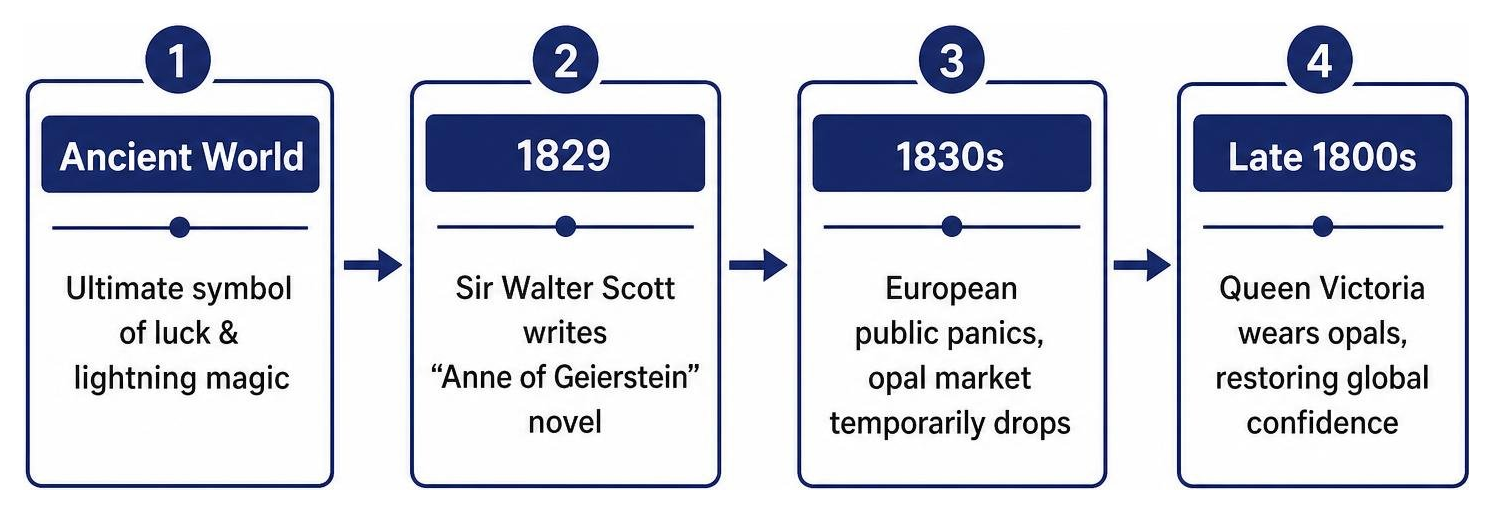
This fictional tale caused public panic across Europe, tanking the gem market for decades. The myth was compounded by lapidaries who found opals tricky to cut without cracking due to their delicate structural nature.
Queen Victoria single-handedly shattered this silly superstition. A true gem admirer, she wore opals prominently throughout her reign and presented fine opal jewelry to her daughters on their wedding days. Today, the bad luck myth is recognized as nothing more than 19th-century fiction, and opal is celebrated worldwide as a gemstone of joy and individuality.
October Dual Gemstones: Opal and Tourmaline
If you were born in October, you get to enjoy two official birthstones: opal and tourmaline. This dual arrangement offers a wide range of colors, styles, and price points.
October's shared status was established in 1912 when the National Association of Jewelers (now Jewelers of America) met in Kansas City to standardize the modern birthstone calendar. While opal remained the traditional favorite, gemologists added tourmaline to offer a hardier, highly accessible option with a broad array of natural colors. For a closer look at both gems, check out our comprehensive October Birthstone Guide.
Comparing Opal and Tourmaline
While both gems showcase magnificent color, their physical makeup, optical behavior, and daily care requirements are quite different.
| Feature | Opal Birthstone | Tourmaline Birthstone |
|---|---|---|
| Structure | Amorphous hydrated silica (3% to 20% water content) | Crystalline complex borosilicate mineral |
| Hardness (Mohs Scale) | 5.5 to 6.5 (Relatively soft, susceptible to scratches) | 7 to 7.5 (Durable, great for everyday wear) |
| Optical Phenomenon | Internal play-of-color from light diffraction | Pleochroism (displays different colors from different angles) |
| Color Spectrum | Multicolored flashes inside white, black, or clear base | Distinct solid colors (pink rubellite, green verdelite, blue indicolite, watermelon) |
| Cleaning & Care | Gentle warm soapy water only; strictly no heat or steamers | Warm soapy water; gentle brush; avoid extreme thermal shock |
Tourmaline rates between 7 and 7.5 on the Mohs hardness scale, making it somewhat more resistant to everyday scratches than opal. Pink tourmaline in particular has become a favorite alternative for October birthstone stack rings and stud earrings. However, nothing quite matches the dancing, spectral display of a natural birthstone opal.
Types, Sources, and Valuation of Opals
Opals form over millions of years as silica-rich rainwater trickles down into underground rock crevices. As the water evaporates, it leaves behind microscopic spheres of silica stacked in neat, organized grids. When ambient light hits these tiny spheres (often measuring just 0.2 microns across), it diffracts into brilliant flashes of spectral color.
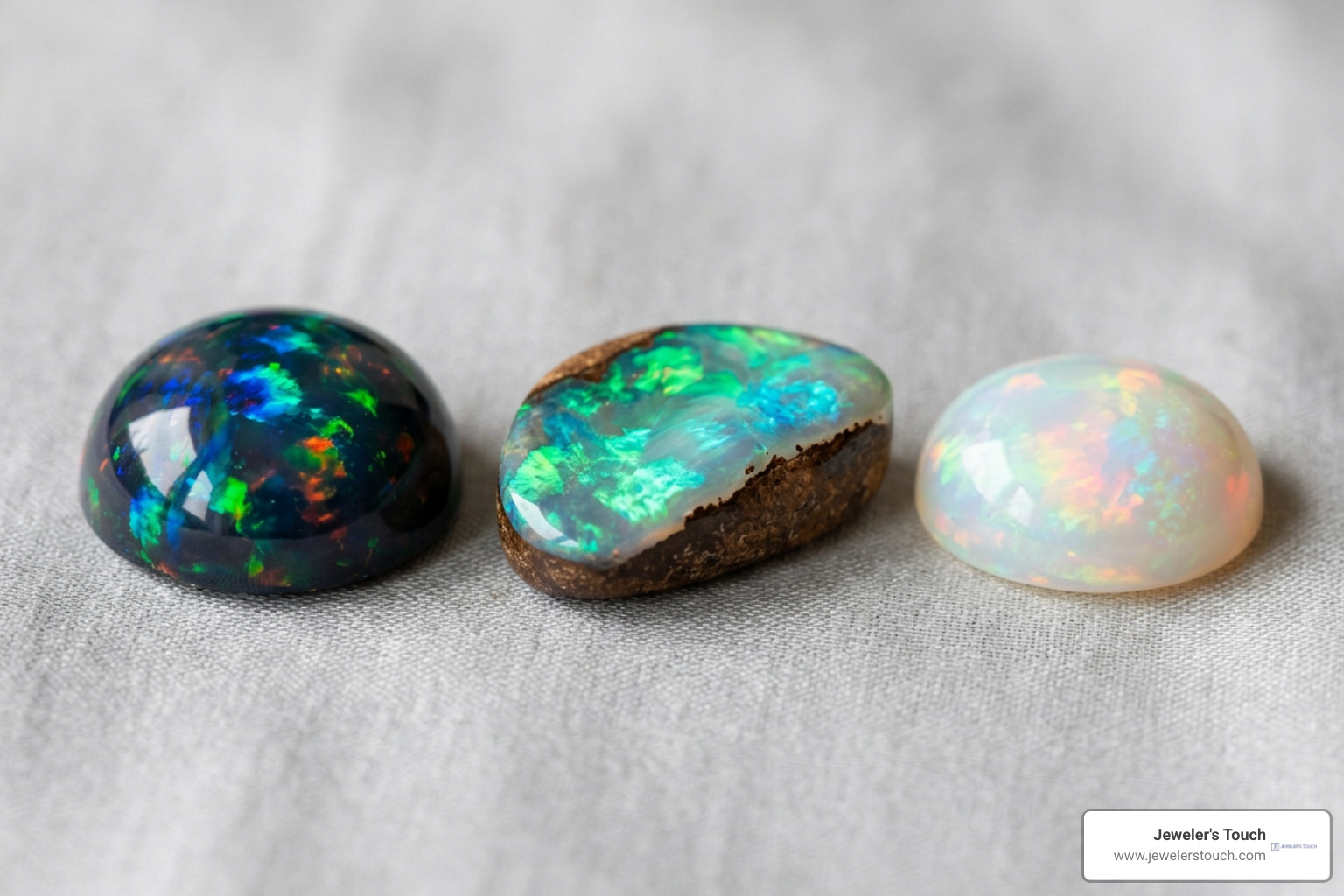
Australia produces over 90% of the world's precious opal, yielding the finest historical specimens known. Other key sources include Ethiopia, Mexico, Brazil, and regions within the United States. You can read more about gemstone structures in the Britannica Opal Overview.
Opal Varieties Used in Fine Jewelry
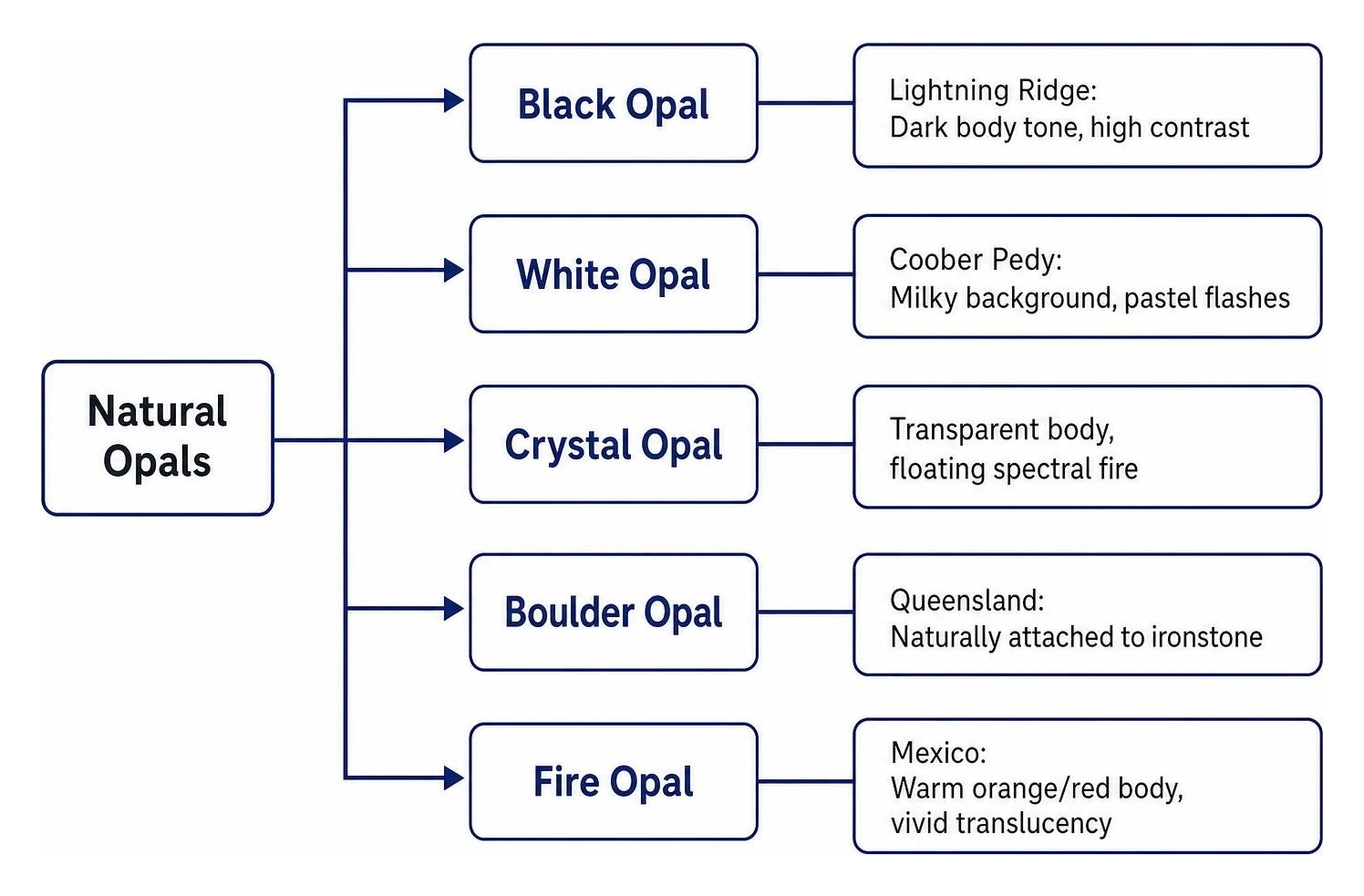
No two opals look identical, but gemologists categorize natural specimens into five primary varieties:
- Black Opal: The rarest and most valuable variety, featuring a dark black or dark gray body tone that makes internal red, green, and blue flashes pop with vivid contrast. Lightning Ridge in New South Wales, Australia, is the world's primary source for fine natural black opal.
- White Opal: The classic traditional choice, featuring a light milk-white or cream background displaying pleasant pastel flashes of pink, blue, yellow, and green. Coober Pedy in South Australia is world-renowned for white opal deposits.
- Crystal Opal: A transparent to semi-transparent variety with clear body tones that let light pass through, revealing floating internal fire from all angles.
- Boulder Opal: Found exclusively in Queensland, Australia, this variety naturally remains attached to its original brown ironstone backing, creating striking natural contrast and exceptional physical stability.
- Fire Opal: Sourced predominantly from Mexico, fire opal is prized for its translucent yellow, bright orange, or cherry-red body colors, which may or may not show classic play-of-color.
Value Factors: Brightness, Pattern, and Origin
When evaluating a birthstone opal, professional gemologists consider three core criteria: brightness, pattern, and body tone.
- Brightness: This is the single most important factor. An opal with a dark body tone and intense, vivid flashes will command a much higher price than a dull stone with muted colors.
- Play-of-Color & Pattern: Red is the rarest and most expensive flash color because it requires larger, perfectly uniform silica spheres to diffract red light waves. Blue and green flashes are much more common. Desirable patterns include large blocky "Harlequin" flashes, rolling ribbons, and broad pinfire patterns.
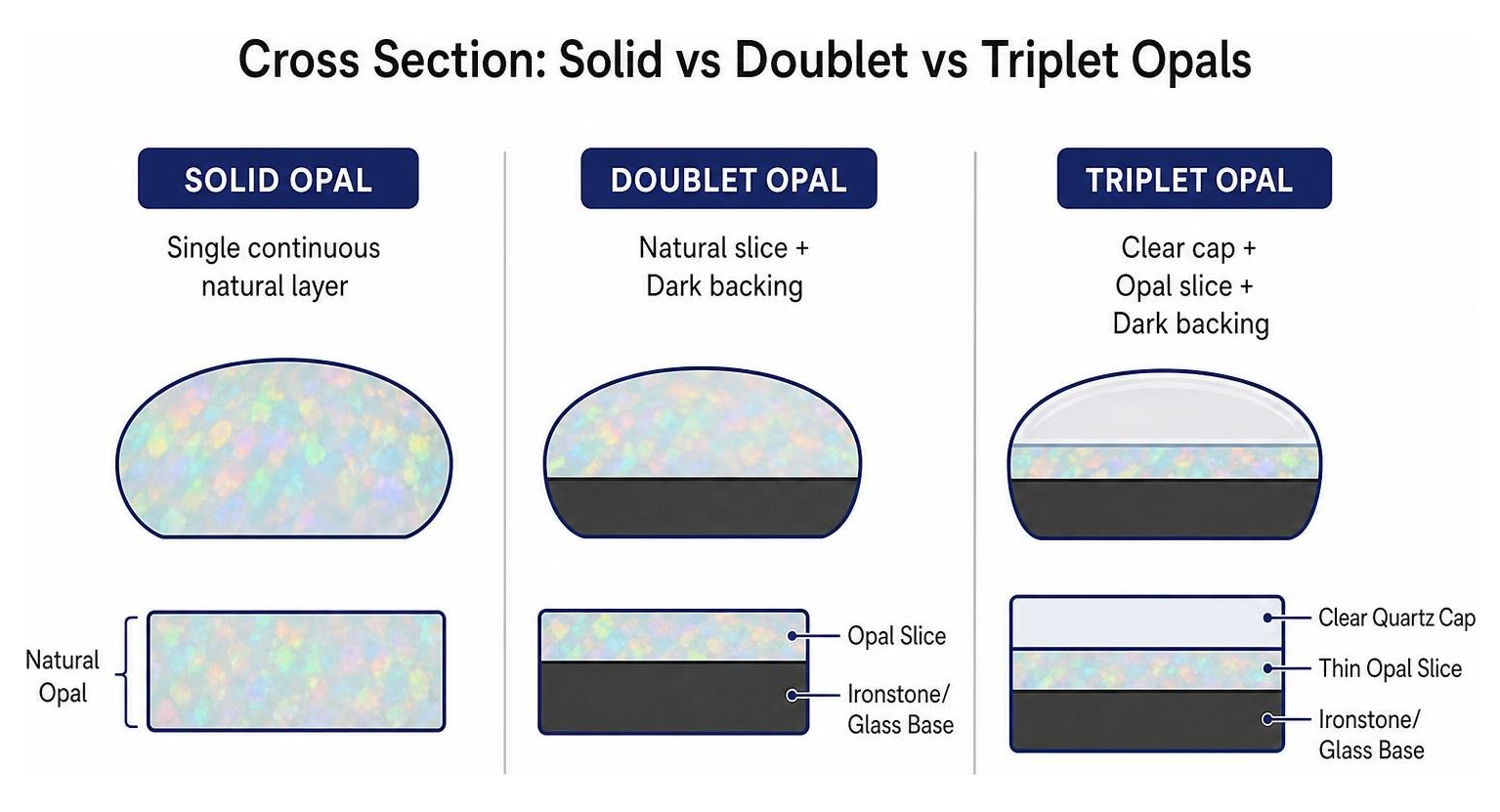
- Solid vs. Composite Stones: A solid opal consists entirely of natural stone. Composite stones, such as doublets and triplets, feature thin slices of natural opal glued to black glass or ironstone backings, topped with clear quartz domes. While doublets and triplets offer vibrant, budget-friendly options, natural solid opals hold significantly higher long-term heirloom value.
Fine black opal displaying bright red play-of-color can command prices higher than diamonds per carat. The world's largest precious opal ever found, the famous Olympic Australis, weighs 17,000 carats (3.45 kilograms) and is valued at over $2.5 million.
Buying, Identifying, and Caring for Opal Jewelry
Because opal rates between 5.5 and 6.5 on the Mohs hardness scale, it requires thoughtful selection and proper maintenance. To learn how hardness affects gemstone wearability, explore our guide on Understanding the Mohs Scale and Gemstone Durability.
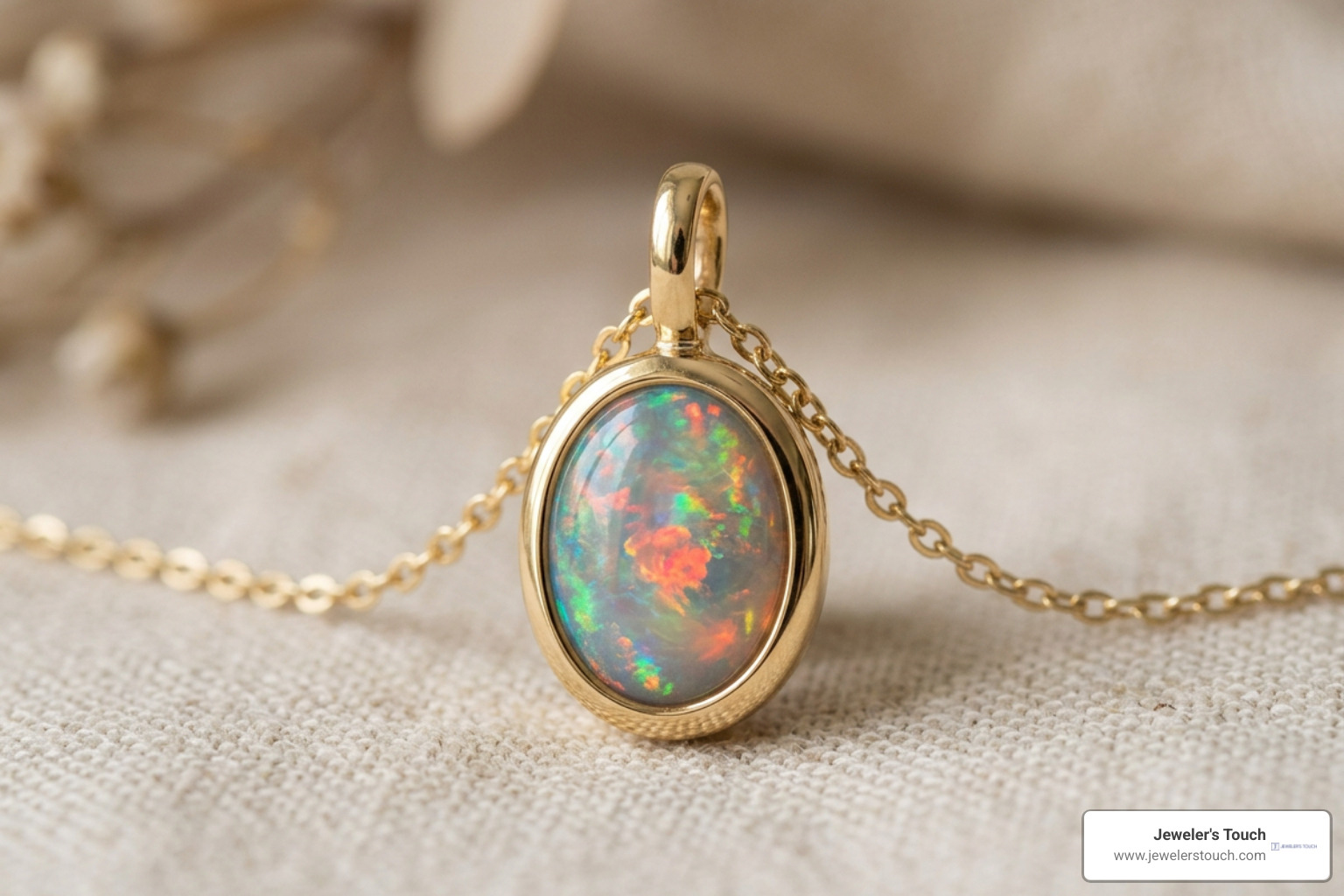
When selecting everyday jewelry, protective bezel settings, which encircle the stone in a smooth metal rim, help shield delicate edges from accidental bumps. Halo settings wrapped in diamonds or hard accent gems also provide solid physical protection. Pendants, drop earrings, and brooches are naturally safe from daily wear, while opal rings are best suited for mindful, occasional wear or protective custom settings.
Real Opal vs. Imitations and Composites
With so many synthetic alternatives on the market, it helps to know how to spot authentic stones:
- Natural Solid Opal: Displays uneven, organic color flashes that shift fluidly when rotated under light. From the side, the body tone looks continuous without visible seams or clear glass layers.
- Synthetic Opal (e.g., Gilson Opal): Man-made in laboratories, synthetic opals have the same chemical composition as natural opals but often display overly uniform "lizard-skin" or "chicken-wire" column patterns under magnification.
- Opalite: A man-made glass imitation that appears milky blue over dark surfaces and pale yellow against light backgrounds. It lacks genuine internal silica play-of-color.
- Doublets and Triplets: Look at the gem from the side under magnification. Doublets will reveal a straight dark joining line where the thin opal slice is glued to a backing. Triplets show a clear quartz cap glued over the top, which can give off a glassy sheen under strong lighting.
Essential Care and Cleaning Protocols
Because opals contain between 3% and 10% water weight (and occasionally up to 20%), maintaining their moisture balance is key to preventing surface cracking, known as crazing.
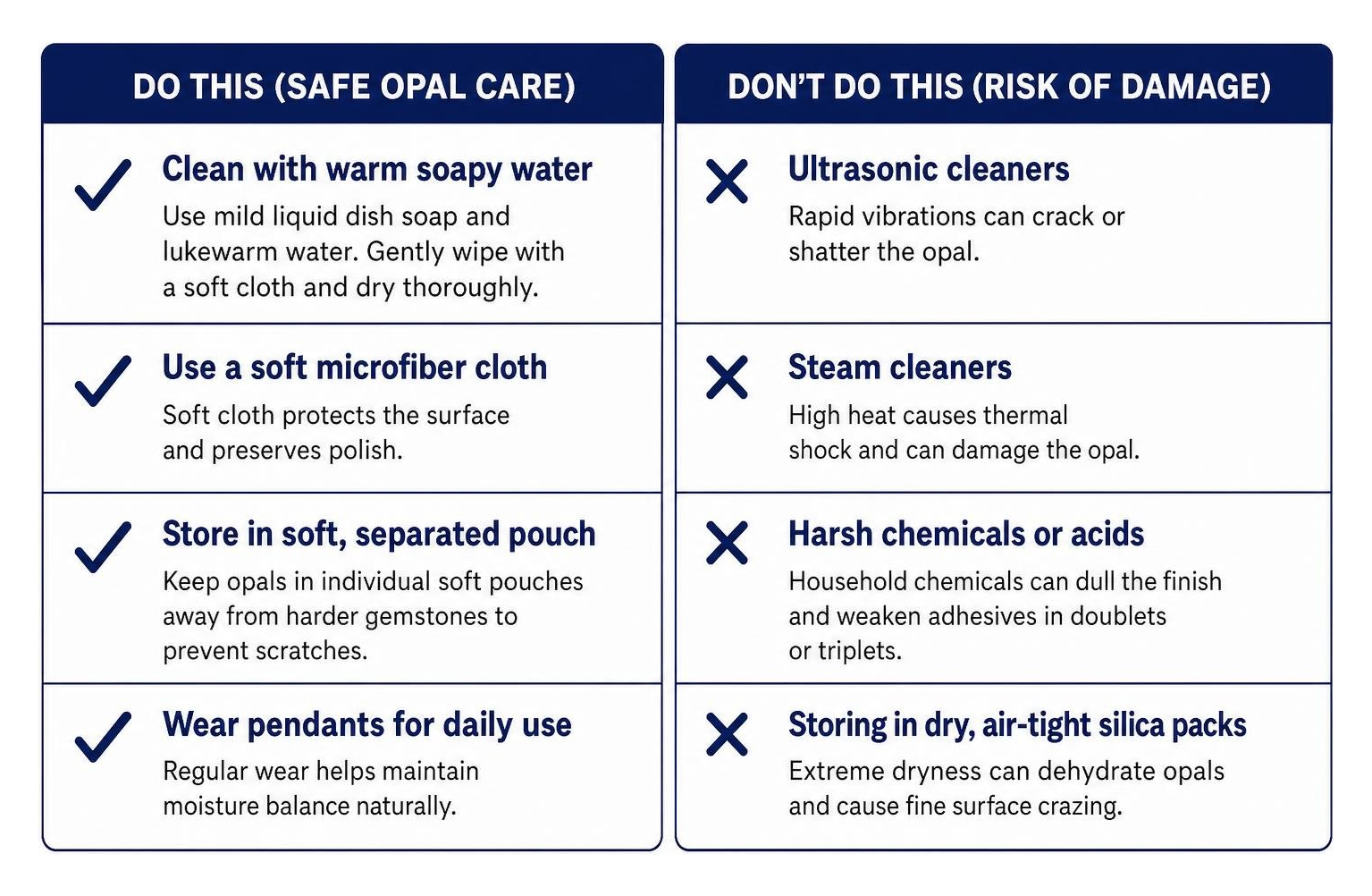
- Cleaning Method: The safest way to clean any birthstone opal is with mild liquid dish soap, lukewarm water, and a soft microfiber cloth. Gently wipe away dust and skin oils, then dry thoroughly.
- Avoid High Heat and Steam: Never clean opals using steam or ultrasonic cleaners. High heat causes sudden thermal shock, while rapid sonic vibrations can shatter fragile silica bonds.
- Chemical Safety: Remove opal rings before applying hand sanitizer, lotion, hairspray, or dish detergent. Harsh chemicals degrade stone polish and can break down the adhesives in doublets or triplets.
- Proper Storage: Store your opal pieces in individual soft fabric pouches separated from harder gems like diamonds, sapphires, and rubies to prevent surface scratching. Avoid storing opals long-term in dry, air-tight silica gel environments, as extreme dehydration can cause fine surface crazing.
For more helpful care tips, visit My Birthstone Guide's Opal Overview.
Frequently Asked Questions About October Birthstones
Can opal birthstone jewelry be worn every day?
Yes, provided you choose practical jewelry designs and wear them thoughtfully. Opal pendants, brooches, and drop earrings rarely suffer direct physical impacts, making them wonderful choices for everyday wear.
If you plan to wear an opal ring daily, look for a protective bezel setting or a low-profile halo mounting that shields the outer rim of the stone. Always remove soft gemstone rings before swimming, doing heavy gardening, working out, or handling cleaning supplies.
Why does October have two birthstones?
October features two official modern birthstones, opal and tourmaline, because the National Association of Jewelers expanded the traditional birthstone calendar in 1912.
While opal remains the original traditional selection, tourmaline was added to provide an accessible, physically resilient gemstone option in a variety of natural colors. This gives October celebrants the freedom to choose between the fiery play-of-color of opal and the durable pleochroic hues of tourmaline.
Where are the finest opals in the world mined?
Australia is home to the world's premier opal fields, producing more than 90% of global supplies. Lightning Ridge in New South Wales is famous as the world's primary source of prized natural black opal, while Coober Pedy yields spectacular white and crystal opals.
Queensland produces rich boulder opals naturally attached to ironstone rock. Other notable mining sources include the Wollo Province in Ethiopia (known for hydrophane opals), Mexico (famous for fire opals), Brazil, Peru, and parts of the western United States.
Conclusion
The birthstone opal remains one of the world's most mesmerizing natural treasures. From ancient Bedouin legends of fallen lightning to modern custom jewelry designs, its dancing spectrum of light celebrates individuality like no other gem. Whether you prefer the dramatic contrast of a black opal or the soft pastel glow of a white opal, this October gemstone makes a meaningful gift for birthdays, 14th anniversaries, and personal milestones.
At Jeweler's Touch, our family-owned team has served Orange County and surrounding communities like Brea, CA, since 1992. Our on-site GIA gemologists and master goldsmiths are always happy to help you select, custom design, or repair your favorite pieces.
Visit our showroom or explore our complete Jeweler's Touch Birthstone Guide to find your perfect custom piece!