

September Birthstone: Sapphire at a Glance
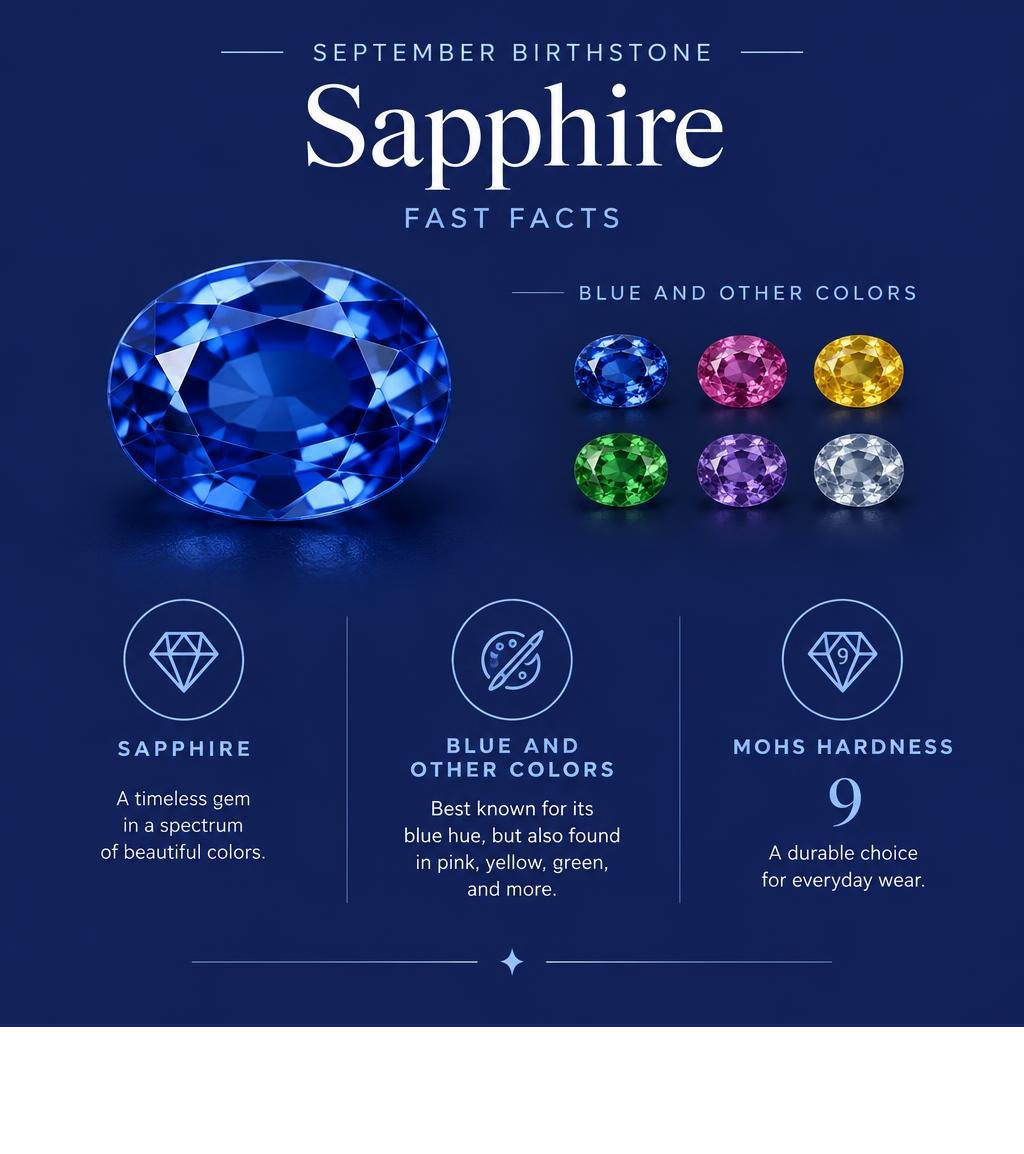
The September birthstone is sapphire. Its best-known color is blue, but sapphires also come in pink, yellow, green, and other shades. Sapphire is a form of corundum that ranks 9 on the Mohs hardness scale, making it a durable choice for jewelry worn often, including engagement rings.
I'm Ken Rutz, and I draw on Jeweler's Touch's experience with fine jewelry and custom engagement rings to guide this look at the September birthstone. Let's start with the meaning and history behind sapphire.
The Meaning and History of the September Birthstone
For thousands of years, sapphires have captured human imagination across civilizations. Deriving its name from the Greek word sappheiros, which historically referred to brilliant blue stones, sapphire has stood as an enduring emblem of sincerity, truth, faithfulness, and nobility.
Ancient Persians believed that our entire world rested atop a colossal sapphire, and its vivid reflection painted the sky with its vibrant blue hue. In Greco-Roman antiquity, travelers and royalty wore sapphires to attract divine favor and shield themselves from envy or harm. According to detailed historical accounts curated in the GIA sapphire birthstone overview, these gems were also prized during medieval times as therapeutic remedies believed to soothe eye ailments, clear plague boils, and calm heated tempers.
Ancient Folklore and Sacred Symbolism
Throughout the Middle Ages, sapphire became deeply intertwined with sacred and royal authority. Clergy members wore sapphire signet rings as symbols of purity and heavenly grace, believing the stone focused the mind toward divine contemplation. Rulers regarded the gem as a potent safeguard against treason, poisoning, and negative energy.
Beyond guarding against physical danger, folklore attributed harmonizing powers to the gem. It was said that wearing a sapphire could foster peace between bitter rivals and protect romantic fidelity across long journeys. If you are curious about how other monthly gemstones compare in folklore and heritage, you can explore our comprehensive birthstone guide.
Sapphire Origins and Sourcing Across the Globe
Sapphires are found across several continents, with distinct geologic conditions giving each source its own signature qualities.
- Kashmir: Discovered in the Himalayas following a landslide around 1881, Kashmir sapphires are legendary for their velvety, cornflower-blue tone caused by tiny inclusions that scatter light without diminishing transparency.
- Sri Lanka (Ceylon): Known for more than 2,000 years as the "Jewel Island," Sri Lanka produces luminous, medium-blue sapphires as well as radiant pastel shades and rare orange-pink varieties.
- Myanmar (Burma): The historic Mogok tract yields rich, saturated royal blue sapphires alongside world-renowned rubies.
- Montana, USA: The United States produces exceptional sapphires from Yogo Gulch and the Rock Creek deposits in Montana, celebrated for their unique metallic blues, greens, and pastel tones.
- Madagascar and Australia: Modern deposits in Madagascar produce stones that rival fine Sri Lankan gems, while Australian mines contribute deeply saturated midnight blue stones.
| Region / Mine | Typical Color Profile | Key Identifying Features | Historical Significance |
|---|---|---|---|
| Kashmir (India) | Velvety cornflower blue | Subtle light-scattering inclusions | Discovered in 1881; highly coveted |
| Sri Lanka (Ceylon) | Brilliant medium blue, pastels | High clarity, luminous brightness | Continuous production for over 2,000 years |
| Mogok (Myanmar) | Intense royal blue | Deep saturation, excellent luster | Historic source of top-tier corundum |
| Montana (USA) | Steel blue, teal, pastel shades | Consistent color, high brilliance | Premier American source since late 19th century |
| Madagascar | Broad spectrum (blue to fancy hues) | Strong saturation, clean crystals | Major modern supplier since the late 1990s |
Beyond Blue: Exploring Fancy September Birthstone Colors
While classic royal blue remains the most celebrated hue, corundum occurs in a dazzling spectrum of colors called fancy sapphires. Pure corundum is naturally colorless, but trace minerals within the Earth's crust create an array of shades:
- Padparadscha: Derived from the Sinhalese word for "lotus blossom," this rare and prized variety combines delicate pink and orange hues.
- Yellow and Orange: Colored by iron impurities, these stones range from soft lemon tones to rich canary and amber gold.
- Pink and Purple: Trace amounts of chromium produce romantic blush tones, vivid magentas, and deep violets.
- Green: Caused by iron interactions, green sapphires offer shades from cool mint to rich forest greens.
- White (Colorless): Free of trace element impurities, pure white sapphires provide an attractive diamond alternative.
- Star Sapphires: Certain stones contain microscopic needle-like rutile inclusions that create asterism, a glowing six-rayed star across the surface when cut as a smooth cabochon.
To learn more about the gemological science behind these color variations, check out the IGS guide on fancy sapphire varieties.
Sapphire Durability, Heat Treatments, and Care
Sapphire is one of the toughest colored gemstones in the world, ranking 9 on the Mohs hardness scale. It is second in scratch resistance only to diamond (which scores a 10), making it well-suited for everyday wear in rings, bracelets, and pendants.
Approximately 95% of natural blue sapphires undergo heat treatment before being cut into jewelry. This traditional, permanent technique uses controlled temperatures to dissolve rutile inclusions, enhance clarity, and improve color saturation. Top-tier, naturally untreated sapphires of high clarity and color command premium market values, often fetching up to 50% more than comparable heated gems.
Other laboratory enhancements include lattice diffusion (which introduces color agents into the gem's outer layer) and fracture filling. These treatments require careful attention:
- Routine Cleaning: Clean your jewelry at home using warm water, mild dish soap, and a soft-bristled toothbrush. Gently scrub behind the setting where oils and lotions gather, then rinse and dry with a lint-free cloth.
- Ultrasonic and Steam Cleaners: These methods are generally safe for untreated and routinely heat-treated stones. However, avoid ultrasonic cleaning for stones with fracture fillings or heavy inclusions.
- Chemical and Heat Exposure: Avoid exposing fancy or treated sapphires to harsh acids, bleach, or sudden extreme temperature changes.
- Proper Storage: Store your sapphire pieces in individual soft fabric pouches or separate jewelry box compartments so their hard surfaces do not scratch softer gemstones like emeralds, opals, or pearls.
September Astrology, Birth Flowers, and Trivia
September is rich with seasonal transitions, astronomical events, and celebratory traditions:
- Zodiac Signs: September spans two astrological signs. Virgo (August 23 to September 22) represents analytical precision, grounding, and loyalty. Libra (September 23 to October 22) embodies balance, harmony, and grace.
- Birth Flowers: The primary birth flower for September is the aster, which symbolizes deep patience, elegance, and love. The morning glory also represents September, reflecting affection and renewal.
- The Big 3: In the fine jewelry world, sapphire forms the prestigious "Big 3" of colored gemstones alongside ruby and emerald. Blue sapphire is often the most accessible and abundant of these three precious gems.
- Milestone Anniversaries: Sapphire is the traditional gemstone gift for celebrating both the 5th and 45th wedding anniversaries.
- Harvest Moon: September often hosts the Harvest Moon, the full moon closest to the autumnal equinox, which illuminates late summer fields.
- Fun Letter Fact: September is the only calendar month whose English name contains nine letters, matching its place as the ninth month of the year.
Famous Historical Sapphires and Design Ideas
Sapphires have long held a place among the world's most celebrated treasures. One notable example is the Rockefeller Sapphire, a 62.02-carat rectangular step-cut gem sourced from Myanmar that was acquired by John D. Rockefeller Jr. in the 1930s.
In modern history, few pieces have captured public attention like the sapphire engagement ring originally chosen by Princess Diana in 1981, which features a 12-carat oval Ceylon blue sapphire framed by fourteen solitaire diamonds.
At Jeweler's Touch, we craft distinctive custom gemstone jewelry that highlights the natural beauty and resilience of sapphire.
How to Choose and Style September Birthstone Jewelry
Whether you are selecting a birthday surprise or an everyday signature piece, consider these versatile jewelry styles:
- Classic Statement Rings: A white gold sapphire and diamond ring pairs deep blue hues with crisp diamond accents for everyday wear or alternative bridal designs.
- Modern Everyday Pendants: For subtle style, a sleek sapphire bar pendant adds a bright touch of blue to casual and professional attire.
- Layered Necklaces: Discover versatile designs across our fine gemstone pendants and charms, perfect for pairing with complementary yellow gold or platinum chains.
- Tennis and Bangle Bracelets: Explore elegant gemstone bracelets set with sapphires to build a sophisticated layered look.
Frequently Asked Questions About Sapphire
What is the official September birthstone and its primary color?
The official birthstone for September is sapphire, a mineral variety of corundum. Its signature color is rich velvet blue, created by trace amounts of titanium and iron interacting within the crystal lattice.
Can sapphires be worn every day in engagement rings?
Yes. Sapphires rank 9 on the Mohs hardness scale, offering excellent resistance to scratching and chipping for daily wear. This makes them one of the most durable colored gemstones available for engagement rings.
What are the traditional birth flowers and zodiac signs for September?
The traditional birth flowers for September are the aster and morning glory. The month includes the zodiac signs Virgo (August 23 to September 22) and Libra (September 23 to October 22).
Conclusion
From ancient royal courts to timeless modern engagement rings, sapphire remains one of the world's most treasured gems. Its outstanding durability, rich color spectrum, and deep symbolism make it a wonderful way to commemorate September birthdays and meaningful milestones.
Visit our Orange County showroom in Brea, CA, to explore our fine jewelry collection in person. In business since 1992, Jeweler's Touch is home to 3 on-site GIA Graduate Gemologists and expert goldsmiths dedicated to providing quality craftsmanship, custom jewelry designs, and professional care.
If you are exploring gifts for other months, check out our previous month birthstone guide to discover the stories behind peridot, sardonyx, and spinel.