

The Truth About a "GIA Certified Appraisal" (And What You Actually Need)
If you are searching for a GIA certified appraisal, here is the most important thing to know right away:
GIA does not perform appraisals or assign monetary value to diamonds or jewelry. A "GIA certified appraisal" does not technically exist as a single document from GIA.
Here is what you actually get, and from whom:
| What You Need | Who Provides It | What It Includes |
|---|---|---|
| Diamond grading report | GIA (the lab) | 4Cs, clarity plot, proportions. No dollar value. |
| Monetary appraisal | Independent appraiser (often a GIA Graduate Gemologist) | Dollar value based on the GIA report |
| "GIA certified appraisal" | Not a real GIA product | A common misconception |
So when most people say "GIA certified appraisal," what they mean is: a professional jewelry appraisal performed by a GIA Graduate Gemologist using a GIA grading report as its foundation. Those are two separate steps, done by two separate parties.
This confusion is incredibly common, especially for couples shopping for engagement rings. You buy a diamond, it comes with a "GIA certificate," and you assume that document tells you what the ring is worth. It does not. It tells you what the diamond is.
I'm Ken Rutz of Jeweler's Touch, a premier jewelry store where I've helped countless clients navigate the difference between a GIA grading report and a true GIA certified appraisal performed by a credentialed gemologist. Understanding this distinction can save you from being underinsured or overpaying.
Why a True GIA Certified Appraisal Does Not Exist
To understand why you cannot order a true GIA certified appraisal directly from the source, we have to look at the mandate of the Gemological Institute of America (GIA). Established in 1931, GIA is a public benefit, non-profit institution. Its primary mission is to protect the gem and jewelry buying public by maintaining absolute global standards of integrity, academics, and science.
To maintain this absolute objectivity, GIA does not participate in the commercial marketplace. They do not buy, sell, or trade gemstones, nor do they estimate their market prices. If GIA were to assign dollar values to the diamonds they graded, it would create an immediate conflict of interest.
By remaining completely detached from commercial pricing, GIA ensures that its laboratory grading reports are globally respected for their scientific neutrality. When a diamond goes to a GIA laboratory, the technicians do not know who owns it, where it was purchased, or how much it cost. They only care about the physical properties of the stone. For more details on this strict policy of neutrality, you can read the official GIA response on Does GIA certify or appraise diamonds and other gemstones?.
The Myth of the GIA Certified Appraisal
The term "GIA certified appraisal" is a linguistic mashup of two different things: a GIA Diamond Grading Report and a professional retail appraisal.
It is also worth noting that the phrase "GIA certificate" is technically a misnomer. GIA itself does not "certify" diamonds, they issue reports. A certificate would imply a guarantee of commercial value or a promise of financial return. Instead, a GIA report is a scientific blueprint of a gemstone's unique characteristics at the exact moment of testing.
By visiting the main Gemological Institute Of America website, consumers can explore the vast educational resources that explain how these scientific reports are compiled. But you will never find a price tag or a valuation tool on their official platform.
Grading vs. Appraising: The Core Differences
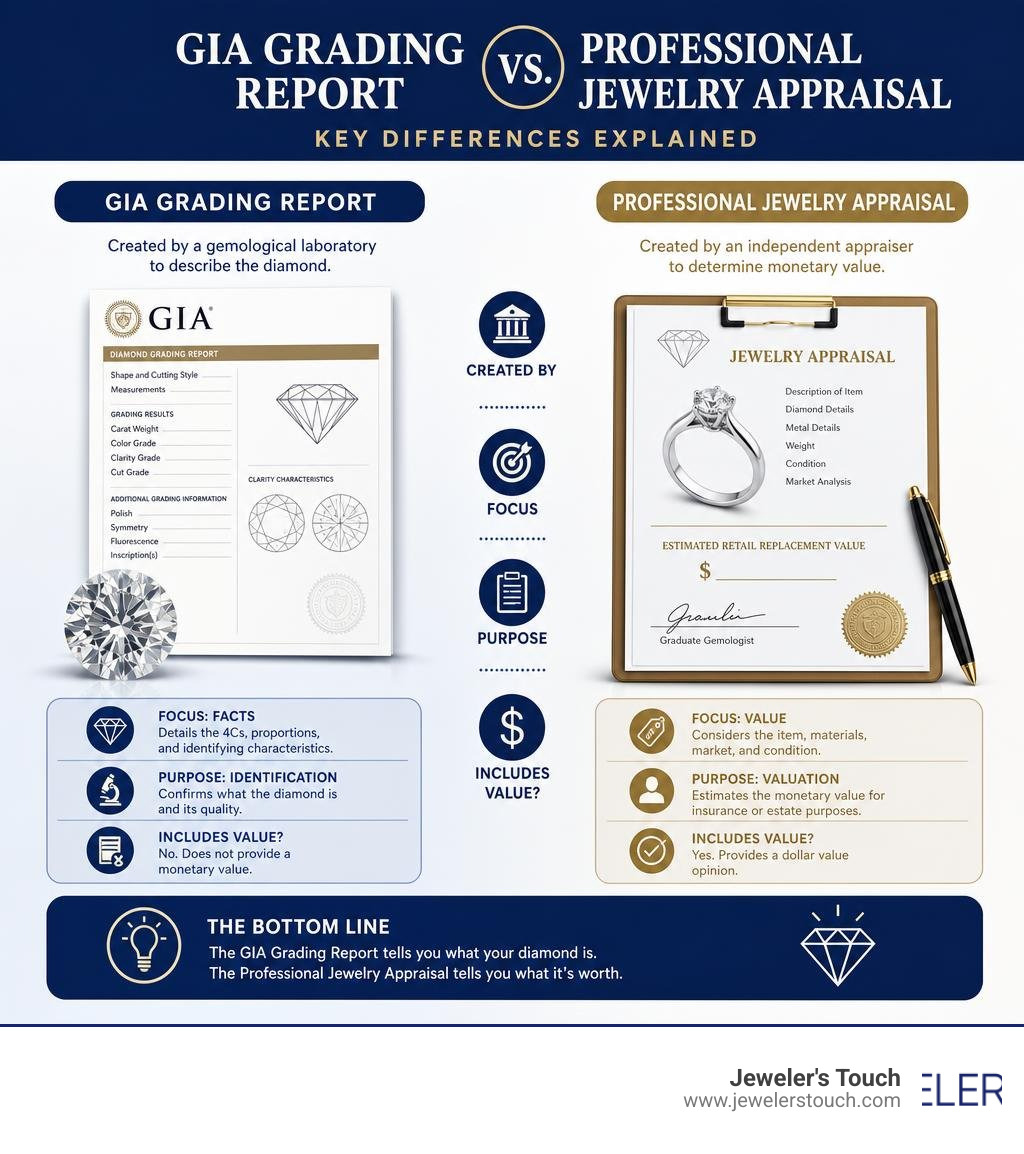
To keep these two essential documents straight, we like to think of a grading report as a diamond's birth certificate and an appraisal as its temporary financial passport.
A grading report identifies the permanent, physical DNA of the diamond. No matter how the stock market behaves, how inflation rises, or how fashion trends shift, the physical attributes of your diamond remain exactly the same.
An appraisal, on the other hand, is a snapshot of financial value in a highly fluid marketplace. The monetary value of gold, platinum, and diamonds fluctuates constantly. An appraisal translates those physical grading attributes into a specific dollar amount based on current market conditions.
Here is a side-by-side comparison to highlight these differences:
| Feature | GIA Grading Report | Professional Jewelry Appraisal |
|---|---|---|
| Primary Purpose | Scientific quality analysis | Monetary valuation |
| Issuer | GIA Laboratory | Independent Credentialed Appraiser |
| Monetary Value Included? | No | Yes |
| Loose or Mounted? | Loose only (0.15 ct or more) | Loose or mounted |
| Expiration Date | Never expires (scientific facts do not change) | Should be updated every 3 to 5 years |
| Key Use Case | Verifying diamond quality before purchase | Securing insurance, estate planning, tax probate |
The GIA Grading Report as the Foundation of Value
Even though GIA does not issue appraisals, their grading report is widely considered the absolute foundation of a professional valuation. Attempting to appraise a high-value diamond without a GIA report is like trying to price a custom home without looking at the architectural blueprints. You can make an educated guess, but you risk being off by thousands of dollars.
When an independent appraiser evaluates a piece of jewelry, they rely heavily on the independent laboratory data to establish the quality baseline. If you would like to explore the different types of analytical documents available for mounted jewelry pieces, GIA offers specialized information on their Jewelry Reports & Services page.
What Information Does a GIA Report Provide?
GIA revolutionized the diamond industry in the 1950s by introducing the International Diamond Grading System. This system established the standard vocabulary for diamond quality, which we refer to today as the 4Cs: Carat Weight, Color Grade, Clarity Grade, and Cut Grade.
If you are unfamiliar with how these metrics are calculated, you can review our quick reference guide on What Are the 5 Cs of Diamonds.
An independent appraiser uses several key details from a GIA report to calculate value:
- The 4Cs: The exact carat weight, color scale (D to Z), clarity scale, and cut grade (for round brilliant diamonds).
- Proportion Diagram: A detailed graphic showing the diamond's table percentage, depth percentage, crown angle, and pavilion angle. These microscopic measurements directly affect how light bounces through the stone.
- Clarity Plot: A hand-drawn map of the diamond's unique internal characteristics (inclusions) and surface blemishes. Since no two diamonds have the exact same clarity plot, this acts as a unique fingerprint for your stone.
- Fluorescence: The reaction of the diamond under ultraviolet light, which can sometimes influence its market value.
Can GIA Grade a Diamond Already Set in a Ring?
This is one of the most common questions we receive at our showroom in Orange County. The answer is: GIA only issues its standard, full Diamond Grading Reports for loose (unmounted) natural diamonds weighing 0.15 carats or more.
If a diamond is already set inside an engagement ring, the metal prongs and bezel settings block the view of the stone's pavilion and girdle. This obstruction makes it impossible for GIA laboratory technicians to calculate an exact carat weight, map every inclusion, or accurately assess the color grade without the metal reflecting light into the stone.
If you have a set stone and want to learn more about how settings affect diamond visibility, check out our Diamond Engagement Ring Guide. To get a full GIA Diamond Grading Report, we must safely unmount the stone from its setting, ship it to GIA, and then reset it once it returns.
Who Performs the Appraisal If GIA Does Not?
Since GIA does not handle valuations, you must work with a qualified, independent professional to secure an appraisal. This is where the magic happens: a skilled appraiser takes the scientific data from your GIA report, examines the metal setting, assesses the craftsmanship, and calculates the current market value.

How to Turn a Grading Report Into a GIA Certified Appraisal
To get what the market refers to as a GIA certified appraisal, you need to find an independent appraiser who holds a GIA Graduate Gemologist (GG) diploma.
A GIA Graduate Gemologist is an individual who has completed rigorous, hands-on training at GIA in gem identification, diamond grading, and colored stone chemistry. When a GIA GG performs your appraisal, they are using the exact same scientific principles and grading standards taught by GIA to evaluate your jewelry.
However, gemology training is only half of the equation. A great gemologist knows how to identify a stone, but an appraiser must also know how to value it. True valuation requires separate, specialized training in market research, tax laws, insurance regulations, and appraisal ethics. You can read more about why this dual expertise matters in our article on Why Work With a GIA Gemologist.
Professional Appraisal Associations to Trust
When searching for a qualified appraiser in your local area, look for professionals who belong to recognized, self-regulating national appraisal organizations. These associations require their members to adhere to strict ethical codes and the Uniform Standards of Professional Appraisal Practice (USPAP).
Excellent professional appraisal organizations include:
- The National Association of Jewelry Appraisers (NAJA): Established in 1981, NAJA is the only major association in the United States devoted exclusively to the appraisal of gems, fine jewelry, and watches.
- The American Society of Appraisers (ASA): A multi-discipline appraisal organization that offers advanced accreditation for master gemologists.
- The American Gem Society (AGS): Highly respected for its focus on consumer protection and gemological ethics.
If you are located in or around Brea, California, you can search for local business licenses and certified professionals using the city's official portal at Search Appraisers or look up specialized regional experts via OC Jewelry Appraisers. To verify if a jeweler is an authorized GIA retail partner, you can also use the official GIA Retailer Lookup tool.
Understanding the Types of Jewelry Appraisals
Not all appraisals are created equal. The value of a piece of jewelry is not a single, fixed number; it depends entirely on the purpose of the appraisal. Before you book an appointment with an appraiser, you must clarify what type of document you need.
Appraisals for Insurance and Asset Protection
By far, the most common type of valuation is the Retail Replacement Value (RRV) appraisal. This document is designed to help you secure an insurance policy that will cover the cost of replacing your jewelry with an equivalent item of the same quality in the event of loss, theft, or damage.
For high-value items, insurance carriers generally require a detailed, third-party appraisal rather than a simple sales receipt. This is often referred to as "scheduled" coverage, which lists your jewelry as an individual item on your policy with a specific replacement limit.
To understand why this is so critical for protecting your investment, we recommend reading our guides on Why Is Jewelry Insurance Important and Jewelry Insurance.
Other common types of appraisals include:
- Fair Market Value (FMV): This represents the price a willing buyer and a willing seller would agree upon in an open, non-forced market. This is typically used for estate tax calculations, IRS charitable donation deductions, and equitable division of assets during divorce proceedings.
- Liquidation Value: This reflects what you could expect to receive during a quick, forced sale (such as a bankruptcy or immediate cash-out scenario). This value is typically much lower than retail replacement value.
Why and How Often to Update Your Appraisal
The jewelry market is highly dynamic. The costs of precious metals like gold and platinum, along with the wholesale prices of polished diamonds, change constantly due to global economic factors, mining supply, and inflation.
If your jewelry appraisal is more than a few years old, you might be severely underinsured. If your ring is lost or stolen, an outdated appraisal from a decade ago might only cover a fraction of what it costs to recreate that same ring today.
We recommend having your jewelry appraised every three to five years to ensure your insurance coverage keeps pace with market fluctuations. If you want to dive deeper into the financial risks of outdated valuations, check out our article on 5 Reasons Why You Need Jewelry Insurance.
Comparing Costs and Alternative Laboratories
Obtaining a GIA report and securing a professional appraisal are two different services with separate fee structures.
A full GIA Diamond Grading Report for a standard one-carat loose diamond typically costs around $113 directly from the laboratory (excluding shipping, insurance, and jeweler handling fees). For very small diamonds (0.15 to 0.22 carats), the base laboratory fee starts around $48.
In contrast, a professional jewelry appraisal is usually charged as a flat fee per item or an hourly rate. At many professional gem labs, a standard appraisal costs around $100 per item. You should always avoid appraisers who charge a percentage of the jewelry's final appraised value, as this creates an immediate incentive for them to artificially inflate the valuation.
While GIA is the gold standard for natural diamonds, other independent laboratories play major roles in the appraisal ecosystem:
- International Gemological Institute (IGI): Established in New York in 1981, IGI is highly respected by major insurance carriers and has become the industry leader in grading lab-grown diamonds.
- European Gemological Laboratory (EGL): Another historic independent grading laboratory often seen in the retail market.
If you are considering a lab-grown diamond, it is important to know how different laboratories handle them. You can read our detailed resources on Everything You Need to Know About Lab-Grown Diamonds and explore the physical differences in The Difference Between Lab-Grown Diamonds and Earth-Mined Diamonds.
Frequently Asked Questions About Jewelry Appraisals
To help you navigate the appraisal process with complete confidence, we have compiled answers to some of the most common questions we hear in our Orange County showroom.
How can I verify that my GIA report is authentic?
You can easily verify any GIA report using the free, online GIA Report Check service. By entering the unique report number engraved on your diamond's girdle along with the stone's exact carat weight, you can instantly pull up the digital matching record directly from GIA's secure database. This ensures that the paper document in your hands perfectly matches the scientific record in their system.
What is the difference between a GIA report and an IGI report?
Historically, GIA has been the premier laboratory for natural, earth-mined diamonds, while IGI has built a massive footprint specializing in the screening and grading of lab-grown diamonds. Both laboratories provide excellent, highly detailed technical data, but they use slightly different grading scales and report formats. Major insurance carriers accept reports from both institutions as valid third-party documentation for high-value jewelry policies.
What should be included in a complete professional appraisal document?
A complete, legally binding professional jewelry appraisal should always include three core elements:
- Quality Analysis: A detailed scientific breakdown of the gemstones (carat weight, color, clarity, cut) and the metal settings (karat gold purity, platinum markings, total item weight).
- Detailed Description: A clear narrative describing the style of the jewelry, the manufacturing method (custom cast, hand-fabricated), and any designer hallmarks or brand names.
- Formal Valuation: A clear statement of the dollar value (such as Retail Replacement Value) along with a high-quality color photograph of the item for positive identification.
Conclusion
While you cannot get a "GIA certified appraisal" directly from GIA, you can achieve the exact same level of scientific accuracy and financial protection by combining a GIA grading report with a professional appraisal from a credentialed gemologist.
At Jeweler's Touch, we have been serving the Orange County and Brea communities since 1992. Our family-owned business features on-site GIA Graduate Gemologists and expert goldsmiths who can safely examine, grade, and appraise your jewelry right in front of you.
Whether you are looking to protect a newly acquired engagement ring, update an outdated insurance policy, or navigate an estate valuation, we are here to provide clear, honest, and professional guidance. To learn more about selecting a quality partner for your jewelry needs, read our guide on How to Find a Trustworthy Jeweler in Your Area.
Ready to secure an accurate, professional valuation for your favorite pieces? Contact the team at Jeweler's Touch today to speak with one of our on-site gemological experts and schedule your professional jewelry appraisal!