

A Broken Necklace Chain Doesn't Have to Be the End
A broken necklace chain is one of the most common jewelry problems — and one of the most fixable. Here's a quick look at your options:
Quick fixes for a broken necklace chain:
- Open jump ring or loose link - Close it sideways with two pairs of flat-nose pliers.
- Snapped single link - Replace with a matching jump ring or take it to a jeweler for soldering.
- Broken clasp - Swap it out with a new lobster claw or spring ring clasp.
- Multiple breaks or complex chain (rope, snake, herringbone) - Go professional. DIY risks permanent damage.
- Precious metal chain - Always use a professional jeweler. Heat-based repairs require precision tools.
You reach for your favorite necklace. You pick it up, and half of it stays in the jewelry box. That little sinking feeling is something most of us have experienced. In fact, over 80% of adults have owned broken jewelry at some point, which tells you this is far from a rare problem.
The good news? Most breaks are completely repairable. Whether it's a simple jump ring fix you can handle at home in five minutes, or a delicate gold chain that needs a jeweler's torch, there's a clear path forward, you just need to know which one applies to your situation.
This guide walks you through everything: identifying the break, DIY repairs, when to call a pro, and how to keep it from happening again.
I'm Ken Rutz, and at Jeweler's Touch I've spent decades working with customers to restore everything from everyday sterling silver chains to precious heirloom pieces with a broken necklace chain. With on-site master goldsmiths and a deep focus on quality craftsmanship, we've seen, and fixed, just about every type of chain damage imaginable, and I'll share exactly what we know in this guide.
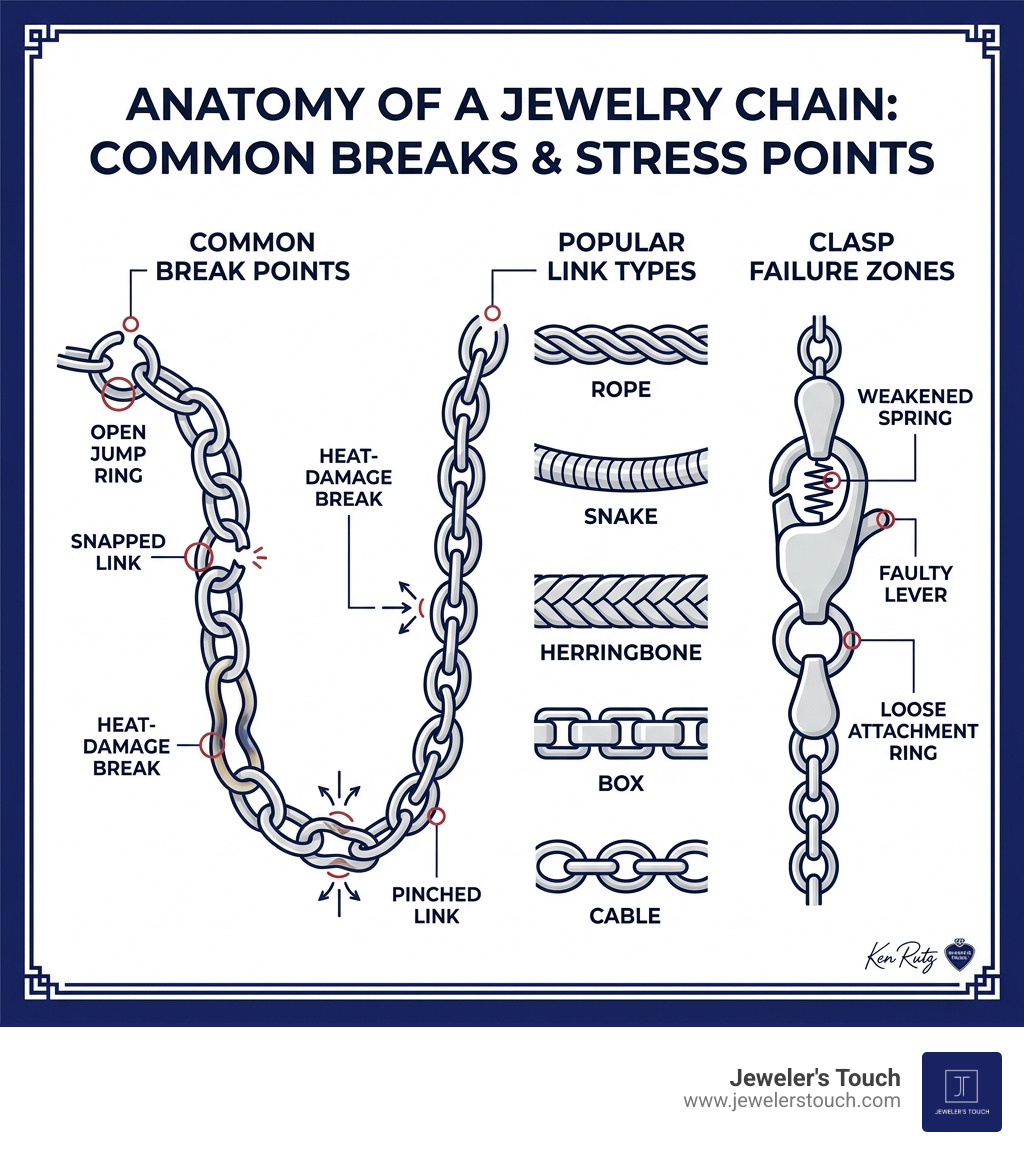
Why Your Necklace Chain Broke: The Usual Suspects
Before we dive into the "how-to" of fixing things, it helps to understand the "why." A broken necklace chain rarely happens for no reason. Usually, it's a combination of physics, chemistry, and life getting in the way.
Physical Tugs and Toddler Hands

The most common cause of a snap is a sudden, sharp tug. This often happens when a necklace snags on the knit of a heavy sweater or when a curious toddler decides your shiny pendant is a convenient handle. These high-tension moments exceed the tensile load the metal can handle, causing a link to stretch and eventually pop open or snap.
Chemical Exposure and Perfume Damage
We often see chains that have become brittle over time. This is frequently due to chemical exposure. Perfumes, hairsprays, lotions, and even the chlorine in your backyard pool can cause microscopic corrosion in the metal alloys. To prevent this, we always recommend putting your jewelry on last, after your beauty routine is complete. For more on keeping your pieces safe, check out our guide on How to Care for Your New Jewelry.
Weight Mismatch and Metal Fatigue
If you put a heavy heirloom pendant on a whisper-thin cable chain, you’re asking for trouble. This weight mismatch puts constant stress on the links, especially the ones near the bail (the part the chain slides through). Over time, this leads to metal fatigue, a process where the metal becomes "tired," thins out, and eventually fails. Choosing the right gauge for your pendant is essential; you can learn more about this in our article on How to Choose the Right Necklace.
Identifying Your Chain Type and Material
Before you grab a pair of pliers, you must know what you are holding. Different metals and weaves require very different approaches.
- Hallmarks: Look near the clasp for tiny stamps. "14K" or "585" indicates 14-karat gold. "925" means sterling silver. You might also see "750" for 18K gold or "916" for 22K.
- Gold-Filled vs. Plated: If you see "GF," it’s gold-filled (a thick layer of gold bonded to base metal). "GP" or "GEP" means it’s electroplated. Be careful with filled and plated items, they don't always handle heat or heavy manipulation well.
-
Chain Weaves:
- Cable and Box: These are the easiest to DIY because they have clear, individual links.
- Rope and Snake: These are intricate. A rope chain is woven, and a snake chain is made of tightly joined plates. If these break, they usually require a professional touch to avoid a visible scar.
- Hollow Chains: These are lightweight but fragile. They are essentially tiny tubes of gold. If you try to squeeze these with pliers, they will collapse rather than bend. And they can easily melt with heat.
How to Fix a Broken Necklace Chain: DIY Step-by-Step
If your broken necklace chain is a simple link style (like a cable or curb chain) and you have a steady hand, a home repair is often possible.
Your DIY Toolkit
To do this right, you’ll need a few basic tools. Don't try to use your husband's heavy-duty garage pliers, you'll mar the metal.
- Two pairs of flat-nose or needle-nose pliers: One to hold, one to twist.
- Jeweler’s Loupe or Magnifying Glass: Essential for seeing those tiny gaps.
- Microfiber Cloth: To work on so your parts don't roll away.
- Replacement Jump Rings: If the original link is lost or mangled.
Step-by-Step: Fixing a Broken Necklace Chain at Home
- Assess the Break: Use your magnifier to see if a jump ring has simply pulled open or if a metal link has actually snapped.
- The Lateral Twist: This is the most important rule in jewelry repair. Never pull the ends of a jump ring outward to open it. Instead, grip each side with your pliers and twist laterally (one side toward you, one side away). This preserves the circular shape of the ring.
- Hook the Links: Slide the open jump ring through the broken end of the chain.
- Close and Realign: Twist the ends back together until they touch perfectly.
- The Fingernail Test: Run your fingernail over the join. If you feel a snag, the ends aren't flush. Re-adjust until it's smooth.
- Tension Check: Give the chain a very gentle tug to ensure the link is secure.
- Clean Up: After handling your jewelry, it’s a good idea to remove skin oils. We have a great resource on How to Clean and Care for Your Jewelry using simple household items like mild dish soap.
When a Broken Necklace Chain Requires Professional Soldering
While pliers are great for mechanical fixes, they aren't permanent for precious metals. A professional jeweler uses soldering, using a micro-torch and a metal alloy with a lower melting point to fuse the links together.
This is required for:
- Hollow chains: Which melt easily under DIY heat.
- High-value gold or platinum: Where you want a seamless, invisible finish.
- Structural integrity: Soldering is significantly stronger than just bending a link shut.
- Intricate weaves: Snake and herringbone chains often require laser welding, a high-tech version of soldering that uses a concentrated beam of light to join metal without heating the surrounding area.
Professional Repair Costs for a Broken Necklace Chain
If the DIY route feels too risky, you might be wondering about the cost. In May 2026, professional repair is more accessible than ever. Most straightforward soldering jobs are fast and affordable.
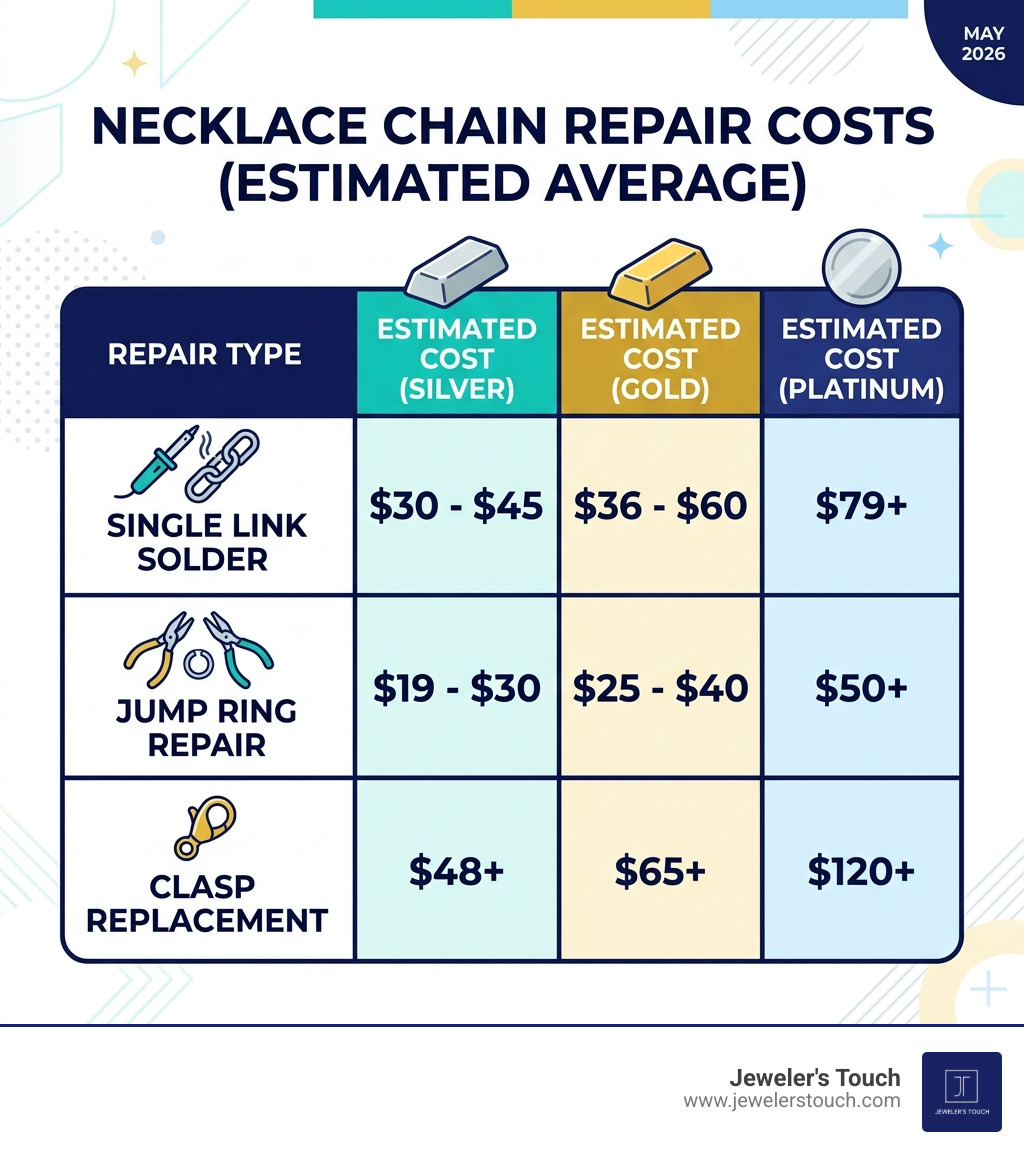
| Repair Type | Estimated Cost (Silver) | Estimated Cost (Gold) | Estimated Cost (Platinum) |
|---|---|---|---|
| Single Link Solder | $30 - $45 | $39 - $60 | $79+ |
| Jump Ring Repair | $19 - $39 | $25 - $40 | $50+ |
| Clasp Replacement | $48+ | $65+ | $120+ |
| Multi-Link Restoration | $60 - $100 | $100 - $199 | Quote Required |
Note: Prices vary based on the thickness of the chain and the current market price of precious metals.
Turnaround Time and Local Expertise
When you search for How to Find Jewelry Repair Near Me, look for a shop with on-site goldsmiths. At Jeweler's Touch in Orange County, having our experts in-house means we can often complete a simple solder in 3-5 days. Mail-in services are an option, but they typically take 7-10 business days and add the stress of shipping.
Assessing Damage: Repair vs. Replacement
Sometimes, a broken necklace chain is a symptom of a larger problem. If your chain has "kinks" that won't come out, or if it has snapped in three different places in the last year, it might be suffering from extensive metal fatigue.
In these cases, we look at the repair vs. replacement value. If the labor to fix five different links exceeds the cost of a brand-new, sturdier chain, we’ll tell you. However, for sentimental pieces, repair is almost always worth it. If your necklace is a high-value item, we also recommend looking into Why is Jewelry Insurance Important to cover major damage or loss.
Preventing Future Breaks and Maintenance Tips
The best way to fix a broken necklace chain is to make sure it doesn't break in the first place.
- Individual Storage: Never toss your necklaces into a "bird's nest" in a drawer. Tangling leads to knots, and pulling on those knots leads to breaks. Use individual hooks or soft pouches.
- Humidity Control: Keep your jewelry in a cool, dry place. High humidity (above 50%) can accelerate tarnish and weaken certain alloys over time.
- The "Last On, First Off" Rule: Your jewelry should be the last thing you put on in the morning (after perfume/hairspray) and the first thing you take off at night. And you should always take off your jewelry every night.
- Annual Inspections: We recommend bringing your most-worn pieces in once a year. We can check for "bald" or worn links that are about to fail, it's much cheaper to reinforce a weak link than to find a new pendant after a chain snaps in public.
Frequently Asked Questions about Chain Repair
Can all types of chains be repaired?
Most precious metal chains (gold, silver, platinum) can be repaired beautifully. However, stainless steel is notoriously difficult because it requires much higher heat than standard jewelry torches provide. Herringbone chains are also tricky; once they are kinked or crushed, they rarely return to their original perfectly flat state, though soldering can reconnect a break.
How long does a professional repair take in 2026?
If you visit us in Brea or the surrounding Orange County area, a standard repair usually takes 3 to 5 days. If the piece requires specialized parts or complex laser welding, it might take up to a week. Mail-in services generally take about 7-10 business days plus shipping time.
Is it safe to use glue on a broken chain?
No! Please, stay away from the super glue. Glue creates a brittle bond that will almost certainly fail again. More importantly, glue leaves a messy residue that makes it much harder (and more expensive) for a professional jeweler to clean and solder the metal later. Heat from a torch can also turn glue into toxic fumes or a charred mess that damages the metal's finish.
Conclusion
A broken necklace chain might feel like a "small tragedy," but it’s usually just a temporary setback. Whether you’re attempting a quick jump ring fix at home or bringing a cherished heirloom into our Orange County studio, the goal is the same: restoring the beauty and security of your jewelry.
Since 1992, Jeweler's Touch has been the go-to destination for Southern California residents looking for expert craftsmanship. With our on-site GIA gemologists and master goldsmiths, we handle every repair with the precision it deserves. Don't let your favorite piece sit forgotten in a drawer, bring it in and let us breathe new life into it.
For expert help with your jewelry, visit our Professional Jewelry Repair and Cleaning Services page or stop by our showroom today.