

Understanding the Core Types of Jewelry Appraisals
A professional jewelry appraisal determines an item's monetary worth through a hands-on gemological inspection of precious metals, diamond quality, and gemstone characteristics matched against current market data. Depending on your specific legal or financial needs, an appraisal calculates one of three main values: retail replacement value for insurance coverage, fair market value for estate and tax settlements, or immediate liquidation value for time-sensitive cash sales.
Value is not a fixed, universal number. Instead, it depends entirely on the context and purpose of the evaluation. An appraisal written for an insurance carrier serves a completely different financial and legal function than one prepared for an estate tax return or a quick cash sale.
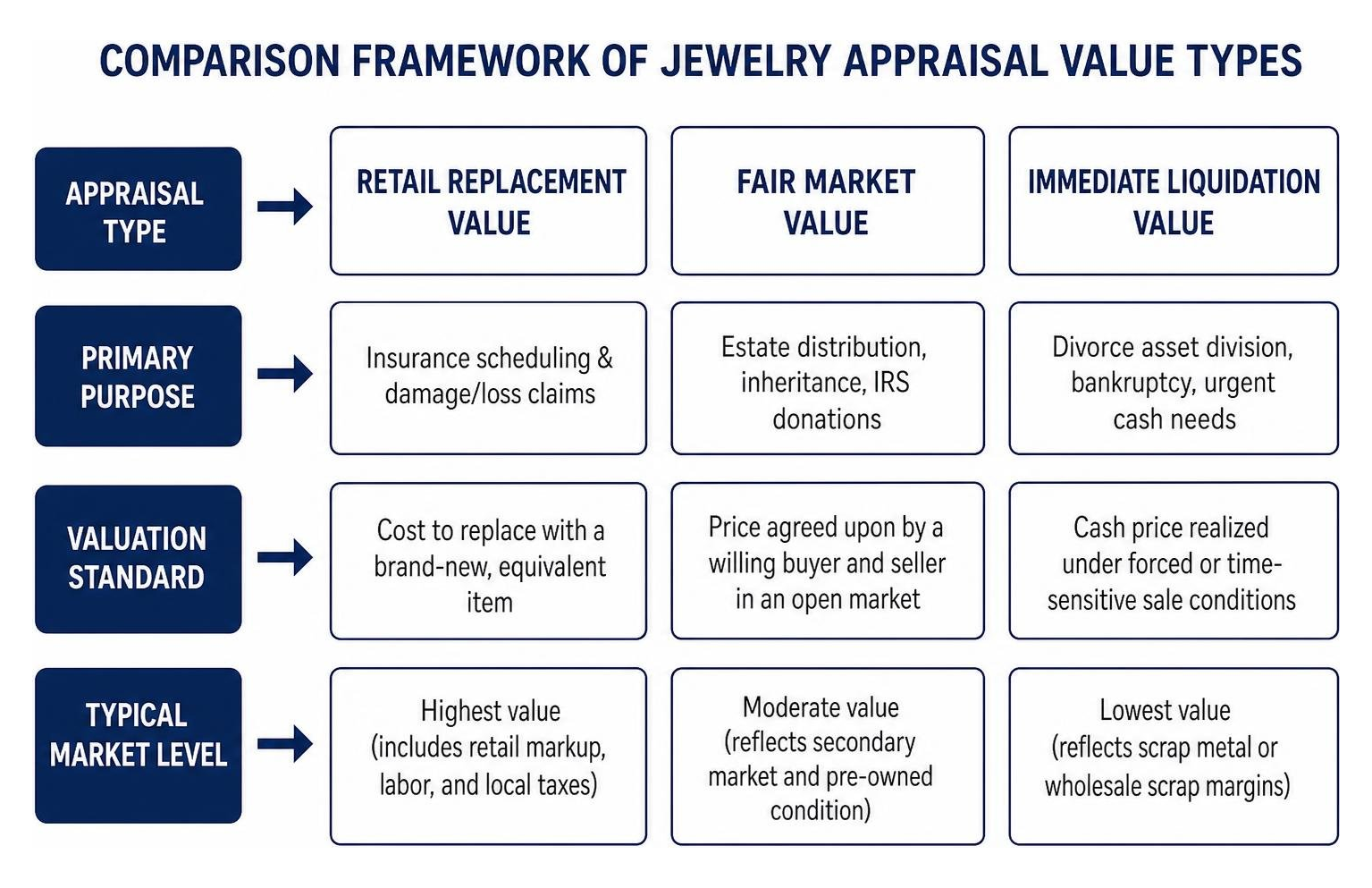
| Appraisal Type | Primary Purpose | Valuation Standard | Typical Market Level |
|---|---|---|---|
| Retail Replacement Value | Insurance scheduling & damage/loss claims | Cost to replace with a brand-new, equivalent item | Highest value (includes retail markup, labor, and local taxes) |
| Fair Market Value | Estate distribution, inheritance, IRS donations | Price agreed upon by a willing buyer and seller in an open market | Moderate value (reflects secondary market and pre-owned condition) |
| Immediate Liquidation Value | Divorce asset division, bankruptcy, urgent cash needs | Cash price realized under forced or time-sensitive sale conditions | Lowest value (reflects scrap metal or wholesale scrap margins) |
Retail Replacement Value for Insurance
The vast majority of modern evaluations fall under this category. When you request professional Appraisals for your fine jewelry, the resulting document establishes retail replacement value. This figure estimates the current cost to recreate or purchase a brand-new piece of equivalent quality in a typical retail jewelry store.
Because it calculates the price of purchasing a new substitute rather than selling a pre-owned item, retail replacement value is generally the highest monetary figure among all appraisal types. It accounts for retail overhead, specialized craftsmanship, design labor, setting fees, and applicable local sales tax. Having an accurate retail replacement appraisal allows you to schedule the item on a homeowners, renters, or dedicated jewelry insurance policy, ensuring that your insurer provides full financial compensation or a proper replacement if the piece is lost, stolen, or destroyed.
Fair Market Value for Estate and Tax Settlements
Fair market value (FMV) is an entirely different legal concept. The Internal Revenue Service (IRS) defines fair market value as the price at which property would change hands between a willing buyer and a willing seller, neither being under any compulsion to buy or to sell, and both having reasonable knowledge of relevant facts.
This valuation standard is mandatory for settling estate taxes, dividing assets among heirs, handling probate court matters, and documenting charitable donations of fine jewelry. Fair market value reflects the reality of the secondary or pre-owned market. It is almost always lower than retail replacement value because pre-owned jewelry does not command the same price as a brand-new retail item. If you are handling an inherited estate or looking for the Best Place to Sell Jewelry in Orange County, a fair market value evaluation offers a realistic reflection of pre-owned cash worth.
Immediate Liquidation Value for Asset Division
Immediate liquidation value is used when an item must be converted into cash quickly under time constraints or legal mandate. This evaluation standard is frequently utilized in divorce proceedings, bankruptcy filings, and court-ordered probate sales where the luxury of waiting for an ideal retail buyer on the secondary market simply does not exist.
Liquidation value reflects what a wholesale buyer, pawnbroker, or refiner would pay for the piece immediately. It typically focuses on the intrinsic scrap value of the precious metals and the wholesale trading value of the mounted gemstones, yielding net proceeds that are substantially lower than both retail replacement and fair market values.
Jewelry Appraisal vs. Diamond Grading Report: Key Differences
Consumers often confuse diamond grading reports with jewelry appraisals, sometimes assuming they are interchangeable. While both documents provide essential information about fine jewelry, their core functions and methodologies are completely distinct.
Subjective Valuation vs. Objective Gemological Analysis
A diamond grading report (commonly issued by independent scientific laboratories like the Gemological Institute of America, or GIA) is an objective scientific analysis of an unmounted gemstone's physical and optical characteristics. It provides an impartial assessment of the 4Cs: Cut, Color, Clarity, and Carat weight.
Crucially, a gemological grading report contains no dollar figures whatsoever. Laboratories do not buy, sell, or assign monetary worth to gemstones. You can explore our Education Diamonds guide to see how these optical characteristics are systematically measured under lab conditions.
In contrast, an appraisal provides a professional opinion of monetary value as of a specific date in a specific market. While an appraisal incorporates objective gemological measurements, assigning a financial price tag requires an understanding of current retail pricing, manufacturing costs, wholesale gemstone markets, and historical market trends.
The Critical Role of Metal Purities and Gemstones
A laboratory grading report typically covers only the primary loose stone before it is set into a ring, pendant, or bracelet. A jewelry appraisal, on the other hand, evaluates the complete piece as a finished work of art.
This comprehensive review includes identifying and testing the mounting metal alloys. The appraiser verifies hallmark stamps and conducts non-destructive testing for Precious Metals such as 14k, 18k, or 24k gold, platinum, and palladium. Furthermore, the appraiser evaluates every accent stone and side diamond, assesses the setting style, and determines whether colored gems are natural, treated, or synthetic. Fine colored stones require meticulous examination, as covered in our review of The World's Most Valuable & Prized Gemstones, where country of origin and heat treatments dramatically influence monetary value.
The Step-by-Step Jewelry Appraisal Process
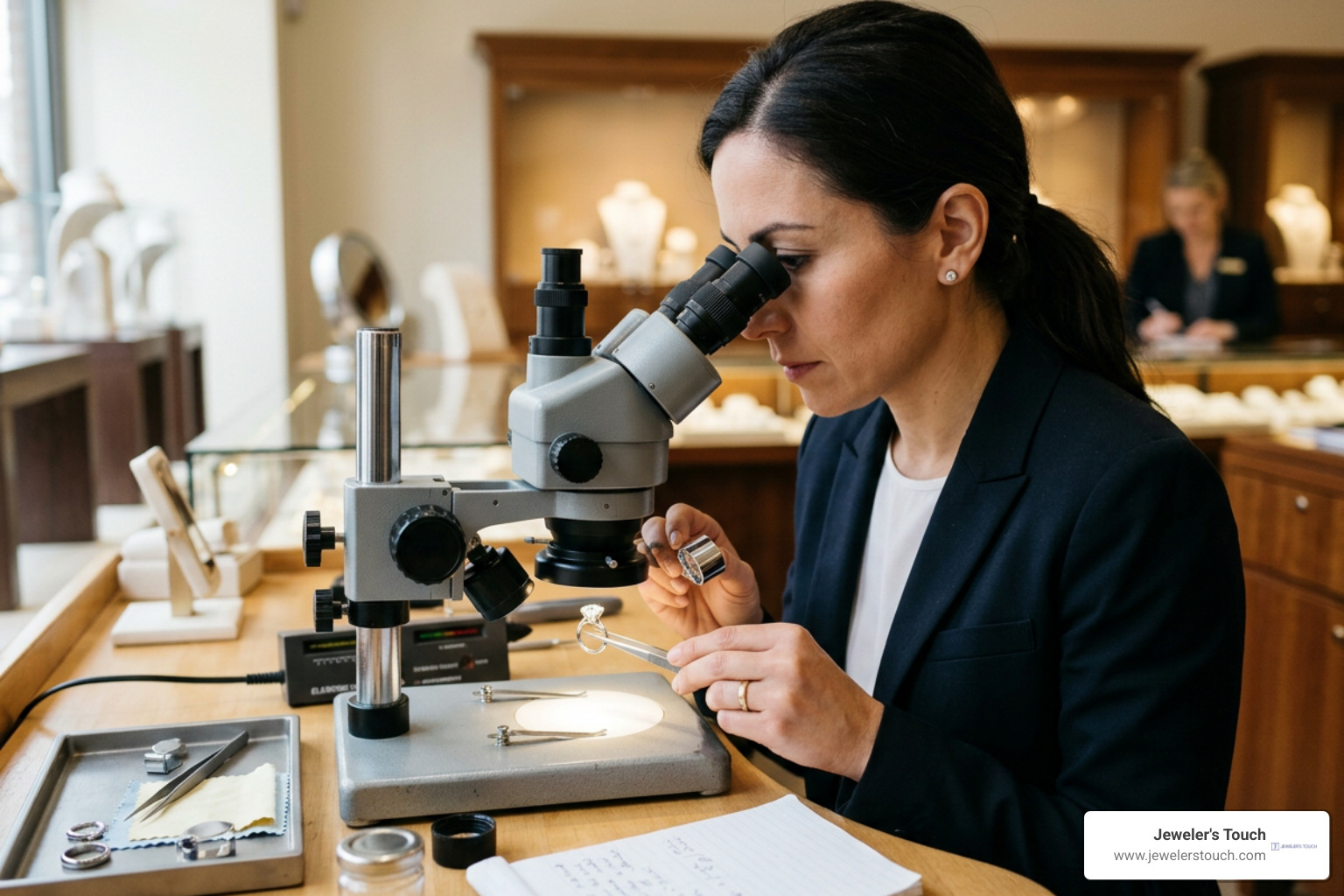
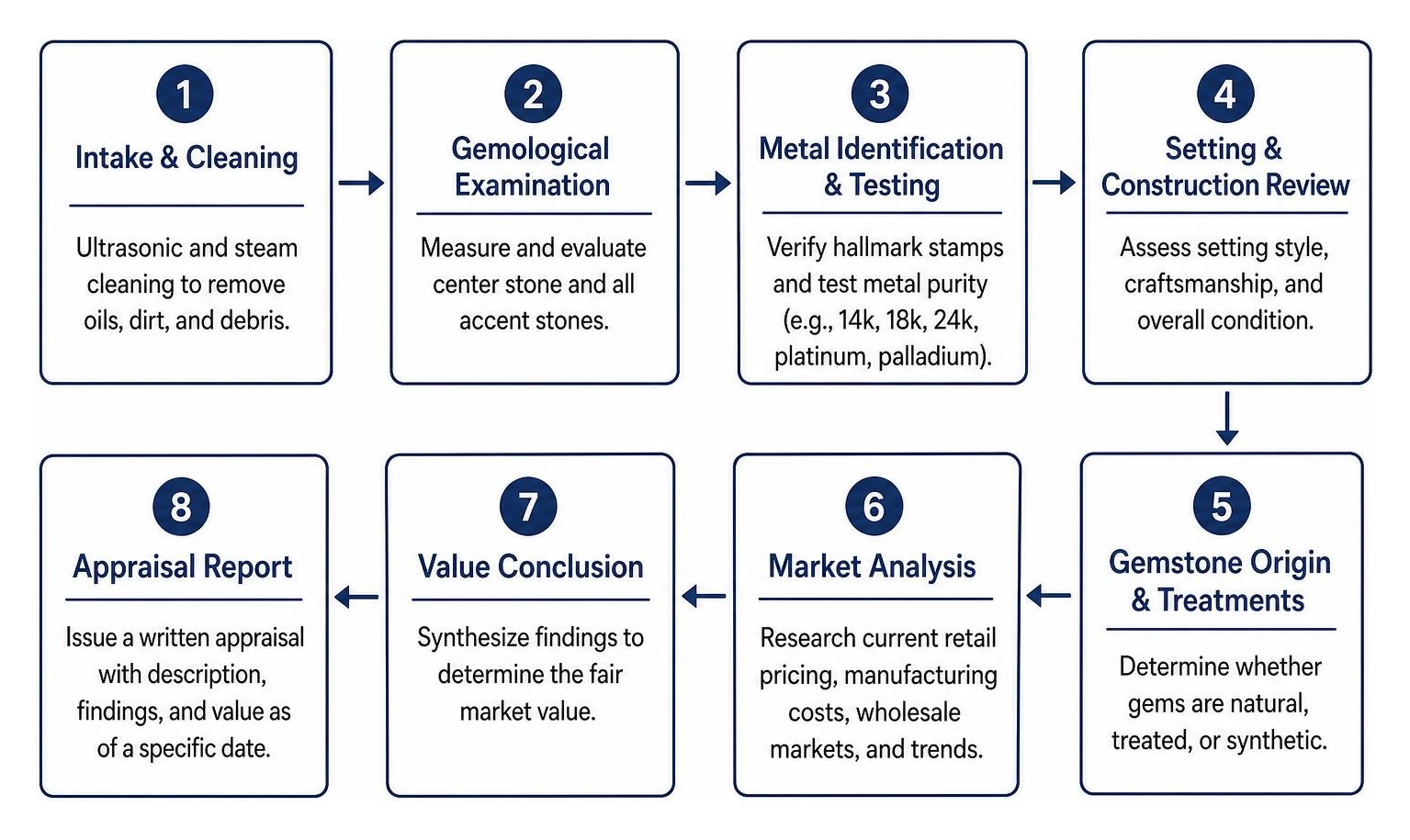
A thorough, professional jewelry appraisal is an exacting, methodical process that blends gemological science with market economics. When you bring your treasured items into a professional jewelry showroom, the evaluation follows a strict sequence to ensure accuracy and complete transparency.
What to Expect During In-Person Jewelry Appraisals
When an in-person appraisal is performed, the appraiser completes several essential technical steps:
- Intake and Cleaning: The piece is ultrasonically cleaned and steamed to remove all oils, dirt, and debris that could obscure inclusions, alter color grades, or conceal cracks. Proper maintenance is essential, as detailed in our guide to Caring for Fine Jewelry.
- Microscopic Gemological Examination: Using a binocular gemological microscope, the appraiser determines whether the stones are natural, laboratory-grown, or imitation. They plot internal inclusions and external blemishes, check for thermal or clarity treatments, and inspect prong security.
- Weight and Dimension Calculations: Because mounted stones cannot be placed directly on a carat scale without taking the jewelry apart, the appraiser uses specialized optical calipers and mathematical formulas to estimate diamond and gemstone carat weights based on precise millimeter measurements and pavilion depth.
- Metal Assay and Hallmark Verification: The mounting is inspected for maker's marks, designer signatures, and purity stamps. Metal testing verifies gold karatage or platinum content.
- Macro Photography: High-resolution digital images are captured to record the piece's design, condition, and hallmark placements directly onto the final document.
- Market Research and Valuation: The appraiser consults wholesale diamond databases, precious metal spot prices, and retail manufacturing indices to compute a defensible replacement cost or market value.
AI Valuation Tools vs. Certified Physical Inspection
With advances in automated image recognition, online tools such as the Fine Jewelry Appraiser Appraisal - Free AI Value Estimate | Appraiser.AI platform offer fast preliminary estimates based on uploaded photographs. These online tools can be a helpful starting point when you want a rough, broad range within 60 seconds before deciding whether an item merits formal evaluation.
However, artificial intelligence tools have unavoidable physical limitations. An automated tool cannot weigh a gold ring, measure the pavilion depth of a center diamond with micrometers, verify metal densities, or detect laser drill holes and clarity fills hidden inside a gemstone.
Digital photographs cannot reveal whether a diamond is earth-mined or lab-grown, nor can they confirm the exact karat purity stamped inside a worn ring shank. For legal filings, probate settlements, and formal insurance underwriting, digital estimates are not accepted. You must have a physical inspection conducted by a certified human gemologist.
How to Select a Qualified and Ethical Appraiser
Many consumers are surprised to learn that there are currently no federal or state laws in the United States requiring licenses, government certifications, or mandatory minimum education to become a jewelry appraiser. Technically, anyone can print an appraisal letterhead and assign a dollar figure to a diamond ring. This regulatory gap makes it vital that consumers carefully verify an appraiser's credentials and professional affiliations before trusting them with high-value heirlooms.
Essential Credentials: GIA Gemologists, NAJA, and USPAP
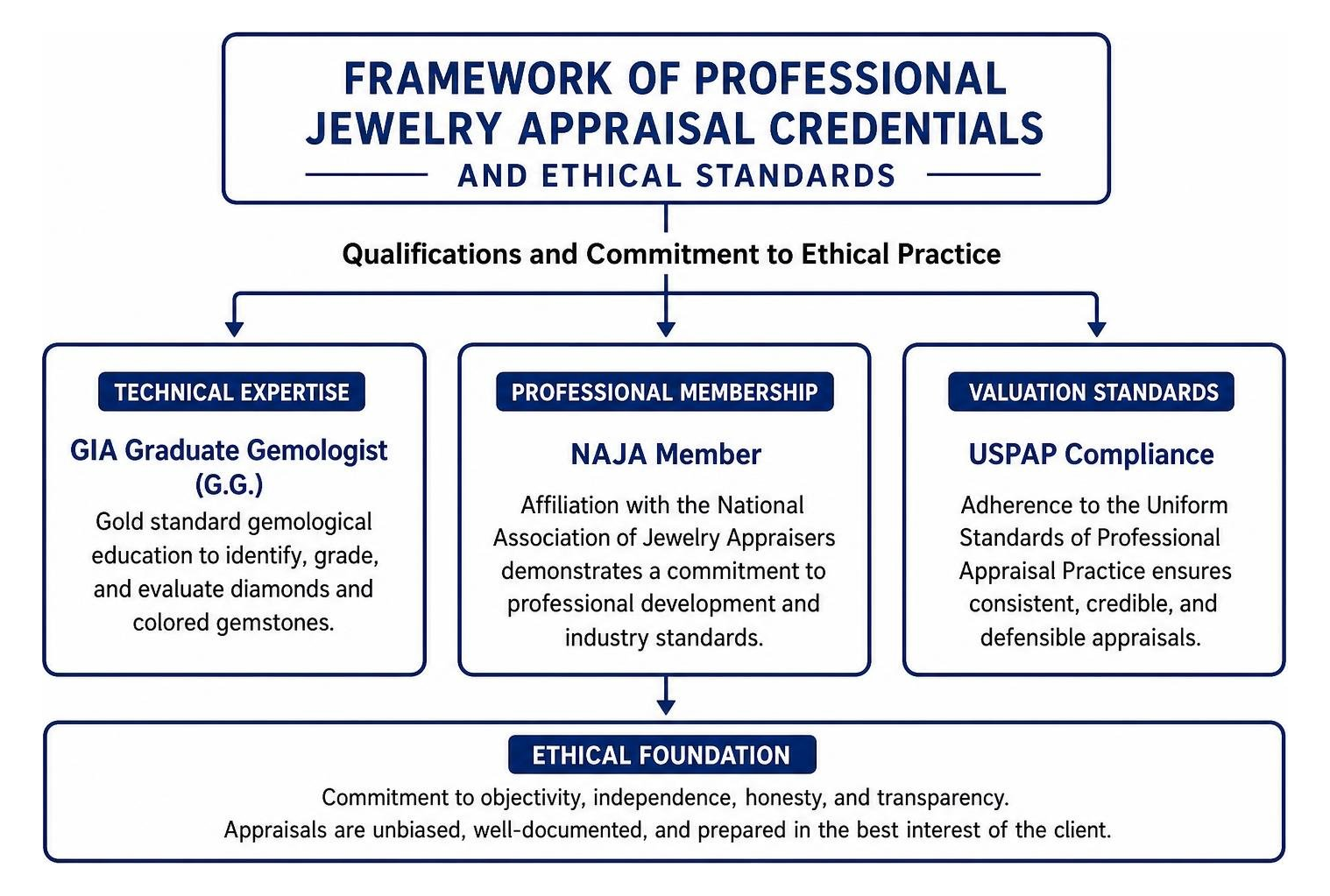
To ensure you receive an accurate, reliable, and legally defensible document, confirm that your appraiser possesses the following core credentials:
- GIA Graduate Gemologist (G.G.): A Graduate Gemologist diploma from the Gemological Institute of America (or an equivalent global credential) represents the gold standard in gemological education. It guarantees the practitioner can accurately identify, grade, and evaluate diamonds and colored gemstones. This serves as the baseline technical foundation for any qualified appraiser.
- National Association of Jewelry Appraisers (NAJA): Since 1981, NAJA has been the only professional appraisal association in the United States devoted solely to the appraisal of fine gems, jewelry, and timepieces. Members must adhere to strict codes of ethics and complete specialized valuation studies that bridge the gap between gem identification and market pricing theory.
- USPAP Compliance: The Uniform Standards of Professional Appraisal Practice (USPAP) establish the recognized ethical and performance standards for appraisal analysis across the United States. An appraiser who maintains USPAP compliance follows structured, auditable methodologies that hold up in courtrooms and IRS audits.
When you need an authoritative Jewelry Appraisal in Orange County, selecting an established jeweler with on-site GIA Graduate Gemologists ensures your items receive the highest standard of technical scrutiny.
Legal and Ethical Standards Governing Jewelry Appraisals
Professional ethics dictate not only how an appraisal is conducted, but also how fees are structured. The Federal Trade Commission (FTC) establishes clear guidelines protecting consumers against misleading valuations and deceptive pricing practices.
Intentionally over-valuing items on an appraisal is illegal under FTC regulations and explicitly prohibited by professional trade groups, including Jewelers of America (founded in 1906 to promote industry integrity). Inflating an appraisal document with an exaggerated price tag deceives consumers into believing they received a massive discount, while forcing them to pay higher annual insurance premiums for coverage they cannot actually collect upon.
Furthermore, an ethical appraiser will never charge a fee based on a percentage of the jewelry's appraised value. Percentage-based fees create an obvious conflict of interest, incentivizing the appraiser to inflate the valuation to increase their fee. Reputable appraisers charge either a flat fee per item or an hourly rate based on the time and research required.
Insurance Replacement Policies and Preferred Jeweler Networks
Understanding how insurance companies handle jewelry claims can save policyholders from unpleasant surprises after a loss. When you submit an insurance claim for a lost or stolen ring, the insurer does not simply mail you a cash check for the full dollar amount listed on your appraisal.
Instead, most standard insurance contracts reserve the right to replace the item with one of "like kind and quality." To minimize their payout costs, many large insurance providers operate internal networks of preferred commercial replacement jewelers. These commercial jewelers purchase wholesale goods in bulk and provide replacements to the insurance company at steep discounts well below normal retail prices.
If you have a custom-designed piece, an antique heirloom, or a specific local family jeweler you trust, check your policy details. Ask your insurer whether you have the right to work directly with your preferred local jeweler for replacements and custom repairs, or if you will be required to accept a replacement sourced through the insurance company's commercial network.
When and Why to Update Your Appraisal Document
A jewelry appraisal is not a permanent, one-time document. It represents a snapshot of value tied to the market conditions on the specific day it was signed. Over time, shifts in global commodity prices, inflation, and manufacturing costs can make older appraisal figures obsolete.
Precious metal markets experience substantial price movement. If your engagement ring was appraised when gold was trading at $1,200 an ounce and gold has since risen significantly, the metal alone in your mounting costs substantially more to replace today. The same applies to platinum and palladium.
Similarly, changes in diamond cutting technologies, shifts in supply chains, and changes in the market share of laboratory-grown gems have altered pricing structures across the jewelry sector. If your appraisal is more than five years old, you may be dangerously under-insured, leaving you vulnerable to out-of-pocket costs if a piece must be remade after a loss. Conversely, holding an outdated appraisal on a piece whose retail value has stabilized could cause you to pay unnecessarily high insurance premiums.
Most insurance carriers and professional appraisal organizations recommend having fine jewelry reappraised every three to five years. Periodic updates ensure your policy limits track current retail replacement costs accurately without leaving gaps in coverage.
Frequently Asked Questions About Jewelry Appraisals
How often should jewelry appraisals be updated?
Jewelry appraisals should generally be updated every three to five years. Updating your paperwork on this schedule accounts for fluctuations in precious metal spot prices, market shifts in diamond and gemstone values, and general retail inflation. Many insurance carriers explicitly require updated appraisals within this timeframe to maintain scheduled coverage limits.
Can an appraiser determine value accurately using only a photograph?
No, an appraiser cannot produce an accurate, legally binding appraisal from a photograph alone. While digital images and AI tools can provide a rough preliminary estimate, photographs cannot reveal the exact weight of precious metals, uncover hidden internal gemstone flaws, detect clarity enhancements or heat treatments, or distinguish natural diamonds from lab-grown stones. A certified valuation requires hands-on microscopic examination and physical testing.
Is it illegal for an appraiser to intentionally inflate jewelry values?
Yes. Intentionally over-valuing jewelry on an appraisal document is considered illegal under Federal Trade Commission (FTC) guidelines and is strictly prohibited by professional trade organizations such as Jewelers of America and the National Association of Jewelry Appraisers. Inflating values artificially inflates the consumer's insurance premiums without providing any extra legal protection during a claim settlement.
Conclusion
A well-prepared jewelry appraisal provides peace of mind, protecting your treasured investments against loss, theft, and damage while providing clarity for estate planning and legal documentation. Knowing the clear difference between retail replacement costs, fair market values, and gemological grading reports ensures that your jewelry is properly documented and fully protected under every circumstance.
At Jeweler's Touch, we have served Southern California families since 1992 with complete dedication to craftsmanship, transparency, and gemological excellence. Our on-site GIA Graduate Gemologists, expert goldsmiths, and experienced staff are here to inspect, clean, and appraise your fine engagement rings, custom creations, and family heirlooms. Whether you need an updated valuation for an existing collection or want to secure comprehensive jewelry insurance protection, visit our showroom in Brea or contact our team to schedule your professional appraisal consultation today.