

What Does a 5 Carat Diamond Ring Actually Look Like?
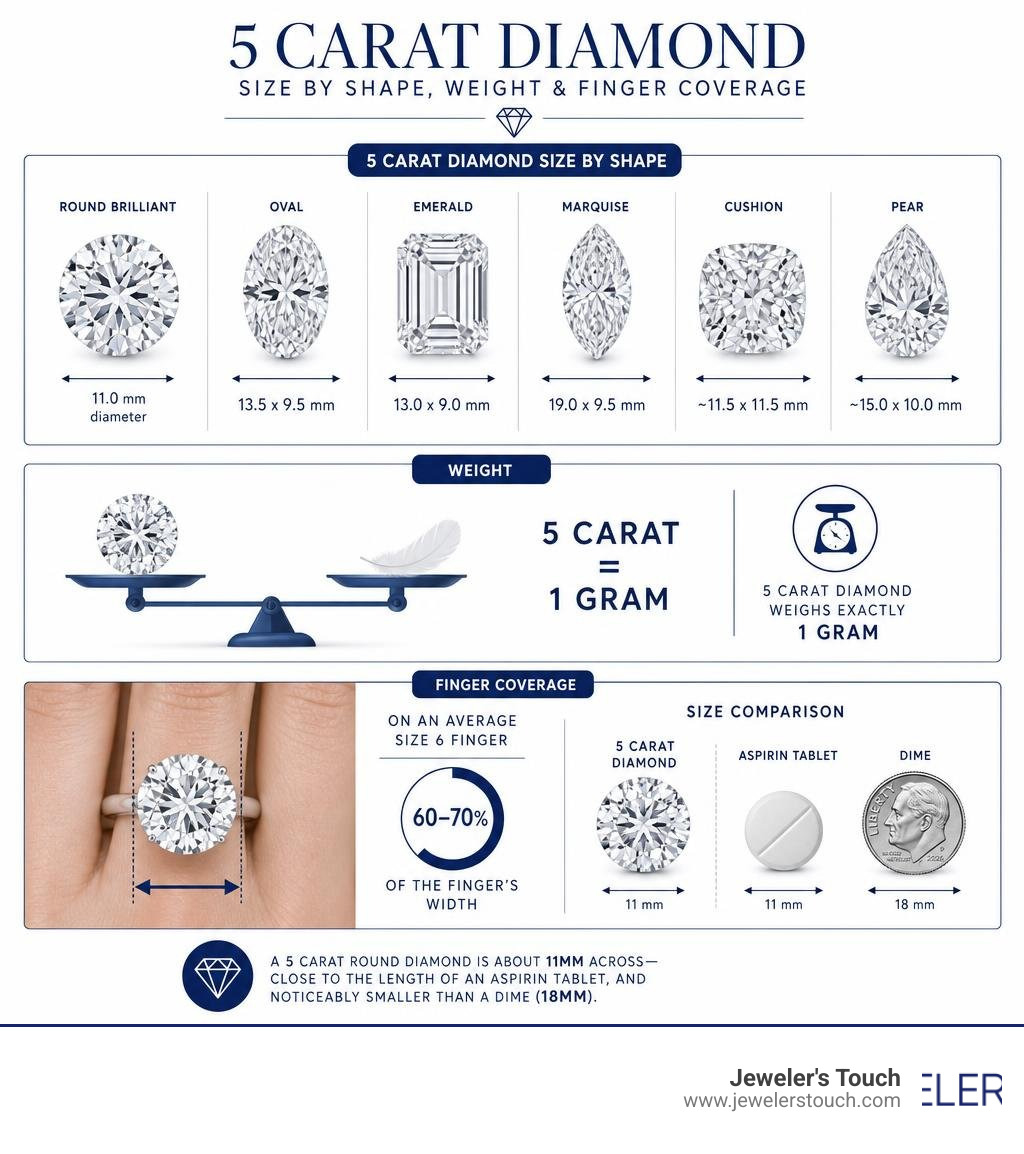
How big is a 5 carat diamond ring? Here's the quick answer:
| Shape | Approximate Dimensions |
|---|---|
| Round Brilliant | 11.0 mm diameter |
| Oval | 13.5 x 9.5 mm |
| Emerald | 13.0 x 9.0 mm |
| Marquise | 19.0 x 9.5 mm |
| Cushion | ~11.5 x 11.5 mm |
| Pear | ~15.0 x 10.0 mm |
A 5 carat diamond weighs exactly 1 gram and sits visibly large on the finger. On an average size 6 finger, a round 5 carat stone covers roughly 60–70% of the finger's width. That's dramatically larger than the average engagement ring diamond, which falls between 1 and 2 carats.
For context: a 5 carat round diamond is about 11mm across, close to the length of an aspirin tablet, and noticeably smaller than a dime (18mm). It's a bold, unmistakable stone.
Less than 1% of all diamonds mined reach 5 carats. That rarity, combined with sheer visual presence, is what puts this stone in a category of its own.
I'm Ken Rutz from Jeweler's Touch, and after years helping clients navigate everything from modest solitaires to exceptional statement pieces, I've guided many couples through the decision of how big is a 5 carat diamond ring, and whether it's the right fit for their lifestyle and budget. Let's break down everything you need to know.
How Big Is a 5 Carat Diamond Ring in Real Life?
When we talk about high-carat jewelry, it is easy to get lost in the numbers. But what does a 5 carat diamond actually look like when you hold it in the palm of your hand or slip it onto your finger?
To understand its true physical presence, we must first look at how we measure these stones.
Carat is a unit of weight, not physical size. One carat equals exactly 200 milligrams (0.2 grams), which means a 5 carat diamond weighs exactly 1 gram. While 1 gram might sound incredibly light when weighing household objects, in gemology, a 1-gram single-crystal diamond is an absolute titan.
Because carat measures weight, two diamonds with the exact same 5.00-carat weight can look vastly different in physical size. This discrepancy comes down to how the diamond is cut. A deep cut hides weight in the bottom of the stone (the pavilion), making the diamond look smaller from above. Conversely, a shallow cut might look larger from the top but will lack the internal angles required to bounce light back to your eyes, resulting in a dull, lifeless stone.
To help you navigate these weight and size differences, we recommend reading our comprehensive Diamond Carat Guide. Understanding the mechanics of weight versus visual spread is the first step in finding a stone that genuinely delivers on its promise of luxury. When choosing a high-carat stone, you will quickly find yourself asking: Does Size Really Matter When Buying a Diamond? The answer depends on how you balance physical dimensions with the optical performance that makes a diamond sparkle.
Understanding the Millimeter Dimensions of a 5 Carat Diamond Ring
To get a precise sense of scale, we have to look at the millimeter measurements. A well-cut 5 carat round brilliant diamond has a diameter of approximately 11.0 mm to 11.2 mm.
If you want to play with different weights and see how millimeter measurements scale, you can use an interactive Diamond Size Calculator to compare various weights side by side. What surprises most buyers is that doubling a diamond's carat weight does not double its physical diameter. Because volume scales three-dimensionally, a 2 carat round diamond is about 8.2 mm wide, while a 5 carat round diamond is roughly 11 mm wide.
To visualize this across different shapes, look at how the physical dimensions shift at the 5 carat mark:
| Diamond Shape | Average Face-Up Dimensions (mm) | Visual Impact & Finger Presence |
|---|---|---|
| Round Brilliant | 11.0 x 11.0 x 6.70 | Classic, perfectly symmetrical, concentrated sparkle |
| Oval Cut | 13.5 x 9.5 x 5.65 | Elongated, elegant, makes the finger look longer |
| Emerald Cut | 13.0 x 9.0 x 5.80 | Hall-of-mirrors effect, sleek lines, highly sophisticated |
| Marquise Cut | 19.0 x 9.5 x 5.40 | Strikingly long, maximum surface area coverage |
| Pear Shape | 15.0 x 10.0 x 5.90 | Teardrop silhouette, dramatic visual spread |
| Cushion Cut | 11.5 x 11.5 x 6.90 | Soft pillow outline, deep vintage warmth |
Because fancy shapes distribute their 1-gram weight differently, they offer varying visual footprints. An elongated shape like a marquise or oval spreads its weight horizontally, giving you a much larger surface area than a round brilliant of the exact same weight.
Visualizing How Big Is a 5 Carat Diamond Ring on Your Finger
On an average woman's finger (which is typically a size 6, measuring about 16.5 mm in width), a 5 carat round brilliant diamond is a showstopper. Measuring 11 mm across, it will cover roughly 60% to 70% of the active width of your finger. If you opt for an elongated shape like a marquise, which can reach up to 19 mm in length, the diamond will actually span beyond the boundaries of your finger's width and extend beautifully up toward your knuckle.
To picture this in everyday life, think of common household items:
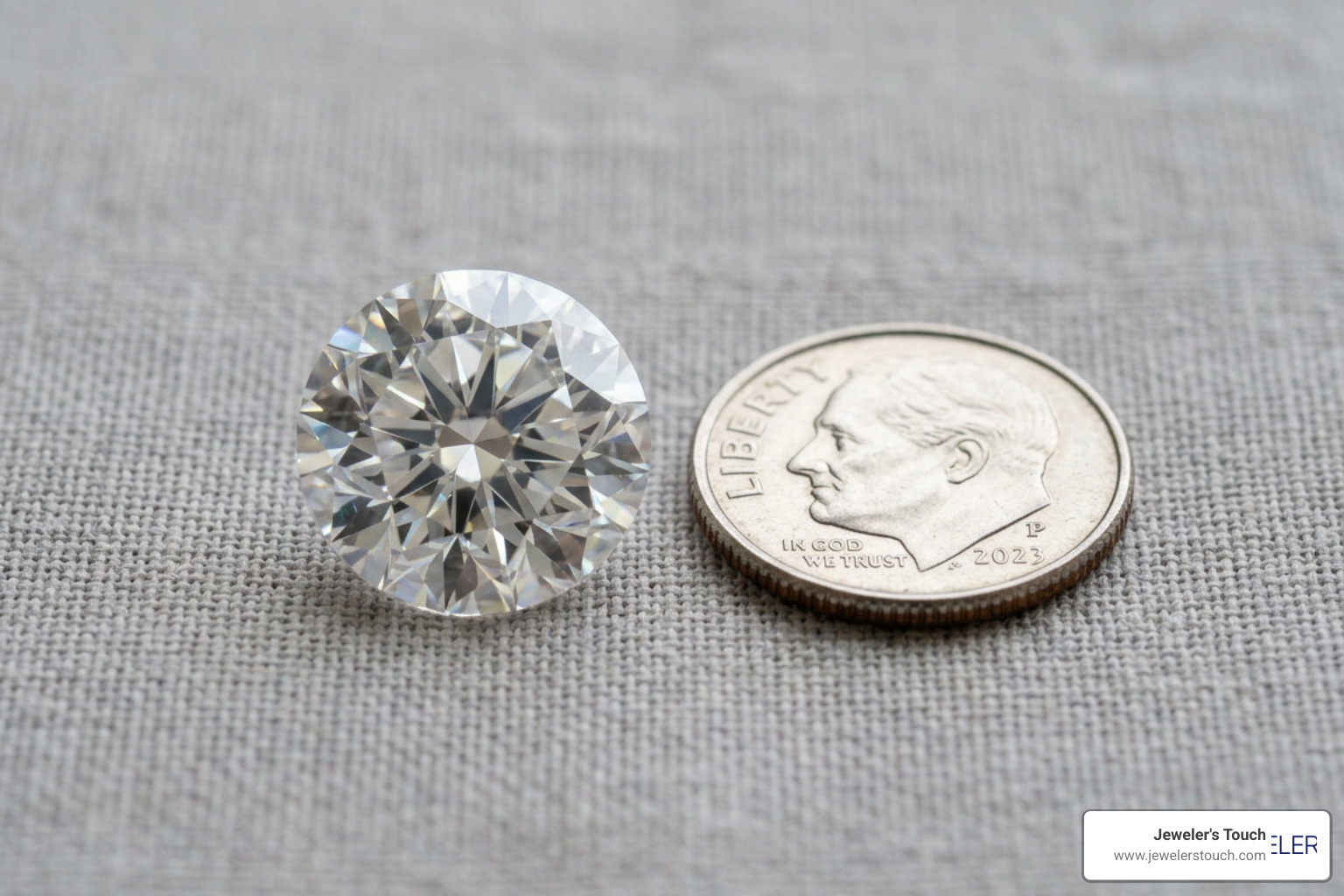
- The Dime Comparison: A standard U.S. dime is 18 mm in diameter. A 5 carat round diamond (11 mm) is just over half the width of a dime.
- The Aspirin Comparison: A standard aspirin tablet is about 14 mm wide. A 5 carat round diamond is slightly smaller than an aspirin pill across its top surface, but it sits much higher.
- The Pencil Eraser: A standard pink pencil eraser is about 6.5 mm in diameter. A 5 carat diamond is nearly double that width, carrying massive dimensional presence.
Because of this size, a 5 carat ring sits noticeably high off the finger. This height means it will catch on pockets, brush against winter gloves, and draw immediate attention in any room. It is a luxurious statement, but one that requires a bit of awareness when you are wearing it out and about in Orange County.
How Diamond Shape and Cut Quality Affect Perceived Size
When looking at how big is a 5 carat diamond ring, the shape you choose plays a massive role in how large the stone appears to the eye. Two diamonds weighing exactly 5.00 carats can look like they belong to completely different size classes simply because of their geometry.

Every diamond cut distributes its weight differently. Some shapes are cut deeper, hiding their carat weight beneath the surface where it cannot be seen once set. Others are cut shallower with a wider "table" (the flat top facet), giving them a larger face-up area.
To explore the visual differences between these geometries, we recommend reviewing our guide on 10 Different Diamond Shapes for Engagement Rings Explained. Choosing the right shape is the easiest way to maximize the visual impact of your ring.
Elongated Shapes vs. Classic Cuts
If your goal is to make your 5 carat diamond look as large as possible, elongated shapes are your best friend.
- The Marquise Cut: This shape has the largest face-up surface area of any diamond cut. At 5 carats, a marquise can stretch to an incredible 19 mm in length, offering unmatched finger coverage.
- The Oval and Pear Shapes: Ovals and pears are highly favored because they deliver the brilliant sparkle pattern of a round diamond while appearing 10% to 15% larger than a round brilliant of the same weight. Their elongated silhouettes also have a slimming effect, making the wearer's finger look longer and more slender.
- The Emerald Cut: While emerald cuts do not have the intense, fiery sparkle of brilliant cuts, their long, open step-cut facets create a sleek, sophisticated "hall of mirrors" look. Because they are often cut shallower, they present a large, elegant table that showcases the diamond's clarity beautifully.
- The Round Brilliant and Cushion Cuts: These are more compact shapes. They carry more of their weight in their bellies (the bottom half of the stone), meaning they will look slightly smaller from a face-up view compared to an oval or marquise. However, what they lose in visual spread, they more than make up for in unparalleled light performance and fire.
For those interested in the rare and collector-level status of these larger cuts, the Sotheby's Guide on Rare 5 Carat Diamonds offers excellent insights into how prestigious jewelry houses view shape, transparency, and rarity in this elite tier.
The Critical Role of Cut Quality and Clarity
We cannot stress this enough: never sacrifice cut quality for carat weight.
A poorly cut 5.50 carat diamond will look smaller, duller, and less impressive than a perfectly cut 5.00 carat diamond. An Ideal or Excellent cut maximizes the light reflecting out of the top of the stone, making the diamond look incredibly bright, lively, and visually larger. When a diamond is cut to perfect proportions, it acts like a series of mirrors, bouncing light so efficiently that the edges of the stone blend into a seamless wall of sparkle.
To understand how cut interacts with the other vital characteristics of a stone, take a look at our educational resources on The Four Cs of Diamonds and What Are the 5 Cs of Diamonds.
At the 5 carat level, clarity becomes exceptionally important. Because the facets on a 5 carat stone are so large, inclusions (internal flaws) are much easier to see with the naked eye than they would be on a 1 carat stone.
- For brilliant cuts (like rounds, ovals, and cushions), we generally recommend a minimum clarity of VS2 to ensure the stone is completely eye-clean.
- For step cuts (like emerald and Asscher cuts), which have wide, clear facets that act like windows, we recommend aiming for VS1 or higher. Inclusions in step cuts have nowhere to hide, making clarity a top priority.
Natural vs. Lab-Grown 5 Carat Diamonds: Pricing and Settings
Deciding between a natural and a lab-grown diamond is one of the most important choices you will make when shopping for a high-carat ring. Both options consist of pure carbon and share identical physical, chemical, and optical properties, but their origins, rarity, and price points are worlds apart.
At Jeweler's Touch, we believe in giving you all the facts so you can choose the diamond that aligns with your personal values and budget. For a deeper look into making this decision, explore our guide on Choosing Your Perfect Diamonds.
Natural 5 Carat Diamond Rarity and 2026 Pricing
Natural diamonds of this size are incredibly rare. Because less than 1% of all mined diamonds are large enough to be cut into a finished 5 carat stone, they command a massive premium.
In the diamond market, pricing is not linear; it is exponential. A 5 carat natural diamond does not simply cost five times more than a 1 carat diamond, it can cost fifty times more. This is because finding a large, gem-quality crystal in nature is an incredibly rare occurrence.
In 2026, the price of a well-cut, natural 5 carat round brilliant diamond can range wildly based on its color and clarity:
- The Entry Tier: A natural 5 carat diamond with a lower color and clarity grade (such as K color and SI2 clarity) typically starts around $57,000.
- The Mid-Range Tier: An eye-clean, near-colorless natural stone (such as G or H color with VS2 clarity) generally ranges between $65,000 and $120,000.
- The Premium Tier: A top-tier natural diamond with exceptional color and clarity (such as F/VVS1 and above) easily climbs past $190,000, with D-Flawless collector stones reaching well over $300,000 to $500,000.
If you are beginning your search for a natural stone, we highly recommend reading the 5 Carat Diamond Buying Guide to help you understand how to make smart trade-offs between color, clarity, and cost without sacrificing the stone's beauty.
Lab-Grown 5 Carat Diamonds: Value and Settings
If you love the look of a massive, sparkling stone but want to keep your budget in check, lab-grown diamonds are an incredibly popular and modern alternative. Created using advanced technology like Chemical Vapor Deposition (CVD) or High-Pressure High-Temperature (HPHT) synthesis, these stones are real diamonds in every sense of the word—they simply started in a lab rather than deep underground.
The primary benefit of lab-grown diamonds is their incredible value. Choosing a lab-grown 5 carat diamond can save you anywhere from 70% to 85% compared to a natural diamond of the exact same quality. While a high-quality natural 5 carat ring might require a budget of $145,000, an equally stunning lab-grown 5 carat diamond ring can often be purchased for $4,000 to $15,000 depending on the setting and exact specifications.
Regardless of whether you choose a natural or lab-grown stone, a 5 carat diamond requires an incredibly secure setting. Because of the stone's weight and value, we recommend specific design choices to keep it safe:
- Prongs: Multi-prong settings (such as six-prong or double-prong designs) offer extra security. If one prong is accidentally damaged, the remaining prongs will keep the stone from falling out.
- Bezel Settings: A bezel setting wraps a protective metal collar completely around the diamond's edge, shielding it from everyday bumps and impacts.
- Sturdy Bands: We recommend a band width of at least 2.5 mm to 3.0 mm to balance the weight of a 5 carat stone, preventing the ring from spinning or sliding on your finger.
Frequently Asked Questions About 5 Carat Diamond Rings
Buying a 5 carat diamond ring is a major milestone. Here are some of the most common questions our clients ask when exploring these magnificent stones.
Is a 5 carat diamond ring too big for everyday wear?
Whether a 5 carat ring is "too big" depends entirely on your personal style, comfort level, and daily lifestyle.
For some, a 5 carat ring is a gorgeous statement piece that they proudly wear every day. For others with highly active, hands-on careers or lifestyles, a stone of this size can feel heavy or impractical for daily tasks.
Many high-carat owners choose to wear their 5 carat ring for special occasions and formal events, opting for a simpler, low-profile band or a smaller solitaire for daily wear. In fact, many celebrities do just this. For example, Mila Kunis famously wears a simple, affordable band for her daily routine, keeping her stunning 5 carat round diamond safely stored away for special events. If you do plan to wear your 5 carat ring daily, we highly recommend choosing a protective setting like a bezel or a heavy prong design to keep the stone secure.
Which diamond shape makes a 5 carat stone look the largest?
The marquise cut creates the largest visual footprint of any diamond shape because of its long, pointed design. Following close behind are the oval and pear shapes, which also distribute their weight horizontally to maximize their face-up surface area.
If your goal is sheer visual size and finger coverage, choosing one of these elongated shapes will make your 5 carat diamond look like a 6 carat stone. On the other end of the spectrum, cushion and princess cuts tend to look the most compact, as they carry more of their weight deeper in the stone.
How do I secure and care for a 5 carat diamond ring?
Caring for a high-value piece of jewelry requires a few simple, proactive habits:
- Choose a Secure Setting: We highly recommend a six-prong, or bezel setting to keep the stone firmly in place. Avoid tension or suspension settings, which do not offer enough security for a stone of this weight.
- Schedule Professional Inspections: Bring your ring to a trusted jeweler at least once a year. Our expert goldsmiths will check the prongs under a microscope to ensure they are tight and have not been bent or worn down.
- Get a Professional Appraisal and Insurance: Because of the value of a 5 carat diamond, keeping your jewelry insurance up to date is essential. We recommend updating your professional appraisal every 3 to 5 years.
- Store Safely: When you are not wearing your ring, store it in a fabric-lined jewelry box, separate from other pieces, to prevent it from scratching your other jewelry (or being scratched by them).
Conclusion
A 5 carat diamond ring is the ultimate symbol of romance, luxury, and timeless elegance. Whether you choose the classic, fiery sparkle of a round brilliant or the dramatic, elongated silhouette of an oval or marquise, a stone of this size is guaranteed to make a lasting impression.
At Jeweler's Touch, we have been helping families in Orange County find and design their dream jewelry since 1992. Whether you are looking for a rare natural diamond or exploring the incredible value of lab-grown options, our on-site GIA gemologists and expert goldsmiths are here to guide you through every step of the process.
If you are ready to find your perfect stone or want to custom-build a ring that perfectly balances comfort, security, and breathtaking size, we invite you to visit our showroom in Brea, CA, or contact our team to schedule a custom design consultation.
And remember, once you find the perfect stone, ensuring a flawless fit is essential. To learn how we make sure your ring sits comfortably and securely on your finger, check out our guide on How Does Ring Resizing Work. Come visit us today, and let's bring your dream ring to life!